
The global citrus industry faces significant challenges in harvesting and post-harvest handling. The fruit’s fragile peel makes it susceptible to bruising and damage during manual picking, sorting, and packing operations. This reliance on human labor is not only costly but also limits efficiency and consistency. While automation offers a solution, most existing end-effectors for spherical fruit are plagued by poor adaptability, limited range of motion, and lack of nuanced control, making them unsuitable for the delicate and variable task of handling citrus. This work addresses this gap by presenting the design, development, and experimental validation of a novel dexterous robotic hand specifically tailored for citrus manipulation. Inspired by the human hand’s biomechanics, this dexterous robotic hand employs a tendon-driven actuation system to achieve the flexibility and compliant grip necessary for handling citrus of various sizes without causing damage.
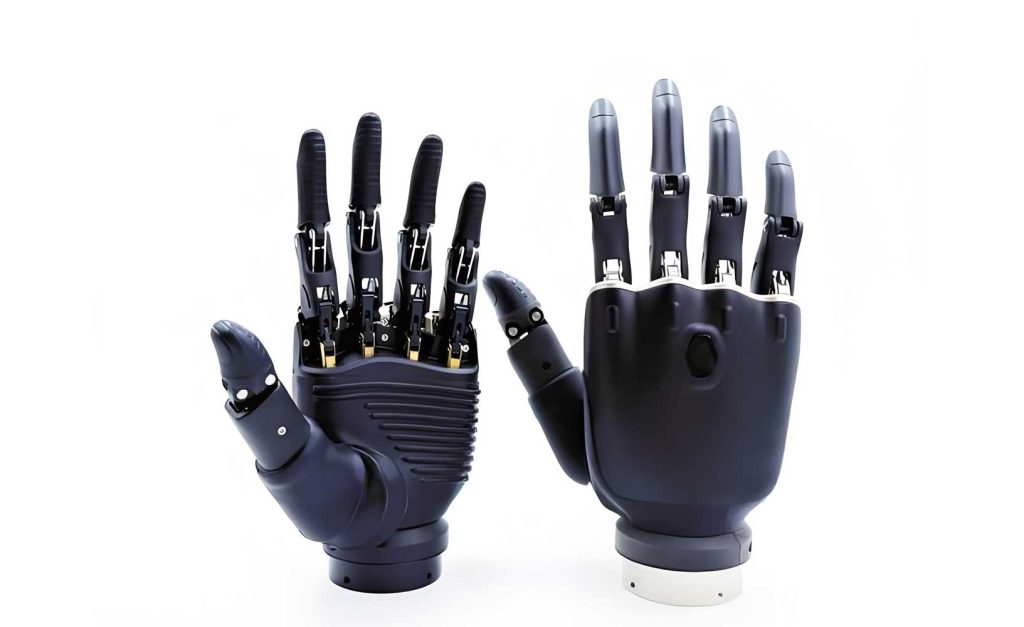
The core objective was to create a dexterous robotic hand that mimics key human grasping gestures—pinch, grasp, and envelop—to accommodate the natural size variation in citrus fruits, which typically range from 40 mm to 80 mm in diameter. The design philosophy centers on a lightweight, 3D-printed structure driven by remote actuators via synthetic tendon cables. This approach, known as tendon-driven transmission, allows for compact finger design and places the heavier motors away from the end-effector, improving dynamic performance. The following sections detail the comprehensive system design, including mechanical architecture, actuation and control systems, and present rigorous experimental data validating its performance.
Mechanical Design and Actuation Architecture
The mechanical design of the dexterous robotic hand prioritizes biomimicry, modularity, and functional simplicity. The hand consists of five fingers mounted on a central palm structure, with all components fabricated from Polylactic Acid (PLA) using Fused Deposition Modeling (FDM) additive manufacturing. This results in a lightweight assembly with a total mass of approximately 1 kg.
Finger and Palm Kinematics: The kinematic configuration is designed to facilitate power and precision grasps. The thumb features two degrees of freedom (DOF) with a proximal and distal phalanx, and is abducted at a 45° angle relative to the palm’s central axis to oppose the other fingers effectively. The index, middle, ring, and little fingers are identical in structure, each possessing three phalanges (proximal, medial, and distal) and three joints, offering a coupled flexion/extension motion. Crucially, to enhance the enveloping grasp for spherical objects like citrus, the ring and little fingers are given a palmar abduction capability at their metacarpophalangeal (MCP) joints (0-30°), while the thumb’s MCP joint allows for 0-90° abduction. The fingers are spatially arranged to naturally conform to a spherical shape: the middle finger serves as the reference, with the index, ring, and little fingers offset by 8°, 5°, and 15° respectively.
Tendon-Driven Actuation System: The chosen actuation method is a dual-tendon, agonist-antagonist system for each finger. This provides independent control of flexion and extension, allowing for active finger opening and closing. Each tendon is a multi-strand, polymer-coated stainless steel cable with a diameter of 0.38 mm, chosen for its high tensile strength (>100 N) and low stretch.
The force transmission from the actuator to the finger joint can be modeled based on static equilibrium. For a given joint \(i\), the torque \(\tau_i\) is related to the tendon tension \(T\) and the moment arm \(r_i\):
$$
\tau_i = r_i \cdot T
$$
In a coupled finger design with multiple joints (e.g., three joints for the main fingers), a single tendon route passes sequentially through pulleys or guides at each joint. The effective tension creating flexion torque is nearly constant across joints if friction is neglected. The total flexion torque vector for an n-jointed finger is:
$$
\vec{\tau}_{flex} = T_{flex} \cdot \begin{bmatrix} r_{1,flex} \\ r_{2,flex} \\ \vdots \\ r_{n,flex} \end{bmatrix}
$$
Similarly, the extension torque is controlled by the antagonistic tendon. The net torque at each joint determines its angular acceleration according to \(\vec{\tau}_{net} = I \cdot \vec{\alpha}\), where \(I\) is the inertia matrix of the finger links.
Actuator Selection and Integration: The remote actuators are standard hobbyist servo motors (MG995 model), selected for their adequate torque (13 N·cm) and positional control capability. Each servo is fitted with a custom spool onto which the tendon cables are wound. The servos and associated spools are housed in a separate “actuation box” connected to the palm via a wrist joint. This design isolates the hand’s moving mass, enhancing responsiveness. The routing of tendons from the actuation box, through the wrist, into the palm, and along each finger is managed by a series of low-friction guides printed directly into the structure.
Control System Design
The control system for the dexterous robotic hand is designed to be intuitive and facilitate both manual operation and pre-programmed gesture execution. It follows a hierarchical architecture with a user-friendly software front-end and a low-level microcontroller.
Hardware Controller: The low-level control is handled by an Arduino MEGA 2560 Pro microcontroller board. This board was chosen for its numerous digital I/O pins, necessary to generate Pulse-Width Modulation (PWM) signals for the 5+ servos. The built-in Arduino `Servo` library allows for precise angular positioning of each servo motor. The PWM duty cycle \(D\) determines the commanded angle \(\theta_{cmd}\):
$$
\theta_{cmd} = \theta_{min} + (\theta_{max} – \theta_{min}) \cdot \frac{(D – D_{min})}{(D_{max} – D_{min})}
$$
where \(D_{min}\) and \(D_{max}\) correspond to the servo’s minimum and maximum pulse widths for its angular range \([\theta_{min}, \theta_{max}]\).
Software and User Interface: A custom graphical user interface (GUI) was developed in Python. This GUI communicates with the Arduino controller via a serial (USB) link, sending angle commands for each finger joint. The interface is divided into three main modules, as summarized in the table below:
| Control Module | Functionality | Purpose |
|---|---|---|
| Real-Time Motion Control | Provides individual sliders for each finger joint. | Allows for manual, dexterous teleoperation of the hand for testing and delicate positioning. |
| Group Motion Control | Stores multiple sets of joint angle presets for sequential execution. | Enables the programming of complex, multi-step manipulation sequences. |
| Predefined Gesture Library | Contains one-click buttons for gestures like ‘Pinch’, ‘Power Grasp’, ‘Spherical Grasp’. | Facilitates rapid execution of common citrus handling actions essential for pick-and-place tasks. |
This control scheme, while currently open-loop, provides a robust platform for testing the mechanical performance of the dexterous robotic hand and forms the basis for future closed-loop force or position control implementations.
Experimental Validation and Performance Analysis
To quantitatively evaluate the dexterous robotic hand, two primary experiments were conducted: fingertip force measurement and grasping capability assessment.
1. Fingertip Force Characterization:
The maximum output force at the fingertip is a critical metric, as it must be sufficient for a secure grip but below the threshold that causes fruit damage. A test stand was constructed to isolate the middle finger. A hook-type strain-gauge load cell was attached between the fingertip and a fixed point. The finger was then commanded to flex to various angles, and the tensile force exerted on the load cell was recorded. The servo command angle \(\theta_s\) relates to the finger’s proximal joint angle \(\phi\) through the spool radius \(r_s\) and tendon moment arm \(r_j\):
$$
\phi \approx \frac{r_s \cdot \theta_s}{r_j}
$$
The force \(F_{tip}\) measured at the fingertip is a function of the tendon tension \(T\) and the kinematic configuration of the finger. For a simplified two-link model under static conditions, the relationship can be approximated as:
$$
F_{tip} \approx \frac{T \cdot r_1}{L_2} + \frac{T \cdot (r_1 + r_2)}{L_1 + L_2}
$$
where \(L_1\) and \(L_2\) are the lengths of the proximal and distal links, and \(r_1\), \(r_2\) are the flexion tendon moment arms at the respective joints. The results for the middle finger at different flexion angles are presented below. Each data point represents the mean ± standard deviation of four trials.
| Commanded Flexion Angle (Degrees) | Mean Fingertip Force, \(F_{tip}\) (N) | Standard Deviation (N) |
|---|---|---|
| 30 | 2.10 | 0.26 |
| 45 | 6.39 | 0.23 |
| 60 | 9.55 | 0.39 |
| 90 (Max) | 11.65 | 0.77 |
The data shows a monotonic increase in fingertip force with flexion angle, reaching a maximum of approximately 12.42 N (mean + 1 std dev). Literature suggests that the elastic limit of citrus peel is typically not exceeded under normal grasping forces below 10 N. Therefore, the dexterous robotic hand is capable of generating forces within a safe range for secure, non-damaging manipulation.
2. Grasping Versatility Test:
To evaluate the hand’s ability to adapt to different fruit sizes, a set of five spherical test objects with diameters of 40, 50, 60, 70, and 80 mm were 3D-printed. The dexterous robotic hand successfully executed stable enveloping grasps on all five spheres. For the smaller diameters (40-50 mm), the hand primarily used a fingertip pinch or a partial enveloping grasp involving 2-3 fingers. For the larger diameters (60-80 mm), the hand employed a full spherical grasp, utilizing the palmar abduction of the ring and little fingers to cup the object effectively. The final validation involved grasping an actual citrus fruit (approx. 70 mm diameter), confirming stable and secure handling without slippage or visible damage to the peel.
Discussion and Comparative Analysis
The presented dexterous robotic hand demonstrates a viable approach to robotic citrus handling. The tendon-driven design offers distinct advantages for this application. By locating the actuators remotely, the hand’s inertia is reduced, which is beneficial for fast, precise movements in a cluttered environment like an orchard or packing line. The inherent compliance of the tendon system, combined with the soft silicone pads added to the fingertips and palm, provides passive adaptability to slight shape variations and helps distribute contact forces, minimizing pressure points on the fruit.
A key performance trade-off in tendon-driven systems is between force, speed, and accuracy. The force transmission efficiency \(\eta\) can be modeled as:
$$
\eta = \frac{\tau_{output}}{r_s \cdot \tau_{motor} / r_j} \approx e^{-\mu \cdot \Sigma \theta_{wrap}}
$$
where \(\mu\) is the coefficient of friction between the tendon and its guides, and \(\Sigma \theta_{wrap}\) is the total cumulative wrap angle along the tendon’s path. Friction losses and cable stretch, hinted at by the slight force decay observed in sustained tests, are the primary limitations. Future iterations could incorporate low-friction liners in guide holes or consider alternative cable materials.
The table below summarizes a qualitative comparison of the proposed design with other common end-effector types for agricultural manipulation:
| End-Effector Type | Advantages | Disadvantages for Citrus |
|---|---|---|
| Simple Gripper (2-Finger) | Simple control, strong grip. | Poor adaptability to size/shape, high point loads risk damage. |
| Suction Cup | Gentle, works on smooth surfaces. | Unreliable on irregular or wet citrus peel, cannot reorient fruit well. |
| Specialized Fruit Cup | Optimized for one fruit size, fast. | Lacks versatility for varying sizes, limited dexterity. |
| Dexterous Robotic Hand (This Work) | High versatility, biomimetic compliant grasp, ability to reorient. | Higher mechanical/control complexity, slower cycle time than specialized tools. |
The current open-loop control system is a limitation for fully autonomous operation. Without tactile or force feedback, the hand cannot dynamically adjust its grip to prevent crushing a softer fruit or to compensate for unexpected loads. The logical next step in the evolution of this dexterous robotic hand is the integration of sensor feedback. Embedding flexible force sensors in the fingertips or estimating tendon tension would enable impedance or force-closure control algorithms. The grasp stability for a spherical object can be analyzed using the concept of force closure. For a multi-fingered grasp, a necessary condition for form closure (a subset of force closure) is that the contact normals positively span the origin of the force-torque space. For our hand with multiple contact points enveloping a sphere, this condition is naturally satisfied when the fingers conform to the object’s surface.
Conclusion and Future Perspectives
This article has detailed the successful design and experimental validation of a tendon-driven dexterous robotic hand for citrus fruit manipulation. The hand’s biomimetic kinematics, featuring adaptive palm joints and multi-articulated fingers, allows it to perform a variety of secure grasps on citrus fruits ranging from 40 mm to 80 mm in diameter. Experimental measurements confirm that the fingertip output force is within a safe range to avoid damaging the delicate fruit peel while ensuring a stable grip. The developed control interface provides a flexible platform for executing both manual and pre-programmed manipulation tasks.
The future trajectory for this technology is promising. The immediate focus is on closing the perception-action loop by integrating tactile and force sensors, enabling the dexterous robotic hand to perform adaptive grasping based on real-time fruit firmness and slip detection. Furthermore, combining the hand with advanced machine vision systems for stem identification and fruit pose estimation will be crucial for autonomous selective harvesting. Beyond harvesting, such a dexterous robotic hand can revolutionize post-harvest operations like gentle sorting, precision grading, and delicate packing. Ultimately, the development of intelligent, sensor-rich dexterous robotic hands represents a fundamental step toward achieving fully automated, efficient, and damage-free handling in the citrus industry and for delicate produce overall.