
In the field of precision mechanical transmission, especially in aerospace and high-performance industrial applications, the planetary roller screw has garnered significant attention due to its exceptional load-bearing capacity, longevity, and reliability compared to traditional ball screws. As a researcher focused on precision transmission systems, I have dedicated effort to understanding and optimizing the performance of planetary roller screws. One critical aspect that influences their practical deployment is transmission efficiency, which, while theoretically high, can be impacted by various factors under real operating conditions. To address this, I designed and constructed a specialized test bench capable of evaluating the efficiency of planetary roller screws under high axial loads, simulating demanding operational environments. This article details the comprehensive design process, testing methodology, error analysis, and experimental results, aiming to provide a reliable framework for efficiency assessment and contribute to the advancement of planetary roller screw technology.
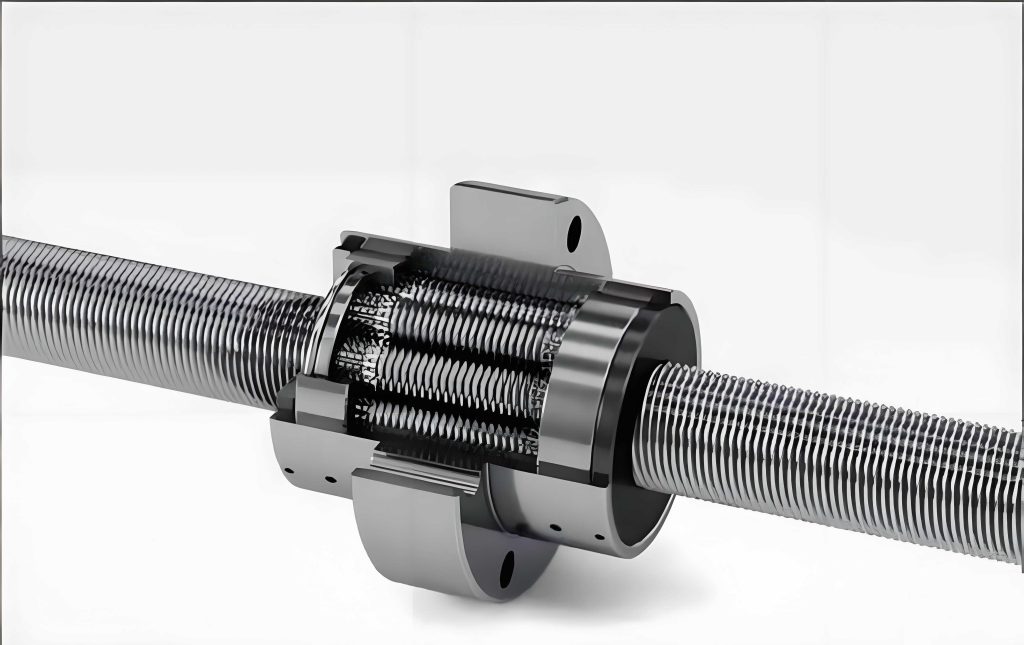
The planetary roller screw is a mechanical actuator that converts rotary motion into linear motion, comprising three primary components: a screw, multiple rollers, and a nut. Its design allows for load distribution across several contact points, leading to higher load capacity and durability. However, its transmission efficiency is often slightly lower than that of ball screws, primarily due to increased friction losses from multiple helical contacts and auxiliary components like gears and retainers. While theoretical models for efficiency exist, experimental validation under high loads is scarce, necessitating a robust test platform. My objective was to create a test bench that could apply axial loads up to 50 kN, precisely measure input torque and output force, and operate under controlled conditions to derive accurate efficiency values. The design integrates mechanical, control, and measurement systems, with a focus on minimizing external errors and ensuring repeatability.
The mechanical structure of the test bench is engineered for stability and precision under heavy loads. Given the vertical orientation of the available 10-ton servo-hydraulic cylinder used for loading, I opted for a vertical setup to align with the axial direction of force application. The planetary roller screw is mounted within a bearing housing, where the screw acts as the input shaft connected to a servo motor via a coupling. The nut is coupled to a nut sleeve using bolts, and this assembly translates linearly along the axis. A key component is the nut sleeve, which interfaces with a tension-compression load cell at its upper end through threaded connections and with an anti-rotation bracket at its lower end via a guide key. This arrangement restricts the nut’s rotation, ensuring pure linear motion while allowing free axial movement. The anti-rotation bracket is fixed to the base frame, which is secured to the ground using T-slots to prevent tilting or vibration during high-load tests. The overall rigidity of the structure is critical, as any deflection could introduce measurement inaccuracies; thus, high-strength materials and reinforced supports were incorporated.
The drive system employs a servo motor with an integral brake, specifically a Siemens 1FL6 model paired with a V90 driver. This selection is pivotal for controlling the planetary roller screw’s rotation accurately. The brake functionality is essential during initial load application by the hydraulic cylinder, as it prevents unintended screw rotation, ensuring that loading and driving are synchronized. The servo motor enables precise forward and reverse rotation at controlled speeds, which is necessary for evaluating efficiency in both directions and preventing over-travel of the screw due to its limited stroke. The control circuit, managed by a programmable logic controller (PLC), allows for setting speed, torque limits, and motion profiles. The drive system’s ability to provide consistent low-speed operation is particularly important, as it reduces slip phenomena at the thread contacts, which can adversely affect efficiency measurements.
Loading is achieved through a servo-hydraulic system consisting of a hydraulic power unit, servo valve, and a vertical hydraulic cylinder capable of applying up to 100 kN force. The cylinder is controlled via a closed-loop system that uses feedback from the load cell to maintain desired axial loads. To simulate realistic operating conditions, I programmed the hydraulic system to apply alternating loads, mimicking reciprocating motion common in applications like actuation systems. The load profile follows a smooth sinusoidal or trapezoidal pattern to minimize冲击 and vibration, which could skew efficiency readings. The control algorithm ensures that load transitions are gradual, maintaining stability throughout the test cycle. This dynamic loading capability allows for testing the planetary roller screw under varying conditions, providing insights into efficiency trends with load changes.
Measurement systems are central to accurate efficiency calculation. I selected a cylindrical tension-compression load cell with a 50 kN capacity, as it offers better resistance to off-axis forces compared to S-type sensors, reducing error from minor misalignments in the vertical setup. For torque measurement, an Interface brand rotary torque sensor with a 20 N·m range is used, attached between the servo motor and the screw input. Both sensors are calibrated prior to testing, and their signals are acquired by a Donghua DH5922N data acquisition system. This platform samples data at high frequencies, transmitting it to a PC via USB for real-time monitoring and storage. The acquisition software is configured to record axial force (F), input torque (M), and screw rotational speed (n) simultaneously, ensuring synchronized datasets for post-processing. Environmental factors like temperature are monitored, though their impact is minimal in controlled lab conditions.
The core of efficiency testing lies in the principle of power transmission. For a planetary roller screw with the screw as input and nut as output, efficiency (η) is defined as the ratio of output power to input power. Output power is the product of axial force (F) and linear velocity (v), while input power is derived from torque (M) and angular speed (ω). Given that linear velocity relates to screw speed and lead (P), the formula can be expressed as:
$$ \eta = \frac{P_{\text{output}}}{P_{\text{input}}} = \frac{F \cdot v}{M \cdot \omega} $$
Where v = (P · n) / 60 (in m/s for P in meters and n in rpm), and ω = (2π n) / 60 (in rad/s). Substituting these, efficiency simplifies to:
$$ \eta = \frac{F \cdot P}{2\pi \cdot M} $$
However, in practice, I use a more convenient form derived from unit conversions. Given that n is in rpm and P in mm, the formula becomes:
$$ \eta = 9.55 \times \frac{F \cdot v}{M \cdot n} $$
Or, alternatively, using lead directly:
$$ \eta = 0.00159 \times \frac{F \cdot P}{M_{\text{actual}}} $$
Here, M_actual is the true torque applied to the planetary roller screw, which must be corrected for system losses. The measured torque (M_measured) from the sensor includes additional resistive torques from couplings and bearings. Thus, M_actual = M_measured – M_loss, where M_loss represents the total resistance torque of the test bench mechanical components. Accurate determination of M_loss is crucial for reliable efficiency calculation.
To quantify M_loss, I conducted separate calibration tests without the planetary roller screw installed. By mounting the bearings and couplings in a similar configuration and applying known axial loads while driving the input shaft with the motor, I measured the torque required to overcome internal friction. The results, summarized in Table 1, show that resistive torque increases with axial load, highlighting the importance of compensation in high-load scenarios.
| Axial Load (N) | Measured Torque Loss (N·m) | Notes |
|---|---|---|
| 0 | 0.012 | Base friction from couplings |
| 5000 | 0.075 | Includes bearing drag |
| 10000 | 0.145 | Linear increase observed |
| 15000 | 0.210 | Consistent with load proportion |
| 20000 | 0.285 | Critical for high-load tests |
The relationship between axial load (F) and torque loss (M_loss) can be modeled linearly for simplicity: $$ M_{\text{loss}} = k \cdot F + c $$ where k is a proportionality constant and c is the constant friction torque. From my data, k ≈ 1.4 × 10⁻⁵ N·m/N and c ≈ 0.01 N·m. This model is used to adjust torque readings during efficiency tests, ensuring that M_actual reflects only the torque consumed by the planetary roller screw itself. Additional error sources, such as signal noise or thermal drift, are minimized through shielding, filtering, and periodic recalibration.
The testing methodology involves a systematic procedure to ensure consistency and accuracy. First, the planetary roller screw is installed and preloaded slightly to eliminate backlash. The servo motor brake is engaged, and the hydraulic cylinder applies an initial axial load in tension or compression, depending on the test direction. Once the load stabilizes, the brake is released, and the motor drives the screw at a constant low speed (e.g., 10-50 rpm) to minimize inertial effects and slip. The load profile is programmed to alternate gradually, simulating a full cycle of operation. Data acquisition starts simultaneously, recording force, torque, and speed at a sampling rate of 1 kHz. Each test run lasts for several cycles to capture steady-state behavior, and multiple runs are conducted at different load levels to map efficiency across a range. The specific parameters of the planetary roller screw used in my experiments are listed in Table 2, which are essential for interpreting results.
| Geometric Parameter | Screw | Roller | Nut |
|---|---|---|---|
| Pitch Diameter (mm) | 19.5 | 6.5 | 32.5 |
| Pitch (mm) | 0.4 | 0.4 | 0.4 |
| Number of Threads | 5 | 1 | 5 |
| Lead (mm) | 2.0 | 0.4 | 2.0 |
| Thread Angle (°) | 45 | 45 | 45 |
Efficiency is computed offline using the adjusted torque values. For each data point, η is calculated via: $$ \eta = 0.00159 \times \frac{F \cdot P}{M_{\text{measured}} – M_{\text{loss}}} $$ where P = 2 mm (0.002 m) for this planetary roller screw. The factor 0.00159 arises from unit conversion: $$ 0.00159 = \frac{1}{2\pi} \times \frac{60}{1000} $$ accounting for rpm to rad/s and mm to m. The results are then averaged over stable cycles to reduce random noise. This approach ensures that efficiency values reflect the true performance of the planetary roller screw, isolated from test bench artifacts.
Experimental results from testing the planetary roller screw under various axial loads are presented in Table 3. The loads range from approximately 3.8 kN to 23.2 kN, covering moderate to high-load conditions relevant to industrial applications. Each load condition was tested with both forward and reverse screw rotations, and the efficiency values reported are averages, showing minimal hysteresis effects.
| Axial Load F (N) | Measured Torque M_measured (N·m) | Torque Loss M_loss (N·m) | Actual Torque M_actual (N·m) | Efficiency η (%) |
|---|---|---|---|---|
| 3784.62 | 1.490 | 0.071 | 1.419 | 84.8 |
| 7383.66 | 2.885 | 0.116 | 2.769 | 84.8 |
| 10204.15 | 4.079 | 0.157 | 3.922 | 82.7 |
| 12794.67 | 5.218 | 0.200 | 5.018 | 81.1 |
| 16997.69 | 6.835 | 0.278 | 6.557 | 82.4 |
| 18717.03 | 7.835 | 0.313 | 7.522 | 79.1 |
| 20331.64 | 8.350 | 0.348 | 8.002 | 80.8 |
| 23178.59 | 9.471 | 0.414 | 9.057 | 81.4 |
The data reveals that the planetary roller screw maintains an efficiency above 75% across all tested loads, with values generally around 80-85%. This aligns with theoretical predictions, though slightly lower due to practical factors. The slight dip in efficiency at mid-loads (e.g., 12.8 kN) may be attributed to increased slip or uneven load distribution among rollers, which merits further investigation. Overall, the consistency of results validates the test bench’s reliability. To visualize trends, I plotted efficiency versus axial load, as shown in Figure 1 (note: this is a descriptive reference; the actual plot would be generated in analysis software). The curve indicates a relatively stable efficiency profile, with minor fluctuations likely due to measurement noise or transient effects. Compared to theoretical efficiency calculated using friction models—estimated at 88.07% for this planetary roller screw—the experimental values are reasonably close, confirming that the design and error compensation are effective.
Several factors contribute to the discrepancy between theoretical and measured efficiency. First, slip at the thread contacts is inevitable, especially under high loads, leading to energy loss not accounted for in ideal models. The planetary roller screw’s complex kinematics, involving multiple rolling and sliding contacts, increases frictional dissipation. Second, auxiliary components like the roller gears engaging with the nut and retainer rings introduce additional friction torques, which are often neglected in simplified analyses. Third, the test bench itself, despite error correction, has residual uncertainties from sensor accuracy (typically ±0.5% for load cells and ±0.2% for torque sensors) and environmental vibrations. However, these are minimized through careful design, making the results representative of real-world performance.
Beyond efficiency measurement, this test bench can be adapted for other studies on planetary roller screws, such as durability testing, dynamic response analysis, or thermal behavior assessment. The modular design allows for swapping components to test different sizes or configurations of planetary roller screws. Future enhancements could include integrating infrared thermography to monitor temperature rises during operation, which correlates with efficiency losses, or adding accelerometers to study vibration signatures. Such expansions would further deepen the understanding of planetary roller screw mechanics and aid in optimization for specific applications.
In conclusion, I have successfully designed and implemented a high-load test bench for evaluating the transmission efficiency of planetary roller screws. The system incorporates a robust mechanical structure, precise servo-hydraulic loading, and accurate measurement instrumentation, with comprehensive error analysis to ensure data integrity. Experimental results demonstrate that the planetary roller screw can achieve efficiencies above 75% under rated loads, with values consistently around 80-85%, validating its suitability for heavy-duty applications. This work provides a practical framework for efficiency testing, contributing to the broader research and development efforts on planetary roller screws. By continuing to refine testing protocols and explore parametric influences, we can unlock further improvements in the performance and adoption of this promising transmission technology.