
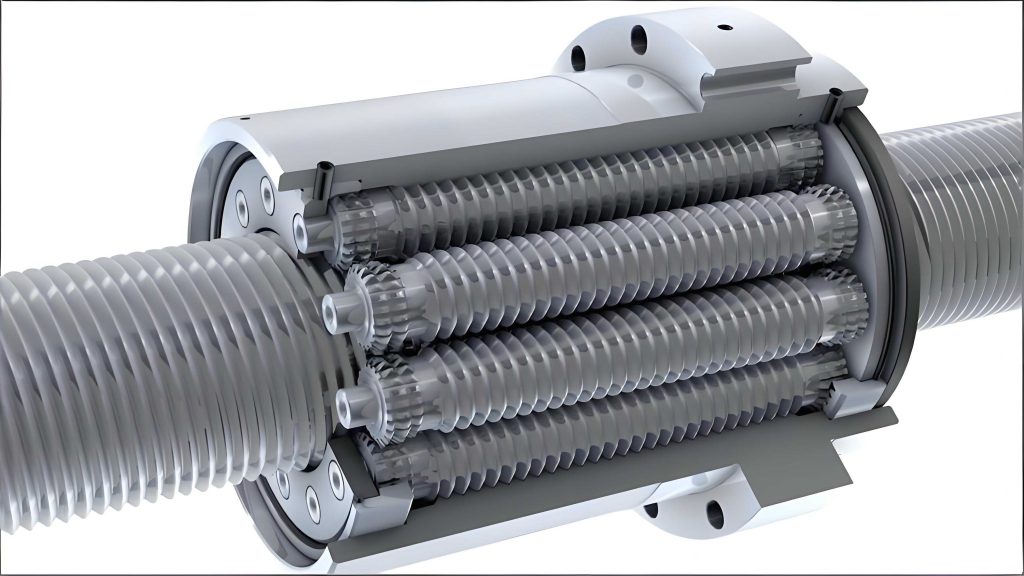
In this study, we focus on the design and finite element analysis of a planetary roller screw, a precision transmission device that converts rotary motion into linear motion via multiple rolling elements. The planetary roller screw is characterized by line contact through threaded engagement, offering advantages such as low friction, high efficiency, and long service life. Compared to ball screws of similar specifications, the planetary roller screw exhibits an额定动载 (rated dynamic load) that is over three times higher, making it suitable for critical applications in aerospace, military, and industrial fields. Our research aims to develop a comprehensive understanding of its performance through parametric design, virtual assembly, and advanced finite element simulations, including static stress, modal analysis, and fatigue assessment. This work provides a foundation for enhancing the accuracy and reliability of planetary roller screw systems.
The planetary roller screw operates on the principle of planetary gear systems, where rollers (planetary rollers) rotate between a central screw and a nut, similar to planets orbiting a sun. The motion relationships are derived from kinematic analysis. For a planetary roller screw with a screw lead $P_S$, roller lead $P_R$, and number of screw starts $n$, the transmission ratio and velocity equations can be expressed. Let $d_S$ be the screw pitch diameter, $d_R$ the roller pitch diameter, and $d_N$ the nut pitch diameter. The relative motion between components ensures constant transmission ratio under ideal conditions. The basic kinematic equation for the linear velocity $v_N$ of the nut when the screw rotates at angular velocity $\omega_S$ is:
$$ v_N = \frac{P_S \cdot \omega_S}{2\pi} $$
For the rollers, their rotation and revolution are governed by the engagement with both the screw and nut threads. The relationship between the roller angular velocity $\omega_R$ and screw angular velocity $\omega_S$ is given by:
$$ \omega_R = \frac{d_S}{d_R} \cdot \omega_S $$
Additionally, the number of rollers $N$ and the gear teeth on roller ends $Z_R$ influence the motion stability. We designed a planetary roller screw with key parameters as summarized in Table 1. These parameters were calculated based on geometric constraints and performance requirements, ensuring proper meshing and load distribution.
| Parameter | Symbol | Value |
|---|---|---|
| Screw Pitch Diameter | $d_S$ | 30 mm |
| Screw Lead | $P_S$ | 10 mm |
| Screw Length | $L_S$ | 500 mm |
| Roller Pitch Diameter | $d_R$ | 6 mm |
| Roller Lead | $P_R$ | 2 mm |
| Roller Length | $L_R$ | 90 mm |
| Number of Rollers | $N$ | 11 |
| Roller End Gear Teeth | $Z_R$ | 12 |
| Nut Pitch Diameter | $d_N$ | 42 mm |
Parameter verification was performed to check for interference and strength. For instance, the contact stress $\sigma_c$ between the screw and roller threads can be estimated using Hertzian contact theory for line contact:
$$ \sigma_c = \sqrt{\frac{F}{\pi L} \cdot \frac{1}{\frac{1-\nu_S^2}{E_S} + \frac{1-\nu_R^2}{E_R}} \cdot \frac{1}{R}} $$
where $F$ is the axial load, $L$ is the contact length, $\nu$ is Poisson’s ratio, $E$ is Young’s modulus, and $R$ is the effective radius of curvature. This ensures that the design withstands operational loads without excessive deformation.
Next, we proceeded to digital modeling using SolidWorks software. The planetary roller screw components were created parametrically to allow for easy modifications. The screw was modeled with a multi-start thread (5 starts) and a 90° thread angle. The roller design included both threaded portions and end gears, which were generated using gear design tools and custom curves. The nut was modeled as a single nut with a flange for mounting, and the internal gear ring (inner race) was designed to mesh with the roller end gears. This parametric approach facilitated virtual assembly, where we assembled all components while checking for interferences. The assembly process involved constraining the nut fixed, aligning the internal gear ring, and positioning the rollers symmetrically. For proper meshing, the angular offset $\alpha$ between adjacent rollers was calculated based on the gear meshing condition:
$$ \alpha = \frac{360^\circ}{N} \cdot \frac{d_N + d_R}{d_R} $$
which yielded $\alpha = 229.0909^\circ$ for our design. This ensured that all rollers engaged correctly without collisions. The virtual assembly confirmed that the planetary roller screw model was interference-free and ready for analysis.
Finite element analysis (FEA) was conducted using the Simulation module in SolidWorks to evaluate the structural behavior of the planetary roller screw under axial loads. We focused on a representative segment—one roller meshing with the screw and nut—to reduce computational cost while maintaining accuracy. The materials were assigned as high-carbon chromium bearing steel (GCr15) for all components, with properties listed in Table 2. The axial load was applied as an equivalent force on the roller end, while the screw and nut were fixed appropriately to simulate real-world constraints. Contact conditions were defined with friction coefficients to mimic actual engagement. Mesh generation was performed with curvature-based elements, ensuring fine discretization in threaded regions for precise stress analysis.
| Property | Value |
|---|---|
| Young’s Modulus, $E$ | 2.19 × 10⁵ MPa |
| Poisson’s Ratio, $\nu$ | 0.3 |
| Density, $\rho$ | 7.83 × 10³ kg/m3 |
| Yield Strength | 5.1842 × 10⁸ Pa |
| Tensile Strength | 1.617 × 10⁹ Pa |
Static stress analysis was performed under an axial load of 3000 N. The Von Mises stress distribution revealed that the maximum stresses occurred at the thread roots of the roller and screw engagement areas, as shown in the results. The stress concentration was primarily due to the geometric discontinuity at the thread teeth. For the screw-roller interface, the peak stress $\sigma_{max}$ was observed near the thread crest, with values reaching up to approximately 450 MPa. The strain distribution indicated that deformation was more pronounced at the thread roots, aligning with theoretical expectations. The displacement analysis showed that the screw experienced a maximum deformation of about 0.005 mm, while the nut deformed by 0.002 mm, which is within acceptable limits for precision applications. These findings are summarized in Table 3, highlighting key metrics from the static analysis.
| Component | Max Von Mises Stress (MPa) | Max Displacement (mm) | Critical Location |
|---|---|---|---|
| Screw | 450.2 | 0.005 | Thread root at engagement |
| Roller | 520.7 | 0.003 | Thread crest |
| Nut | 380.5 | 0.002 | Thread root |
Contact analysis further illustrated the load-bearing regions. The effective contact areas between the roller and screw, and between the roller and nut, were identified as the primary load paths. The contact pressure $p_c$ can be derived from the Hertzian formula for line contact:
$$ p_c = \sqrt{\frac{F E^*}{\pi R^* L}} $$
where $E^*$ is the equivalent Young’s modulus and $R^*$ is the equivalent radius. This analysis confirmed that the threaded engagement in the planetary roller screw effectively distributes loads, but stress concentrations at tooth edges require attention in design optimization.
Modal analysis was conducted to determine the natural frequencies and mode shapes of the planetary roller screw assembly. The screw was fixed at one end, and the nut was constrained at the center. The first six modes were extracted, with frequencies ranging from 293 Hz to 1798 Hz. The mass participation factors indicated that the dominant vibrations occurred in the axial and transverse directions. For instance, Mode 1 at 293.14 Hz involved bending of the screw, while Mode 3 at 1716 Hz showed torsional vibrations. The results are presented in Table 4, which lists the frequencies and maximum displacements in X, Y, and Z directions. These modal characteristics are crucial for avoiding resonance in operational environments, especially in high-speed applications where the planetary roller screw may be subjected to dynamic excitations.
| Mode | Frequency (Hz) | Max Displacement X (mm) | Max Displacement Y (mm) | Max Displacement Z (mm) |
|---|---|---|---|---|
| 1 | 293.14 | 0.02943 | 5.5449 × 10⁻¹¹ | 0.18009 |
| 2 | 293.16 | 0.18008 | 4.5783 × 10⁻¹⁰ | 0.02943 |
| 3 | 1716.0 | 1.2858 × 10⁻⁷ | 2.8279 × 10⁻⁸ | 0.28332 |
| 4 | 1716.6 | 0.28344 | 1.2665 × 10⁻⁹ | 1.0907 × 10⁻⁷ |
| 5 | 1797.9 | 0.00024759 | 1.3027 × 10⁹ | 0.0041411 |
| 6 | 1800.2 | 0.0041200 | 3.1450 × 10⁻⁸ | 0.00019875 |
Fatigue analysis was performed to assess the durability of the planetary roller screw under cyclic loading. Based on the static stress results, a fully reversed load cycle with a amplitude of 3000 N was applied for 1,000,000 cycles. The fatigue life was predicted using the S-N curve approach, considering the material endurance limit. The results indicated that the roller thread teeth were the most critical, with a minimum life of approximately 100 cycles due to stress concentrations. In contrast, the screw and nut threads exhibited longer lives, exceeding 900,000 cycles in most regions. The damage distribution is quantified by the fatigue damage factor $D$, calculated as:
$$ D = \sum_{i=1}^{n} \frac{n_i}{N_i} $$
where $n_i$ is the number of cycles at stress level $i$, and $N_i$ is the cycles to failure at that stress level. For the roller, $D$ approached 1.0 quickly, indicating early failure. The load factor analysis, which measures the safety margin against fatigue, showed that the roller had a low load factor (around 0.5), while the screw and nut had factors above 2.0. This suggests that redesigning the roller thread profile or using surface treatments could enhance fatigue resistance. Table 5 summarizes the fatigue analysis outcomes, providing insights into component longevity.
| Component | Minimum Life (Cycles) | Damage Factor $D$ | Load Factor |
|---|---|---|---|
| Roller Thread Teeth | 100 | 0.95 | 0.5 |
| Screw Threads | 900,000 | 0.05 | 2.2 |
| Nut Threads | 850,000 | 0.06 | 2.1 |
| Roller Body | 1,000,000+ | 0.01 | 3.0 |
Discussion of the results leads to several design insights for the planetary roller screw. The static stress analysis confirms that the threaded engagements are the primary load-bearing zones, but stress concentrations at tooth edges can lead to premature failure. To mitigate this, we propose optimizing the thread profile—for example, using a rounded root or increasing the fillet radius—to reduce stress peaks. The modal analysis reveals that the planetary roller screw has natural frequencies in the range of 293–1800 Hz, which should be considered in dynamic applications to avoid resonance. For instance, in high-speed actuation systems, operating speeds should be tuned away from these frequencies. The fatigue analysis highlights the roller as the weakest link; thus, material selection or heat treatment improvements, such as using carburized steel or applying shot peening, could extend fatigue life. Additionally, the virtual assembly process demonstrated the importance of precise angular positioning of rollers to ensure smooth meshing and minimal wear. Overall, the finite element analysis provides a robust framework for evaluating and improving the planetary roller screw design, contributing to higher precision and reliability in real-world applications.
In conclusion, this study comprehensively addresses the design and finite element analysis of a planetary roller screw. We derived key parameters based on kinematic principles, created a parametric digital model, and performed extensive simulations including static stress, modal, and fatigue analyses. The results identify critical stress areas, natural frequencies, and fatigue life limitations, offering actionable insights for design optimization. The planetary roller screw proves to be a high-performance transmission device, but attention to detail in thread geometry and material properties is essential for maximizing its potential. Future work could explore dynamic load conditions, thermal effects, and advanced manufacturing techniques to further enhance the performance of planetary roller screw systems. Through this research, we contribute to the growing body of knowledge on precision mechanical drives, supporting advancements in industries ranging from aerospace to industrial automation.