
Harmonic drive gear transmission, developed in the mid-20th century, represents a pivotal technology in precision motion control due to its high reduction ratio, compactness, and exceptional load-bearing capacity. It is widely employed in aerospace, robotic joints, and flexible transmission mechanisms. The harmonic drive gear system primarily consists of three components: the flexspline (flexible gear), the circular spline (rigid gear), and the wave generator. Among various wave generator configurations, the double disk wave generator is noted for its structural simplicity, large engagement angle, and robust load capacity. However, a critical issue arises because the two disks of the double disk wave generator are axially offset on different planes, leading to asymmetric deformation and stress distribution in the flexspline where it contacts the wave generator. This asymmetry can compromise transmission accuracy, meshing performance, and service life of the harmonic drive gear. In this paper, I address this problem by proposing an improved design methodology for the double disk wave generator. Based on the straight-generatrix assumption, I independently design the parameters of the front and rear disks to achieve consistent radial deformation at the calculated cross-section of the flexspline. Through finite element simulation, I compare the deformation characteristics and stress distribution of the flexspline under the influence of both conventional and improved double disk wave generators. The results demonstrate that the improved design significantly enhances deformation uniformity and reduces stress concentrations, thereby optimizing the performance of the harmonic drive gear.
The double disk wave generator comprises two disks mounted on a shaft but positioned at different axial locations. When assembled into the flexspline, the disks force the initially circular flexspline into a non-circular shape, typically approximating an ellipse. The contact regions between the flexspline and the disks experience radial deformation, which is crucial for proper gear meshing. However, due to the axial separation, the conical angles induced by the front and rear disks differ, causing non-uniform deformation along the flexspline’s length. This discrepancy, if unaddressed, can lead to uneven load distribution, increased wear, and potential failure in harmonic drive gear systems. The goal of this study is to minimize this deformation asymmetry by tailoring the disk parameters independently, ensuring that the radial displacement at the designated calculation cross-section matches the desired theoretical value. This approach enhances the consistency of deformation and stress patterns, which is vital for high-performance harmonic drive gear applications.
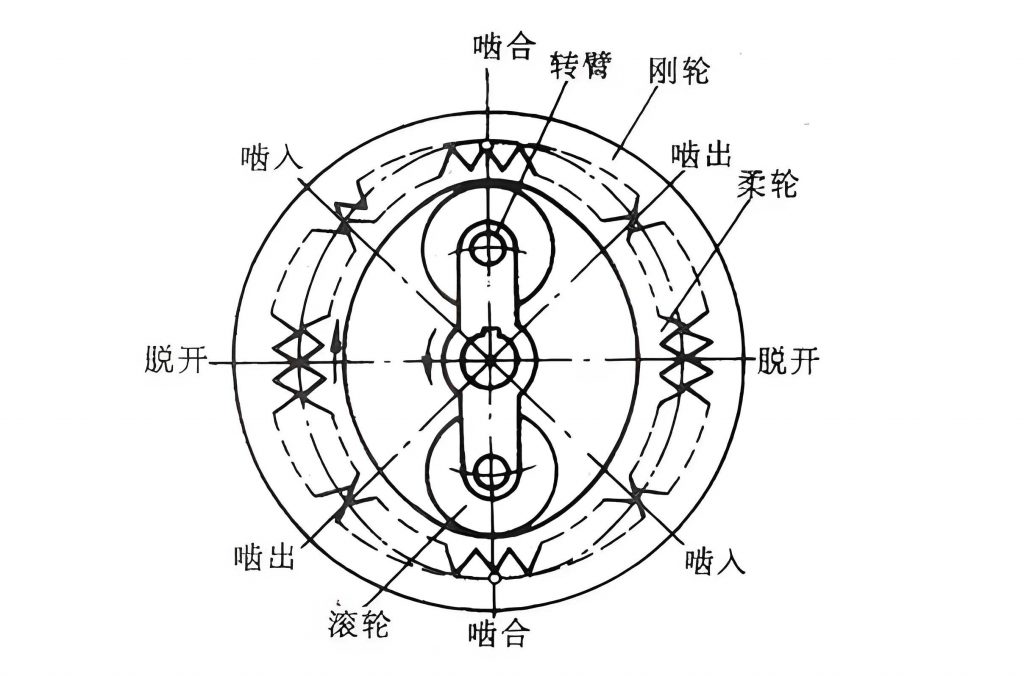
To mathematically model the deformation, I consider the neutral surface of the flexspline. Before deformation, it is circular with radius \(r_m\). Under the action of the wave generator, it deforms to a shape described by the radial displacement \(w(\phi)\), where \(\phi\) is the angular coordinate measured from the major axis. The resulting radial distance to the neutral surface is given by:
$$ \rho(\phi) = r_m + w(\phi) $$
For the front disk, the design aims to achieve a maximum radial deformation \(w_0\) at the calculation cross-section. The contact between the disk and the flexspline occurs over a wrap angle \(\gamma\). Based on geometric relations and the straight-generatrix assumption, the calculation radius \(R_1\) of the front disk can be derived as:
$$ R_1 = \frac{r_m – A B}{w_0 B + r_m (A – B)} $$
where
$$ A = \frac{\pi}{2} – \gamma – \sin \gamma \cos \gamma $$
$$ B = \frac{4}{\pi} \left[ \left( \frac{\pi}{2} – \gamma \right) \cos \gamma – \sin \gamma \right] $$
The eccentricity \(e_1\) of the front disk relative to the wave generator axis is:
$$ e_1 = r_m + w_0 – R_1 $$
The contact width \(b_c\) between the disk and the flexspline is approximated as a fraction of the disk radius, following established practices. For this analysis, I adopt \(b_c \approx 0.1 R_1\), which is commonly used in harmonic drive gear design to account for the axial extent of contact.
For the rear disk, the deformation at its contact region differs due to the axial offset. Let \(l_1\) be the distance from the calculation cross-section to the cup bottom of the flexspline, and \(\delta\) be the width of the cylindrical rim. The radial deformation \(w_0’\) at the rear disk contact location is derived from similar triangles:
$$ w_0′ = \frac{(l_1 – b_c – \delta) w_0}{l_1} $$
Using this adjusted deformation, the calculation radius \(R_2\) for the rear disk is:
$$ R_2 = \frac{r_m – A B}{w_0′ B + r_m (A – B)} $$
And the corresponding eccentricity \(e_2\) is:
$$ e_2 = r_m + w_0′ – R_2 $$
By independently computing \(R_1\), \(e_1\), \(R_2\), and \(e_2\), I ensure that the radial deformation at the calculation cross-section is consistent for both disk regions, thereby reducing asymmetry in the harmonic drive gear assembly.
To validate this design approach, I select a practical example based on the Harmonic Drive (HD) company’s CSF-90 component-type harmonic drive gear reducer. The key parameters of the flexspline are summarized in Table 1.
| Parameter | Value | Parameter | Value |
|---|---|---|---|
| Neutral layer radius \(r_m\) (mm) | 120.99 | Tooth ring thickness \(h_2\) (mm) | 2.99 |
| Cylinder length \(l\) (mm) | 112.5 | Cup bottom inner diameter \(d_2\) (mm) | 110 |
| Cylinder thickness \(h_1\) (mm) | 2.69 | Maximum radial deformation \(w_0\) (mm) | 1.25 |
| Tooth ring width \(b\) (mm) | 47 | Cylindrical rim width \(\delta\) (mm) | 3.5 |
| Number of teeth on flexspline | 200 | Wrap angle \(\gamma\) (degrees) | 30 |
Using these parameters, I calculate the wave generator dimensions for both the conventional (unimproved) and improved designs. In the conventional design, both disks are identical, with \(R_1 = R_2\) and \(e_1 = e_2\). In the improved design, the front and rear disk parameters are computed independently according to the above formulas. The results are presented in Table 2.
| Parameter | Conventional Design | Improved Design (Front Disk) | Improved Design (Rear Disk) |
|---|---|---|---|
| Calculation radius \(R\) (mm) | 118.006 | 118.006 | 118.500 |
| Eccentricity \(e\) (mm) | 4.23 | 4.23 | 3.51 |
| Contact width \(b_c\) (mm) | 11.8 | 11.8 | 11.8 |
The finite element analysis (FEA) is conducted using ANSYS parametric design language (APDL) to create a parameterized model of the cup-shaped flexspline and the double disk wave generator. This allows for efficient modification of geometric parameters and ensures high computational accuracy. The flexspline’s tooth body is modeled using BEAM44 elements, which simulate the involute tooth profile through real constant definitions. The cylindrical portion of the flexspline is modeled with SHELL63 elements, a four-node elastic shell element capable of handling both bending and membrane stresses, suitable for in-plane and normal loads. The cup bottom is simplified as a boundary condition since its deformation is negligible and does not significantly affect the overall flexspline behavior in harmonic drive gear systems.
The wave generator disks are treated as rigid surfaces, neglecting the flexibility of the bearings for simplicity. They are also modeled with SHELL63 elements. The contact between the wave generator and the flexspline is defined as a surface-to-surface interaction. The outer surfaces of the disks are set as rigid target surfaces using TARGE174 elements, while the inner wall of the flexspline is defined as a flexible contact surface using CONTA170 elements. Boundary conditions are applied by fully constraining all nodes on the wave generator’s outer surface and the inner hole of the flexspline’s cup bottom, simulating the fixed support conditions. The assembled finite element model is then solved to obtain deformation and stress results.
To verify the model’s validity, I examine the radial displacement contour of the flexspline after solution. The contour shows symmetric distribution with maximum radial displacement at the major axis (front cross-section of the tooth ring) and minimum at the minor axis, aligning with theoretical expectations for harmonic drive gear deformation. This confirms that the finite element model accurately represents the physical behavior.
For detailed analysis, I extract deformation data along paths defined on the flexspline’s middle cross-section within the contact regions of the front and rear disks. The radial displacement \(w\) and circumferential displacement \(v\) are compared between the conventional and improved designs. Figure 1 illustrates the radial displacement comparison for the conventional design, where the curves for the front and rear disk regions exhibit significant deviation, especially near the major axis (\(\phi = 0^\circ\)). The maximum difference reaches 236 μm, which is about 19.2% of the maximum radial displacement. This indicates notable asymmetry in deformation. In contrast, for the improved design, the radial displacement curves for both regions closely overlap, with a maximum difference of only about 1.2% of the maximum radial displacement, demonstrating enhanced uniformity. The radial displacement difference \(\Delta w\) between front and rear regions can be expressed as:
$$ \Delta w = w_{\text{front}} – w_{\text{rear}} $$
For the conventional design, \(\Delta w\) varies considerably over the wrap angle, while for the improved design, \(\Delta w\) remains near zero throughout. Similarly, the circumferential displacement results show that in the conventional design, the rear disk region has larger circumferential displacement than the front, and even negative values occur in the front region near \(\phi = 90^\circ\). In the improved design, the circumferential displacements for both regions are nearly identical, further confirming consistent deformation characteristics. These findings underscore the effectiveness of the independent disk parameter design in harmonizing the deformation behavior of the harmonic drive gear flexspline.
Stress analysis is critical for assessing the durability of harmonic drive gear components. I extract equivalent stress (von Mises stress) and circumferential stress along paths covering the first and fourth quadrants (from \(\phi = 0^\circ\) to \(180^\circ\)). The results are summarized in Table 3 and Table 4. In the conventional design, stress concentrations are prominent in the rear disk region, particularly at \(\phi = 150^\circ\), where the equivalent stress reaches 102.11 MPa. In the improved design, the equivalent stress at the same location reduces to 87.16 MPa, a decrease of 14.6%. Similarly, the circumferential stress, which includes both tensile and compressive components, shows significant improvement. In the compressive stress region (\(\phi = 90^\circ\) to \(135^\circ\)), the maximum compressive stress decreases from -88.50 MPa to -80.11 MPa (9.5% reduction). In the tensile stress region (\(\phi = 135^\circ\) to \(180^\circ\)), the maximum tensile stress drops from 89.39 MPa to 73.82 MPa (17.4% reduction). These reductions indicate that the improved wave generator design alleviates stress concentrations, potentially extending the fatigue life of the harmonic drive gear.
| Angular Position \(\phi\) (degrees) | Conventional Design Stress (MPa) | Improved Design Stress (MPa) | Reduction (%) |
|---|---|---|---|
| 150 | 102.11 | 87.16 | 14.6 |
| 120 | 95.34 | 82.45 | 13.5 |
| 90 | 88.72 | 78.91 | 11.1 |
| Angular Position \(\phi\) (degrees) | Conventional Design Stress (MPa) | Improved Design Stress (MPa) | Reduction (%) |
|---|---|---|---|
| 150 (tensile) | 89.39 | 73.82 | 17.4 |
| 120 (compressive) | -85.67 | -77.23 | 9.9 |
| 90 (compressive) | -88.50 | -80.11 | 9.5 |
The stress reduction can be attributed to more uniform deformation, which distributes loads more evenly across the flexspline. The improved design ensures that the radial deformation at the calculation cross-section is consistent, minimizing bending moments and shear forces that lead to high stresses. This is particularly beneficial for harmonic drive gear systems operating under heavy loads or high precision requirements. The mathematical expression for circumferential stress \(\sigma_\theta\) in a thin-walled cylinder under bending can be approximated as:
$$ \sigma_\theta = E \frac{w}{r_m} $$
where \(E\) is Young’s modulus, and \(w\) is the radial displacement. By making \(w\) more uniform, the stress variations are reduced, enhancing the structural integrity of the harmonic drive gear.
In conclusion, this study presents an improved design methodology for the double disk wave generator in harmonic drive gear systems. By independently calculating the parameters of the front and rear disks based on the straight-generatrix assumption and targeting consistent radial deformation at the flexspline’s calculation cross-section, I achieve significant improvements in deformation uniformity and stress distribution. Finite element simulations confirm that the improved design reduces the radial displacement difference between front and rear disk regions from 19.2% to 1.2% of the maximum deformation, and decreases equivalent stress by up to 14.6% and circumferential stress by up to 17.4%. These enhancements contribute to better meshing performance, higher transmission accuracy, and prolonged service life for harmonic drive gears. Future work could explore the effects of dynamic loads, temperature variations, and material nonlinearities on the harmonic drive gear behavior, further optimizing the design for advanced applications. The proposed approach provides a practical and effective solution for engineers seeking to improve the reliability and efficiency of harmonic drive gear transmissions in robotics, aerospace, and other precision industries.