
In the era of Industry 4.0 and the push for advanced manufacturing, the development of bionic robots has gained significant attention. As a researcher in robotics, I have focused on creating a twelve-degree-of-freedom bionic quadruped robot inspired by the locomotion of cats and dogs. This bionic robot leverages the STM32F4 microcontroller to achieve versatile movements and functionalities, aiming to assist in complex environments such as home use, rescue operations, and intelligent inspections. In this article, I will detail the hardware design, software architecture, system implementation, and potential expansions, emphasizing the integration of kinematics and control systems to realize a fully functional bionic robot. Throughout this work, the term “bionic robot” is central, reflecting its biomimetic nature and adaptability.
The core of this project lies in emulating the natural gait and agility of quadruped animals. By utilizing twelve MG90S servo motors—three per leg—the bionic robot achieves precise limb control. The STM32F411 module serves as the main controller, chosen for its compact size, low power consumption, and extensibility, which are crucial for reducing weight and saving space in the bionic robot. The system is designed to be controlled via a mobile app, enabling basic gaits and various bionic actions. To provide a comprehensive overview, I will use tables and formulas to summarize key aspects, ensuring clarity and depth in explaining this bionic robot’s design.
From a hardware perspective, the bionic robot comprises several interconnected modules: the main control module, power supply module, image transmission module, servo drive module, and WiFi module. Each module plays a vital role in ensuring the bionic robot’s functionality and reliability. Below, I present a table summarizing the hardware components and their specifications:
| Module | Component | Key Features | Role in Bionic Robot |
|---|---|---|---|
| Main Control | STM32F411 | ARM Cortex-M4 core, 100 MHz clock, compact size | Processes instructions and controls all modules |
| Power Supply | 2S LiPo battery, LM2596 buck converter, low-voltage alarm | 800 mAh capacity, 5V output, over-discharge protection | Provides stable power to all components |
| Image Transmission | ESP32CAM | Dual-core CPU, supports camera modes, low power | Enables real-time environmental monitoring |
| Servo Drive | Custom PWM board, MG90S servos | 68-pin interface, metal gears, 180° rotation | Drives leg movements for bionic locomotion |
| WiFi Communication | ESP8266-01S | Supports透传 mode, low cost, small form factor | Facilitates wireless control via app |
The power supply module ensures the bionic robot operates efficiently. The LM2596 buck converter regulates the battery voltage to 5V, with an output current capability of up to 3A. The low-voltage alarm module monitors battery levels to prevent damage, extending the lifespan of this bionic robot. For servo control, the MG90S servos are driven by PWM signals generated by the STM32F411. The relationship between rotation angle and pulse width is critical for precise movement. I summarize this in a table below, which aids in calibrating the bionic robot’s limbs:
| Rotation Angle | Pulse Width | Duty Cycle | Corresponding Register Value |
|---|---|---|---|
| 0° | 0.5 ms | 2.5% | 195 |
| 45° | 1.0 ms | 5.0% | 190 |
| 90° | 1.5 ms | 7.5% | 185 |
| 135° | 2.0 ms | 10.0% | 180 |
| 180° | 2.5 ms | 12.5% | 175 |
In terms of software design, the bionic robot relies on kinematics inverse solutions to coordinate leg movements. Using the Denavit-Hartenberg (DH) parameters, I model each leg as a three-link manipulator. For a given foot position (x, y, z) relative to the hip joint, the joint angles (θ1, θ2, θ3) can be computed. The forward kinematics for a single leg is expressed as:
$$ x = L_1 \cos(\theta_1) + L_2 \cos(\theta_1 + \theta_2) + L_3 \cos(\theta_1 + \theta_2 + \theta_3) $$
$$ y = L_1 \sin(\theta_1) + L_2 \sin(\theta_1 + \theta_2) + L_3 \sin(\theta_1 + \theta_2 + \theta_3) $$
$$ z = 0 \quad \text{(for planar simplification, but adjusted in 3D space)} $$
Where \(L_1\), \(L_2\), and \(L_3\) are the lengths of the thigh, calf, and foot links, respectively. For inverse kinematics, I use geometric methods to solve for the angles. Given the desired foot position, the solution involves:
$$ r = \sqrt{x^2 + y^2} $$
$$ \theta_1 = \atan2(y, x) $$
$$ \theta_2 = \arccos\left(\frac{r^2 + L_1^2 – L_2^2}{2 L_1 r}\right) $$
$$ \theta_3 = \pi – \arccos\left(\frac{L_1^2 + L_2^2 – r^2}{2 L_1 L_2}\right) $$
These formulas are implemented in the STM32F411 firmware using C language, enabling real-time control of the bionic robot’s gait. The software development is done in Keil μVision5, with code structured to handle multiple tasks: WiFi communication, servo PWM generation, and image processing. The WiFi module, ESP8266-01S, is configured in透传 mode to relay commands from the mobile app. The app is built using MIT App Inventor, providing a user-friendly interface to control the bionic robot. Below is a flowchart summary of the software process:
| Step | Process | Description |
|---|---|---|
| 1 | Initialization | STM32F411 and ESP8266 boot up, servos set to neutral |
| 2 | Command Reception | App sends指令 via WiFi, ESP8266 forwards to STM32F411 |
| 3 | Kinematics Computation | Inverse kinematics calculates joint angles for desired motion |
| 4 | Servo Control | PWM signals generated to drive MG90S servos |
| 5 | Action Execution | Bionic robot performs gait or bionic action |
| 6 | Feedback Loop | Optional sensor data (e.g., camera) sent to app for monitoring |
The mechanical structure of the bionic robot is designed using CAD software and fabricated via 3D printing. This approach allows for lightweight and customizable parts, essential for a agile bionic robot. The model consists of a central body and four legs, each assembled with screws to ensure durability. The use of 3D printing facilitates rapid prototyping and modifications, which is beneficial for optimizing the bionic robot’s performance. To enhance functionality, the ESP32CAM module is integrated for image transmission. Its software is programmed using Arduino IDE, enabling live video streaming to a上位机 for environmental surveillance. This adds a layer of intelligence to the bionic robot, making it suitable for applications like patrol or search missions.
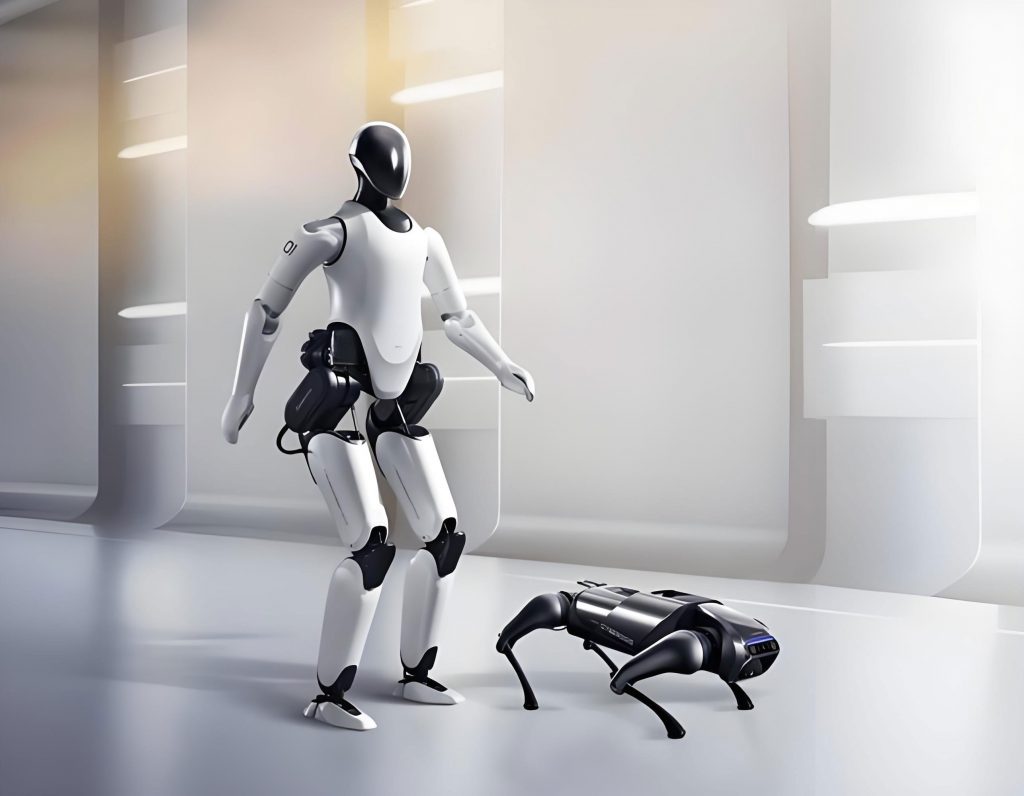
The system implementation results in a fully operational bionic robot capable of various movements and actions. Through the mobile app, users can control the bionic robot to perform basic gaits such as forward, backward, left turn, right turn, left shift, and right shift. Additionally, the bionic robot executes bionic actions like jumping, stretching, doing push-ups, sitting, kneeling, dancing, lying down, and covering its head—emulating animal behaviors. These actions are pre-programmed using the kinematics formulas and servo control tables. The bionic robot’s versatility is demonstrated in its ability to adapt to different commands, showcasing the effectiveness of the STM32F4-based design. The integration of the image transmission module allows the bionic robot to act as a mobile surveillance platform, further expanding its utility in real-world scenarios.
From a technical perspective, the bionic robot’s locomotion relies on gait patterns generated via periodic leg movements. For a trotting gait, which is common in quadrupeds, I define a phase relationship between legs. Let \(\phi_i\) represent the phase of leg \(i\) (where \(i=1,2,3,4\) for front-left, front-right, hind-left, hind-right). In a trot, diagonal legs move in synchrony: \(\phi_1 = \phi_3\) and \(\phi_2 = \phi_4 = \phi_1 + \pi\). The foot trajectory for each leg is parameterized as:
$$ x_f(t) = A_x \sin(2\pi f t + \phi_i) $$
$$ y_f(t) = A_y \cos(2\pi f t + \phi_i) $$
$$ z_f(t) =
\begin{cases}
H & \text{if } \sin(2\pi f t + \phi_i) > 0 \\
0 & \text{otherwise}
\end{cases} $$
Where \(A_x\) and \(A_y\) are amplitude constants, \(f\) is the gait frequency, and \(H\) is the step height. This formulation ensures smooth and stable motion for the bionic robot. The STM32F411 computes these trajectories in real-time, adjusting for speed and direction based on app inputs. To optimize performance, I implement a PID controller for servo positioning, reducing errors in joint angles. The control law is given by:
$$ u(t) = K_p e(t) + K_i \int_0^t e(\tau) d\tau + K_d \frac{de(t)}{dt} $$
Where \(e(t)\) is the error between desired and actual angle, and \(K_p\), \(K_i\), \(K_d\) are tuning parameters. This enhances the precision of the bionic robot’s movements, making it more responsive and stable.
Looking ahead, there are several avenues for expanding this bionic robot’s capabilities. First, the hardware can be upgraded with additional sensors, such as GPS for localization or inertial measurement units (IMUs) for balance control. This would improve the bionic robot’s autonomy and adaptability in uneven terrains. Second, software enhancements could include machine learning algorithms for gait optimization, allowing the bionic robot to learn from its environment and adjust movements accordingly. For instance, reinforcement learning could be applied to minimize energy consumption or maximize speed. Third, cost reduction is a key factor for scalability; using off-the-shelf components and simplified designs can make bionic robots more accessible for educational or commercial use.
In terms of potential applications, this bionic robot can be deployed in disaster response scenarios, where it navigates rubble to locate survivors. Its bionic design enables it to traverse obstacles that wheeled robots cannot, highlighting the advantage of legged locomotion. Moreover, in home settings, the bionic robot could serve as a companion or assistant, equipped with voice recognition modules for human-robot interaction. The integration of AI would transform it into a smart bionic robot capable of understanding and executing complex commands.
To summarize the technical specifications, I provide a table comparing this bionic robot with ideal characteristics for such systems:
| Aspect | Current Bionic Robot | Ideal Target | Improvement Strategies |
|---|---|---|---|
| Degrees of Freedom | 12 (3 per leg) | 16+ for enhanced dexterity | Add ankle or waist joints |
| Control System | STM32F411 with inverse kinematics | Multi-core processor with AI | Upgrade to STM32H7 or Jetson Nano |
| Power Autonomy | ~1 hour with 800 mAh battery | 4+ hours for extended missions | Use higher capacity cells or solar |
| Sensing Capabilities | Camera and basic voltage monitoring | LIDAR, IMU, force sensors | Integrate modular sensor suites |
| Cost | Moderate (DIY components) | Low for mass adoption | Bulk manufacturing and open-source |
The development of this bionic robot underscores the importance of interdisciplinary approaches, combining mechanical engineering, electronics, and computer science. As bionic robots evolve, they will play a pivotal role in addressing societal challenges, from elderly care to industrial automation. This project serves as a foundation for future research, encouraging innovations in locomotion algorithms and human-robot collaboration. By continuously refining the design, I aim to contribute to the next generation of intelligent bionic robots that are both robust and affordable.
In conclusion, the STM32F4-based bionic quadruped robot demonstrates the feasibility of creating agile and multifunctional bionic robots with off-the-shelf components. Through careful integration of hardware and software, this bionic robot achieves a range of motions and features that mimic biological systems. The use of kinematics and control theory ensures precise movement, while the modular design allows for easy expansions. As I look to the future, enhancing the bionic robot’s intelligence and adaptability will be key to unlocking its full potential in diverse environments. The journey of building this bionic robot has been insightful, highlighting the endless possibilities in the field of bionics and robotics.