
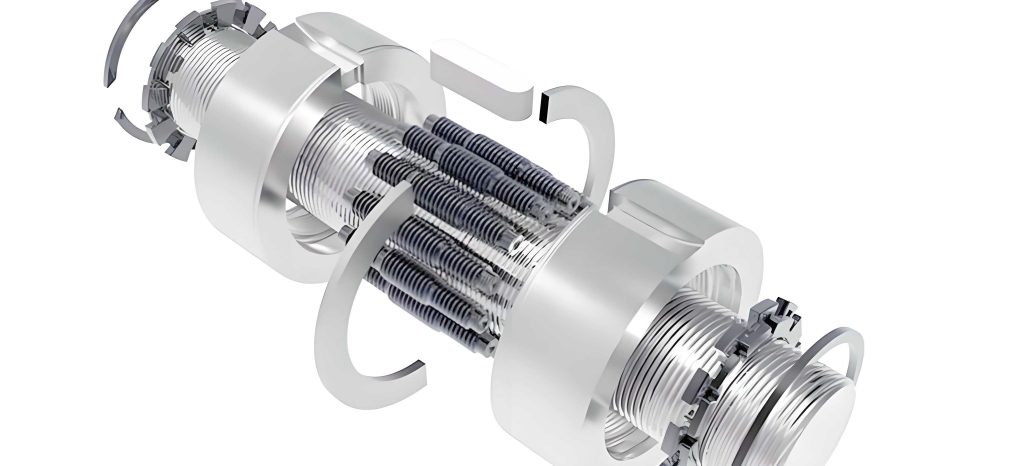
In recent years, the application of planetary roller screws in aerospace, marine, and other high-precision industries has demonstrated remarkable achievements, highlighting their critical role in advanced mechanical systems. As a key component in linear motion control, the planetary roller screw offers high load capacity, stiffness, and efficiency, making it indispensable for applications requiring precise and reliable actuation. However, accurately evaluating the comprehensive performance of planetary roller screws remains a significant bottleneck that limits their widespread adoption. The performance of planetary roller screws directly impacts the safety and reliability of the equipment they serve, underscoring the importance of effective testing methodologies. In this context, I have developed an upper computer system based on LABVIEW for a comprehensive performance test platform dedicated to planetary roller screws. This system integrates measurement, control, data storage, query, and communication functions, providing a robust solution for performance assessment. The design encompasses interface development, logical structuring, and communication interface implementation, all tailored to ensure seamless operation and accurate data acquisition. This article details the system’s architecture, functionality, and experimental validation, emphasizing the integration of various sensors and control mechanisms to evaluate parameters such as acceleration, velocity, displacement, temperature-induced displacement, tensile pressure, and noise. Through this work, I aim to contribute to the advancement of testing technologies for planetary roller screws, facilitating their safer and more efficient deployment in critical applications.
The performance of planetary roller screws is influenced by numerous factors, including mechanical wear, thermal effects, and dynamic loads. Traditional testing methods often rely on fragmented approaches, lacking a holistic system for real-time monitoring and analysis. To address this, my design focuses on a unified platform that leverages LABVIEW’s graphical programming environment to create an intuitive and powerful upper computer system. The system is built around a modular architecture, allowing for flexibility in accommodating different sensor types and communication protocols. By incorporating multiple measurement channels and control loops, it enables comprehensive evaluation under various operational conditions, from high-speed dynamics to precision positioning. The following sections elaborate on the system’s overall design, functional components, and implementation details, supported by tables and formulas to summarize key aspects. Throughout, the term “planetary roller screw” is emphasized to reinforce the focus on this critical component, ensuring clarity and relevance in the discussion.
The overall design of the planetary roller screw comprehensive performance test platform revolves around a hierarchical structure connecting the upper computer PC with external devices through three primary communication types. This design ensures robust data acquisition and control, essential for accurate performance assessment. First, sensors with serial communication capabilities, such as tension-pressure sensors and sound level meters, interface directly with LABVIEW via RS232 protocol. Second, sensors like circular gratings and platinum resistors, along with their subsequent circuits, connect through NI-PCI data acquisition cards, enabling LABVIEW to communicate via the built-in DAQ assistant. Third, a PLC (Programmable Logic Controller) communicates with the upper computer LABVIEW through TCP/IP over an RJ45 interface, forming a control loop from PC to PLC to servo system to actuator, and a measurement loop from sensors to PC. This integrated framework allows for synchronized control and monitoring, critical for evaluating the dynamic behavior of planetary roller screws. The system’s architecture is summarized in Table 1, which outlines the communication methods, sensor types, and their roles in the test platform.
| Communication Type | Interface Protocol | Sensor/Device Examples | Function in System |
|---|---|---|---|
| Serial Communication | RS232/RS485 | Tension-Pressure Sensor, Sound Level Meter | Direct data acquisition for force and noise measurements |
| PCI Board Communication | NI-DAQ via PCI Card | Circular Grating (displacement), Platinum Resistor (temperature) | Acquisition of pulse signals and analog currents for displacement and temperature |
| TCP/IP Communication | Ethernet (RJ45) | PLC (controlling servo system) | Control parameter transmission and system coordination |
Building on this architecture, the upper computer system for planetary roller screw testing is designed with five core functions: measurement, control, data saving, data query, and communication. These functions are interdependent yet modular, ensuring efficient operation. The measurement function collects real-time data from sensors to monitor the planetary roller screw’s performance during tests. The control function allows the upper computer to send commands to the servo system via the PLC, adjusting parameters like speed and acceleration. The data saving function stores acquired data locally for post-analysis, while the data query function enables retrieval of historical test records. Communication underpins all these functions, facilitating data flow between the PC, sensors, and control units. The system’s interface design includes a main startup screen, high-speed test interface, precision test interface, and auxiliary dialog boxes, all developed in LABVIEW for user-friendly interaction. For instance, the main interface provides navigation to different test modes and configuration settings, as shown in the high-speed test interface that displays waveforms for speed, acceleration, noise, and vibration. This design ensures that operators can easily configure tests and monitor results, enhancing the usability of the planetary roller screw test platform.
The measurement function is central to evaluating the planetary roller screw’s performance, as it captures critical parameters that reflect its operational state. During testing, parameters such as velocity, acceleration, temperature, thermal displacement, displacement, noise, and tensile pressure are monitored in real-time to prevent overload and ensure safety. The high-speed test interface graphically represents velocity and acceleration waveforms, derived from sensors like encoders and accelerometers. For velocity, the relationship is given by the derivative of displacement: $$v(t) = \frac{dx(t)}{dt}$$ where \( v(t) \) is the instantaneous velocity, and \( x(t) \) is the displacement measured by circular gratings. Acceleration is similarly derived: $$a(t) = \frac{dv(t)}{dt} = \frac{d^2x(t)}{dt^2}$$. In LABVIEW, these calculations are implemented using numerical differentiation techniques within the data acquisition loops. Temperature measurements, crucial for assessing thermal effects on the planetary roller screw, are obtained from platinum resistors, with the resistance-temperature relationship approximated by the Callendar-Van Dusen equation: $$R(T) = R_0 \left[1 + A T + B T^2 + C (T – 100) T^3\right]$$ for temperatures below 0°C, though for typical ranges, a linear simplification is used. Noise levels, measured by sound level meters, are captured in decibels to evaluate acoustic performance, while tensile pressure sensors provide force data using strain gauge principles, with output voltage proportional to applied force: $$V_{out} = k \cdot F$$ where \( k \) is a calibration constant. The precision test interface focuses on displacement-time plots, enabling accuracy assessment by comparing commanded and actual positions. Table 2 summarizes the measured parameters, their sensors, and corresponding mathematical models, emphasizing the comprehensive nature of the planetary roller screw evaluation.
| Parameter | Sensor Type | Measurement Principle | Mathematical Model/Formula | Relevance to Planetary Roller Screw |
|---|---|---|---|---|
| Displacement | Circular Grating Encoder | Optical pulse counting | \( x = n \cdot \lambda \), where \( n \) is pulse count, \( \lambda \) is resolution | Evaluates positioning accuracy and backlash |
| Velocity | Derived from displacement | Numerical differentiation | \( v = \frac{\Delta x}{\Delta t} \) | Assesses dynamic response and smoothness |
| Acceleration | Accelerometer | Piezoelectric or MEMS sensing | \( a = \frac{dv}{dt} \), or direct analog output | Indicates inertial loads and vibration |
| Temperature | Platinum Resistance Thermometer | Resistance change with temperature | \( R(T) = R_0 (1 + \alpha T) \), linear approximation | Monitors thermal expansion and lubrication effects |
| Thermal Displacement | Calculated from temperature and CTE | Thermal expansion theory | \( \Delta L = \alpha \cdot L_0 \cdot \Delta T \), where \( \alpha \) is coefficient of thermal expansion | Quantifies dimensional changes due to heating |
| Tensile Pressure | Strain Gauge Load Cell | Wheatstone bridge output | \( F = \frac{V_{out}}{S} \), with sensitivity \( S \) | Measures axial loads and fatigue resistance |
| Noise | Sound Level Meter | Acoustic pressure measurement | \( L_p = 20 \log_{10}\left(\frac{p}{p_0}\right) \) dB | Evaluates acoustic emissions and wear |
The control function of the upper computer system enables precise manipulation of the servo system driving the planetary roller screw, essential for simulating real-world operating conditions. Through the LABVIEW front panel, users can input control parameters such as target speed, acceleration, run mode, and lubrication settings. These parameters are converted into property nodes and transmitted to the PLC via TCP/IP communication, forming a closed-loop control system. The control algorithm incorporates soft limit switches to restrict motion within safe boundaries, defined by left and right positional limits. If the planetary roller screw exceeds these limits, the system automatically issues a stop command, preventing damage. The control logic can be described using a proportional-integral-derivative (PID) formulation for velocity control: $$u(t) = K_p e(t) + K_i \int_0^t e(\tau) d\tau + K_d \frac{de(t)}{dt}$$ where \( u(t) \) is the control output to the servo, \( e(t) \) is the error between desired and actual velocity, and \( K_p \), \( K_i \), \( K_d \) are tuning gains. In LABVIEW, this is implemented within event structures that trigger actions based on user inputs, such as starting or stopping tests. The control interface also allows selection between high-speed and precision tests, with manual entry fields for custom parameterization. This flexibility ensures that the planetary roller screw can be tested under diverse scenarios, from rapid cycling to fine positioning, thereby comprehensively assessing its performance envelope.
Data saving and query functions are integral to the long-term utility of the planetary roller screw test system, facilitating data traceability and analysis. During operation, sensor data is continuously acquired and buffered in local memory. Upon test completion, users can opt to save the data to an electronic spreadsheet, with timestamps aligned to each measurement point. The saving process is implemented using LABVIEW’s file I/O functions, writing data in a structured format that includes metadata like test ID, date, and operator. For historical data retrieval, a query interface is provided, allowing searches based on multiple fields: screw identification number, test date, testing institution, and personnel. These fields are combined using logical AND operations, enabling precise filtering. The query results display in a list, and selecting an entry loads the corresponding data and waveforms for review. This functionality not only verifies data integrity but also supports comparative studies across different planetary roller screw units or test conditions. Underlying this is a simple database schema, though for scalability, integration with SQL databases could be considered. The emphasis on data management underscores the importance of reliable record-keeping in performance evaluation, particularly for planetary roller screws used in safety-critical applications.
Communication functionality forms the backbone of the upper computer system, enabling seamless interaction between LABVIEW, sensors, and control devices. Three communication methods are employed, each tailored to specific hardware requirements. First, serial communication with RS232/RS485 sensors involves configuring the VISA serial port in LABVIEW, setting parameters like baud rate and data bits. For example, to read from a tension-pressure sensor, a command message is sent via VISA Write, followed by VISA Read to capture the response, and finally VISA Close to terminate the session. This request-response pattern ensures accurate data acquisition for sensors like sound level meters. Second, communication via NI-PCI data acquisition cards utilizes the DAQ Assistant, which is configured to match the card model and channel assignments. The DAQ output, often in volts or counts, is scaled to physical units using calibration coefficients. For pulse signals from encoders, the frequency is converted to displacement: $$x = \frac{N \cdot P}{R}$$ where \( N \) is the pulse count, \( P \) is the pitch of the planetary roller screw, and \( R \) is the encoder resolution. Third, TCP/IP communication with the PLC is established by setting IP addresses in the same subnet, with LABVIEW acting as a client sending control parameters to the PLC’s data blocks. The communication protocol ensures reliable transmission, with error handling for network issues. Table 3 compares these communication methods, highlighting their roles in the planetary roller screw test platform.
| Method | Protocol/Interface | Typical Use Case | Advantages | Challenges |
|---|---|---|---|---|
| Serial Communication | RS232/RS485, VISA in LABVIEW | Direct sensor data acquisition (e.g., force, noise) | Simple, low-cost, widely supported | Limited speed, point-to-point only |
| PCI Board Communication | NI-DAQ, analog/digital channels | High-speed data acquisition (e.g., displacement, temperature) | High precision, multi-channel, real-time processing | Requires specialized hardware, driver installation |
| TCP/IP Communication | Ethernet, TCP sockets | Control command transmission to PLC | Networkable, flexible, supports remote access | Network latency, configuration complexity |
The implementation of the upper computer system for planetary roller screw testing involves detailed programming in LABVIEW, leveraging its graphical dataflow paradigm. The main program structure uses a while loop with an event case structure to handle user interactions, such as button clicks for starting tests or saving data. Within the measurement loops, data from sensors is acquired concurrently, using parallel loops for different communication types to avoid bottlenecks. For instance, serial communication runs in one loop, while PCI acquisition runs in another, with synchronization mechanisms to timestamp data accurately. The control loop sends parameters to the PLC at regular intervals, ensuring the servo system responds promptly to changes. Error handling is incorporated throughout, with try-catch blocks to manage communication failures or sensor faults, thereby enhancing system robustness. Additionally, the system includes calibration routines to offset sensor biases, crucial for accurate evaluation of planetary roller screw performance. For example, displacement sensors are calibrated using known reference positions, with correction factors applied: $$x_{corrected} = a \cdot x_{raw} + b$$ where \( a \) and \( b \) are calibration coefficients determined via least-squares fitting. This attention to detail ensures that the test results are reliable and reproducible, which is vital for validating the performance of planetary roller screws in demanding environments.
Experimental validation of the upper computer system was conducted through a series of tests on planetary roller screw prototypes, covering both high-speed and precision scenarios. In high-speed tests, the system controlled the servo to achieve velocities up to 1 m/s and accelerations of 5 m/s², while measuring real-time data. The results, displayed on the high-speed interface, showed smooth velocity profiles and minimal noise spikes, indicating stable operation of the planetary roller screw. Acceleration data revealed transient peaks during direction changes, which were analyzed to assess inertial effects. Noise measurements remained below 75 dB, within acceptable limits for industrial applications. In precision tests, the system commanded the planetary roller screw to move to multiple target positions with micron-level accuracy. Displacement-time plots demonstrated minimal tracking error, calculated as: $$e = x_{commanded} – x_{measured}$$. The average error across five target points was less than 10 micrometers, showcasing the high precision achievable with the system. Data from these tests were saved and later queried to verify consistency, with no discrepancies found. The successful integration of measurement, control, and communication functions confirms the system’s capability to comprehensively evaluate planetary roller screw performance. Future enhancements could include advanced diagnostics using machine learning algorithms to predict wear or failure modes, further extending the utility of the test platform.
In conclusion, the upper computer system designed for planetary roller screw comprehensive performance testing represents a significant advancement in evaluation methodologies. By integrating LABVIEW-based software with multi-protocol hardware, the system provides a unified platform for real-time monitoring, control, and data management. The emphasis on planetary roller screw performance is evident throughout the design, from sensor selection to test protocols. The system’s ability to measure critical parameters like acceleration, displacement, and noise, coupled with precise control via PLC communication, enables thorough assessment under varied conditions. Data saving and query functions ensure traceability, supporting quality assurance and research efforts. The experimental results validate the system’s effectiveness, demonstrating its potential for widespread adoption in industries reliant on planetary roller screws, such as aerospace and marine engineering. As technology evolves, this system can be adapted to incorporate new sensors or communication standards, ensuring its relevance for future testing needs. Ultimately, this work contributes to safer and more efficient use of planetary roller screws, underpinning their role in advanced mechanical systems.