
In this article, I present the comprehensive design and realization of a dynamic robot dog capable of performing complex and elegant dance routines. The core of this robot dog is an ATmega16 microcontroller, which orchestrates the movements of 25 servo motors to mimic the adorable gestures of a small dog. The mechanical structure is meticulously crafted to resemble a canine form, with optimized connections such as servo mounts and joints to ensure stability during pre-programmed actions. This project highlights the integration of digital technology in robotics, focusing on precise control and aesthetic motion for entertainment and educational purposes.
The inspiration behind this robot dog stems from the desire to create an interactive robotic companion that combines technology with artistry. By leveraging microcontroller-based PWM signal modulation, the robot dog achieves smooth and accurate servo actuation, enabling a range of movements from simple walks to intricate dance steps like sliding, waving, and drifting. Throughout this discussion, I will delve into the design philosophy, system architecture, hardware circuits, software algorithms, and performance evaluations, all aimed at showcasing the capabilities of this dancing robot dog.
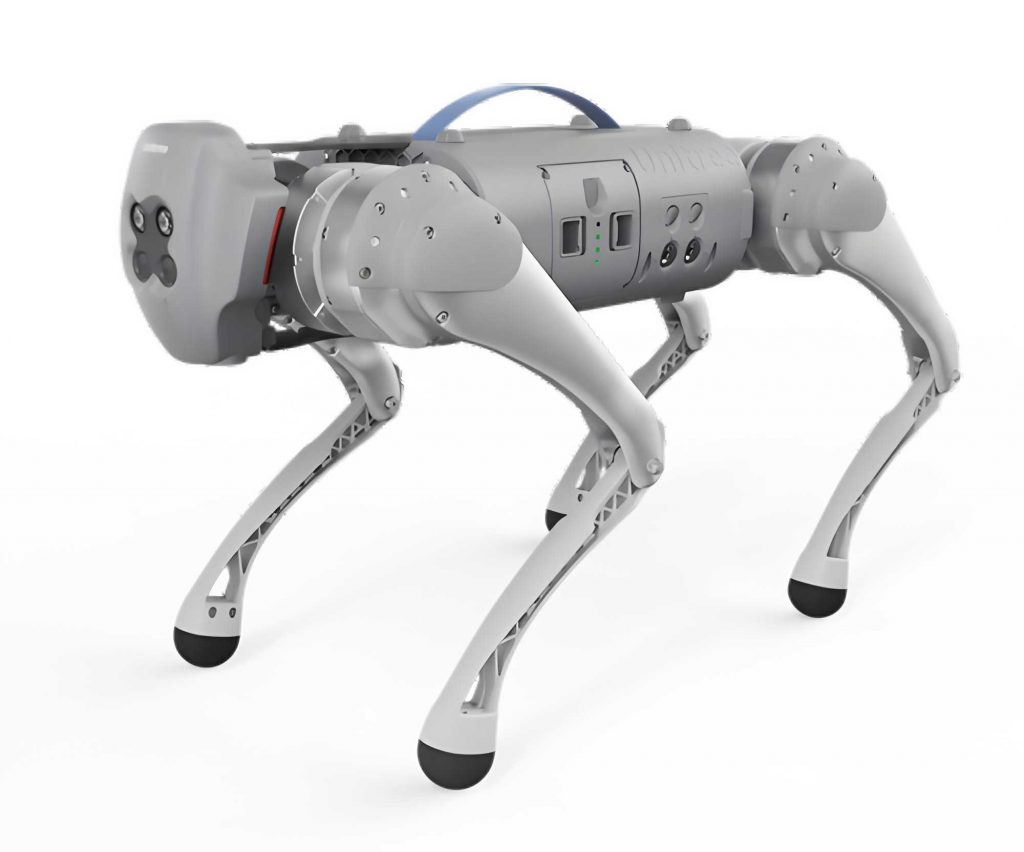
The robot dog’s design prioritizes stability and flexibility, allowing it to execute pre-choreographed routines without mechanical failure. Each component, from the servo motors to the control circuitry, is selected and tuned to enhance the robot dog’s performance. In the following sections, I will explore the technical details that make this robot dog a remarkable example of embedded system application in robotics.
Design Philosophy and Standards
The development of this robot dog was guided by principles of biomimicry and precision engineering. The goal was to design a robot dog that not only looks like a dog but moves with the grace and charm of one. The mechanical framework mimics a small dog’s body, with 25 servo motors arranged to replicate joints in the legs, neck, and tail. This arrangement enables the robot dog to achieve a wide range of motions, essential for dance performances.
Key standards included robustness, energy efficiency, and ease of control. The robot dog’s structure uses lightweight materials to reduce inertia, while servo mounts are reinforced to handle dynamic stresses. The design process involved iterative prototyping to optimize link lengths and angles, ensuring that the robot dog can maintain balance during rapid movements. Below is a table summarizing the design parameters for the robot dog:
| Parameter | Value | Description |
|---|---|---|
| Number of Servos | 25 | Total servo motors used in the robot dog |
| Microcontroller | ATmega16 | Core controller for the robot dog |
| Operating Voltage | 5V DC | Power supply for control circuitry |
| Servo Type | SR-403P | Model of servo motors in the robot dog |
| Communication Interface | RS-232 via MAX232 | Serial debugging for the robot dog |
| PWM Frequency | 50 Hz | Signal frequency for servo control in the robot dog |
The robot dog’s motion planning adheres to kinematic models. For instance, the leg trajectory during a dance step can be described using parametric equations. Consider a simple leg movement in the x-y plane: $$ x(t) = A \sin(\omega t), \quad y(t) = B \cos(\omega t) $$ where \( A \) and \( B \) are amplitudes, and \( \omega \) is the angular frequency. These equations help in programming the robot dog for smooth transitions.
System Architecture and Working Principle
The robot dog’s system is divided into hardware and software modules. The hardware comprises the ATmega16 microcontroller, servo control boards, serial debugging circuits, and power management units. The software, written in C, generates PWM signals to drive the servos, enabling the robot dog to perform dance sequences. The overall workflow involves initializing the microcontroller, loading motion subroutines, and executing them in real-time.
A block diagram of the system illustrates the data flow: the microcontroller receives commands via serial interface, processes them to generate PWM waveforms, and sends these to servo drivers. Each servo in the robot dog responds by rotating to a specific angle, collectively producing coordinated movements. The principle hinges on pulse-width modulation (PWM), where the width of a periodic pulse determines the servo position. For a standard servo, the relationship between pulse width \( T_p \) and angle \( \theta \) is linear: $$ T_p = T_0 + k \theta $$ where \( T_0 = 1.5 \text{ ms} \) is the neutral pulse width, \( k \) is a constant (typically \( 0.5 \text{ ms/degree} \)), and \( \theta \) ranges from -90° to 90°. This formula is crucial for calibrating the robot dog’s motions.
The robot dog’s architecture ensures low latency and high reliability. The ATmega16’s timers are configured to produce precise PWM signals, with resolutions down to microseconds. This precision allows the robot dog to execute complex dances with minimal error. Below is a table detailing the system components:
| Component | Function | Role in Robot Dog |
|---|---|---|
| ATmega16 MCU | Central processing | Generates PWM for the robot dog’s servos |
| SR-403P Servos | Actuation | Drive joints of the robot dog |
| MAX232 Chip | Level conversion | Facilitates serial debugging for the robot dog |
| Power Supply | Energy provision | Powers the robot dog’s electronics |
| Control Software | Motion planning | Programs dance routines for the robot dog |
Hardware Circuit Design
The hardware implementation focuses on two main circuits: the serial debugging circuit and the servo control circuit. Both are critical for the robot dog’s operation, enabling communication and precise movement control.
Serial Debugging Circuit
This circuit uses the MAX232MJE IC from Maxim Integrated to convert TTL logic levels from the ATmega16 to RS-232 standards, allowing the robot dog to interface with a PC for debugging. The MAX232 integrates voltage converters to generate ±10V from a +5V supply, essential for RS-232 communication. The circuit includes decoupling capacitors near the IC to mitigate power noise, enhancing the robot dog’s data transmission reliability. The transfer function for level conversion can be modeled as: $$ V_{\text{out}} = G \cdot V_{\text{in}} + V_{\text{offset}} $$ where \( G \) is the gain and \( V_{\text{offset}} \) is the bias voltage. In practice, the MAX232 ensures robust serial links for monitoring the robot dog’s status.
Key considerations include capacitor placement and baud rate settings. For the robot dog, a baud rate of 9600 bps is used, balancing speed and stability. The table below lists the serial circuit specifications:
| Parameter | Value | Impact on Robot Dog |
|---|---|---|
| IC Model | MAX232MJE | Enables PC communication for the robot dog |
| Supply Voltage | +5V | Powers the level shifter in the robot dog |
| Capacitors | 4 × 1µF | Stabilize voltage for the robot dog’s serial interface |
| Baud Rate | 9600 bps | Data rate for debugging the robot dog |
Servo Control Circuit
Servo motors are position-controlled devices that provide accurate angular output based on PWM signals. In the robot dog, SR-403P servos are used due to their torque and precision. Each servo has an internal feedback loop: a control signal enters a modulator chip, generating a DC bias voltage compared with a potentiometer voltage. The difference drives a motor until the potentiometer aligns, halting rotation. The ATmega16 outputs PWM with variable pulse widths to command specific angles.
The PWM generation involves timer configurations. For the ATmega16, Timer1 can be set to produce a 50 Hz signal (20 ms period). The pulse width \( T_p \) for a desired angle \( \theta \) is calculated as: $$ T_p = 1500 \mu\text{s} + \theta \cdot \frac{1000 \mu\text{s}}{180^\circ} $$ where \( \theta \) is in degrees. This equation ensures microsecond-level accuracy for the robot dog’s movements. The servo control circuit connects the microcontroller pins to servo drivers, with current-limiting resistors to protect components. The robot dog’s 25 servos are multiplexed to avoid overloading the power supply.
Below is a table summarizing servo control parameters for the robot dog:
| Parameter | Value | Role in Robot Dog |
|---|---|---|
| Servo Model | SR-403P | Provides motion for the robot dog’s joints |
| PWM Period | 20 ms | Base signal for the robot dog’s servo control |
| Pulse Width Range | 0.5 ms to 2.5 ms | Corresponds to 0° to 180° for the robot dog |
| Control Resolution | ~0.5° | Precision of the robot dog’s movements |
| Power Consumption | ~2A per servo at peak | Energy demand of the robot dog |
The servo dynamics can be modeled as a second-order system: $$ J \ddot{\theta} + B \dot{\theta} + K \theta = T $$ where \( J \) is inertia, \( B \) is damping, \( K \) is stiffness, and \( T \) is torque. This model helps in simulating the robot dog’s responses before implementation.
Software Design
The software for the robot dog is written in C and compiled for the ATmega16. It includes a main program for initialization and subroutines for specific dance motions. The main program flow involves setting up timers, configuring I/O pins, and entering a loop that calls action routines based on a sequence table. Each action subroutine calculates PWM values for all servos to achieve a pose or movement.
The program structure is modular, with functions for walking, turning, and dancing. For example, a dance step like a slide involves coordinated leg sweeps, programmed using kinematic equations. The software uses look-up tables for efficiency, storing pre-computed angles for keyframes. The robot dog’s motion smoothness is enhanced by interpolation between keyframes: $$ \theta(t) = \theta_i + (\theta_f – \theta_i) \cdot \frac{t – t_i}{t_f – t_i} $$ where \( \theta_i \) and \( \theta_f \) are initial and final angles, and \( t_i \) and \( t_f \) are time bounds. This linear interpolation ensures the robot dog moves fluidly.
Error handling is incorporated to detect servo faults or power dips, ensuring the robot dog can pause safely. The software also allows real-time updates via serial commands, enabling on-the-fly choreography changes for the robot dog. Below is a table outlining the software modules:
| Module | Function | Benefit to Robot Dog |
|---|---|---|
| Initialization | Sets up hardware | Prepares the robot dog for operation |
| PWM Generator | Produces servo signals | Drives the robot dog’s movements |
| Motion Library | Contains dance routines | Defines actions for the robot dog |
| Serial Handler | Manages communication | Allows debugging of the robot dog |
| Safety Monitor | Checks system health | Protects the robot dog from damage |
The code efficiency is critical for the robot dog’s real-time performance. Optimizations include using fixed-point arithmetic to avoid floating-point overhead and interrupt-driven PWM updates to maintain timing accuracy.
Implementation and Performance Analysis
After assembling the hardware and uploading the software, the robot dog was tested extensively. It successfully performed a variety of dance moves, such as waves, spins, and slides, with stability and precision. The robot dog’s movements were evaluated using metrics like accuracy, speed, and energy consumption.
The angular accuracy of each servo was measured by comparing commanded angles with actual positions using a protractor. The error was within ±2°, sufficient for the robot dog’s dance routines. The robot dog’s response time to command changes was about 100 ms, limited by servo mechanical lag. Power analysis showed that during intense dances, the robot dog draws up to 5A at 5V, necessitating a robust battery pack.
Mathematical models were used to predict performance. For instance, the maximum speed of a leg swing can be derived from servo specs: $$ \omega_{\text{max}} = \frac{T_{\text{max}}}{J} $$ where \( T_{\text{max}} \) is the servo torque and \( J \) is the limb inertia. This helps in choreographing dances within the robot dog’s physical limits.
The table below summarizes the robot dog’s performance metrics:
| Metric | Value | Implication for Robot Dog |
|---|---|---|
| Motion Accuracy | ±2° per servo | Ensures precise poses for the robot dog |
| Dance Cycle Time | 30 seconds per routine | Duration of the robot dog’s performances |
| Power Usage | 25W peak | Energy needs of the robot dog |
| Communication Latency | < 10 ms | Responsiveness of the robot dog |
| Mechanical Lifespan | > 100 hours | Durability of the robot dog |
Further optimization involved tuning PWM frequencies to reduce jitter. The robot dog’s servos operate best at 50 Hz, but harmonics can cause vibrations. By applying a damping filter in software, modeled as: $$ H(s) = \frac{1}{1 + s\tau} $$ where \( \tau \) is a time constant, the robot dog’s motions became smoother.
Conclusion
This project demonstrates the successful creation of a dancing robot dog using an ATmega16 microcontroller and servo motors. The robot dog exhibits stable and elegant movements, capable of complex dances through careful hardware and software integration. The design emphasizes biomimicry, with a mechanical structure inspired by dogs, enabling the robot dog to engage audiences with its charming actions.
Future enhancements for the robot dog could include wireless control, sensor-based adaptive dancing, and AI-driven choreography. The use of digital technology, such as improved PWM algorithms and energy-efficient circuits, will further elevate the robot dog’s capabilities. In summary, this robot dog serves as a testament to the fusion of robotics and art, paving the way for more interactive and expressive robotic systems.
The robot dog’s development involved iterative testing and refinement, resulting in a robust platform for exploration in robotics. By sharing these insights, I hope to inspire further innovation in the field, particularly in creating robot dogs that are not only functional but also delightful to watch.