
The evolution of robotic technology has expanded its operational domains into environments that are hazardous or inaccessible to humans, such as disaster zones, industrial inspection sites, and deep-sea exploration. In these contexts, traditional wheeled or tracked vehicles often face limitations in navigating complex, unstructured terrain. Inspired by biological organisms, legged bionic robots offer superior adaptability, flexibility, and reliability. Among these, hexapod bionic robots are particularly notable for their high degree of limb redundancy, which grants them enhanced stability, significant load-bearing capacity, and considerable fault tolerance. This paper details the comprehensive design and implementation process of a hexapod bionic robot tailored for inspection tasks, covering mechanical structure design, gait planning, kinematic modeling, system simulation, and physical validation.
The foundational step in creating an effective bionic robot is its structural design, which is directly inspired by the biomechanics of hexapod insects. The robot’s body is designed with six walking legs symmetrically distributed on either side. Each leg is configured as a multi-joint serial manipulator with three rotational degrees of freedom (DOF), mimicking the hip, knee, and ankle joints found in biological counterparts. This configuration is crucial for generating the complex trajectories required for stable locomotion over uneven surfaces. The legs are sequentially numbered from 1 to 6, starting with the left-front leg (L1), followed by left-middle (L2), left-rear (L3), right-rear (R4), right-middle (R5), and right-front (R6). This systematic numbering is essential for coordinated gait control.
To enable precise control and simulation, a quantitative model of the leg mechanism is established. Each leg is treated as a 3-DOF serial robotic arm. Using the standard Denavit-Hartenberg (D-H) parameter method, a coordinate system is attached to each joint. The origin is set at the center of the hip joint, with the Z-axis pointing downward, the X-axis pointing forward, and the Y-axis pointing laterally outward from the robot’s body. The D-H parameters for a single leg are summarized in the table below. These parameters define the geometric relationship between consecutive links and joints, forming the basis for all subsequent kinematic calculations.
| Joint j | $\theta_j$ (Joint Angle) | $d_j$ (Link Offset) | $a_j$ (Link Length) | $\alpha_j$ (Link Twist) | Offset |
|---|---|---|---|---|---|
| 1 (Hip) | $q_1$ | 0 | 0.062 m | $\pi/2$ | $\pi/2$ |
| 2 (Knee) | $q_2$ | 0 | 0.068 m | 0 | 0 |
| 3 (Ankle) | $q_3$ | 0 | -0.104 m | 0 | $-\pi/2$ |
The homogeneous transformation matrix between adjacent links, ${^{j-1}T_j}$, is given by the standard D-H formula:
$$ {^{j-1}T_j} = \begin{bmatrix}
\cos\theta_j & -\sin\theta_j \cos\alpha_j & \sin\theta_j \sin\alpha_j & a_j \cos\theta_j\\
\sin\theta_j & \cos\theta_j \cos\alpha_j & -\cos\theta_j \sin\alpha_j & a_j \sin\theta_j\\
0 & \sin\alpha_j & \cos\alpha_j & d_j\\
0 & 0 & 0 & 1
\end{bmatrix} $$
The complete forward kinematics for the foot-tip position relative to the hip base is obtained by the chain multiplication of these matrices: ${^{0}T_3} = {^{0}T_1} \cdot {^{1}T_2} \cdot {^{2}T_3}$. This model allows us to calculate the Cartesian coordinates of the foot given a set of joint angles $(q_1, q_2, q_3)$, which is vital for trajectory planning.
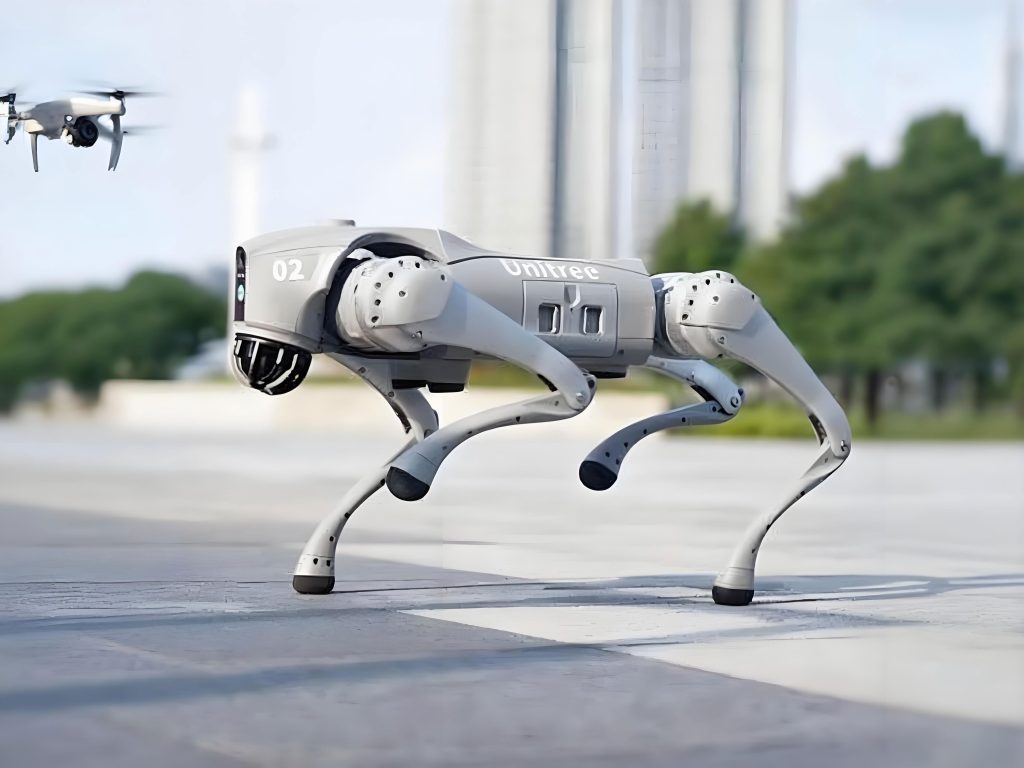
The core intelligence of a walking bionic robot lies in its gait planning—the coordinated sequencing of leg movements to achieve stable locomotion. For a hexapod bionic robot, a tripod gait is often employed for its efficiency and inherent stability. In this gait, the six legs are divided into two synchronously moving groups: Group A (Legs L1, L3, R5) and Group B (Legs L2, R4, R6). The fundamental principle is that at any time, one group (three legs) remains in the stance phase, supporting the robot’s body, while the other group is in the swing phase, moving forward. This ensures the robot’s center of mass (CoM) is always projected inside a stable “support polygon” formed by the three grounded feet.
Key parameters in gait analysis are the cycle time $T$ and the duty factor $\beta$. The duty factor for a leg is defined as the fraction of the cycle time it spends in the stance phase:
$$ \beta = \frac{T_{st}}{T} = 1 – \frac{T_{sw}}{T} $$
where $T_{st}$ is the stance time and $T_{sw}$ is the swing time. For a stable and efficient tripod gait, $\beta = 0.5$ is typically chosen, meaning each leg spends half the cycle supporting and half the cycle swinging. The stability of the bionic robot during motion is quantified using the concept of Stability Margin ($S$). It is defined as the minimum distance from the projection of the robot’s CoM to the boundaries of the support polygon formed by the stance feet:
$$ S = \min(d_1, d_2, d_3) $$
where $d_1, d_2, d_3$ are the perpendicular distances from the CoM projection to the three edges of the support triangle. A positive and larger $S$ indicates greater static stability, making the bionic robot less prone to tipping over.
The detailed sequence for a forward walking tripod gait, which involves a moving CoM, is broken down into six distinct states for each leg: Lift, Move, Place, Mid-Stance, Return, and Hold. The interleaved sequence for the two groups across these states is designed to ensure smooth weight transfer and continuous motion.
| Action Sequence | Phase 1 | Phase 2 | Phase 3 | Phase 4 | Phase 5 | Phase 6 |
|---|---|---|---|---|---|---|
| Group A (L1, L3, R5) | Mid-Stance | Return | Hold | Lift | Move | Place |
| Group B (L2, R4, R6) | Lift | Move | Place | Mid-Stance | Return | Hold |
To translate this gait into actionable motor commands, we must solve the inverse kinematics (IK) problem. For a given desired foot-tip trajectory in Cartesian space $(x, y, z)$ relative to the hip joint, we need to find the corresponding joint angles $(q_1, q_2, q_3)$. Using the D-H model and geometric analysis, the IK solutions for this specific bionic robot leg structure can be derived. The joint angles are calculated as follows:
$$ q_1 = \arctan2(y, x) $$
Let $r = \sqrt{x^2 + y^2} – a_1$, where $a_1$ is the length of the first link (hip). The coordinates in the leg plane become $(r, -z)$ (note: Z-axis is down). Then,
$$ D = \frac{r^2 + z^2 – a_2^2 – a_3^2}{2 a_2 a_3} $$
$$ q_3 = \arctan2(\pm\sqrt{1-D^2}, D) $$
$$ q_2 = \arctan2(z, r) – \arctan2(a_3 \sin q_3, a_2 + a_3 \cos q_3) $$
Here, $a_2$ and $a_3$ are the lengths of the second (knee) and third (ankle) links, respectively. The $\pm$ sign corresponds to different arm configurations (elbow-up or elbow-down). By planning a simple trajectory for the foot-tip (e.g., a raised curve for swing, a straight line for body shift during stance) and applying these IK equations at discrete points, we obtain the time-series data for all 18 joint angles (3 joints x 6 legs) required to execute the gait.
Prior to physical construction, the entire gait plan and the kinematic model were simulated and validated using the Robotics Toolbox in a MATLAB environment. This step is crucial for debugging the logic and ensuring the mathematical models produce viable, stable motion for the bionic robot. The simulation involved creating a robot model using the D-H parameters from Table 1 and then commanding its joints through the calculated inverse kinematics trajectories for both forward (longitudinal) and crab (lateral) walking.
For forward walking, the foot-tip trajectories were designed to move the legs along straight lines relative to the body. The joint angle profiles for one leg over a full cycle exhibited smooth, periodic behavior, confirming the absence of discontinuities. The simulation visually confirmed that the bionic robot maintained a stable tripod stance throughout the cycle, with its body moving forward in a straight line. The stability margin $S$ was computed throughout the simulation. Its value remained positive and above a safe threshold during the entire gait cycle, validating the static stability of the planned motion for the bionic robot.
Lateral walking, akin to a crab’s motion, was also simulated by modifying the Cartesian trajectory planning. Instead of moving primarily in the X-direction, the foot-tip trajectories were planned primarily in the Y-direction, with appropriate adjustments to maintain symmetry between left and right side legs. The joint angle profiles for lateral motion differed from those of forward motion but were equally smooth. The simulation successfully demonstrated the bionic robot shifting sideways while maintaining stability. Interestingly, the calculated stability margin for lateral walking was generally larger than that for forward walking, indicating potentially higher stability during sideways motion for this particular bionic robot design.
The final and most critical phase was the physical implementation of the hexapod bionic robot. The robot was constructed using modular robotic components, including a central microcontroller and high-torque digital servos for the joints. The mechanical structure was assembled according to the design specifications, ensuring the link lengths and joint alignments matched the D-H model. The control software was developed to execute the pre-calculated gait tables, sending precise angle commands to each of the 18 servos in the correct sequence and timing.
The joint angle sequences for the forward walking gait, derived from the inverse kinematics solution applied to the planned foot trajectories, were programmed into the robot’s controller. A snippet of the command angles (in degrees) for one complete cycle is shown below. The states correspond to the start of each phase in the gait sequence table. These angles include the mechanical offsets specific to the physical servo mounts.
| Leg & Joint | Mid-Stance (A) / Lift (B) | Return (A) / Move (B) | Hold (A) / Place (B) | Lift (A) / Mid-Stance (B) | Move (A) / Return (B) | Place (A) / Hold (B) |
|---|---|---|---|---|---|---|
| L1-Hip | 149 | 164 | 180 | 180 | 180 | 149 |
| L1-Knee | 179 | 177 | 177 | 177 | 132 | 140 |
| L1-Ankle | 170 | 180 | 183 | 183 | 215 | 199 |
| L2-Hip | 180 | 180 | 149 | 149 | 164 | 180 |
| L2-Knee | 177 | 132 | 140 | 179 | 177 | 177 |
| … (Data for other legs follows a similar patterned sequence) | ||||||
Similarly, the joint angle table for lateral walking was implemented. The physical tests were conducted on a flat surface. The hexapod bionic robot successfully demonstrated stable forward and lateral locomotion according to the tripod gait. The motion was observed to be smooth and coordinated, with no visible instability or tipping. The robot was also able to perform basic obstacle avoidance by sequencing straight-line motions, confirming the practicality of the gait planning approach. The successful physical operation of the bionic robot served as the ultimate validation of the entire design and planning methodology.
The process of designing and implementing a functional hexapod bionic robot involves a multidisciplinary integration of mechanical design, kinematic modeling, gait planning, and embedded control. This work has outlined a general framework for this process, starting from a bio-inspired mechanical structure, deriving its mathematical model using D-H parameters, planning a stable tripod gait with quantifiable stability metrics, solving the necessary inverse kinematics, and validating the approach through simulation before successful physical deployment. The resulting bionic robot exhibits the key advantages of legged systems, namely adaptability and stability on flat terrain. This foundation paves the way for future enhancements, such as the integration of dynamic balancing algorithms, more sophisticated terrain-aware gait transitions, and the addition of inspection-specific sensors like cameras and LiDAR, ultimately leading to a fully autonomous inspection bionic robot capable of operating in complex real-world environments.