
The pursuit of biologically inspired mobility has led to significant advancements in robotics, with quadrupedal platforms standing out for their superior stability and adaptability on rough, unstructured terrain compared to their wheeled counterparts. The development of a low-cost, capable quadruped bionic robot presents a compelling challenge, requiring a harmonious integration of mechanical design, electronic control, and intelligent algorithms. This work details the design, implementation, and testing of a compact quadruped bionic robot built around the ESP8266 microcontroller. The system aims to serve as an accessible platform for research and education in legged robotics, demonstrating fundamental functionalities such as stable walking, turning, and basic obstacle avoidance through a modular and cost-effective architecture.
The core of this bionic robot is an ESP8266 Wi-Fi SoC (System on Chip), chosen for its integrated wireless capabilities, sufficient processing power, and low cost. The hardware is structured modularly, encompassing the main controller, servo drivers, power management, sensor suite, and a 3D-printed mechanical chassis. For motion generation, a gait planning algorithm based on the static-stable triangular gait is implemented. Wireless communication via Wi-Fi enables real-time teleoperation and data feedback. This article comprehensively covers the system’s overall design, detailed hardware and software implementation, experimental validation, and discusses pathways for future enhancement, consistently focusing on the principles that enable this efficient bionic robot.
System Architecture and Design Philosophy
The overarching design philosophy prioritizes modularity, simplicity, and functionality. The system is decomposed into discrete, interoperable modules to facilitate debugging, upgrades, and maintenance. The ESP8266 acts as the central computational and communication hub. It receives high-level commands (e.g., “walk forward,” “turn left”) via Wi-Fi, executes the gait algorithm, and generates precise pulse-width modulation (PWM) signals for servo control. Simultaneously, it polls data from onboard sensors to inform balance and navigation decisions. The following block diagram illustrates this modular architecture:
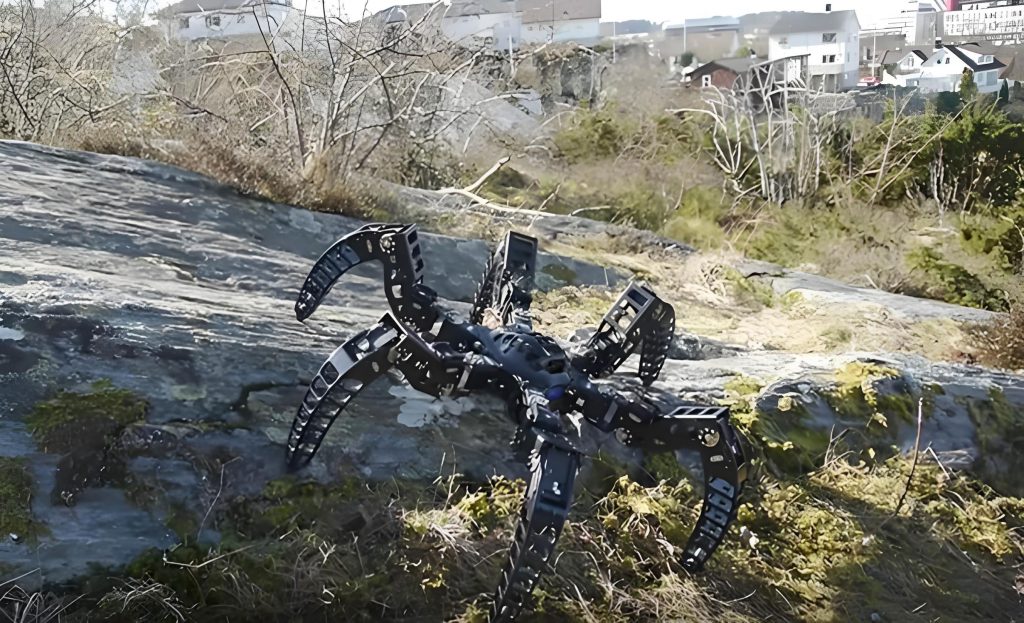
The mechanical design of this quadruped bionic robot employs a mammal-like configuration with four legs, each possessing two active degrees of freedom (DOF). This 2-DOF per leg design offers a balance between mechanical complexity and controllable pose. The first DOF (abduction/adduction) controls the lateral swing of the leg, primarily for balance and turning. The second DOF (flexion/extension) controls the forward-backward motion and is the main driver for propulsion. The kinematic structure is summarized below:
| Leg | Joint 1 (Hip) | Joint 2 (Knee) | Primary Function |
|---|---|---|---|
| Front-Left (FL) | Abduction/Adduction | Flexion/Extension | Steering, Support |
| Front-Right (FR) | Abduction/Adduction | Flexion/Extension | Steering, Support |
| Rear-Left (RL) | Abduction/Adduction | Flexion/Extension | Propulsion, Support |
| Rear-Right (RR) | Abduction/Adduction | Flexion/Extension | Propulsion, Support |
This symmetric design is fundamental to the stability and gait patterns of the bionic robot. The total of eight servos necessitates a multi-channel, synchronized control strategy, which is handled by a dedicated PWM driver chip interfaced with the main controller.
Hardware Design and Component Selection
The hardware implementation is critical for realizing a robust and responsive bionic robot. Each component was selected based on performance, form factor, power consumption, and cost.
Core Control Module: ESP8266
The ESP8266 is the brain of the operation. Its key features that make it suitable for this bionic robot project include:
- Processing: A 32-bit Tensilica L106 microcontroller core running at 80 MHz (or up to 160 MHz), providing adequate computational power for gait algorithms and sensor fusion.
- Integrated Wi-Fi: Full 802.11 b/g/n Wi-Fi stack with integrated TCP/IP protocol stack. This eliminates the need for a separate communication module, drastically reducing cost and complexity.
- GPIO & Interfaces: Multiple General Purpose Input/Output pins, along with I²C and SPI interfaces, allow for easy connection to sensors and peripheral chips.
- Low Power Operation: Supports sleep modes, which is beneficial for extending operational life in battery-powered scenarios.
A comparison with other common microcontrollers highlights its advantages for this specific application:
| Microcontroller | Core | Wireless | Cost | Suitability for Bionic Robot |
|---|---|---|---|---|
| ESP8266 | 32-bit, 80-160 MHz | Integrated Wi-Fi | Very Low | Excellent (Integrated comms) |
| Arduino UNO (ATmega328P) | 8-bit, 16 MHz | None (requires shield) | Low | Fair (Limited I/O, speed) |
| STM32 (e.g., F103) | 32-bit ARM Cortex-M3, 72 MHz | None (requires module) | Low-Medium | Good (Powerful, but needs extra Wi-Fi) |
Actuation: Servo Motors and Driver
Small, digital servo motors (SG90/MG90S type) were selected for actuation. They provide a reasonable torque-to-weight ratio and are controlled via a standardized PWM signal. A single 50 Hz PWM signal controls the servo’s angular position, where a pulse width ($T_{pulse}$) maps linearly to the output angle ($\theta$):
$$ \theta = k \cdot (T_{pulse} – T_{min}) $$
where $T_{pulse}$ typically ranges from 0.5 ms (0°) to 2.5 ms (180°), $T_{min}$ = 0.5 ms, and $k$ is a constant (e.g., 90°/ms). Controlling eight servos directly from the ESP8266’s limited PWM pins is inefficient. Therefore, a PCA9685 16-channel PWM driver is employed. This chip communicates with the ESP8266 via the I²C bus and handles the precise timing generation for all servos simultaneously, offloading this critical task from the main CPU. Key servo specifications are:
| Parameter | Specification |
|---|---|
| Model | SG90 / Analog Micro Servo |
| Operating Voltage | 4.8V – 6.0V |
| Stall Torque | 1.8 kg-cm @ 4.8V |
| Speed | 0.1 s/60° @ 4.8V |
| Control Signal | PWM (50 Hz, 0.5ms – 2.5ms pulse) |
Perception: Sensor Suite
For a bionic robot to interact with its environment, sensing is paramount. Our platform integrates two primary sensor types:
1. Inertial Measurement Unit (MPU6050): This MEMS-based sensor combines a 3-axis gyroscope and a 3-axis accelerometer. It is crucial for estimating the robot’s orientation (roll $\phi$ and pitch $\theta$ angles). The raw gyroscope data ($\omega_x, \omega_y, \omega_z$) is integrated to estimate angle, but it drifts over time. The accelerometer data ($a_x, a_y, a_z$) provides a stable, gravity-referenced angle estimate but is noisy during movement. A complementary filter is used to fuse these signals optimally for this dynamic bionic robot:
$$ \theta_{filtered}(t) = \alpha \cdot (\theta_{filtered}(t-1) + \omega_y \cdot \Delta t) + (1-\alpha) \cdot \theta_{accelerometer} $$
where $\alpha$ is a tuning constant (typically ~0.98), favoring the gyroscope’s short-term accuracy and the accelerometer’s long-term stability.
2. Distance Sensors: Ultrasonic (HC-SR04) and infrared proximity sensors are mounted on the front and sides. They provide simple but effective environment awareness for obstacle detection and collision avoidance. The ultrasonic sensor measures distance ($d$) based on the time-of-flight ($t$) of a sound wave: $d = \frac{v_{sound} \cdot t}{2}$.
| Sensor | Type | Range | Purpose on Bionic Robot |
|---|---|---|---|
| MPU6050 | IMU (Gyro + Accel) | N/A | Attitude Estimation, Balance |
| HC-SR04 | Ultrasonic | 2cm – 400cm | Frontal Obstacle Detection |
| IR Proximity | Infrared | ~2cm – 30cm | Side/Rear Obstacle Detection |
Power System
A dual-voltage power system is implemented. A single-cell Lithium-Polymer (LiPo) battery (3.7V nominal) is used as the primary source. A switching buck-boost converter regulates this to a stable 5V rail, which powers the servo motors and the PCA9685 driver. A separate low-dropout (LDO) linear regulator steps the 5V down to 3.3V to power the ESP8266 and sensors reliably, protecting them from voltage noise generated by the servos.
Software Architecture and Gait Control
The software transforms the hardware into an intelligent, walking bionic robot. The program is structured around a central finite-state machine and a timed control loop.
System Initialization and Main Control Loop
Upon startup, the bionic robot undergoes a comprehensive initialization sequence:
- Hardware Init: Configures I²C bus, initializes the PCA9685 PWM driver, and sets all servos to a predefined “neutral” standing position.
- Sensor Init: Configures the MPU6050 (sets ranges, sample rate, filters) and calibrates it by averaging readings while the robot is stationary.
- Communication Init: Connects to a predefined Wi-Fi network (Station mode) or creates its own access point. Starts a TCP server to listen for commands from a remote client (e.g., a Python script or mobile app).
The main control loop then runs at a fixed frequency (e.g., 50 Hz). Each cycle involves:
1. Sensor Reading: Polling IMU and distance sensors.
2. Data Processing: Applying the complementary filter to IMU data, checking obstacle thresholds.
3. Command Parsing: Checking the TCP socket for new high-level commands.
4. Gait Engine Update: Based on the current command and sensor state, calculating the next set of target angles for all eight servos.
5. Actuation: Sending the new angle targets to the PCA9685 driver via I²C.
Gait Planning: The Triangular Gait
The quintessential feature of a walking bionic robot is its gait. For static stability (where the robot’s center of gravity is always projected within the polygon formed by the supporting feet), we implement a diagonal-coupled or triangular gait. In this gait, three feet are always on the ground, forming a stable triangle of support, while the fourth foot is lifted and moved forward.
The movement is coordinated in phases. Legs are grouped into two diagonal pairs: (Front-Left + Rear-Right) and (Front-Right + Rear-Left). These pairs move in alternation. The step cycle for one leg consists of two phases:
- Swing Phase: The foot is lifted, moved forward through the air, and placed down ahead of its starting point.
- Support Phase: The foot is on the ground, moving backward relative to the body, thereby propelling the bionic robot forward.
The timing is controlled by a phase variable $\Phi$ that cycles from 0 to $2\pi$. The relationship between the phase of leg $i$ ($\Phi_i$) and its duty factor $\beta$ (fraction of cycle spent in support) determines the gait. For a trotting quadruped bionic robot, $\beta = 0.5$ and the phase difference between diagonal pairs is $\pi$.
$$
\Phi_{FL} = \Phi_0,\quad \Phi_{RR} = \Phi_0,\quad \Phi_{FR} = \Phi_0 + \pi,\quad \Phi_{RL} = \Phi_0 + \pi
$$
The foot trajectory during the swing phase is critical for smooth operation. We define a parametric curve for the foot tip in the leg’s coordinate frame. A simple semi-elliptical trajectory is often effective. If $S$ is the step length and $H$ is the swing height, the foot position $(x_f, z_f)$ can be given as a function of the swing phase $\phi_s = \Phi_i$ (mapped to $[0, 2\pi]$ during swing):
$$
x_f(\phi_s) = -\frac{S}{2} \cos(\phi_s) \quad \text{(for a leg on the right side)}
$$
$$
z_f(\phi_s) = \begin{cases}
H \sin(\phi_s) & \text{if } 0 \leq \phi_s \leq \pi \\
0 & \text{otherwise (grounded)}
\end{cases}
$$
These Cartesian foot coordinates are then translated into desired joint angles ($\theta_1$ for hip, $\theta_2$ for knee) using inverse kinematics. For our simple 2-DOF leg with link lengths $L_1$ (thigh) and $L_2$ (shin), the inverse kinematics equations are:
$$
D = \frac{x_f^2 + z_f^2 – L_1^2 – L_2^2}{2 L_1 L_2}
$$
$$
\theta_2 = \operatorname{atan2}( \pm \sqrt{1 – D^2}, D )
$$
$$
\theta_1 = \operatorname{atan2}(z_f, x_f) – \operatorname{atan2}(L_2 \sin(\theta_2), L_1 + L_2 \cos(\theta_2))
$$
The sign for $\theta_2$ is chosen based on the desired leg configuration (elbow-up or elbow-down). This mathematical framework allows the bionic robot to execute a stable, periodic walking motion. Turning is achieved by introducing an offset to the hip abduction/adduction angles during the swing phase, causing the foot to land slightly turned inward or outward.
| Gait Parameter | Symbol | Typical Value | Effect on Bionic Robot Motion |
|---|---|---|---|
| Step Length | $S$ | 40 mm | Larger S increases speed but may reduce stability. |
| Swing Height | $H$ | 20 mm | Clears ground obstacles. Too high wastes energy. |
| Cycle Time | $T_c$ | 1.0 s | Shorter T_c increases stepping frequency and speed. |
| Duty Factor | $\beta$ | 0.5 (Trot) | Defines fraction of cycle leg is on ground. |
Attitude Adjustment and Stability
Using the pitch and roll angles ($\theta, \phi$) estimated from the IMU, a simple proportional-derivative (PD) controller can be implemented to adjust the body posture actively. If the bionic robot starts tilting forward ($\theta > 0$), the controller can lengthen the front legs and shorten the rear legs by modifying the neutral foot positions in the inverse kinematics calculation. The control law for the body height adjustment of leg $i$ ($\Delta z_i$) could be:
$$
\Delta z_{FL} = -K_p \cdot \phi – K_d \cdot \dot{\phi} – K_p \cdot \theta – K_d \cdot \dot{\theta}
$$
$$
\Delta z_{FR} = +K_p \cdot \phi + K_d \cdot \dot{\phi} – K_p \cdot \theta – K_d \cdot \dot{\theta}
$$
$$
\Delta z_{RL} = -K_p \cdot \phi – K_d \cdot \dot{\phi} + K_p \cdot \theta + K_d \cdot \dot{\theta}
$$
$$
\Delta z_{RR} = +K_p \cdot \phi + K_d \cdot \dot{\phi} + K_p \cdot \theta + K_d \cdot \dot{\theta}
$$
where $K_p$ and $K_d$ are controller gains. This distributes corrective forces across all legs to level the body.
Wireless Communication Protocol
The ESP8266’s integrated Wi-Fi is used to create a bidirectional link. The robot operates as a TCP server. A custom, lightweight ASCII-based protocol is defined for efficiency. Commands from the client are simple strings, e.g., "WALK:0.2,0.0" (walk forward at speed 0.2, turn rate 0.0) or "MODE:STOP". The bionic robot can also stream back sensor data as formatted strings, e.g., "DATA:PITCH:1.5,ROLL:-0.8,OBST:150".
Integration, Testing, and Results
Following the assembly of the mechanical chassis and wiring of all electronic modules, a systematic testing procedure was conducted to validate the performance of the quadruped bionic robot.
Unit and Integration Testing
1. Power and Module Test: Verified stable 5V and 3.3V rails under load. Confirmed individual communication links (I²C with PCA9685 and MPU6050).
2. Servo Calibration: Each servo was commanded to its extreme and mid-point angles to ensure correct mechanical alignment and no binding.
3. Gait Simulation: Before running on the physical bionic robot, the gait algorithm and inverse kinematics were simulated in a Python environment to visualize foot trajectories and check for self-collisions.
4. Single Leg Motion: The software was tested to move each leg independently through its full range of motion.
5. Static Pose: The robot was commanded to stand up from a crouched position, verifying the basic kinematic model.
Functional and Performance Testing
With unit tests passed, comprehensive functional tests were performed:
Straight-Line Walking: The bionic robot was placed on a flat, low-pile carpet surface. The trotting gait was initiated with moderate step length and cycle time. The robot successfully walked forward in a relatively straight line. Minor deviations were corrected by the IMU-based attitude controller.
Turning In Place: By applying a constant offset to the hip angles during the swing phase (as described in the gait section), the bionic robot executed left and right turns. The turning radius could be modulated by the magnitude of the offset.
Obstacle Avoidance: Using data from the frontal ultrasonic sensor, a simple behavior was implemented: if an obstacle was detected within 25 cm, the bionic robot would stop walking forward, execute a 90-degree turn, and then resume walking. This demonstrated basic autonomous reactive navigation.
Remote Control: A simple Python GUI application was developed to send command packets over Wi-Fi. This allowed real-time control of the bionic robot’s walking speed, turning, and gait parameters from a computer several meters away, with negligible latency in a typical indoor environment.
| Test Category | Success Criteria | Outcome | Notes |
|---|---|---|---|
| Forward Locomotion | Stable, continuous walking > 2 meters | Passed | Speed ~ 0.05 m/s. Occasional foot slippage on smooth surfaces. |
| Turning | Execute 90° turn within 15 seconds | Passed | Turning radius adjustable from ~0 cm (spin) to large radius. |
| Obstacle Reaction | Stop before collision and initiate turn | Passed | Reliable detection range: 10cm to 2m. |
| Wi-Fi Control | Latency < 100ms, reliable command reception | Passed | Stable within same room. Range ~10m through walls. |
| Battery Life | Sustain operation > 20 minutes | Passed | ~25 mins with continuous walking (1500mAh battery). |
Discussion and Future Enhancements
This project successfully demonstrates that a fully functional, low-cost quadruped bionic robot can be built using accessible components like the ESP8266. The implemented triangular gait provides static stability, which is forgiving for a platform of this scale and computational power. The integration of an IMU for basic attitude sensing and simple distance sensors for obstacle awareness lays the groundwork for autonomous behaviors.
However, this bionic robot represents a starting point. Several avenues exist for significant improvement and more advanced research:
- Advanced Gait and Dynamic Stability: Transitioning from statically stable gaits (like the implemented walk/trot) to dynamically stable gaits (like a running trot or bound) would greatly increase speed and energy efficiency. This requires more sophisticated control algorithms, such as the Spring-Loaded Inverted Pendulum (SLIP) model, and likely a more powerful microcontroller.
- Enhanced Environment Perception: Replacing or supplementing ultrasonic sensors with a small camera (e.g., ESP32-CAM module) would enable visual odometry, landmark recognition, and more complex path planning for the bionic robot. Machine learning models for terrain classification could also be explored.
- Improved Mechanical Design: Implementing compliant elements (springs, rubber feet) or even passive joints can improve energy efficiency and shock absorption. Designing a leg with 3 DOF would allow for full omnidirectional foot placement, greatly enhancing mobility.
- Centralized State Estimation: Implementing an Extended Kalman Filter (EKF) to fuse data from the IMU, motor encoders (if added), and potentially a camera would yield a much more accurate and robust estimate of the bionic robot’s pose and velocity.
- Higher-Level Autonomy: Integrating simultaneous localization and mapping (SLAM) algorithms would allow the bionic robot to build a map of its environment and navigate to specified goals autonomously.
The modular nature of the design, particularly the clear separation between the gait engine, sensor drivers, and communication layer, makes it straightforward to port the software to a more powerful platform (like an ESP32, STM32, or Raspberry Pi Pico) to pursue these advanced capabilities while retaining the core mechanical design.
Conclusion
In this work, the complete development cycle of a quadruped bionic robot—from conceptual design and hardware selection through algorithm implementation and experimental validation—has been presented. The robot utilizes an ESP8266 as its computational and communicative core, driving eight servo motors via a PCA9685 driver to execute a stable triangular walking gait. The inclusion of an IMU and distance sensors provides a foundational level of environmental perception and self-awareness. Testing confirmed the bionic robot’s ability to perform basic locomotion, turning, and reactive obstacle avoidance under wireless control. The project underscores the feasibility of creating capable legged robotic platforms using inexpensive, off-the-shelf components. It serves as a practical educational tool and a robust foundation for further research into more adaptive, intelligent, and dynamic bionic robot systems. The design choices, control strategies, and lessons learned provide a valuable reference point for anyone embarking on the development of their own legged bionic robot.