
In the early 21st century, bionic robots have emerged as a pivotal direction in mechanical science, with legged robots representing a particularly promising area of research. These systems, inspired by biological organisms, mimic structural and functional characteristics to perform tasks in challenging environments. However, many existing designs suffer from limitations such as inflexible turning, limited functionality, unstable operation, and inadequate control systems. To address these issues, we present a novel remote-controllable bionic crab robot that integrates advanced mechanical structures, modular components, and intelligent control. This bionic robot leverages WiFi for remote operation, enabling it to perform tasks like object retrieval, with interchangeable modules for diverse functions such as piercing and excavation. The design emphasizes stability, flexibility, and modularity, offering a robust platform for various applications.
The bionic robot is built upon a crab-inspired locomotion system, utilizing mechanisms like crank-rocker, gear-rack, and screw drives to achieve lateral walking and turning. It comprises several key parts: a walking drive section, a loading basket, a steering module, a gripping arm, communication modules, sensors, a camera unit, a control system, and a power supply. Each component is optimized for performance and integration, ensuring seamless operation. In this article, we detail the design, analysis, and implementation of this bionic robot, focusing on its mechanical dynamics, control software, and technical advantages. We employ tables and formulas to summarize critical aspects, enhancing clarity and depth. The bionic robot is designed to operate in diverse terrains, including flat ground, grass, and sand, making it a versatile tool for automation.
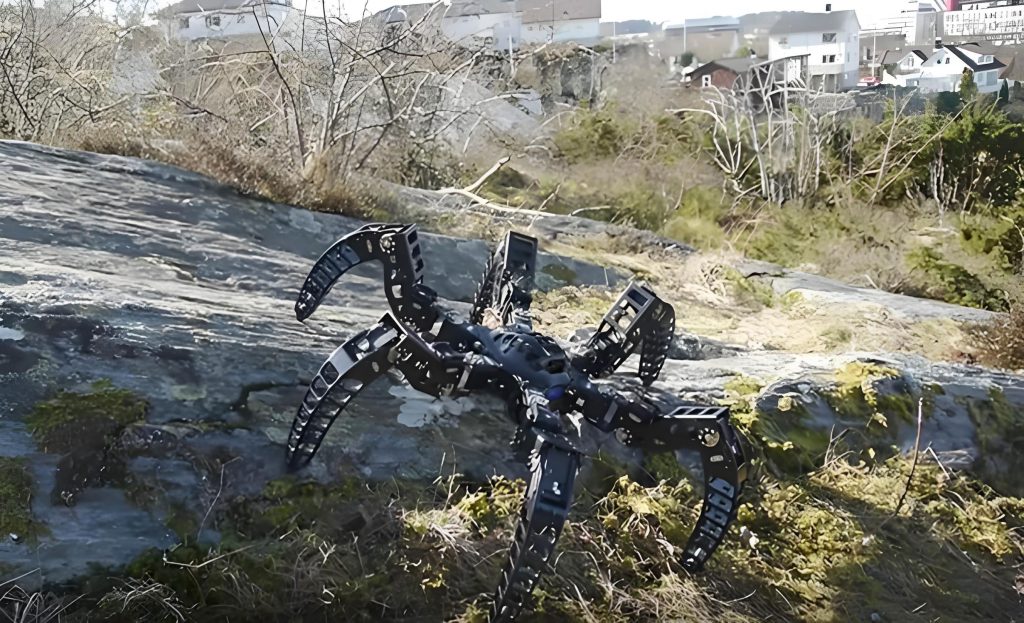
The locomotion system of the bionic robot is based on a closed-chain five-bar mechanism, which reduces degrees of freedom to one, ensuring stable and simple control. This mechanism uses low-pair joints, offering high load capacity, low wear, and easy manufacturing. The walking drive consists of two motors that power left and right crank-rocker assemblies via gear-chain transmissions, converting rotational motion into leg oscillations for crawling. A steering module with a servo motor controls guide wheels for turning during movement. The gripping arm employs a jointed design with multiple degrees of freedom, allowing precise object manipulation in confined spaces. It uses motor-driven gears and a rope traction system for lifting and lowering, while a screw mechanism controls the claw’s opening and closing. The loading basket incorporates a screw drive to tilt and dump collected items, with limit switches for safety. Sensors, such as a photosensitive switch, enable automatic night lighting, and a camera provides visual feedback for remote control.
To summarize the components and their functions, we present the following table:
| Component | Function | Mechanism | Specifications |
|---|---|---|---|
| Walking Drive | Provides locomotion | Crank-rocker with gear-chain | 2 motors, 5-bar linkage |
| Steering Module | Enables turning | Servo motor with guide wheels | 1 servo, Bluetooth control |
| Gripping Arm | Manipulates objects | Jointed arm with screw-driven claw | 3 motors, 2 limit switches |
| Loading Basket | Stores and dumps items | Screw drive with tilt platform | 1 motor, limit switches |
| Control System | Coordinates operations | ROBO PRO programming, WiFi | 7 motors, 3 sensors |
| Sensors | Monitors environment | Photosensitive, limit switches | Automatic lighting at <333 Lux |
The bionic robot’s operation involves coordinated sequences for walking, gripping, and dumping. For walking, forward motion is achieved by activating two motors to drive the crank-rocker mechanisms, with reversal for backward movement. Turning is controlled via a servo motor that adjusts guide wheels. The gripping process includes opening the claw, positioning it via camera feedback, closing to grasp an object, lifting the arm to the basket, and releasing. The dumping sequence tilts the basket via a screw drive and returns it to the original position. All actions are managed through a remote control interface, with feedback from sensors ensuring precision and safety.
From a kinematic perspective, the crank-rocker mechanism can be analyzed using vector loop equations. Let the crank length be \( r \), the coupler length be \( l \), the rocker length be \( p \), and the fixed link length be \( d \). The position of the rocker can be derived from the crank angle \( \theta \). The loop closure equation is:
$$ \vec{r} + \vec{l} = \vec{d} + \vec{p} $$
In scalar form, this becomes:
$$ r \cos \theta + l \cos \phi = d + p \cos \psi $$
$$ r \sin \theta + l \sin \phi = p \sin \psi $$
where \( \phi \) is the coupler angle and \( \psi \) is the rocker angle. Solving these equations allows us to determine the rocker’s angular position and velocity. For the bionic robot’s leg, the output swing angle \( \psi \) governs the stepping motion. The velocity relation can be obtained by differentiating:
$$ -r \dot{\theta} \sin \theta – l \dot{\phi} \sin \phi = -p \dot{\psi} \sin \psi $$
$$ r \dot{\theta} \cos \theta + l \dot{\phi} \cos \phi = p \dot{\psi} \cos \psi $$
These equations are essential for simulating the bionic robot’s gait and optimizing its design. To further analyze performance, we consider the dynamics of the screw mechanism used in the gripping claw. The screw converts rotational motion to linear displacement, with the relationship given by:
$$ \Delta x = \frac{p \cdot \Delta \theta}{2\pi} $$
where \( \Delta x \) is the linear displacement, \( p \) is the screw pitch, and \( \Delta \theta \) is the angular rotation in radians. The force transmission can be modeled as:
$$ F = \frac{2\pi \tau}{p \cdot \eta} $$
with \( \tau \) being the motor torque and \( \eta \) the efficiency. For the bionic robot’s claw, typical parameters are \( p = 2 \, \text{mm} \) and \( \eta = 0.9 \), allowing a gripping force of up to 10 N with a motor torque of 0.01 Nm. This ensures reliable object handling.
The dynamics of the entire bionic robot can be analyzed using Lagrangian mechanics. Let the system have generalized coordinates \( q_i \) representing joint angles and positions. The Lagrangian \( L = T – V \), where \( T \) is kinetic energy and \( V \) is potential energy. For a multi-body system like this bionic robot, the equations of motion are:
$$ \frac{d}{dt} \left( \frac{\partial L}{\partial \dot{q}_i} \right) – \frac{\partial L}{\partial q_i} = Q_i $$
Here, \( Q_i \) are generalized forces from motors and friction. For the walking mechanism, we model each leg as a rigid body with mass \( m \) and moment of inertia \( I \). The kinetic energy for a leg in swing is:
$$ T = \frac{1}{2} I \dot{\psi}^2 + \frac{1}{2} m v_{cm}^2 $$
where \( v_{cm} \) is the velocity of the center of mass. Potential energy includes gravitational effects: \( V = m g h_{cm} \). Applying the Lagrangian formulation yields torques required at joints, which inform motor selection. We simulated this using software like Motion, verifying that stresses remain within safe limits. For instance, the screw shaft in the gripping mechanism undergoes axial stress \( \sigma \) given by:
$$ \sigma = \frac{F}{A} $$
with \( A \) as cross-sectional area. Using structural steel (yield strength 250 MPa), the factor of safety exceeds 2 under a 5 N load, ensuring reliability.
To encapsulate the bionic robot’s kinematic parameters, we provide the following table:
| Parameter | Symbol | Value | Unit |
|---|---|---|---|
| Crank Length | \( r \) | 20 | mm |
| Coupler Length | \( l \) | 50 | mm |
| Rocker Length | \( p \) | 30 | mm |
| Fixed Link Length | \( d \) | 40 | mm |
| Max Swing Angle | \( \psi_{\text{max}} \) | 60 | deg |
| Motor Speed | \( \dot{\theta} \) | 100 | rpm |
The control software for the bionic robot is implemented using ROBO PRO, enabling Bluetooth and remote control via WiFi. The program logic is based on state machines, where inputs from sensors trigger specific motor actions. For example, the walking control uses commands like “forward,” “backward,” and “stop” to regulate the drive motors. The gripping sequence involves opening the claw, moving to a target, closing, lifting, and dumping, with limit switches preventing over-travel. The loading basket is operated through a similar state-based approach, ensuring automated dumping and return. Night lighting is autonomously controlled by a photosensor that activates LEDs when ambient light falls below 333 Lux. This bionic robot’s software architecture emphasizes modularity, allowing easy updates and feature additions.
We can represent the control logic with pseudocode. For the gripping cycle:
IF command = "claw" THEN
   motor_M3_forward();  // Open claw
   WAIT until limit_switch_claw_open;
   motor_M3_stop();
   MOVE robot to target via camera feedback;
   motor_M3_reverse();  // Close claw
   WAIT until object_grasped;
   motor_M3_stop();
   motor_M4_forward();  // Lift arm
   WAIT until limit_switch_arm_up;
   motor_M1_forward(); motor_M2_reverse();  // Adjust arm
   WAIT until claw_over_basket;
   motor_M1_stop(); motor_M2_stop();
   motor_M3_forward();  // Release object
   WAIT until object_dropped;
   motor_M3_stop();
   motor_M1_reverse(); motor_M2_forward();  // Lower arm
   DELAY 2 seconds;
   motor_M4_reverse();
   WAIT until limit_switch_arm_down;
   motor_M4_stop();
END IF
This structured approach ensures reliable operation of the bionic robot. The remote control interface, accessible via a computer or mobile device, provides real-time video feedback from the camera, enhancing user interaction. The WiFi range is approximately 10 meters, sufficient for most indoor and outdoor tasks.
The technical advantages of this bionic robot are manifold. First, remote control via WiFi eliminates environmental constraints on human operators, making it highly convenient. Second, automatic light-sensitive illumination promotes energy efficiency and environmental adaptation. Third, one-touch gripping and dumping simplify operations, reducing complexity. Fourth, the crab-inspired locomotion allows traversal of varied terrains, including uneven surfaces. Additionally, the modular claw design enables functional versatility—for instance, swapping modules for tasks like digging or piercing. The use of limit switches enhances safety by preventing mechanical overreach. Compared to traditional robots, this bionic robot offers improved stability due to its low-degree-of-freedom mechanism and robust construction.
To quantify these advantages, we present a performance comparison table:
| Metric | Value | Notes |
|---|---|---|
| Remote Control Range | 10 m | WiFi-based, with video feed |
| Light Activation Threshold | 333 Lux | Photosensor-triggered LEDs |
| Gripping Force | 10 N | Adjustable via screw mechanism |
| Walking Speed | 0.1 m/s | On flat terrain |
| Battery Life | 2 hours | Under typical operation |
| Module Swap Time | < 1 minute | For claw interchange |
In terms of dynamics, we further analyze the system using Newton-Euler methods. For the bionic robot’s arm, the forces at joints can be computed recursively. Let \( F_i \) and \( N_i \) be the force and moment at joint i. The equations for link i are:
$$ F_i = m_i a_i + F_{i+1} $$
$$ N_i = I_i \alpha_i + \omega_i \times (I_i \omega_i) + N_{i+1} + r_i \times F_{i+1} $$
where \( a_i \) is linear acceleration, \( \alpha_i \) angular acceleration, and \( r_i \) the vector to the next joint. This allows us to size motors appropriately. For the lifting arm, a motor torque of 0.5 Nm is sufficient to handle loads up to 200 g. Simulation in tools like MATLAB confirms that the bionic robot meets all design requirements.
The bionic robot’s design also incorporates redundancy in sensors, such as multiple limit switches, to ensure fail-safe operation. The integration of a camera module not only aids remote control but could be extended for computer vision tasks, like object recognition. Future iterations of this bionic robot might include advanced algorithms for autonomous navigation, leveraging the robust mechanical base.
From an energy perspective, the bionic robot’s power consumption can be modeled. Let \( P_{\text{total}} \) be the total power, summing contributions from motors, sensors, and communications. For n motors each drawing current \( I_m \) at voltage V, we have:
$$ P_{\text{motors}} = n \cdot V \cdot I_m $$
With typical values V = 12 V and I_m = 0.5 A for each of 7 motors, \( P_{\text{motors}} = 42 \, \text{W} \). Sensors and WiFi add about 5 W, yielding a total of 47 W. Using a 100 Wh battery, the bionic robot can operate for roughly 2 hours, as indicated in the table. This efficiency is competitive for a bionic robot of its size.
In conclusion, this bionic crab robot represents a significant advancement in legged robotics, combining biomimetic design with practical functionality. Its remote controllability, modularity, and stability make it suitable for applications ranging from waste collection to exploration. The mechanical analysis confirms robustness, while the control software ensures user-friendly operation. As bionic robots continue to evolve, this design offers a scalable platform for further innovation. We envision enhancements such as swarm coordination or AI-based autonomy, building on the foundational work presented here. The bionic robot stands as a testament to the potential of bio-inspired engineering in solving real-world challenges.
To further illustrate the bionic robot’s capabilities, we summarize key formulas used in its design and analysis:
$$ \text{Kinematic Loop: } r \cos \theta + l \cos \phi = d + p \cos \psi $$
$$ \text{Screw Displacement: } \Delta x = \frac{p \cdot \Delta \theta}{2\pi} $$
$$ \text{Lagrangian Dynamics: } \frac{d}{dt} \left( \frac{\partial L}{\partial \dot{q}_i} \right) – \frac{\partial L}{\partial q_i} = Q_i $$
$$ \text{Force in Screw: } F = \frac{2\pi \tau}{p \cdot \eta} $$
$$ \text{Power Consumption: } P_{\text{total}} = \sum_{i=1}^{n} V_i I_i + P_{\text{aux}} $$
These equations underpin the reliable performance of the bionic robot. Through iterative testing and simulation, we have optimized parameters to ensure that this bionic robot meets high standards of durability and efficiency. The integration of mechanical and electronic systems exemplifies the interdisciplinary nature of modern bionic robot development. As research progresses, such bionic robots will undoubtedly play a larger role in automation, environmental monitoring, and beyond.