
The rapid evolution of science and technology has catalyzed profound transformations across every industry. The application of robotics has become increasingly ubiquitous, permeating nearly every facet of modern life and significantly altering human existence. Numerous environments exist that are either inaccessible or hazardous to humans, such as mine shafts, lunar surfaces, and toxic zones. To gather data and conduct exploration in these areas, intelligent robots are typically deployed. Many of these terrains are rugged and uneven, posing significant challenges for wheeled robots. Therefore, the designed bionic robot must possess greater flexibility, stability, and coordination. In the current era led by “Artificial Intelligence,” the accelerated development of intelligent robotics is a field of constant innovation and exploration worldwide. The capability of robotic applications is not only a symbol of a nation’s high level of industrial automation but also a crucial indicator of its prowess in scientific, technological, and military domains.
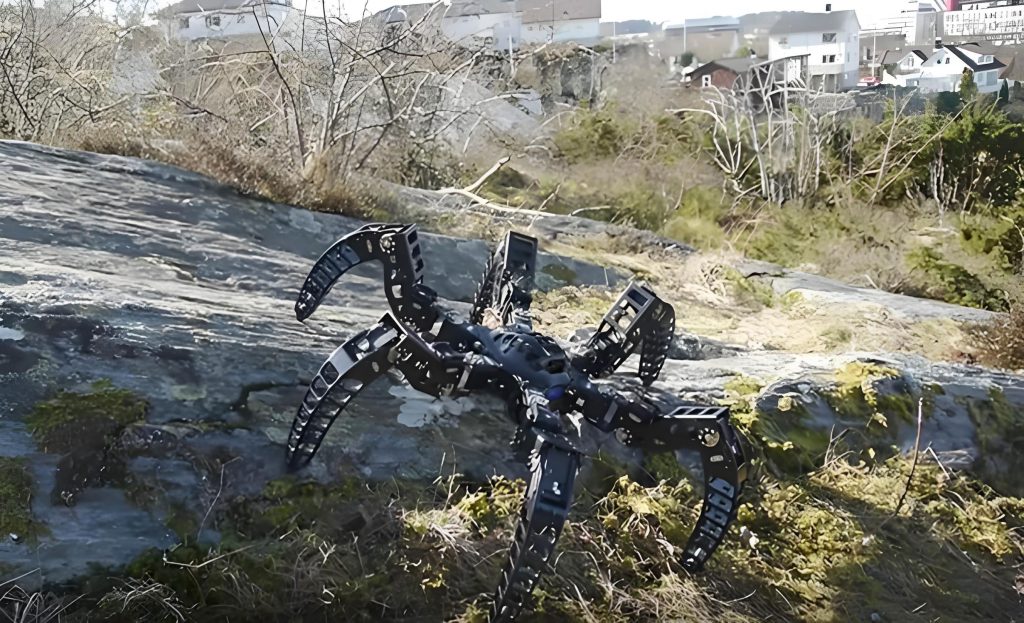
The development and research of robotics have seen more advanced levels and sophisticated technologies historically in other regions. For instance, the BigDog, a biomimetic quadruped bionic robot developed by Boston Dynamics, represents one of the most advanced legged platforms, demonstrating exceptional mobility in complex environments like forests, swamps, and snow. Similarly, development in other parts of Asia has also been pioneering, with humanoid walking robots representing top-tier achievements in the field.
While concepts resembling automata existed centuries ago, using wooden structures for rudimentary functions, the development of modern robotics, particularly multi-legged platforms, began later in many regions. Despite this, through persistent research and dedicated effort, significant scientific progress has been made. Notable contributions include the development of a pneumatically artificial muscle-actuated hexapod bionic robot and research into micro-hexapod biomimetic platforms, alongside the successful development of underwater hexapod robots.
As technological capabilities continue to improve, research into hexapod robots will never cease. To better integrate these bionic robot systems into practical applications, scholars worldwide persistently pursue endless studies on multi-legged robots. The goal is to make robots more flexible, intelligent, and capable, transforming them from simple mobile platforms into capable assistants for humans. They hold significant application prospects in various fields, especially in military domains.
Morphological and Structural Design of the Bionic Robot
Overall Morphological Design
The overall morphology of this bionic robot is inspired by the six-legged spider found in nature, mimicking its joint movement patterns and the coordinated operation between its legs and neural control. The robot’s structure is relatively simple, consisting of an upper chassis, a lower chassis, six tibia segments, six femur segments, and MG996R model servo motors. The robot has six legs, each equipped with three analog servos. One servo connects the tibia and femur, acting as the knee joint, allowing the lower leg to extend and swing within a certain range to realize the robot’s standing and lowering motions. The other two servos are installed on the side and within the body chassis. One servo enables the entire leg to swing up and down within a specified arc, while the other allows the leg to swing forward and backward, facilitating the robot’s forward and backward locomotion. The coordinated movement of the three servos on each leg enables the bionic robot to perform more complex maneuvers.
Determination of Degrees of Freedom (DoF)
The leg configuration critically determines the mobility and gait flexibility of the bionic robot. Two primary configurations were considered.
| Leg Configuration | Number of Servos per Leg | Total Servos (6 legs) | Key Joint Axes | Primary Motions Enabled | Advantages | Disadvantages |
|---|---|---|---|---|---|---|
| 2-DoF Leg | 2 | 12 | Vertical (Body joint), Horizontal (Hip joint) | Forward/Backward locomotion, Turning | Simpler control, Lower cost, Reduced weight | Limited adaptability to uneven terrain, Less stable on slopes |
| 3-DoF Leg | 3 | 18 | Vertical (Body joint), Horizontal (Hip joint), Knee joint | All 2-DoF motions plus body elevation/depression, better obstacle negotiation | Superior stability, Enhanced adaptability to complex terrain, Richer gait library | More complex control, Higher cost, Increased weight and power consumption |
After comparative analysis, the 3-DoF leg configuration was selected for this bionic robot design to achieve greater flexibility and stability. The two servos connecting the leg to the body chassis are designed in an integrated fashion: one is clamped within the chassis plates, and the other connects the chassis to the femur. The third servo connects the femur and the tibia.
Component Structural Design
The leg’s distal end effector consists of a servo, a femur link, and a tibia link. The servo connects the femur and tibia, forming the knee joint. The femur and tibia were designed with lightweight geometry and necessary mounting points for the servo horn.
The chassis connection block is designed to house two vertically oriented servos. Attention was paid to servo dimensions to ensure a compact, robust, and easily assemblable structure that aligns the leg’s first two axes correctly.
The body chassis is the robot’s main structure, serving to connect all legs and house the control electronics and battery. The design of the upper and lower chassis plates was dictated by the need for precise servo horn mounting hole locations, interconnection points, wire routing holes, and bearing mounts for structural rigidity. The lower plate also incorporates mounting points for the main control board.
Gait Analysis
The robot employs a tripod gait for locomotion. The six legs are divided into two groups: Group 1 consists of the left-front, left-rear, and right-middle legs; Group 2 consists of the right-front, right-rear, and left-middle legs. This grouping ensures that the robot’s body is always supported by three legs forming a stable triangular base. The two groups alternate between a swing phase (moving forward) and a stance phase (pushing the body forward), enabling continuous movement.
For forward locomotion, the sequence is analyzed below. Let \( L \) represent the full step length, and \( \theta_{hip} \), \( \theta_{knee} \) represent the commanded servo angles for the hip and knee joints respectively during the swing phase.
Phase 1: Group 1 legs (e.g., a, c, e) are in stance, forming a support polygon. The robot’s center of mass (CoM) projects inside this polygon, ensuring static stability. Group 2 legs (b, d, f) are in the air (swing phase), preparing to move forward. The forward swing displacement \( \Delta x_{swing} \) is typically less than \( L \).
Phase 2: Group 2 legs swing forward by a distance \( \Delta x_{swing} \). The swing trajectory for a leg can be simplified as a raised cycloid to avoid ground scraping. The vertical lift \( y(t) \) and horizontal movement \( x(t) \) during swing time \( T_{swing} \) can be parameterized. Simultaneously, the stance legs (Group 1) may retract slightly or maintain position, acting as fixed supports for this phase.
Phase 3: With Group 2 legs now placed on the ground, they transition to stance. The body is then propelled forward by a distance \( \Delta x_{body} \) (approximately \( L/2 \)) through the coordinated backward rotation of the Group 1 stance leg servos. This body movement is driven by the kinematic relationship between the leg joint angles and the body’s position. A simplified 2D model for a single stance leg relating body velocity \( \dot{P}_{body} \) to joint angular velocities \( \dot{\Theta} = [\dot{\theta}_{body}, \dot{\theta}_{hip}]^T \) is given by the Jacobian matrix \( J \):
$$ \dot{P}_{body} = J(\Theta) \cdot \dot{\Theta} $$
For the bionic robot‘s tripod gait, the combined effect of three stance legs propels the body forward.
Phase 4, 5, 6: The roles reverse. Group 1 legs lift off (swing) and move forward, while Group 2 legs support and propel the body another \( \Delta x_{body} \). The cycle repeats from Phase 1, creating continuous forward motion. The average forward speed \( v \) is given by:
$$ v = \frac{L}{T_{cycle}} $$
where \( T_{cycle} \) is the total time for one complete cycle (Phases 1-6). Turning is achieved by introducing a differential in the stride length or swing angle between legs on opposite sides of the bionic robot.
A key stability metric for this static walking gait is the Stability Margin \( S \), defined as the shortest distance from the vertical projection of the CoM to the boundaries of the support polygon formed by the feet in contact with the ground. For stable static walking:
$$ S > 0 $$
The gait planning ensures \( S \) remains positive throughout the cycle. The energy expenditure per cycle \( E_{cycle} \) can be approximated by summing the work done by each servo during stance (propulsion and support) and swing (lifting and moving):
$$ E_{cycle} \approx \sum_{i=1}^{18} \int_{0}^{T_{cycle}} \tau_i(t) \cdot \omega_i(t) \, dt $$
where \( \tau_i(t) \) and \( \omega_i(t) \) are the torque and angular velocity of the i-th servo, respectively.
| Gait Parameter | Symbol | Description & Typical Consideration |
|---|---|---|
| Step Length | \( L \) | Governs stride size; limited by leg kinematics and joint limits. |
| Swing Phase Duration | \( T_{swing} \) | Affects gait speed and dynamic stability. Must be synchronized. |
| Stance Phase Duration | \( T_{stance} \) | Determines body propulsion period. \( T_{cycle} = T_{swing} + T_{stance} \). |
| Duty Factor | \( \beta = T_{stance}/T_{cycle} \) | For tripod gait, \( \beta = 0.5 \). |
| Stability Margin | \( S \) | Critical for static walking. Gait is planned to maximize \( S \). |
Hardware System Design of the Bionic Robot
Overall System Architecture
The core controller of this bionic robot system is an Arduino microcontroller. An Arduino-compatible 32-channel servo control board is used as a secondary controller to manage the 18 servo motors, ensuring smooth and coordinated motion. For legged robots, the tripod gait is a conventional and effective locomotion method, providing excellent static stability. A PS2-style wireless communication手柄 is used for teleoperation, enabling control commands for forward, backward, left turn, and right turn movements. Furthermore, the robot is equipped with environmental sensors, such as a temperature and humidity module, allowing it to collect real-time data from its surroundings via its onboard data acquisition system. The overall system framework follows a hierarchical control structure.
| System Layer | Component | Primary Function |
|---|---|---|
| Decision & User Interface | PS2 Wireless手柄 & Receiver | Translates user commands into high-level motion directives. |
| Main Control | Arduino Main Board (e.g., Uno) | Executes main control logic, processes sensor data, computes gait sequences, sends high-level commands to servo controller. |
| Servo Drive | 32-Channel Servo Control Board | Receives angle/speed commands from main board, generates precise PWM signals for all 18 servos. |
| Actuation | 18 x MG996R Servo Motors | Convert electrical signals into precise mechanical angular displacement at the robot’s joints. |
| Sensing | DHT11 Sensor Module | Measures ambient temperature and humidity, providing data to the main controller. |
| Power | Li-Po Battery Pack, Voltage Regulators | Provides stable electrical power to all subsystems, with special consideration for high servo current demands. |
Arduino Mini USB 32-Channel Servo Controller Performance
This specialized controller uses a 32-bit high-speed CPU and provides 32 channels of PWM output, capable of independently controlling up to 32 servo motors. It allows for precise control over servo position (angle) and movement speed. Communication with a host computer (or main Arduino board) is typically done via a serial interface (UART). The controller runs dedicated firmware that interprets high-level commands (e.g., “set servo #5 to 90 degrees at speed 200”) and generates the corresponding PWM waveforms. Its key advantages are speed, stability, and precision, making it suitable for multi-joint bionic robot applications like hexapods, humanoids, and robotic arms.
Arduino Development Board Performance
The Arduino platform is an open-source electronics prototyping platform based on flexible, easy-to-use hardware and software. The board used (e.g., Uno, Mega) features an Atmel microcontroller, digital and analog I/O pins, and supports serial communication protocols like UART, I2C, and SPI. Its open-source nature, extensive community support, and rich library ecosystem make it ideal for rapid prototyping of complex systems like this bionic robot. It interfaces seamlessly with the servo controller, the PS2 receiver, and the DHT11 sensor, running the overarching control algorithm.
Servo Module Performance Analysis
The MG996R is a high-torque analog servo motor. Unlike DC motors that rotate continuously, servos rotate within a limited angular range (typically 0-180 degrees) and provide closed-loop position feedback using a potentiometer integrated into the gear train. The control signal is a Pulse Width Modulation (PWM) waveform where the pulse width corresponds to the desired angle. Internally, a control circuit compares the potentiometer’s feedback with the commanded pulse width and drives a DC motor in the appropriate direction to minimize the error. The MG996R provides a stall torque sufficient for a medium-sized hexapod bionic robot. The relationship between the commanded pulse width \( PW_{cmd} \) (in microseconds) and the output shaft angle \( \theta \) is approximately linear:
$$ \theta = k \cdot (PW_{cmd} – PW_{center}) $$
where \( k \) is a gain (degrees per microsecond) and \( PW_{center} \) is the pulse width for the center position (e.g., 90 degrees). The dynamic response can be modeled as a second-order system, but for gait planning, ensuring that the commanded angle changes do not exceed the servo’s maximum rotational speed \( \omega_{max} \) is critical:
$$ \frac{|\theta_{target} – \theta_{current}|}{\Delta t_{move}} \leq \omega_{max} $$
PS2 Wireless Communication手柄 Performance
The PS2-style system consists of a手柄 transmitter and a receiver module. The receiver communicates with the main Arduino board via a digital protocol (often SPI-like or using a proprietary library), transmitting the state of all buttons and analog joysticks. This provides a low-latency, intuitive human-machine interface for manually operating the bionic robot. The main controller code maps specific button presses or joystick movements to pre-programmed gait sequences (e.g., pressing “Up” triggers the continuous forward gait cycle).
DHT11 Temperature and Humidity Module
The DHT11 is a calibrated digital sensor that outputs serial data containing temperature and humidity measurements. It uses a capacitive humidity sensor and a thermistor. Communication follows a single-wire bidirectional protocol. The host (Arduino) initiates a reading by sending a start signal. The sensor then responds and sends a 40-bit data frame (16 bits for humidity, 16 bits for temperature, and 8 bits for a checksum). The sensor’s low cost, small size, and simple interface make it suitable for integration into this bionic robot for environmental monitoring tasks. The data acquisition period is approximately 2-4 seconds.
Software System Design for the Bionic Robot
Servo Controller Configuration Software (PC Host)
Dedicated configuration software is used to interface with the 32-channel servo controller. This software typically provides a graphical user interface (GUI) allowing the user to: (1) Test and calibrate individual servos by setting their angles via sliders; (2) Record a sequence of servo positions over time to create complex motion “frames” or “animations”; (3) Compile these frames into a script that can be uploaded to the servo controller’s memory. This allows the servo controller to execute pre-recorded motion sequences autonomously, reducing the real-time processing burden on the main Arduino board. For the bionic robot, basic gait cycles can be scripted and stored in the servo controller, which the main Arduino simply triggers based on higher-level commands.
Arduino Integrated Development Environment (IDE)
The Arduino IDE is the open-source software used to write, compile, and upload code (called a “sketch”) to the main Arduino board. The core control logic for the bionic robot is implemented here. This includes:
1. Initializing serial communication with the servo controller and PS2 receiver.
2. Polling the PS2 receiver for user input.
3. Mapping user input to specific gait functions (e.g., `walkForward()`, `turnLeft()`).
4. Implementing these gait functions by calculating the sequence of joint angles for all 18 servos over time and sending the appropriate commands to the servo controller.
5. Reading data from the DHT11 sensor periodically and making it available (e.g., via serial output to a monitor or for potential wireless transmission).
The program structure is typically built around a `setup()` function for initialization and a `loop()` function that continuously executes the main control logic.
Implementation Challenges and Discussion
During the design and implementation of this bionic robot, several practical challenges were encountered and addressed.
Power Supply Inadequacy: When attempting to control all 18 servos simultaneously, issues such as erratic servo behavior, loss of position control, and system resets were observed. This was traced to insufficient current supply from the initial power system. Servos, especially under load (like supporting the robot’s weight), can draw significant stall current \( I_{stall} \). The total peak current demand \( I_{total\_peak} \) can be approximated as:
$$ I_{total\_peak} \approx n \cdot I_{stall} $$
where \( n \) is the number of servos moving simultaneously under load (e.g., the 9 servos in the three stance legs during propulsion). This value can exceed the rating of standard voltage regulators or batteries. The solution involved using a high-current-capacity Lithium Polymer (Li-Po) battery and separate, robust voltage regulators dedicated to the servo power bus, ensuring the control electronics were isolated from power supply noise.
Locomotion Difficulties: Initial prototypes exhibited leg collisions, slow movement, and instability. Root causes included: (1) Excessively heavy structural material (e.g., thick aluminum), increasing the inertia and torque requirements. (2) Leg segment dimensions that created kinematic interference (collision) between adjacent legs during certain phases of the gait. (3) Servos with insufficient torque for the robot’s weight, leading to stalling. Solutions involved iterative redesign: switching to lighter materials (thinner aluminum, composite), optimizing link lengths to maximize stride while avoiding collisions, and carefully adjusting the kinematic limits (software joint limits) programmed into the gait sequences. While these modifications enabled stable tripod walking, the fixed choice of servo torque and overall dimensions ultimately constrained the robot’s payload capacity and maximum terrain obstacle height.
The field of bionic robot design is a continuous trade-off between stability, agility, power efficiency, and mechanical complexity. Future iterations of this design would benefit from dynamic simulation prior to construction, the use of digital servos with communication feedback for better control, and the integration of inertial measurement units (IMUs) to enable dynamic gait adjustment and balance control on uneven terrain, moving beyond purely static walking.