
The assembly phase constitutes a cornerstone of aircraft manufacturing, often accounting for up to 40% of the total product cost and 50-70% of the direct manufacturing workload. Within this phase, drilling is a fundamental and ubiquitous process. While robotic automated drilling is extensively employed in the aerospace industries of developed nations, core technologies related to the end effector are often protected. This necessitates independent research and development to achieve self-sufficient capabilities in high-precision flexible manufacturing. This article presents the design rationale and a comprehensive mechanical analysis of a novel, modular robotic drilling end effector tailored for aircraft aluminum alloy structures. We detail its architectural philosophy, perform finite element analysis to validate its structural integrity, and explore the critical interplay between the end effector‘s dynamic characteristics, associated robot cost, and final drilling quality.
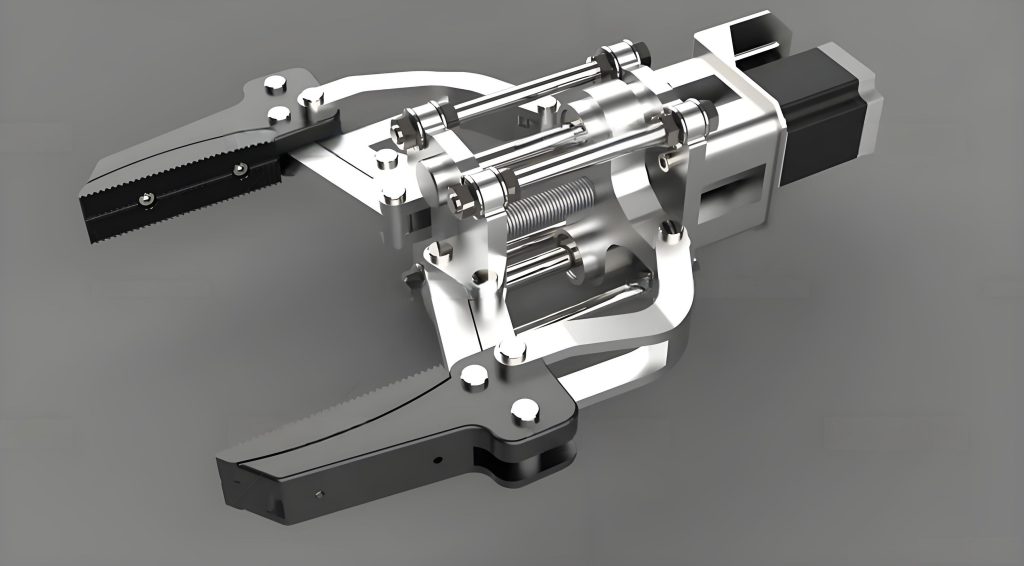
The conceptual layout of our proposed drilling end effector is founded on a modular architecture. This approach enhances maintainability, allows for functional upgrades, and simplifies the design process. The primary modules include the Mounting Flange Unit, the Z1 Main Feed Unit, the Z2 Clamping Feed Unit, the Electro-Spindle Unit, the Nose Clamping Unit, a Robot Vision Unit, and an Energy & Supply Unit. The system employs a compact dual-axis (Z1, Z2) linear feed configuration. The Z1 axis is dedicated to the precise advancement and retraction of the cutting tool, while the Z2 axis manages the controlled approach and application of clamp-up force on the workpiece. This separation of functions ensures high rigidity, accuracy, and dynamic response. Key structural members are fabricated from high-strength aluminum alloys, subjected to optimized heat treatment and machining processes to maximize stiffness and dampen vibrations induced during the cutting process.
The operational sequence of the drilling end effector is as follows: The unit is fixed to an industrial robot via its Mounting Flange. The robot positions the end effector near a target hole location. The integrated vision system then detects positional errors, which are compensated for by the robot’s controller. Subsequently, the Z2 Clamping Feed Unit extends, bringing the Nose Clamping Unit into contact with the workpiece to apply a predefined force, thereby stabilizing the machining zone. The Z1 Main Feed Unit then actuates the Electro-Spindle Unit to perform the drilling cycle. Upon completion, the sequence reverses, and the robot moves to the next hole location.
Modular Unit Design and Technical Specifications
Each module within the end effector is designed with specific performance goals in mind, contributing to the system’s overall capability.
- Mounting Flange Unit: This interface provides a rigid and precise connection to the robot wrist. Its design prioritizes a high stiffness-to-weight ratio to minimize deflection under load.
- Z1 & Z2 Feed Units: Both units utilize a servo motor coupled with a precision gear reducer and a ball screw drive mechanism. The reducer increases torque and allows for a more compact design. The ball screws are supported in a “fixed-supported” configuration to mitigate the effects of thermal expansion. Linear motion is guided by high-precision recirculating linear guides, ensuring low friction, high smoothness, and excellent positioning accuracy.
- Electro-Spindle Unit: A high-frequency motorized spindle is selected for its superior speed stability, rigidity, and power density. It is equipped with an HSK-type tool interface, which provides high clamping stiffness and balance suitable for high-speed operation.
- Nose Clamping Unit: This unit features an integrated chamber design. A cooling air stream is directed through upper channels, while a vacuum system connected to the lower chamber efficiently evacuates chips, protecting the work environment and ensuring process cleanliness.
Based on an analysis of aerospace aluminum alloy drilling requirements, the key technical parameters for the designed end effector are summarized below.
| Parameter | Specification |
|---|---|
| Total Weight | < 120 kg |
| Z1 Axis Stroke (Tool Feed) | ≥ 100 mm |
| Z2 Axis Stroke (Clamping) | ≥ 20 mm |
| Spindle Power | 5 kW |
| Maximum Spindle Speed | 10,000 rpm |
| Maximum Clamping Force | 0 – 1,500 N |
Finite Element Static Analysis of the End Effector
Static structural analysis is crucial for verifying that the end effector can withstand operational loads without excessive deformation, which would compromise drilling accuracy. We employ the Finite Element Method (FEM) for this assessment. The analysis involves three core steps: creating the simplified FE model, applying boundary conditions and loads, and solving for deformations and stresses.
The complex CAD assembly is simplified by suppressing small cosmetic features, fasteners, and internal components that do not significantly contribute to overall stiffness. The model is then discretized using a tetrahedral mesh with a global element size of 10 mm, resulting in a model with approximately 517,690 nodes and 323,820 elements. The mounting flange faces are constrained with a fixed support, simulating its rigid connection to the robot. A conservative clamping force of 2,000 N is applied to the nose clamp interface, representing the worst-case loading scenario.
The overall static deformation result is shown below. The maximum deformation is found to be 0.0571 mm. Given the scale of the end effector and the magnitude of the applied force, this level of deflection is considered acceptable and confirms the global structural integrity of the design.
We further analyze critical components. The Mounting Flange, a key load-transfer element, shows a maximum deformation of only 0.0069 mm, indicating high localized stiffness. The Main Feed Support Structure, which forms the backbone for mounting the Z1 axis and spindle, experiences a maximum deformation of 0.042 mm. This value, while being the largest among the individual components analyzed, remains within acceptable limits for maintaining the relative alignment between the tool and workpiece during the drilling process. The static analysis validates that the end effector design possesses sufficient static stiffness.
Dynamic Modal Analysis of the End Effector
While static stiffness is essential, the dynamic behavior of the drilling end effector is equally critical. During operation, time-varying cutting forces act as dynamic excitations. If the excitation frequency coincides with a natural frequency of the structure, resonance occurs, leading to severe vibrations, poor hole quality, tool wear, and potential damage. Modal analysis is used to determine the inherent vibration characteristics (natural frequencies and mode shapes) of the structure, independent of external loads.
The same FE model used for static analysis is employed, but without any applied external forces. Only the fixed boundary conditions are retained. The analysis solves the eigenvalue problem derived from the undamped equations of motion:
$$ [K]\{\phi_i\} = \omega_i^2 [M]\{\phi_i\} $$
where $[K]$ is the stiffness matrix, $[M]$ is the mass matrix, $\omega_i$ is the i-th natural frequency (rad/s), and $\{\phi_i\}$ is the corresponding mode shape vector. The first six natural frequencies of the overall end effector assembly are extracted.
| Mode Number | Natural Frequency (Hz) | Corresponding Spindle Speed (rpm)* |
|---|---|---|
| 1 | 14.22 | 853.2 |
| 2 | 18.05 | 1,083.0 |
| 3 | 22.78 | 1,366.8 |
| 4 | 25.41 | 1,524.6 |
| 5 | 28.94 | 1,736.4 |
| 6 | 30.32 | 1,819.2 |
*Calculated using $n = 60 \times f$, where $f$ is the natural frequency.
The results indicate that the fundamental natural frequency of the assembled end effector is approximately 14.2 Hz. The highest calculated resonant speed from these modes is about 1,819 rpm. Since the operational spindle speed for drilling aluminum alloys is typically above 2,000 rpm and can reach up to the maximum of 10,000 rpm, the end effector will operate above its first few critical speeds. With proper system damping and control, this design should avoid problematic resonance during high-speed drilling operations.
A more focused analysis on the Main Feed Support Structure reveals its higher local natural frequencies, as shown below. These frequencies are significantly higher than those of the overall assembly because the support structure is a more rigid component when considered in isolation (with appropriate boundary conditions).
| Mode Number | Natural Frequency (Hz) | Corresponding Spindle Speed (rpm) | Primary Mode Shape Description |
|---|---|---|---|
| 1 | 185.42 | 11,125.2 | First bending about the weak axis |
| 2 | 197.35 | 11,841.0 | First bending about the strong axis |
| 3 | 314.74 | 18,884.4 | Torsional mode |
| 4 | 345.15 | 20,709.0 | Second bending combination |
| 5 | 499.43 | 29,965.8 | Complex local panel vibration |
| 6 | 580.54 | 34,832.4 | Higher-order bending |
All resonant speeds for this critical component are well above the maximum operational speed of 10,000 rpm, confirming its robust dynamic design.
Discussion: The Mass-Stiffness-Cost Trade-off in End Effector Design
The dynamic analysis reveals a fundamental engineering trade-off in designing a robotic drilling end effector. The natural frequency $f_n$ of a simplified single-degree-of-freedom system is given by:
$$ f_n = \frac{1}{2\pi} \sqrt{\frac{k}{m}} $$
where $k$ is the stiffness and $m$ is the mass. For a complex structure like an end effector, the relationship is analogous: higher stiffness and lower mass lead to higher natural frequencies.
- Heavier, More Rigid Design: Increasing mass and stiffness generally raises the natural frequencies, pushing resonant speeds further away from the operational range. This is desirable for stability. However, a heavier end effector reduces the robot’s effective payload capacity. To carry a heavy end effector while maintaining precision and speed, a larger, more rigid, and consequently more expensive industrial robot is required. The relationship between required robot payload $P_{robot}$ and end effector mass $m_{ee}$ can be approximated by considering dynamic forces:
$$ P_{robot} \gg m_{ee} \cdot g + F_{dynamic} $$
where $F_{dynamic}$ includes inertia forces during robot acceleration. - Lighter, Less Rigid Design: Reducing mass lowers the robot payload requirement, allowing the use of a smaller, less expensive robot. However, this often comes at the cost of reduced stiffness ($k$), which can cause the natural frequencies to drop. If the fundamental frequency falls too low, the operational spindle speed may coincide with or be close to a resonant peak, exciting severe vibrations. This degrades hole quality (affecting parameters like bore diameter $D_b$ and surface roughness $R_a$), increases tool wear, and can cause premature failure. The resulting cost savings on the robot may be negated by poor process outcomes and maintenance.
Therefore, the optimal design of a drilling end effector involves a careful balance. The structure must be light enough to be carried by a cost-effective robot but stiff enough to maintain high natural frequencies and adequate static rigidity for precision. Our design approach, utilizing high-strength aluminum alloys in an optimized modular layout, aims to maximize the specific stiffness (stiffness-to-weight ratio) to navigate this trade-off effectively. The presented static and dynamic analyses confirm that the proposed end effector achieves sufficient performance within the target weight limit, making it suitable for integration with a medium-payload industrial robot.
Advanced Considerations and Future Design Optimization
The initial analysis provides a foundation. For advanced end effector development, further steps include:
- Harmonic Response Analysis: Simulating the steady-state vibration response of the end effector under a harmonically varying cutting force $F_c(t) = F_0 \cdot \sin(2\pi f_c t)$, where $f_c$ is related to spindle speed and number of cutting edges ($f_c = N \cdot RPM / 60$). This predicts forced vibration amplitudes at the tool tip.
- Transient Dynamic Analysis: Modeling the transient forces during drill entry and exit, which are often the most critical phases for vibration and burr formation.
- Structural Optimization: Using topology optimization techniques to algorithmically remove material from low-stress regions of components like the Main Feed Support, further enhancing the specific stiffness. The optimization goal can be formulated as:
$$ \text{Minimize: } m = \int_V \rho dV $$
$$ \text{Subject to: } \sigma_{max} \leq \sigma_{allowable},\quad f_{n,1} \geq f_{target},\quad u_{max} \leq u_{allowable} $$
where $\rho$ is density, $\sigma$ is stress, $f_{n,1}$ is the first natural frequency, and $u$ is displacement. - Integrated System Dynamics: The end effector is part of a coupled system including the robot, the workpiece, and the fixture. A full system model is necessary to understand chatter stability limits. The stability lobe diagram, which plots limiting depth of cut against spindle speed, can be generated using models like:
$$ b_{lim} = -\frac{1}{2K_s \cdot \text{Re}[G(\omega)]} $$
where $b_{lim}$ is the critical depth of cut, $K_s$ is the specific cutting force coefficient, and $G(\omega)$ is the frequency response function at the tool tip.
In conclusion, the development of a high-performance robotic drilling end effector requires a holistic approach integrating modular mechanical design, meticulous material selection, and rigorous multi-physics analysis. The presented end effector design, with its validated static stiffness and favorable dynamic characteristics, provides a viable solution for automated aircraft assembly. Crucially, the design process must consciously address the intrinsic trade-off between the end effector‘s mass, its dynamic properties, the cost of the supporting robot, and the ultimate quality of the machining process. The methodologies and analyses detailed here offer a framework for the design and evaluation of similar robotic end-effectors for precision manufacturing applications.