
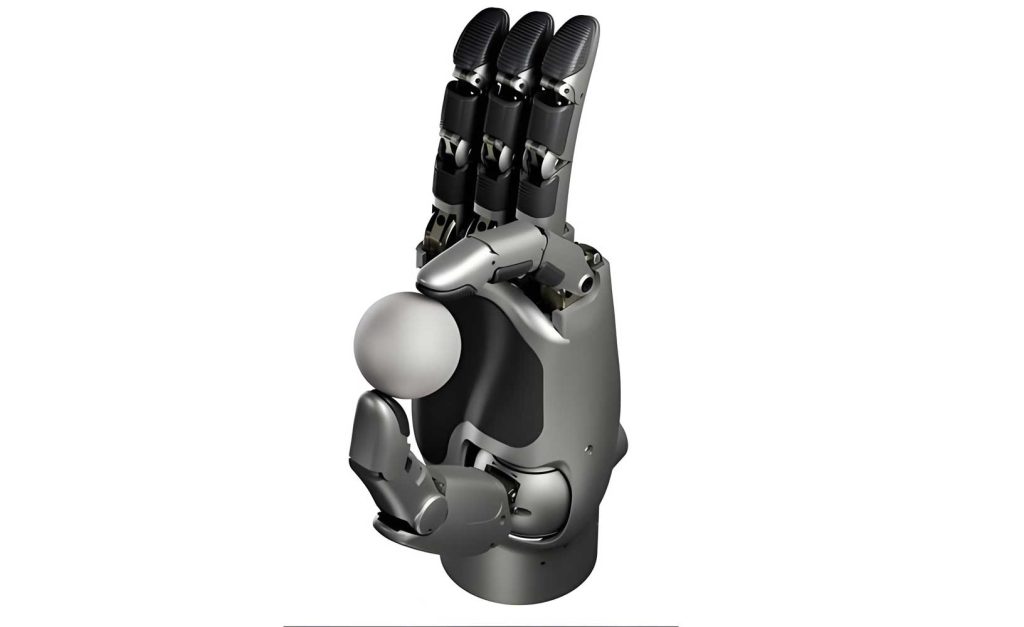
The development of advanced robotic end-effectors is crucial for expanding the operational capabilities of robots in unstructured environments. Among these, the dexterous robotic hand stands out due to its superior adaptability and versatility, mimicking the complex manipulation skills of the human hand. A core component of any dexterous robotic hand is its fingers, which must replicate the kinematics, force output, and sensing abilities of their biological counterparts. This work presents the detailed structural design, kinematic modeling, and analysis of a single anthropomorphic finger module intended for integration into a multi-fingered dexterous robotic hand. The finger is uniquely actuated by Pneumatic Artificial Muscles (PAMs), known for their high power-to-weight ratio and compliant behavior, which are desirable traits for safe and adaptive interaction.
The design philosophy is rooted in biomimicry, aiming to capture the essential functional anatomy of a human finger while optimizing for manufacturability and integration with mechatronic systems. The human finger’s skeletal structure, comprising proximal, middle, and distal phalanges connected by hinge-like joints, serves as the primary blueprint. The goal is to create a finger module that can be replicated and assembled modularly to construct a complete dexterous robotic hand. The primary design objectives were: 1) to achieve a compact and lightweight structure, 2) to implement independent tendon-driven flexion for three joints, 3) to integrate joint angle and fingertip force sensing for closed-loop control, and 4) to enable a sufficient range of motion and force output for dexterous tasks.
The finger’s mechanical architecture was conceived and assembled within a 3D CAD environment to perform virtual prototyping, interference checks, and kinematic validation. The structural skeleton consists of a base frame, a proximal phalanx, a medial phalanx, and a distal phalanx (fingertip). To minimize weight, the proximal and medial phalanges are fabricated from thin-gauge aluminum alloy sheet metal, forming hollow enclosures for routing tendons and wires. The distal phalanx, which must withstand contact forces, is machined from solid aluminum and features a recess for embedding a micro force sensor. The three revolute joints (metacarpophalangeal – MCP, proximal interphalangeal – PIP, and distal interphalangeal – DIP) are realized using precision bearings. A key aspect of the dexterous robotic hand finger design is the actuation transmission. Each flexion motion is driven by a separate PAM, located remotely to reduce the finger’s inertial mass. The PAM pulls on a stainless steel tendon cable, which is routed through low-friction guides and wrapped around a pulley fixed to the rotating part of each joint. The pulley incorporates a groove to secure the tendon. To prevent coupling and interference between the tendon paths for the three joints, the pulleys were designed with specific diameters: Φ22mm for the MCP and PIP joints, and Φ20mm for the DIP joint. Extension is passively provided by elastic elements (not shown in the initial design but considered for system completeness).
Sensing is integral for a functional dexterous robotic hand. For proprioception, a rotary potentiometer is coaxially integrated with each joint pulley to measure the absolute joint angle (θ₁, θ₂, θ₃). For exteroception, a miniature force-sensitive resistor (FSR) is mounted on the pad of the distal phalanx to measure contact forces normal to the fingertip surface. This sensor suite provides the necessary feedback for implementing sophisticated grip force control and object manipulation algorithms in a complete dexterous robotic hand.
The dimensional proportions were optimized based on average human finger ratios. The final designed link lengths are: L₁ (Base to MCP) = 43mm for the proximal phalanx, L₂ = 36mm for the medial phalanx, and L₃ = 20mm for the distal phalanx. The total finger length is approximately 99mm from the base to the fingertip, making it suitable for a medium-scale dexterous robotic hand.
| Parameter | Symbol | Value | Description |
|---|---|---|---|
| Proximal Phalanx Length | L₁ | 43 mm | Length from MCP joint axis to PIP joint axis. |
| Medial Phalanx Length | L₂ | 36 mm | Length from PIP joint axis to DIP joint axis. |
| Distal Phalanx Length | L₃ | 20 mm | Length from DIP joint axis to fingertip. |
| MCP Joint Range | θ₁ | -60° to +90° | Flexion/Extension and limited abduction/adduction. |
| PIP Joint Range | θ₂ | 0° to 110° | Flexion/Extension. |
| DIP Joint Range | θ₃ | 0° to 90° | Flexion/Extension. |
| Actuation Type | – | Tendon-driven (PAM) | Pneumatic Artificial Muscle via tendon and pulley. |
| Joint Sensing | – | Potentiometer | Absolute angular position measurement. |
| Fingertip Sensing | – | Force Sensitive Resistor | Normal contact force measurement. |
To validate the design and establish a foundation for control, a comprehensive kinematic analysis was performed. The kinematic model describes the relationship between the joint angles and the position & orientation of the fingertip. The standard Denavit-Hartenberg (D-H) convention was used to assign coordinate frames to each link of the finger. Starting from a fixed base frame {0} attached to the MCP joint, frames {1}, {2}, and {3} are attached to the proximal, medial, and distal phalanges, respectively. Frame {4} is placed at the fingertip center. The D-H parameters for this 4-degree-of-freedom serial chain (3 active rotational joints + 1 static fingertip frame) are summarized below.
| Link i | αi-1 (twist) | ai-1 (length) | di (offset) | θi (angle) |
|---|---|---|---|---|
| 1 | 0 | 0 | 0 | θ₁* |
| 2 | 0 | L₁ | 0 | θ₂* |
| 3 | 0 | L₂ | 0 | θ₃* |
| 4 (Fingertip) | 0 | L₃ | 0 | 0 |
* Denotes the active joint variable.
The transformation matrix relating frame {i} to frame {i-1} is given by the standard D-H formula:
$$ ^{i-1}T_{i} = \begin{bmatrix}
\cos\theta_i & -\sin\theta_i & 0 & a_{i-1}\\
\sin\theta_i\cos\alpha_{i-1} & \cos\theta_i\cos\alpha_{i-1} & -\sin\alpha_{i-1} & -\sin\alpha_{i-1}d_i\\
\sin\theta_i\sin\alpha_{i-1} & \cos\theta_i\sin\alpha_{i-1} & \cos\alpha_{i-1} & \cos\alpha_{i-1}d_i\\
0 & 0 & 0 & 1
\end{bmatrix} $$
For our parameters (αi-1 = 0, di = 0), this simplifies to:
$$ ^{i-1}T_{i} = \begin{bmatrix}
\cos\theta_i & -\sin\theta_i & 0 & a_{i-1}\\
\sin\theta_i & \cos\theta_i & 0 & 0\\
0 & 0 & 1 & 0\\
0 & 0 & 0 & 1
\end{bmatrix} $$
The complete forward kinematics, giving the position and orientation of the fingertip (frame {4}) relative to the base (frame {0}), is obtained by consecutive multiplication:
$$ ^{0}T_{4} = ^{0}T_{1} \cdot ^{1}T_{2} \cdot ^{2}T_{3} \cdot ^{3}T_{4} $$
Substituting the simplified transform and D-H parameters yields:
$$ ^{0}T_{4} = \begin{bmatrix}
c_{123} & -s_{123} & 0 & L_1 c_1 + L_2 c_{12} + L_3 c_{123}\\
s_{123} & c_{123} & 0 & L_1 s_1 + L_2 s_{12} + L_3 s_{123}\\
0 & 0 & 1 & 0\\
0 & 0 & 0 & 1
\end{bmatrix} $$
where \( c_1 = \cos\theta_1 \), \( s_1 = \sin\theta_1 \), \( c_{12} = \cos(\theta_1+\theta_2) \), \( s_{12} = \sin(\theta_1+\theta_2) \), \( c_{123} = \cos(\theta_1+\theta_2+\theta_3) \), and \( s_{123} = \sin(\theta_1+\theta_2+\theta_3) \).
The primary point of interest is the fingertip position (x, y) in the base plane (assuming motion is confined to a plane for simplicity in this analysis, though the MCP joint can enable out-of-plane motion). From \( ^{0}T_{4} \), we extract:
$$ x = L_1 \cos\theta_1 + L_2 \cos(\theta_1+\theta_2) + L_3 \cos(\theta_1+\theta_2+\theta_3) $$
$$ y = L_1 \sin\theta_1 + L_2 \sin(\theta_1+\theta_2) + L_3 \sin(\theta_1+\theta_2+\theta_3) $$
To verify the model and visualize the finger’s workspace, a simulation was scripted in MATLAB. The joint angles were varied within their physiological ranges: θ₁ ∈ [-60°, 90°], θ₂ ∈ [0°, 110°], θ₃ ∈ [0°, 90°]. Plotting the resulting (x, y) coordinates for thousands of random angle combinations generates the reachable workspace of the fingertip. The simulation confirmed a large, continuous workspace approximating the dexterous region of a natural finger, which is essential for a functional dexterous robotic hand. The workspace spans roughly 300mm x 300mm, accommodating a wide variety of grasping and manipulation geometries.
For control and trajectory planning, the inverse kinematics (IK) solution is necessary: finding the joint angles (θ₁, θ₂, θ₃) required to place the fingertip at a desired position (x, y) with a specific orientation φ = θ₁+θ₂+θ₃. For this planar 3R manipulator, an analytical solution exists. Given x, y, and φ, we first find the wrist point (the DIP joint location, p_w = (x_w, y_w)):
$$ x_w = x – L_3 \cos\phi $$
$$ y_w = y – L_3 \sin\phi $$
The problem then reduces to the IK of a 2R planar arm (links L₁ and L₂) reaching point (x_w, y_w). The solution for θ₂ is:
$$ c_2 = \frac{x_w^2 + y_w^2 – L_1^2 – L_2^2}{2 L_1 L_2} $$
$$ s_2 = \pm \sqrt{1 – c_2^2} \quad \text{(choose sign based on elbow configuration)} $$
$$ \theta_2 = \operatorname{atan2}(s_2, c_2) $$
Then, θ₁ is found using the two-argument arctangent function:
$$ \theta_1 = \operatorname{atan2}(y_w, x_w) – \operatorname{atan2}(L_2 s_2, L_1 + L_2 c_2) $$
Finally, θ₃ is computed from the desired orientation:
$$ \theta_3 = \phi – (\theta_1 + \theta_2) $$
This IK solution allows any control system for the dexterous robotic hand to plan finger trajectories in Cartesian space. A specific test case was evaluated: setting φ = 120°, x = 21.5 mm, y = 73.24 mm with L₁=43mm, L₂=36mm. The IK solver yielded θ₁ ≈ 60.00°, θ₂ ≈ 30.00°, θ₃ ≈ 30.00°, which perfectly matched the forward kinematics calculation for those joint angles, validating both the model and the implementation.
| Parameter | Input / Calculated Value | Notes |
|---|---|---|
| Desired Fingertip (x, y) | (21.5 mm, 73.24 mm) | Target position. |
| Desired Orientation φ | 120° | θ₁+θ₂+θ₃. |
| Calculated θ₁ | 60.00° | Via inverse kinematics. |
| Calculated θ₂ | 30.00° | Via inverse kinematics. |
| Calculated θ₃ | 30.00° | Via inverse kinematics. |
| Forward Kinematics Check (x, y) | (21.5 mm, 73.24 mm) | Matches desired target, confirming consistency. |
Beyond kinematics, a static force analysis is critical to assess the finger’s manipulation capability, a key metric for a dexterous robotic hand. The tendon-driven mechanism converts the contraction force of the PAM (F_PAM) into a joint torque. For a pulley of radius r, the relationship is τ = F_PAM * r. This joint torque is then related to the force that can be exerted at the fingertip through the Jacobian transpose matrix. The principle of virtual work states that τ = Jᵀ(θ) * F, where τ is the vector of joint torques [τ₁, τ₂, τ₃]ᵀ, J is the geometric Jacobian matrix, and F is the force vector applied at the fingertip. For our planar case, considering only forces F_x and F_y, the Jacobian is derived from the position kinematics:
$$ J = \begin{bmatrix}
\frac{\partial x}{\partial \theta_1} & \frac{\partial x}{\partial \theta_2} & \frac{\partial x}{\partial \theta_3} \\
\frac{\partial y}{\partial \theta_1} & \frac{\partial y}{\partial \theta_2} & \frac{\partial y}{\partial \theta_3}
\end{bmatrix} $$
This yields:
$$ J = \begin{bmatrix}
-L_1 s_1 – L_2 s_{12} – L_3 s_{123} & -L_2 s_{12} – L_3 s_{123} & -L_3 s_{123} \\
L_1 c_1 + L_2 c_{12} + L_3 c_{123} & L_2 c_{12} + L_3 c_{123} & L_3 c_{123}
\end{bmatrix} $$
Therefore, given the maximum torque each joint’s PAM can produce (τ_max,i = r_i * F_PAM_max,i), we can estimate the maximum fingertip force in different directions for a specific posture by solving F = (Jᵀ)⁺ τ, where (·)⁺ denotes the Moore-Penrose pseudoinverse. This analysis confirms that the designed dexterous robotic hand finger, with appropriately sized PAMs, can generate sufficient pinch and enveloping grasp forces for a wide range of common objects.
The integration of sensors transforms the mechanical structure into an intelligent module for a dexterous robotic hand. The joint potentiometers provide continuous feedback for position control, enabling precise trajectory following. The fingertip FSR is crucial for implementing force-controlled interactions. A basic but effective control law for each joint could be a PID controller on position, with the force sensor signal used to trigger a transition to a force-control mode or to modulate grip strength to prevent slip or damage. The fusion of these sensory data streams is what will allow a future multi-fingered dexterous robotic hand to perform complex, reactive manipulation tasks.
In conclusion, this work has presented a holistic approach to designing a single module for a dexterous robotic hand. The process encompassed biomimetic structural design using advanced CAD tools, detailed kinematic analysis including forward and inverse model derivation and verification, and consideration of actuation mechanics and sensory integration. The finger design successfully incorporates PAM actuation for compliance, maintains anthropomorphic proportions and ranges of motion, and integrates necessary sensors for closed-loop operation. The kinematic models provide the essential mathematical foundation for controlling the finger within a larger dexterous robotic hand system. Future work will focus on the detailed dynamic modeling including PAM hysteresis and tendon elasticity, the fabrication and experimental characterization of a physical prototype, the development of robust multi-modal control algorithms, and finally, the integration of multiple such fingers into a fully functional, adaptive dexterous robotic hand capable of performing sophisticated manipulation tasks in real-world environments.