
The harvesting end effector is a critical component of agricultural robots. This paper presents the design and experimental validation of a cutting-type end effector specifically for harvesting fresh, single-growing “Chaotian” chili peppers. The design addresses the distinct upward-growing orientation of the pepper fruit. The process began with a comprehensive analysis of the biological characteristics of the target pepper variety, followed by the mechanical design of the end effector. A detailed kinematic and kineto-static model of the shearing mechanism was established. Using the results from the kineto-static analysis, a genetic algorithm was employed to optimize the link dimensions of the shearing mechanism with the objective of minimizing the required external driving force. The optimization yielded link lengths for the crank, connecting rod, and connecting rod extension as 33 mm, 60 mm, and 54 mm, respectively. To reliably sever the pepper stem, the optimized mechanism requires an external driving torque of 0.94 N·m, leading to the selection of a suitable servo motor as the power source. Finally, harvesting experiments were conducted to validate the feasibility and performance of the proposed pepper harvesting end effector.
1. Biological Characteristics of Pepper
The design of an effective harvesting end effector must be grounded in the physical properties of the target crop. We selected the single-fruit variety “High Spice 878” as the research subject. Key physical parameters, including fruit length (L), maximum fruit diameter (D), stem length (l), and stem diameter (d), were measured for 200 pepper samples to establish design constraints for the end effector.
The statistical results of these measurements are summarized in the table below. The data shows that the mature “High Spice 878” pepper has a fruit length primarily between 55-80 mm, a maximum fruit diameter of 9-13 mm, a stem length of 20-30 mm, and a stem diameter of 2-3 mm.
| Parameter | Primary Range (mm) | Percentage of Samples (%) |
|---|---|---|
| Fruit Length (L) | 55 – 80 | 85.5 |
| Fruit Diameter (D) | 9 – 13 | 91.5 |
| Stem Length (l) | 20 – 30 | 97.5 |
| Stem Diameter (d) | 2 – 3 | 89.5 |
The cutting force required to sever the stem is a fundamental input for designing the shearing mechanism of the end effector. Experiments were conducted using a universal material testing machine to measure the maximum cutting force ($F_r$) under different cutting methods (transverse, oblique, slicing) and at different entry angles ($\beta$: 70°, 80°, 90°). The entry angle is defined as the angle between the stem’s central axis and the direction of blade motion. The force-displacement curve typically showed two peaks corresponding to the cutting of the outer epidermal layers and a valley for the internal tissue.
The maximum cutting forces recorded from multiple test groups are presented in the following table. The results indicate that the required cutting force increases with larger stem diameter and larger entry angle. For a stem diameter of 2.9-3.2 mm under transverse cutting at 90°, the maximum force $F_r$ was 13.1 N. This value was used as the design cutting force for the subsequent optimization of the end effector’s shearing mechanism.
| Diameter Range (mm) | Transverse Cut | Oblique Cut ($\beta$) | Slicing Cut ($\beta$) | |||
|---|---|---|---|---|---|---|
| d (mm) | Fr (N) | 70° | 80° | 70° | 80° | |
| (2.0-2.3] | 2.1 | 6.9 | 6.8 | 6.8 | 7.2 | 6.7 |
| (2.3-2.6] | 2.5 | 9.7 | 8.3 | 7.4 | 8.7 | 9.3 |
| (2.6-2.9] | 2.8 | 11.9 | 10.3 | 10.1 | 10.8 | 11.7 |
| (2.9-3.2] | 3.2 | 13.1 | 12.4 | 11.5 | 12.5 | 12.1 |
2. Design of the Harvesting End Effector
Based on the biological characteristics, we designed a shearing-type end effector with tolerance for positioning errors. The overall design consists of three main parts: a posture adjustment joint, a tolerance sleeve (conical cylinder), and a symmetrical shearing mechanism. The conical sleeve provides a funnel-like space larger than the pepper fruit, allowing the robotic arm a certain degree of positioning error during the approach phase.
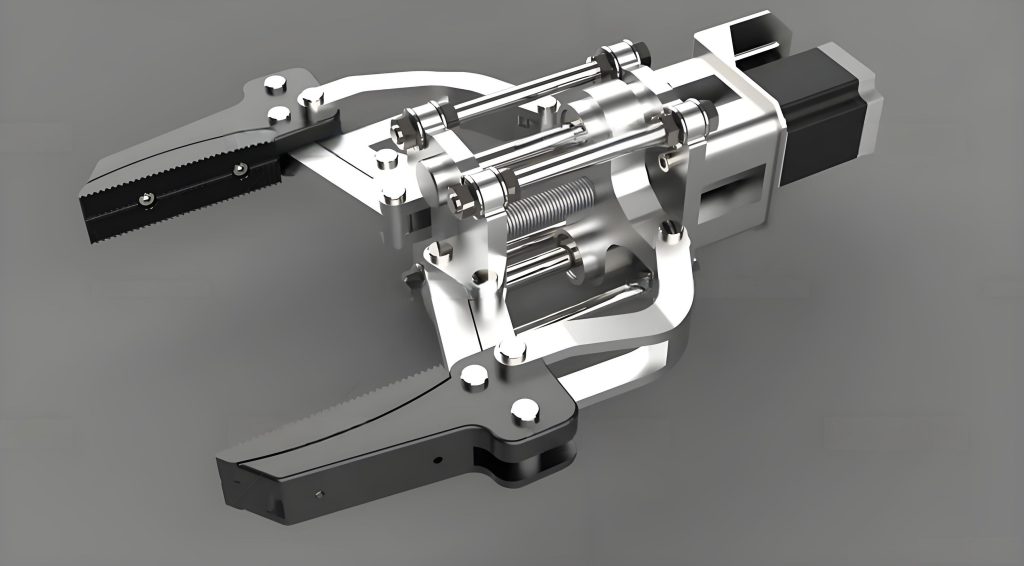
The working principle is as follows: First, the adjustment joints orient the sleeve’s axis parallel to the target pepper. The robotic arm then moves the end effector downward, enclosing the fruit within the sleeve. The servo motor activates the shearing mechanism. The blades close to cut the stem while a flexible flap attached to the mechanism closes the bottom of the sleeve, capturing the harvested fruit. Finally, the robot moves to a collection point, the mechanism opens, and the fruit is released.
The core shearing mechanism is a symmetrical crank-slider linkage. One crank acts as the input, driven by the servo. As it rotates, it drives the connecting rod, which in turn moves the cutting blade attached to its extension. The blade follows a curved path to shear the stem.
2.1 Kinematic Model of the Shearing Mechanism
We established a kinematic model using the analytical method. A coordinate system was defined with origin O at the central axis. The positions of key points A (crank pivot), B (crank-rod joint), C (rod-slider joint), and D (blade tip) are given by:
$$ x_A = e, \quad y_A = 0 $$
$$ x_B = e + l_1 \cos\theta_1, \quad y_B = l_1 \sin\theta_1 $$
$$ x_C = 0, \quad y_C = l_1 \sin\theta_1 + l_2 \sin\theta_2 $$
$$ x_D = 0, \quad y_D = l_1 \sin\theta_1 + (l_2 + l_3) \sin\theta_2 $$
Where $e$ is the crank offset, $l_1$, $l_2$, $l_3$ are the lengths of the crank, connecting rod, and rod extension, respectively. $\theta_1$ and $\theta_2$ are the angles of the crank and connecting rod relative to the x-axis. The geometric constraint between $\theta_1$ and $\theta_2$ is:
$$ l_2 \cos\theta_2 + e + l_1 \cos\theta_1 = 0 $$
By differentiating the position equations, the velocities and accelerations of points C and D can be derived. For example, the acceleration of point D ($a_{Dx}, a_{Dy}$) is crucial for dynamic analysis:
$$ a_{Dx} = -l_3(\alpha_2 \sin\theta_2 + \omega_2^2 \cos\theta_2) $$
$$ \begin{aligned} a_{Dy} = & l_1(\alpha_1 \cos\theta_1 – \omega_1^2 \sin\theta_1) + (l_2 + l_3)(\alpha_2 \cos\theta_2 – \omega_2^2 \sin\theta_2) \end{aligned} $$
Where $\omega_1$, $\omega_2$ and $\alpha_1$, $\alpha_2$ are the angular velocities and accelerations of the crank and connecting rod, respectively.
2.2 Kineto-Static Analysis of the Shearing Mechanism
To size the actuator, a dynamic force analysis was performed. Considering the inertia of the moving links and the cutting force $F_r$, a kineto-static model was developed. Each link was isolated, and equilibrium equations were written for forces in x and y directions and moments about the center of mass. The inertial forces and moments for link $i$ are $F_{ix} = -m_i a_{ix}$, $F_{iy} = -m_i a_{iy}$, and $M_i = -J_i \alpha_i$, where $m_i$ is mass, $J_i$ is moment of inertia, and $a_{ix}, a_{iy}, \alpha_i$ are accelerations.
For the system with 4 simple joints, 1 compound joint, and 1 sliding joint, there are 14 unknown forces/moments ($F_{12x}, F_{12y}, …, F_{16x}, F_{16y}, R_{14}, M_b$). The 14 equilibrium equations can be written in matrix form:
$$ \mathbf{C} \cdot \mathbf{F_R} = \mathbf{D} $$
Where $\mathbf{C}$ is a 14×14 coefficient matrix containing geometric parameters, $\mathbf{F_R}$ is the vector of unknown reactions and the driving torque $M_b$, and $\mathbf{D}$ is the vector containing known inertial terms, gravity, and the cutting force $F_r$. Solving this system yields the required driving torque $M_b$ at any position during the cut.
2.3 Optimization of the Shearing Mechanism Linkage
A genetic algorithm was used to optimize the link lengths ($l_1$, $l_2$, $l_3$) to minimize the required driving torque $M_b$ while satisfying geometric constraints. The objective function was $M_b = f(l_1, l_2, l_3)$. The optimization constraints were:
- Transmission angle $> 45°$ for good force transmission.
- Initial blade opening $> 40$ mm to accommodate the pepper.
- Blade tip X-coordinate $≥ 0$ at the end of the stroke.
- Total vertical travel of blade tip $< 30$ mm.
- Link length bounds: $10 \leq l_1 \leq 40$ mm, $20 \leq l_2 \leq 60$ mm, $40 \leq l_3 \leq 70$ mm.
The crank was set to rotate uniformly from $\theta_1 = 90^\circ$ to $150^\circ$ at $\omega_1 = 40^\circ/s$. A conservative cutting force $F_r = 15$ N was used. The algorithm converged to the following optimal lengths, requiring a maximum driving torque of 0.94 N·m. Consequently, a servo motor with a 10 kg·cm (≈0.98 N·m) torque rating was selected.
| Parameter | Optimized Value (mm) |
|---|---|
| Crank Length ($l_1$) | 33.0 |
| Connecting Rod Length ($l_2$) | 60.0 |
| Rod Extension Length ($l_3$) | 54.0 |
3. Harvesting Experiments and Results
A physical prototype of the end effector was manufactured based on the optimized design. It was integrated with a Delta parallel robot arm to form a harvesting test platform. The pepper plants were fixed in pots beneath the robot. The harvesting cycle involved: positioning the sleeve over a target pepper, descending to enclose it, activating the shearing mechanism to cut the stem and capture the fruit, moving to a collection bin, and releasing the fruit.
Harvesting tests were performed on 150 mature peppers. Success was defined as the complete severing of the stem during the shearing action. The results, categorized by stem diameter and entry angle range, are shown below. The overall success rate was 91.3% (137/150). Failures (13 instances) were attributed to machining/assembly gaps between blades, interference from leaves increasing cutting force, or stems with exceptionally robust fibers.
| Entry Angle Range (°) | Success Rate by Stem Diameter (mm) (%) | ||||
|---|---|---|---|---|---|
| (2.2, 2.4] | (2.4, 2.6] | (2.6, 2.8] | (2.8, 3.0] | (3.0, 3.2] | |
| (70, 80] | 100 | 100 | 100 | 86.7 | 73.3 |
| (80, 90] | 100 | 100 | 100 | 80.0 | 73.3 |
4. Conclusion
This paper presented the design and testing of a novel end effector for selectively harvesting fresh “Chaotian” peppers. The design process was driven by empirical data on pepper biophysical properties, particularly a maximum stem cutting force of 13.1 N. The end effector features a tolerance sleeve and an optimized symmetrical shearing mechanism. Through detailed kinematic and kineto-static modeling, followed by genetic algorithm optimization, the link dimensions of the shearing mechanism were determined to minimize the required actuator torque to 0.94 N·m. Experimental validation on a robotic platform demonstrated a high harvesting success rate of 91.3%, confirming the effectiveness and feasibility of the proposed end effector design for automated pepper harvesting.