
In recent years, the field of robotics has seen tremendous growth, with bionic robots increasingly entering our daily lives to assist with complex and tedious tasks. Among these, quadruped bionic robots, which mimic the morphology and gait of four-legged animals, have garnered significant attention due to their potential in various applications, from search and rescue to competitive events. As an enthusiast and designer in this domain, I embarked on a project to develop a quadruped bionic robot capable of efficient line-following, a common challenge in robotics competitions. This article details my journey through the structural design, motion programming, and closed-loop system implementation, with a focus on optimization for speed and accuracy. Throughout this process, the term “bionic robot” has been a guiding principle, emphasizing the imitation of biological systems to achieve robust and adaptive locomotion.
The core objective was to create a quadruped bionic robot that could swiftly and accurately follow arbitrary trajectories, such as the red line in a line-tracking competition. Unlike wheeled robots, a true bionic robot requires distinct leg features for movement, rejecting substitutes like wheels. In my design, I drew inspiration from canine locomotion, aiming to replicate the agility and stability observed in nature. This involved meticulous planning of the leg structure, actuator selection, and control systems. The following sections delve into each aspect, supported by tables and formulas to summarize key concepts. For instance, the kinematic analysis of the leg mechanism can be expressed using geometric relationships. If we denote the thigh length as \(L_1\), the shank length as \(L_2\), the hip joint angle as \(\theta_1\), and the knee joint angle as \(\theta_2\), the foot position \((x, y)\) relative to the body is given by:
$$ x = L_1 \sin(\theta_1) + L_2 \sin(\theta_1 + \theta_2) $$
$$ y = L_1 \cos(\theta_1) + L_2 \cos(\theta_1 + \theta_2) $$
These equations are fundamental for understanding the stride length and motion range of the bionic robot, directly impacting its speed. To maximize stride, I optimized the angles, as discussed later.
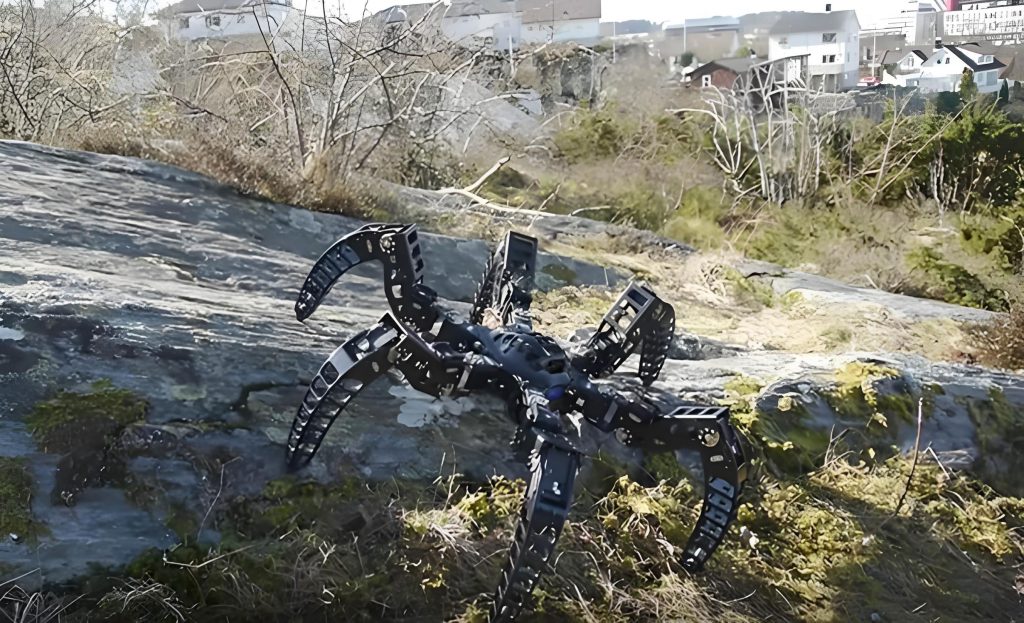
Structural design is the foundation of any effective bionic robot. For my quadruped bionic robot, I focused on replicating the leg configuration of a dog, with three servos per leg, totaling twelve servos. This design allows for enhanced maneuverability and speed, crucial for line-tracking tasks. The servos are categorized based on their functions: one servo at the hip (referred to as the “turning servo”) connects the leg to the body and enables turning motions; another servo at the thigh controls forward and backward swings; and a third at the shank manages knee flexion and extension. This arrangement ensures that the bionic robot can achieve complex movements like left and right turns while maintaining balance. Table 1 summarizes the servo configuration for each leg of the bionic robot.
| Servo Position | Primary Function | Typical Range of Motion | Impact on Gait |
|---|---|---|---|
| Hip (Turning Servo) | Leg attachment and turning | ±90° | Enables left/right turns; coordinates with other legs for smooth rotation |
| Thigh Servo | Forward/backward swing relative to body | ±45° | Determines stride length; larger angles increase speed |
| Shank Servo | Knee flexion/extension relative to thigh | ±60° | Adds to stride length; allows adaptive foot placement |
To optimize speed, I analyzed the relationship between joint angles and stride length. The total swing angle \(\phi\) for leg movement is the sum of the thigh angle \(\alpha\) and the shank angle \(\beta\) relative to the thigh:
$$ \phi = \alpha + \beta $$
Given leg lengths \(L_1\) and \(L_2\), the stride length \(S\) can be approximated for small angles as:
$$ S \approx L_1 \sin(\alpha) + L_2 \sin(\alpha + \beta) $$
Maximizing \(S\) involves tuning \(\alpha\) and \(\beta\) within mechanical limits. After observing canine gait, I set the neutral positions: the thigh is angled backward about 35° from vertical, and the shank forms about 125° with the thigh. This configuration allows the bionic robot to achieve a larger stride during walking, enhancing speed. The design also considers weight distribution and stability, critical for a bionic robot navigating uneven terrains. The use of servos, rather than motors or hybrids, was chosen for their precision and ease of control, common in bionic robot applications. However, servo torque and response time must be balanced; Table 2 compares potential servo specifications for a bionic robot.
| Servo Type | Torque (kg-cm) | Speed (s/60°) | Power Consumption | Suitability for Bionic Robot |
|---|---|---|---|---|
| Standard Analog | 9-12 | 0.15-0.20 | Moderate | Good for basic motions; cost-effective |
| Digital High-Torque | 20-30 | 0.10-0.15 | High | Ideal for dynamic movements; enhances speed |
| Coreless Motor Servo | 15-25 | 0.08-0.12 | Moderate to High | Excellent response; improves agility in bionic robot |
With the structure in place, the next step was motion group design. A bionic robot requires pre-programmed actions for walking, turning, and other maneuvers. I used Lobot Servo Control-7-24 software to create action groups for straight walking, left turns, and right turns, which were then downloaded to a servo control board. Each action group defines precise servo angles and timings to produce smooth, coordinated movements. For example, the straight walk action involves a cyclic sequence where legs move in diagonally opposed pairs, mimicking a trot gait common in quadruped bionic robots. The timing for each servo can be represented as a function of time \(t\). If \(\theta_i(t)\) denotes the angle of servo \(i\) at time \(t\), the motion for one leg during a stride period \(T\) can be modeled as:
$$ \theta_{\text{thigh}}(t) = A \sin\left(\frac{2\pi t}{T}\right) + \theta_{\text{neutral}} $$
$$ \theta_{\text{shank}}(t) = B \sin\left(\frac{2\pi t}{T} + \delta\right) + \theta_{\text{shank-neutral}} $$
Here, \(A\) and \(B\) are amplitudes, and \(\delta\) is a phase shift to ensure proper foot clearance. For turning, the hip servos are adjusted asymmetrically. For instance, a right turn requires the left hip servos to rotate forward and the right ones backward, creating a yaw moment. The turning radius \(R\) can be estimated from the differential hip angles \(\Delta\theta\) and leg length \(L\):
$$ R \approx \frac{L}{\tan(\Delta\theta)} $$
This formula helps in tuning turn sharpness for the bionic robot. The action groups are stored as arrays in the control board, allowing quick recall during operation. This modular approach simplifies programming and enables rapid adjustments, essential for optimizing the bionic robot’s performance in different scenarios.
To achieve autonomous line-following, I implemented a closed-loop control system. This system integrates an OpenMV4 smart camera, an Arduino board, and the servo control board, forming a feedback loop where the bionic robot perceives its environment and adjusts actions accordingly. The OpenMV camera captures the track—typically a red line on a white background—and processes the image using linear regression to fit a vertical line in the center of the view. By comparing this reference line with the detected track, the camera calculates the deviation in terms of angle \(\theta_{\text{dev}}\) and distance \(d_{\text{dev}}\). If either exceeds a threshold, a corrective signal is sent. The control logic can be summarized as:
$$ \text{If } |\theta_{\text{dev}}| > \theta_{\text{thresh}} \text{ or } |d_{\text{dev}}| > d_{\text{thresh}}, \text{ then output turn signal} $$
$$ \text{Else, output straight signal} $$
Table 3 outlines the signal mapping for the bionic robot’s closed-loop system.
| Camera Output | Condition | Arduino Signal | Action Group Called |
|---|---|---|---|
| Left Turn | \(\theta_{\text{dev}} > 0\) or \(d_{\text{dev}} < 0\) | Digital HIGH on pin 2 | Left Turn Sequence |
| Right Turn | \(\theta_{\text{dev}} < 0\) or \(d_{\text{dev}} > 0\) | Digital HIGH on pin 3 | Right Turn Sequence |
| Straight | Within thresholds | Digital LOW on all pins | Straight Walk Sequence |
Communication between components posed a challenge. Initially, signal mismatches between the OpenMV and Arduino caused erratic behavior in the bionic robot. To resolve this, I adopted a digital signal transmission method: the OpenMV connects to Arduino digital pins, sending HIGH or LOW voltages based on the detected condition. This binary approach ensures reliable signal reception, avoiding frequency inconsistencies. The Arduino program, written in C++, continuously monitors these pins and calls the corresponding action groups from the servo control board via serial communication. For instance, when pin 2 is HIGH, the Arduino sends a command byte to the servo board to execute the left turn action group. The response time of this loop is critical for the bionic robot’s agility; thus, I optimized the code to minimize delays. The overall system latency \(\tau\) can be approximated as:
$$ \tau = \tau_{\text{camera}} + \tau_{\text{processing}} + \tau_{\text{communication}} + \tau_{\text{servo}} $$
Where \(\tau_{\text{camera}}\) is the image capture time, \(\tau_{\text{processing}}\) is the Arduino decision time, \(\tau_{\text{communication}}\) is the serial transmission delay, and \(\tau_{\text{servo}}\) is the servo response. By reducing each component—e.g., using lower resolution on the OpenMV or higher baud rates—I improved the bionic robot’s responsiveness.
During testing, I encountered issues like overheating of the Arduino chip and occasional action group confusion. Investigation revealed that voltage spikes were the culprit. The servos in a bionic robot can draw significant current during rapid movements, causing voltage drops or surges. To stabilize the system, I incorporated a buck converter module to step down the power supply voltage to a consistent 5V, protecting the electronics. This highlights the importance of power management in bionic robot design. Additionally, I refined the OpenMV algorithm to handle various track conditions, such as curves and intersections, ensuring robust performance. The linear regression method computes the line parameters using least squares, expressed as:
$$ y = mx + c $$
Where \(m\) is the slope and \(c\) is the intercept. The deviation angle is \(\theta_{\text{dev}} = \arctan(m)\), and the distance is calculated from the center pixel. By adjusting thresholds empirically, I balanced sensitivity and stability for the bionic robot.
To quantify the bionic robot’s performance, I conducted experiments on a simulated track similar to competition layouts. Key metrics included completion time, accuracy (deviation from the line), and energy efficiency. Table 4 presents sample results from multiple runs, comparing different design iterations of the bionic robot.
| Iteration | Average Speed (cm/s) | Max Deviation (mm) | Power Consumption (W) | Notes on Bionic Robot Optimization |
|---|---|---|---|---|
| Initial Design | 8.2 | 25 | 12.5 | Basic servo setup; moderate stride |
| Optimized Angles | 10.5 | 18 | 13.0 | Increased thigh and shank ranges; faster gait |
| Closed-Loop Added | 9.8 | 5 | 13.5 | Improved accuracy but slight speed drop due to processing |
| Final Version | 11.0 | 7 | 12.8 | Balanced speed and accuracy with voltage regulation |
The data shows that optimizing joint angles boosted speed, while the closed-loop system enhanced accuracy. The final bionic robot achieved a good balance, completing a 5-meter track in under 30 seconds with minimal deviation. These results underscore the value of iterative design in developing effective bionic robots.
Beyond technical aspects, this project taught me valuable lessons. First, I learned to think from first principles: in designing a bionic robot, considering fundamental factors like stride mechanics from the outset leads to better outcomes. Second, attention to logic is crucial; anticipating edge cases in programming, such as sensor failures or track anomalies, ensures reliability. Third, observant troubleshooting—like identifying voltage issues—is key to refining a bionic robot. These insights are applicable to broader robotics endeavors.
In conclusion, the design and optimization of a quadruped bionic robot involve a holistic approach encompassing mechanical structure, motion planning, and closed-loop control. My experience demonstrates that by mimicking biological systems and leveraging modern tools, we can create bionic robots capable of complex tasks like line-following with speed and precision. The integration of formulas, such as those for kinematics and control, along with tabular summaries of components and performance, provides a framework for future advancements. As bionic robots continue to evolve, they hold promise for diverse applications, from competition arenas to real-world assistance. The journey of building this bionic robot has deepened my appreciation for the interplay between imitation and innovation in robotics.
Looking ahead, further improvements could involve machine learning for adaptive gait control or more advanced sensors like LiDAR for 3D navigation. The principles established here—emphasizing robustness, efficiency, and biological inspiration—will remain central to the development of next-generation bionic robots. Whether for education, research, or competition, the pursuit of better bionic robots drives progress in technology and our understanding of locomotion.