
In this project, I embarked on the design and implementation of a bionic quadruped robot. The bionic robot concept draws inspiration from biological locomotion, aiming to replicate the efficient and adaptable movement of four-legged animals. Such bionic robots hold extensive application and research value, ranging from transportation and mechanical companionship to assisting workers or replacing humans in hazardous environments. Moreover, simulating biological behavior can uncover mechanical structures with superior motion and dynamic advantages, which can then be applied across various fields. This bionic robot employs a full-elbow leg configuration, where the thigh is directly rotated by a servo motor, and the lower leg’s motion is achieved through a spatial four-bar linkage mechanism, causing it to swing via a lever action. The gait chosen is the trot gait, and the microcontroller utilized is the Infineon TC264. To perceive motion posture, the bionic robot is equipped with a gyroscope. For convenient command transmission and feedback data viewing, besides onboard buttons, it features two communication modules: a wireless-to-serial module and a Bluetooth module.
The mechanical architecture of this bionic robot is central to its functionality. The body is designed as a rectangular torso with four symmetrically arranged legs, each identical in structure. This symmetry simplifies motion control, manufacturing, and assembly. Based on the hip and knee joint positions relative to the body and direction of motion, quadruped leg configurations can be categorized into front-elbow rear-knee, front-knee rear-elbow, full-elbow, and full-knee types. Defining the forward direction, if the hip joint is anterior to the knee joint relative to the body, it is termed an elbow joint; otherwise, it is a knee joint. Our bionic robot adopts the full-elbow configuration, where all legs have the hip joint positioned ahead of the knee joint. This configuration offers specific dynamic advantages for stability and stride.
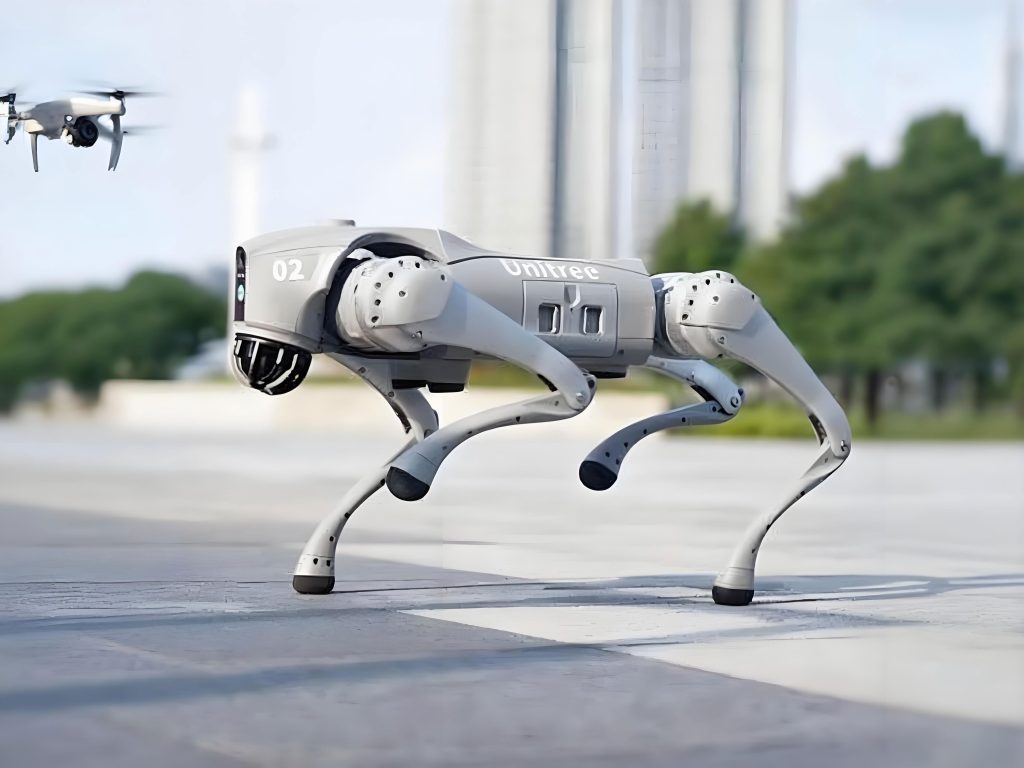
Leg joint structures typically include rotary joints and prismatic joints. Rotary joints involve direct rotation of the leg by an actuator like a motor or servo, with the joint angle equal to the actuator’s rotation. Prismatic joints use linear actuators to drive leg rotation, requiring conversion from linear displacement to angular displacement. In this bionic robot, the thigh is directly driven by a servo motor for rotation. The lower leg’s motion employs a spatial four-bar linkage, akin to a prismatic joint, where a servo drives a connecting rod, which in turn swings the lower leg. This design reduces complexity and part count while providing controlled motion.
The motion principles of the bionic robot are grounded in gait analysis and kinematics. For gait selection, quadruped robot gaits are divided into static and dynamic gaits. Static gaits, such as walk and amble, involve sequential lifting and landing of legs, with at most one leg in swing phase at any time, ensuring high stability but slower speed. Dynamic gaits, including pace, trot, canter, and run, allow at least two legs in swing phase, enabling faster movement. The trot gait, a diagonal gait, is widely favored for its balance of speed and stability. Thus, our bionic robot uses the trot gait.
In trot gait motion, the four mechanical legs alternate between swing and support phases in a planned sequence. Key parameters include duty factor $\beta$ (ratio of support phase time to gait cycle time, with $\beta > 0.5$ for static gaits and $\beta \leq 0.5$ for dynamic gaits), phase difference $\phi$ (absolute difference in phase values between alternating legs, where phase ranges from 0 to 1 per cycle), swing phase (leg off the ground), support phase (leg on ground providing support and friction), gait cycle $T$ (time from one leg lift to the next), stride length $L$ (distance traveled by the foot during support phase), and step height $H$ (maximum vertical distance of the foot during swing phase). For this bionic robot, we choose $\beta < 1/2$ and $\phi < 1/2$, resulting in a brief period where all four legs are in support phase. The leg movement timing diagram illustrates this pattern, with diagonal leg pairs moving synchronously but out of phase.
To achieve precise control, kinematic analysis of the leg is essential. Using the Denavit-Hartenberg (D-H) method, we establish a coordinate system for a single leg, assuming the robot body is fixed. The body coordinate system is defined with the Y-axis as the forward direction, Z-axis as the joint rotation axis, and X-axis determined by the right-hand rule. The transformation matrices between consecutive frames are derived as follows:
$$^0_1A = \begin{bmatrix} c_1 & -s_1 & 0 & 0 \\ s_1 & c_1 & 0 & 0 \\ 0 & 0 & 1 & 0 \\ 0 & 0 & 0 & 1 \end{bmatrix}, \quad ^1_2A = \begin{bmatrix} c_2 & -s_2 & 0 & l_1 \\ s_2 & c_2 & 0 & 0 \\ 0 & 0 & 1 & 0 \\ 0 & 0 & 0 & 1 \end{bmatrix}, \quad ^2_3A = \begin{bmatrix} 1 & 0 & 0 & l_2 \\ 0 & 1 & 0 & 0 \\ 0 & 0 & 1 & 0 \\ 0 & 0 & 0 & 1 \end{bmatrix}$$
where $c_i = \cos\theta_i$, $s_i = \sin\theta_i$, $\theta_1$ and $\theta_2$ are the hip and knee joint angles, and $l_1$ and $l_2$ are the lengths of the thigh and lower leg, respectively. The homogeneous transformation matrix from the foot to the body is:
$$^0_3T = ^0_1A \cdot ^1_2A \cdot ^2_3A = \begin{bmatrix} c(\theta_1 + \theta_2) & -s(\theta_1 + \theta_2) & 0 & p_x \\ s(\theta_1 + \theta_2) & c(\theta_1 + \theta_2) & 0 & p_y \\ 0 & 0 & 1 & p_z \\ 0 & 0 & 0 & 1 \end{bmatrix}$$
with foot position coordinates:
$$p_x = l_1 \cos\theta_1 + l_2 \cos(\theta_1 + \theta_2)$$
$$p_y = l_1 \sin\theta_1 + l_2 \sin(\theta_1 + \theta_2)$$
$$p_z = 0$$
These equations represent the forward kinematics, mapping joint angles to foot position. For inverse kinematics, solving for $\theta_1$ and $\theta_2$ given $p_x$ and $p_y$:
$$\theta_2 = \arccos\left( \frac{p_x^2 + p_y^2 – l_1^2 – l_2^2}{2l_1 l_2} \right)$$
$$\theta_1 = \arctan\left( \frac{p_y}{p_x} \right) – \arctan\left( \frac{l_2 \sin\theta_2}{l_1 + l_2 \cos\theta_2} \right)$$
These kinematic models are fundamental for trajectory planning and servo control in the bionic robot.
The hardware system of the bionic robot is meticulously designed to support robust operation. The core microcontroller is the Infineon TC264D, chosen for its high performance with a 200 MHz dual TRI/DSP core, 2.5 MB flash memory, 240 KB RAM, powerful General Timer Module (GTM), and interfaces like SENT, PSI5, and PSI5S for sensors. The mainboard integrates onboard buttons, a gyroscope interface, servo interfaces (with potentiometers for voltage adjustment), display interface, and serial ports. The power system uses a 7.4V 2s lithium battery, with voltage regulation circuits providing +3.3V for the microcontroller and buttons, and +5V for the gyroscope and display. Servo motors are DS3115 digital servos, offering 180° rotation and a torque of 17 kg·cm, operating at 4.8V to 6.8V. Twelve servos are employed, powered via a breadboard due to limited mainboard connections, each connected to PWM outputs on the mainboard. The gyroscope is an ICM20602, known for high accuracy and low noise, supporting I2C and SPI communication at up to 10 Mbps, operating at 3.3V to 5V. The display is an IPS parallel interface LCD with 240×320 resolution, small size, and fast parallel communication. Table 1 summarizes key hardware components.
| Component | Specifications | Purpose |
|---|---|---|
| Microcontroller | Infineon TC264D, 200 MHz, 2.5 MB flash, 240 KB RAM | Central processing and control |
| Servo Motor | DS3115, 180°, 17 kg·cm, 4.8-6.8V | Leg joint actuation |
| Gyroscope | ICM20602, 6-axis, SPI/I2C, 3.3-5V | Motion posture sensing |
| Display | IPS LCD, 240×320, parallel interface, 3.3-5V | Data visualization |
| Power Source | 7.4V 2s lithium battery | Energy supply |
| Communication | Wireless-to-serial module, HC-06 Bluetooth module | Remote control and data transmission |
The software system is developed using the AURIX Development Studio (ADS) with C programming. Motion control employs open-loop servo control based on the trot gait. Diagonal leg pairs are grouped, with each group performing identical motions but out of phase. Foot trajectory is planned in the Y-axis (forward-backward swing) and X-axis (lift-lower). For the Y-axis, the support phase uses a linear trajectory, while the swing phase uses a cubic curve. For the X-axis, the support phase is constant, and the swing phase uses a cosine curve. After planning, the trajectory coordinates are converted to servo angles using the inverse kinematics equations, and then to PWM signals for servo driving. This enables basic trot gait walking.
Sensor integration involves the six-axis gyroscope (ICM20602) using software SPI protocol. A quaternion algorithm computes the three Euler angles—roll, pitch, and yaw—representing the robot’s body posture. Due to mechanical errors, uneven terrain, and open-loop control, the bionic robot may deviate from ideal motion or even tip over. To mitigate this, a servo output compensation control is implemented. Based on the gyroscope feedback, the Euler angles are converted to adjustments for the shoulder servo outputs, helping maintain balance during movement.
Communication modules include a wireless-to-serial module and an HC-06 Bluetooth module. The wireless module functions like a standard serial port, enabling wireless communication for command sending and data reception. The Bluetooth module pairs with an Android mobile app, allowing control via smartphone. Additionally, the display module shows feedback values and parameters for monitoring, and onboard buttons provide an alternative for input. Both modules operate on a 20 ms interrupt cycle due to display refresh rates and button debouncing requirements.
The overall system framework integrates these components seamlessly. The microcontroller core coordinates sensor data acquisition, motion control algorithms, communication interfaces, and user inputs. Power management ensures stable voltage levels for all subsystems. The mechanical structure, driven by servos, executes planned trajectories while the gyroscope provides real-time posture feedback for compensation. This integrated approach enables the bionic robot to perform complex locomotion tasks. Table 2 outlines the software modules and their functions.
| Module | Function | Implementation Details |
|---|---|---|
| Motion Control | Gait generation and servo driving | Open-loop control with trajectory planning using cubic and cosine curves; PWM output generation |
| Sensor Processing | Posture sensing and compensation | Gyroscope data acquisition via SPI; quaternion-based Euler angle computation; servo compensation algorithms |
| Communication | Remote control and data feedback | Wireless serial and Bluetooth modules; command parsing and response transmission |
| User Interface | Parameter display and input | LCD display for real-time data; button interfacing for manual control |
| System Integration | Coordinating all modules | Interrupt-driven timing (20 ms cycles); task scheduling and resource management |
In testing, this bionic robot successfully achieves various motions, including walking, turning left and right, standing up, and squatting. The trot gait provides stable and efficient locomotion, with the gyroscope compensation enhancing robustness on uneven surfaces. The wireless and Bluetooth controls allow flexible operation from a distance, making the bionic robot suitable for diverse scenarios. The design emphasizes simplicity in mechanical structure, using spatial linkages to reduce part count, though this introduces some mechanical errors. Kinematic solutions and real-time compensation algorithms help naturalize the gait and correct foot trajectories.
The development of this bionic robot underscores the potential of bio-inspired designs in robotics. By mimicking biological leg configurations and gaits, we can create machines that navigate complex environments with agility. Future improvements could include closed-loop control with force sensors, more advanced gaits like gallop or bound, and machine learning for adaptive terrain response. The integration of lightweight materials and energy-efficient actuators could further enhance performance. This bionic robot serves as a platform for exploring these avenues, contributing to the broader field of bionic robotics.
In conclusion, the bionic quadruped robot presented here demonstrates a practical approach to bio-inspired locomotion. From mechanical design based on full-elbow configuration to software-driven trot gait control, each aspect is tailored for functionality and ease of implementation. The use of kinematic modeling, sensor feedback, and wireless communication enables versatile operation. While challenges like mechanical precision and balance persist, the compensation strategies and modular design offer a foundation for refinement. As bionic robots evolve, they promise to revolutionize fields from logistics to exploration, blending biological insights with engineering innovation.
Throughout this project, the term “bionic robot” has been central, reflecting the integration of biological principles into mechanical systems. This bionic robot not only mimics animal movement but also adapts through computational control, showcasing the synergy between nature and technology. By continuing to refine such bionic robots, we can unlock new capabilities for autonomous machines in our daily lives and beyond.