
In the field of robotics, the development of end-effectors capable of sophisticated manipulation is paramount. As a researcher focused on robotic manipulation, I have observed that existing dexterous robotic hands often face significant trade-offs. Fully actuated dexterous robotic hands, while offering high dexterity, suffer from excessive numbers of actuators, leading to complex spatial layouts, weak grasping forces, and limited practical application. Conversely, highly underactuated dexterous robotic hands simplify actuation but at the cost of low independent control capability and insufficient dexterity, restricting their ability to perform complex tasks. To address these limitations, this work presents the design and comprehensive analysis of a novel four-fingered dexterous robotic hand. The primary objective is to achieve a balance between mechanical simplicity, sufficient grasping force, and high dexterity, enabling robust and versatile object manipulation.
The core innovation lies in a bio-inspired mechanical architecture. The design philosophy emulates the human hand’s functional anatomy, particularly the coupling between the proximal interphalangeal (PIP) and distal interphalangeal (DIP) joints. For the three fingers (index, middle, and ring fingers), a roll-pitch configuration at the metacarpophalangeal (MCP) joint is proposed, deviating from the traditional yaw-pitch type. This configuration enriches the dexterous robotic hand’s repertoire of grasping postures and significantly enhances its operational agility. The thumb employs a distinct lateral swing structure at its MCP joint to facilitate opposition and coordination with the other fingers. The PIP and DIP joints for all fingers are driven by a crossed four-bar linkage mechanism, enabling coupled motion from a single linear actuator, thereby reducing the number of actuators while preserving essential kinematic functionality.
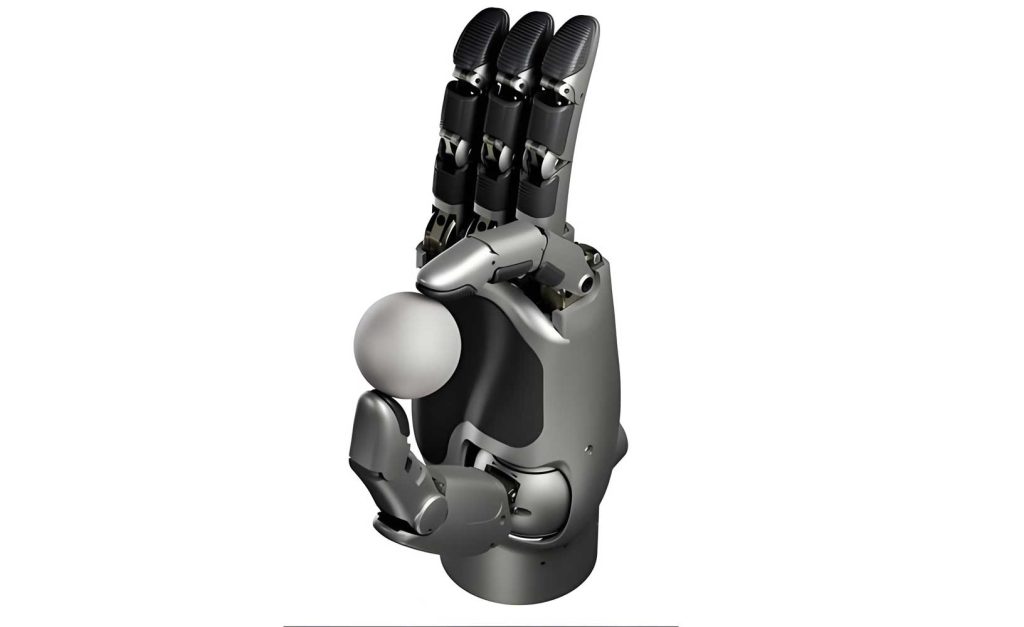
The mechanical design of the index finger module is representative of the three non-thumb fingers. It consists of a proximal phalanx, middle phalanx, and distal phalanx, analogous to human finger bones. The MCP joint provides two degrees of freedom (DoF): roll (activated by a servo motor) and pitch (activated by a linear actuator). The PIP and DIP joints are not independently actuated; instead, their motion is coupled via the crossed four-bar linkage housed within the proximal phalanx and driven by a second linear actuator. This design choice dramatically reduces the actuator count for the dexterous robotic hand. The thumb’s structure is specialized: its MCP joint provides an abduction/adduction degree of freedom (lateral swing) via a linear actuator and a guide mechanism to simulate opposition, while its PIP and DIP joints are also coupled via an identical crossed four-bar linkage. All finger linkages are designed with extension plates for future integration of tactile sensors. The palm base is designed for easy mounting on a robotic arm. The key parameters for the kinematic modeling of the fingers are summarized in the following tables.
| Link i | αi-1 (deg) | ai-1 (mm) | di (mm) | θi |
|---|---|---|---|---|
| 1 | 0 | 0 | 0 | θ1 (MCP Roll) |
| 2 | -90 | 0 | 0 | θ2 (MCP Pitch) |
| 3 | 0 | 70 | 0 | θ3 (PIP Joint) |
| 4 | 0 | 46 | 0 | θ4 (DIP Joint, coupled) |
| 5 | 0 | 30 | 0 | 0 (End-effector) |
| Link i | αi-1 (deg) | ai-1 (mm) | di (mm) | θi |
|---|---|---|---|---|
| 1 | 0 | 0 | 40 | θ1 (MCP Lateral Swing) |
| 2 | -90 | 90 | 0 | θ2 (PIP Joint) |
| 3 | 0 | 46 | 0 | θ3 (DIP Joint, coupled) |
| 4 | 0 | 30 | 0 | 0 (End-effector) |
The kinematic coupling of the PIP and DIP joints via the crossed four-bar linkage is fundamental to this dexterous robotic hand’s design. The linkage, with specific dimensions (L0 = 10 mm, L1 = 46 mm, L2 = 10 mm, L3 = 50 mm, initial angle = 0.8 rad), creates a deterministic relationship between the rotation angles of the PIP joint (α) and the DIP joint (γ). The geometric analysis yields the following relationship. Let point A be the PIP joint, B the driving joint, C the connection point, and D the DIP joint. The lengths are defined as L0 (frame), L1 (coupler link), L2 (connecting rod), and L3 (input link). The angle β is the interior angle at the connecting vertex.
The relationship between the input angle α and the intermediate angle β is given by:
$$
\beta = \angle ACD – \angle ACB
$$
$$
\cos(\angle ACD) = \frac{L_2^2 + AC^2 – L_1^2}{2 \cdot L_2 \cdot AC}
$$
$$
\cos(\angle ACB) = \frac{L_3^2 + AC^2 – L_0^2}{2 \cdot L_3 \cdot AC}
$$
$$
AC^2 = L_3^2 + L_0^2 – 2 \cdot L_3 \cdot L_0 \cdot \cos(\alpha)
$$
Thus, β can be expressed as a function of α: β = g(α). Subsequently, the output angle γ is related to β by:
$$
\cos(\gamma) = \frac{L_1^2 + L_0^2 – BD^2}{2 \cdot L_1 \cdot L_0}
$$
$$
BD^2 = L_2^2 + L_3^2 – 2 \cdot \cos(\beta) \cdot L_2 \cdot L_3
$$
Therefore, γ = h(β). Combining these, the overall coupling function for the dexterous robotic hand’s finger joints is:
$$
\gamma = f(\alpha) = h(g(\alpha))
$$
For the index finger, this means θ4 = u(θ3), and for the thumb, θ3 = u(θ2). This functional coupling is plotted below, showing a nearly linear relationship which is beneficial for stable and predictable finger flexion in the dexterous robotic hand.
| Input Angle α (deg, PIP) | Output Angle γ (deg, DIP) |
|---|---|
| 0 | 0 |
| 10 | 8.2 |
| 20 | 16.5 |
| 30 | 24.9 |
| 40 | 33.4 |
| 50 | 42.1 |
| 60 | 50.9 |
| 70 | 59.8 |
| 80 | 68.7 |
| 90 | 77.6 |
To evaluate the dexterity and operational capability of our dexterous robotic hand, a comprehensive kinematic analysis was performed. Using the modified Denavit-Hartenberg (D-H) parameters, the forward kinematics model was established in MATLAB. The workspace of the fingers, a critical indicator for a dexterous robotic hand’s versatility, was generated using the Monte Carlo method with 30,000 random samples within each joint’s limits. The homogeneous transformation matrix for a link i is given by:
$$
^{i-1}T_i = \begin{bmatrix}
\cos\theta_i & -\sin\theta_i \cos\alpha_{i-1} & \sin\theta_i \sin\alpha_{i-1} & a_{i-1}\cos\theta_i \\
\sin\theta_i & \cos\theta_i \cos\alpha_{i-1} & -\cos\theta_i \sin\alpha_{i-1} & a_{i-1}\sin\theta_i \\
0 & \sin\alpha_{i-1} & \cos\alpha_{i-1} & d_i \\
0 & 0 & 0 & 1
\end{bmatrix}
$$
The end-effector position for a finger with n links is obtained by the consecutive product: $$ ^{0}T_n = ^{0}T_1 \cdot ^{1}T_2 \cdots ^{n-1}T_n $$. The resulting workspaces for the index finger and the thumb are dense, well-distributed volumes. The index finger’s workspace forms a uniform fan-shaped surface, while the thumb’s workspace comprises two intersecting fan-shaped surfaces. The collective workspace of the four-fingered dexterous robotic hand shows significant overlap between the fingers, indicating strong potential for coordinated fine manipulation and enveloping grasps, which is a key feature for a capable dexterous robotic hand.
| Finger | X-axis Span (mm) | Y-axis Span (mm) | Z-axis Span (mm) | Approximate Volume Shape |
|---|---|---|---|---|
| Index | -50 to 50 | 0 to 120 | -20 to 80 | Fan-shaped surface |
| Thumb | -40 to 40 | 40 to 130 | -30 to 60 | Two intersecting fans |
| Four-Finger Combined | -80 to 80 | 0 to 150 | -30 to 100 | Complex, overlapping volume |
Dynamic simulation was conducted in ADAMS software to validate the motion characteristics and force requirements of the dexterous robotic hand’s finger mechanism. The crossed four-bar linkage assembly for the index finger was modeled, and appropriate constraints, materials (ABS plastic for links, steel for pins), and a STEP function drive (STEP(time, 1, 0, 5, 90d)) were applied to the input link. Gravity was set to 9.81 m/s². Marker points were placed at the fingertip and driving joint to measure displacement, velocity, and required driving torque. The simulation results confirmed smooth, vibration-free motion. The fingertip trajectory showed a primary displacement in the Y and Z axes, with negligible X-axis movement, consistent with the intended flexion plane. The velocity profiles were smooth, accelerating from 1s, peaking around 2s, and decelerating to stop at 5s, matching the input drive function perfectly. This smoothness is essential for stable operation of a dexterous robotic hand.
The dynamic analysis also provided the required driving torque for the linkage. The maximum torque during the motion was approximately 35 N·mm. Given that the selected linear actuator for the dexterous robotic hand can provide a force of 100 N over a moment arm of 10 mm (yielding a potential torque of 1000 N·mm), the design has a substantial safety factor, ensuring reliable actuation even under load. This analysis confirms the mechanical feasibility of the proposed dexterous robotic hand architecture.
| Time (s) | Fingertip Y-Displacement (mm) | Fingertip Y-Velocity (mm/s) | Fingertip Z-Displacement (mm) | Fingertip Z-Velocity (mm/s) | Driving Torque (N·mm) |
|---|---|---|---|---|---|
| 1.0 | 0.0 | 0.0 | 0.0 | 0.0 | 0.0 |
| 2.0 | 25.4 | 45.2 | 15.8 | 28.1 | 18.5 |
| 3.0 | 52.1 | 38.1 | 32.5 | 23.8 | 28.7 |
| 4.0 | 70.8 | 22.3 | 44.2 | 13.9 | 34.2 |
| 5.0 | 78.5 | 0.0 | 49.0 | 0.0 | 32.1 |
The physical prototype of the four-fingered dexterous robotic hand was fabricated using 3D printing (for structural components) and assembled with off-the-shelf actuators and controllers. To rigorously evaluate its grasping performance and dexterity—the ultimate test for any dexterous robotic hand—we adopted a structured protocol inspired by the Anthropomorphic Hand Assessment Protocol (AHAP). The tests focused on two fundamental grasp types: power grasps (enveloping) and precision grasps (fingertip).
For power grasp evaluation, objects of various shapes and sizes were used, including a cylindrical cup, a standard drink bottle, and a small-diameter bottle. The dexterous robotic hand successfully performed enveloping grasps on all objects. The adaptive coupling of the PIP and DIP joints allowed the fingers to conform naturally to the object’s geometry, with the proximal phalanx making contact first, followed by the middle and distal phalanges, resulting in a stable, multi-point grip. A specific grasp force test was conducted by progressively adding mass (weights and sand) to the cylindrical cup until slippage occurred. The dexterous robotic hand demonstrated a maximum stable grasping capability, confirming its substantial gripping force.
| Object | Approx. Diameter (mm) | Approx. Mass Held (g) | Grasp Stability | Notes |
|---|---|---|---|---|
| Cylindrical Cup | 80 | ~850 | Excellent | No slippage until max load |
| Standard Bottle | 65 | ~500 (full) | Excellent | Secure hold, easy lift |
| Small Bottle | 40 | ~300 | Excellent | Firm envelopment |
Precision grasp tests were performed to assess the dexterous robotic hand’s ability to manipulate small objects. Using the thumb in opposition to the index, middle, and ring fingers independently, the hand successfully grasped objects like a bottle cap, a screwdriver, and tweezers. The roll-pitch MCP configuration of the non-thumb fingers proved crucial here. The roll degree of freedom allowed these fingers to orient their pads optimally towards the thumb, creating stable pinch grasps. This functionality highlights the enhanced dexterity afforded by our novel MCP joint design compared to simpler one-DoF or traditional yaw-pitch joints in other dexterous robotic hand designs.
Furthermore, to demonstrate practical utility beyond standardized tests, the dexterous robotic hand was tasked with grasping common household and workshop items of complex shapes, such as a computer mouse, a small apple, a roll of tape, and a power drill. The hand successfully adapted its posture to secure each object, showcasing its versatility and robust design. The combination of the adaptive coupled distal joints and the independently controllable roll-pitch MCP joints allowed the dexterous robotic hand to achieve a wide variety of stable grasp configurations.
| Grasp Type | Object Examples | Fingers Involved | Key Requirement | Result |
|---|---|---|---|---|
| Precision Pinch | Bottle cap, Screwdriver | Thumb + Index | Fine force control, alignment | Successful, stable hold |
| Lateral Pinch | Tweezers, Key | Thumb + Middle | Sideways finger positioning | Successful |
| Three-finger Grasp | Small Apple, Tape | Thumb + Index + Middle | Multi-point coordination | Successful, enveloping shape |
| Power Tool Hold | Drill Gun | All four fingers | High force, conformal grip | Successful, secure handle grasp |
In conclusion, this work has presented the complete design, analysis, and experimental validation of a novel four-fingered dexterous robotic hand. The primary design challenges of actuator proliferation, insufficient force, and limited dexterity were addressed through a bio-inspired mechanical synthesis. The implementation of a crossed four-bar linkage for PIP-DIP coupling effectively reduces the number of actuators while maintaining adaptive grasping behavior. The introduction of a roll-pitch configuration at the MCP joint for three fingers, as opposed to the common yaw-pitch type, represents a significant contribution to enhancing the operational workspace and dexterity of an underactuated dexterous robotic hand. The specialized thumb with lateral swing enables effective opposition.
Kinematic modeling and Monte Carlo simulation confirmed that the dexterous robotic hand possesses a large, well-distributed, and overlapping workspace, which is foundational for dexterous manipulation. Dynamic simulations in ADAMS verified smooth motion characteristics and feasible force requirements. Finally, extensive physical experiments on both power and precision grasps, following an anthropomorphic assessment framework, demonstrated that the prototype dexterous robotic hand possesses excellent grasping stability, substantial grip force, and notably high dexterity. It successfully manipulated a wide range of objects, from heavy cylinders to small, delicate items. The results affirm that this dexterous robotic hand achieves a favorable balance between mechanical simplicity, force capability, and dexterity, holding considerable practical value for applications in robotic manipulation, prosthetics, and industrial automation. Future work will focus on integrating embedded tactile sensors and implementing advanced force/impedance control algorithms to further elevate the autonomy and sensitivity of this dexterous robotic hand platform.