
The pursuit of creating a truly versatile and adaptable dexterous robotic hand has been a central challenge in robotics for decades. While significant progress has been made with electromechanical and tendon-driven systems, the quest for actuation that combines high power density, inherent compliance, and anthropomorphic form factor continues. My research focuses on exploring an alternative pathway: a fluid-driven, biomimetic approach. This article details the design, modeling, and analysis of a three-fingered anthropomorphic hand actuated by novel flexible hydraulic “artificial muscles.” This approach aims to bridge the gap between the robust, powerful movements of hydraulic systems and the gentle, adaptive compliance necessary for a high-performance dexterous robotic hand.
Traditional robotic grippers and hands often lack the subtlety and adaptability of their biological counterparts. The human hand’s unparalleled dexterity stems from a complex interplay of bones, tendons, ligaments, and muscles, providing both strength and a delicate sense of touch. Replicating this in robotics typically involves intricate assemblies of motors, gears, and cables, leading to challenges with weight, complexity, and impact resistance. Fluidic actuation, particularly pneumatics, has offered advantages in power-to-weight ratio and natural compliance. However, pneumatic muscles often suffer from lower bandwidth and control challenges due to air compressibility. Hydraulic systems, with their superior power density and stiffness, present a compelling alternative but are traditionally associated with rigid components and complex sealing. My work investigates a hybrid concept: a flexible hydraulic actuator that behaves like an artificial muscle, directly driving finger joints without conventional rotational mechanisms. The core objective is to develop a dexterous robotic hand that is not only functional but also inherently safe and compliant due to its material properties and working principle.
The heart of this dexterous robotic hand is the flexible hydraulic drive unit, or “artificial muscle.” Its working principle is elegantly simple yet effective. Imagine a cylindrical elastic tube, similar to a high-pressure rubber hose. If pressurized uniformly, such a tube would expand radially and elongate axially in all directions. The key to generating bending motion lies in introducing an asymmetry in axial stiffness. By embedding a high-strength, inextensible wire (or a narrow strip of rigid material) along one side of the tube’s inner wall, running parallel to its axis, that particular longitudinal line is constrained from stretching. When internal hydraulic pressure is applied, the unconstrained side of the tube wall elongates, while the constrained side does not. This differential elongation forces the entire tube to bend towards the stiffened side. The magnitude of the bending angle is directly related to the applied pressure and the length of the tube. This concept transforms a simple pressurized chamber into a direct, joint-less bending actuator, mimicking the contraction of a biological muscle.
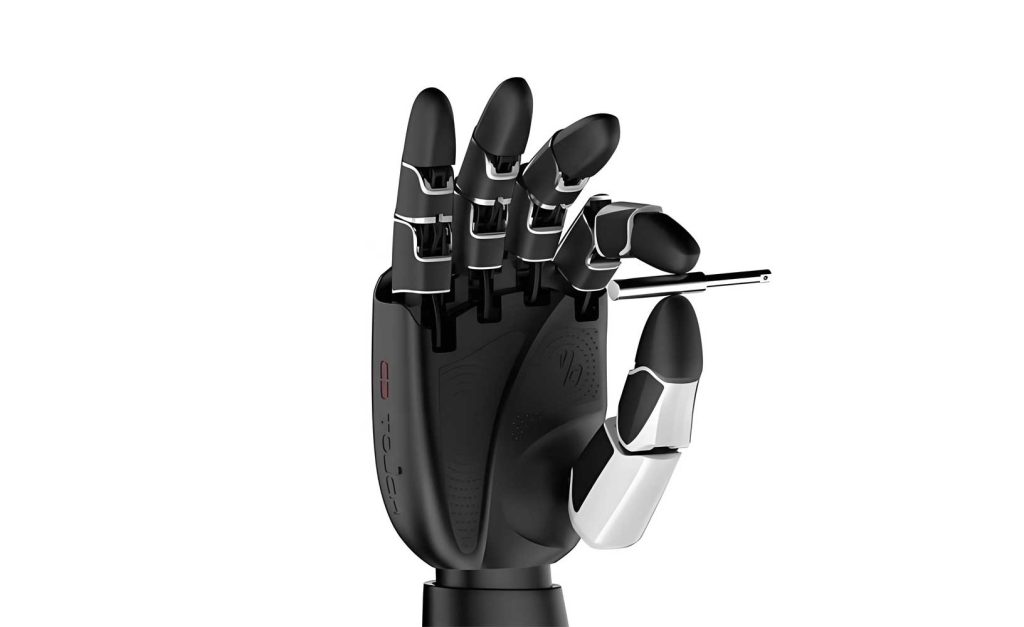
The finger design for the dexterous robotic hand directly implements this principle to create anthropomorphic movement. Each finger consists of three rigid phalanges (proximal, medial, and distal), connected by pin joints to form the three kinematic joints. Instead of a complex network of tendons, a single flexible hydraulic drive unit is dedicated to each finger. One end of this flexible actuator is fixed to the proximal phalanx (or the palm structure). The other, free end is attached to a sliding block that engages with a guide slot running along the dorsal side of the finger. When the actuator is pressurized and bends, it pushes this sliding block distally. The block, in turn, is connected to the medial and distal phalanges via linking mechanisms. As the sliding block moves, it pulls on these links, causing all three finger joints to flex in a coordinated, human-like curling motion. The resting (extended) posture is maintained by the natural elasticity of the flexible tube or with the aid of small passive return springs. This design results in a dexterous robotic hand finger that is remarkably simple, contains minimal moving parts in the finger itself, and exhibits natural compliance.
To understand and predict the performance of this dexterous robotic hand, developing a dynamic model for the flexible hydraulic drive unit is essential. The actuator can be modeled as a cantilever beam subjected to a distributed moment generated by the internal pressure. For small bending angles, the geometry relates the free-end deflection \( f \) to the bend angle \( \theta \) and the effective length \( L_0 \):
$$ f = \frac{L_0 \theta}{2} $$
The elongation of the centerline on the unconstrained (pressurized) side of the tube, which drives the bending, is given by:
$$ \Delta L_0 = r_m \theta $$
where \( r_m \) is the mean radius of the tube. Considering the actuator as a damped, vibrating cantilever beam with a concentrated mass \( m_1 \) at the free end (representing the sliding block and linkage inertia) and a distributed mass \( m_2 \) for the tube itself, its fundamental natural frequency \( \omega_n \) can be approximated by:
$$ \omega_n = \sqrt{ \frac{3EI}{ (m_1 + \frac{33}{140}m_2) L_0^3 } } $$
Here, \( EI \) represents the flexural rigidity of the composite tube structure (elastic shell plus embedded wire). The pressure-to-deflection transfer function for the drive unit itself, ignoring fluid dynamics for a moment, is:
$$ \frac{f(s)}{P_L(s)} = \frac{\pi r_i^2 r_m L_0^2}{2EI} \cdot \frac{\omega_n^2}{s^2 + 2\zeta \omega_n s + \omega_n^2} = B_4 \cdot \frac{\omega_n^2}{s^2 + 2\zeta \omega_n s + \omega_n^2} $$
where \( P_L \) is the pressure inside the actuator, \( r_i \) is its internal radius, and \( \zeta \) is the damping ratio.
The complete system dynamics must include the fluid supply line. Modeling the supply line as a long, thin capillary tube of length \( l \) and radius \( R \), the flow rate \( Q_i \) from the pressure source \( P \) to the actuator chamber \( P_L \) can be described by the Hagen-Poiseuille law for laminar flow:
$$ Q_i = \frac{\pi R^4}{8 \mu \rho l} (P – P_L) = B_1 (P – P_L) $$
where \( \mu \) is the dynamic viscosity and \( \rho \) is the density of the hydraulic fluid. The continuity equation for the actuator chamber accounts for fluid compressibility and the volume change due to motion:
$$ Q_i = \pi r_i^2 s \Delta L_0(s) + \frac{\pi r_i^2 L_0}{K} s P_L(s) $$
where \( K \) is the bulk modulus of the hydraulic fluid. Substituting \( \Delta L_0 = r_m \theta \) and the relationship between \( \theta \) and \( f \), we can combine these equations. After manipulation, the overall transfer function from supply pressure \( P \) to fingertip deflection \( f \) for a single drive unit in the dexterous robotic hand is derived as:
$$ \frac{f(s)}{P(s)} = \frac{B_1 B_4 \omega_n^2}{B_3 s^3 + (B_1 + 2\zeta \omega_n B_3)s^2 + (2\zeta B_1 \omega_n + B_3 \omega_n^2 + B_2 B_4 \omega_n^2)s + B_1 \omega_n^2} $$
The constants are summarized for clarity:
| Symbol | Expression | Physical Meaning |
|---|---|---|
| \( B_1 \) | \( \frac{\pi R^4}{8 \mu \rho l} \) | Fluid flow conductance of supply line |
| \( B_2 \) | \( \frac{2}{r_m L_0} \) | Geometric constant from kinematics |
| \( B_3 \) | \( \frac{\pi r_i^2 L_0}{K} \) | Compliance factor of actuator chamber |
| \( B_4 \) | \( \frac{\pi r_i^2 r_m L_0^2}{2EI} \) | Static sensitivity of actuator |
Simulation of this model reveals critical insights for designing a functional dexterous robotic hand. The dynamic response is highly sensitive to key parameters. For instance, increasing the load mass \( m_1 \) at the actuator’s free end significantly reduces the system’s natural frequency and increases settling time, leading to a sluggish response. Conversely, the radius \( R \) of the fluid supply capillary tube acts as a major damping element. A smaller radius dramatically increases fluidic resistance, which can over-damp the system, eliminating oscillation but also slowing the response. This tunability is a double-edged sword; it allows for stabilizing the system but must be carefully balanced against speed requirements. The following table summarizes the effects of varying key design parameters on the dynamic performance of the actuator within the dexterous robotic hand:
| Parameter | Increase Leads To… | Primary Impact on Performance |
|---|---|---|
| Load Mass (\( m_1 \)) | Lower natural frequency, slower response | Reduced bandwidth, potential instability if too high |
| Tube Radius (\( R \)) | Higher system damping, faster flow | Can stabilize system; too small causes excessive sluggishness |
| Actuator Length (\( L_0 \)) | Much lower natural frequency, higher static gain | Slower, larger strokes but more prone to vibration |
| Flexural Rigidity (\( EI \)) | Higher natural frequency, lower static gain | Faster, stiffer response with smaller bending per unit pressure |
| Fluid Bulk Modulus (\( K \)) | Reduced compliance effects, higher frequency | Stiffer hydraulic response, less lag from compressibility |
Beyond system dynamics, the structural integrity of the flexible drive unit under pressure is paramount for a reliable dexterous robotic hand. The elastic tube, typically made of a hyperelastic material like rubber or polyurethane, undergoes large, non-linear deformations. Finite Element Analysis (FEA) is indispensable for evaluating stress distribution and potential failure points. The tube material is modeled using a Mooney-Rivlin constitutive model, which is suitable for representing the incompressible, non-linear elasticity of rubber. A two-dimensional axisymmetric model of a quarter cross-section of the tube is sufficient for initial stress analysis. The model incorporates the constraint of the embedded wire by applying appropriate boundary conditions to the nodes along the corresponding arc. Internal pressure is applied as a distributed load on the inner surface.
The FEA results across a range of pressures reveal the operational limits of the design. At very low pressures (e.g., 5 MPa), deformation and stress are minimal, confirming the linear region for small deflections. At a target operational pressure of 25 MPa, significant deformation begins to occur. The inner wall on the unconstrained side shows noticeable radial expansion and von Mises stress concentrations near the constrained boundary and the end caps. The maximum stress values approach but remain below the tensile strength of typical reinforced elastomers. This analysis validates that with appropriate material selection—such as incorporating high-strength fiber braiding within the tube wall to limit radial expansion—a durable actuator can be designed for this pressure range. However, at excessively high pressures (e.g., 40 MPa), the analysis predicts extreme deformations and stress values that far exceed the yield strength of even reinforced elastomers, leading to immediate structural failure. These results critically inform the safe working pressure range for the actuators in the dexterous robotic hand.
| Internal Pressure (MPa) | Max. Deformation (mm) | Max. Von Mises Stress (MPa) | Observations & Design Implications |
|---|---|---|---|
| 5 | Negligible | < 1 | Linear elastic region; safe but produces negligible bending force. |
| 15 | Moderate | ~15 | Useful bending begins; stress within safe range for many reinforced rubbers. |
| 25 | Significant | ~35-50 | Target operational range. Stress requires high-quality fiber reinforcement (e.g., aramid, glass fiber) in tube wall. |
| 40 | Extreme | > 100 | Danger of rupture. Not feasible without radical material/design changes (e.g., metal bellows). |
The integration of these flexible hydraulic actuators into a multi-fingered dexterous robotic hand presents further system-level considerations. A compact hydraulic power unit (HPU)—consisting of a pump, reservoir, accumulator, and valves—must be developed. For control, high-bandwidth servo or proportional valves are needed to modulate the pressure to each actuator accurately. The control strategy must account for the coupling between fingers if they share a pump, as well as the non-linear pressure-deflection relationship and hysteresis of the elastic tubes. Advanced control algorithms, such as impedance or force control, can leverage the natural compliance of the actuators to achieve safe and responsive interaction with objects and environments. The potential applications for such a dexterous robotic hand are vast, ranging from advanced industrial automation for handling fragile or irregular items to teleoperation in hazardous environments and ultimately as a component of humanoid service robots.
In conclusion, the design and research into a dexterous robotic hand based on flexible hydraulic artificial muscles offer a promising alternative to conventional actuation methods. This approach yields a finger mechanism that is structurally simple, inherently compliant, and capable of generating substantial force from a compact form factor. The established dynamic model provides a crucial tool for simulating and optimizing the system’s response, highlighting the critical trade-offs between load, fluidic resistance, and structural geometry. Furthermore, finite element analysis has been instrumental in defining the practical pressure limits and material requirements for the flexible actuators, ensuring robust and safe operation. While challenges remain in system integration, sealing technology for long-duration flexing, and precise control of the non-linear actuators, the foundational work demonstrates clear feasibility and distinct advantages. This line of research contributes a valuable paradigm towards building a new generation of dexterous robotic hands that more closely emulate the versatility, resilience, and gentle strength of the human hand.