
In the realm of robotics, the development of end-effectors capable of performing complex and versatile tasks has always been a focal point. Traditional grippers, often designed for specific tasks and objects, show significant limitations when faced with the unpredictable and complex environments of modern industrial and service applications. The human hand, a product of millennia of evolution, stands as a pinnacle of dexterity, adaptability, and precision. Consequently, the field has increasingly turned to biomimetics, aiming to replicate the structure and function of the human hand to create what are known as anthropomorphic dexterous robotic hands. These advanced manipulators promise to bridge the gap between rigid industrial automation and the flexible, nuanced manipulation humans perform daily. This article presents the comprehensive design, modeling, and simulation of a novel 20-degree-of-freedom (DOF) anthropomorphic dexterous robotic hand, developed from a first-person research perspective. The goal is to create a dexterous robotic hand with a workspace and functionality approaching that of a human hand, validated through rigorous kinematic and dynamic simulation.
The pursuit of a truly dexterous robotic hand is driven by the need for machines that can interact safely and effectively with human environments, perform delicate assembly, handle diverse objects, and even provide assistance in fields like surgery or disaster response. Anthropomorphic designs are particularly appealing because they allow for the intuitive transfer of human manipulation strategies and can leverage the vast existing knowledge of human hand biomechanics. Broadly, these dexterous robotic hands can be categorized based on the placement of their actuators: embedded (or built-in) and external. Embedded dexterous robotic hands, such as the DLR II Hand and the HIT/DLR Hand, house actuators within the fingers or palm. This design offers a self-contained system that can be mounted on various robotic arms but imposes stringent constraints on actuator size, weight, and power. External dexterous robotic hands, like the Utah/MIT Hand, locate actuators remotely, transmitting motion through tendons. This allows for simpler finger mechanics and greater gripping forces but often results in increased control complexity, longer transmission paths, and reduced overall compactness. The dexterous robotic hand presented here, termed the ZSTU hand, adopts an embedded design philosophy, utilizing micro servo motors to achieve a highly integrated and anthropomorphic structure.
The core of our design process was a deep biomimetic analysis of the human hand. The human hand is a marvel of biological engineering, comprising 27 bones and 22 DOFs, not including the wrist. The skeletal structure, as shown in simplified form, consists of the palm and five fingers—thumb, index, middle, ring, and little finger. Each finger, except the thumb which has a unique saddle joint at its base, possesses four DOFs: two at the metacarpophalangeal (MCP) joint (abduction/adduction and flexion/extension), one at the proximal interphalangeal (PIP) joint, and one at the distal interphalangeal (DIP) joint. The thumb’s carpometacarpal (CMC) joint provides additional mobility crucial for opposition. From a mechanical perspective, the hand can be modeled as a multi-link chain connected by revolute and universal joints. Our dexterous robotic hand emulates this configuration. The ZSTU dexterous robotic hand features five fingers arranged in an anthropomorphic layout: the index, middle, ring, and little fingers are positioned parallel to each other, while the thumb is opposed at approximately a 60-degree plane relative to the index finger, facilitating powerful and precision grips. Each finger is identical in mechanical structure, consisting of three phalanges (proximal, medial, and distal) and three active joints: the base joint, the medial joint, and the fingertip joint. In total, this dexterous robotic hand boasts 20 independent DOFs, each driven by its own dedicated micro servo motor embedded within the hand structure. The base joint of each finger is designed to provide two DOFs (flexion/extension and abduction/adduction), mimicking the MCP joint. The medial and fingertip joints each provide one DOF for flexion/extension. This architecture grants our dexterous robotic hand a kinematic structure very close to its biological counterpart.
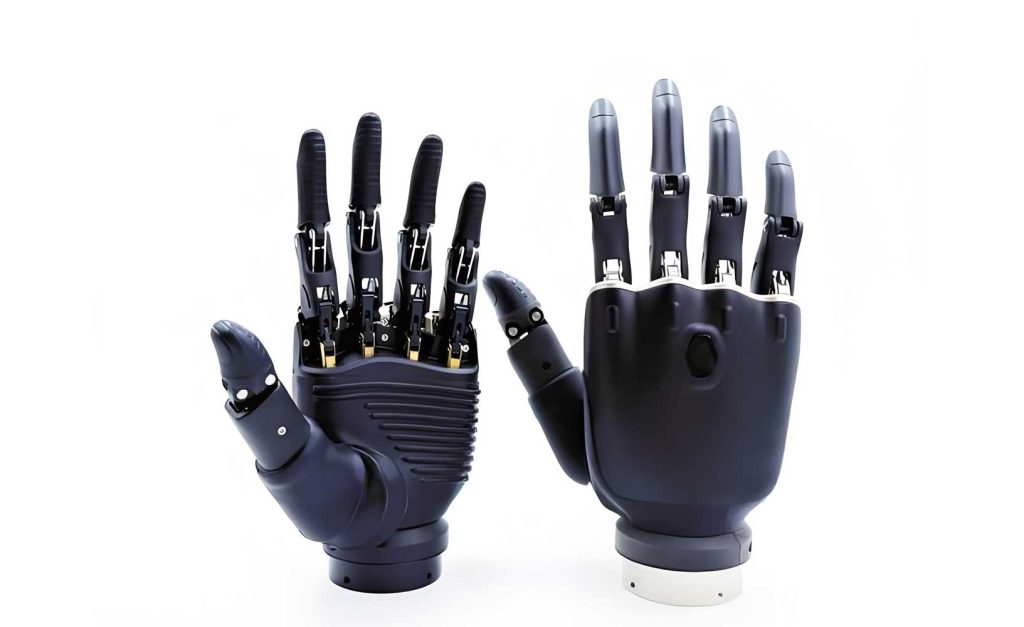
To evaluate the performance of this dexterous robotic hand before physical prototyping, a comprehensive virtual simulation plan was established. This plan involved both kinematic and dynamic performance metrics. Kinematically, the primary measure is the workspace—the set of all points the fingertip can reach. A large and dexterous workspace is essential for performing a wide variety of gestures and manipulation tasks. Dynamically, the focus is on the joint torques required during motion and object interaction, which determines grasp stability, lifting capacity, and the selection of appropriate actuators. The simulation workflow was structured as follows: First, a detailed 3D virtual prototype of the dexterous robotic hand was assembled using UGNX 5.0 CAD software. This model accurately represented all links, joints, and mass properties. Second, this model was used for kinematic simulations within UGNX’s motion simulation module to analyze gestures, grasping, and workspace. Third, for dynamic analysis, a simplified model was exported to ADAMS 2017 multibody dynamics software to compute joint torques under various loading conditions. This virtual engineering approach allows for extensive optimization and validation of the dexterous robotic hand’s design.
The kinematic analysis of a multi-DOF system like a dexterous robotic hand is fundamental for understanding its motion capabilities. We employ the Denavit-Hartenberg (D-H) convention to systematically describe the geometry and motion of each finger. Since all fingers share an identical kinematic chain (with the thumb having a different base orientation), we can analyze a generic finger. The kinematic chain for a single finger is represented as a series of four links and four joints, starting from the fixed palm base. The D-H parameters for this chain are summarized in the table below. Here, $θ_i$ is the joint angle, $α_i$ is the link twist, $a_i$ is the link length, and $d_i$ is the link offset. For our finger design, all $d_i$ are zero, and the twists are defined by the orthogonal joint axes.
| Link i | $θ_i$ (Joint Variable) | $α_i$ (deg) | $a_i$ (mm) | $d_i$ (mm) |
|---|---|---|---|---|
| 1 | $θ_1$ (Abduction) | 90 | 0 | 0 |
| 2 | $θ_2$ (Base Flexion) | 0 | $a_2$ | 0 |
| 3 | $θ_3$ (Medial Flexion) | 0 | $a_3$ | 0 |
| 4 | $θ_4$ (Fingertip Flexion) | 0 | $a_4$ | 0 |
The transformation matrix between successive coordinate frames, $^{i-1}T_i$, is given by the standard D-H formula:
$$^{i-1}T_i = \begin{bmatrix}
\cosθ_i & -\sinθ_i \cosα_i & \sinθ_i \sinα_i & a_i \cosθ_i\\
\sinθ_i & \cosθ_i \cosα_i & -\cosθ_i \sinα_i & a_i \sinθ_i\\
0 & \sinα_i & \cosα_i & d_i\\
0 & 0 & 0 & 1
\end{bmatrix}$$
The complete transformation from the finger base frame {0} to the fingertip frame {4} is obtained by the chain multiplication:
$$^{0}T_4 = ^{0}T_1 \cdot ^{1}T_2 \cdot ^{2}T_3 \cdot ^{3}T_4$$
Carrying out this multiplication yields the position and orientation of the fingertip. Let us use the shorthand $c_i = \cos θ_i$, $s_i = \sin θ_i$, $c_{ij} = \cos(θ_i+θ_j)$, $s_{ij} = \sin(θ_i+θ_j)$, $c_{234} = \cos(θ_2+θ_3+θ_4)$, $s_{234} = \sin(θ_2+θ_3+θ_4)$. The final transformation matrix is:
$$^{0}T_4 = \begin{bmatrix}
c_1 c_{234} & -c_1 s_{234} & s_1 & a_4 c_1 c_{234} + a_3 c_1 c_{23} + a_2 c_1 c_2\\
s_1 c_{234} & -s_1 s_{234} & -c_1 & a_4 s_1 c_{234} + a_3 s_1 c_{23} + a_2 s_1 c_2\\
s_{234} & c_{234} & 0 & a_4 s_{234} + a_3 s_{23} + a_2 s_2\\
0 & 0 & 0 & 1
\end{bmatrix}$$
The position vector of the fingertip, $^{0}\mathbf{p} = [p_x, p_y, p_z]^T$, is extracted from the last column:
$$ p_x = c_1 (a_4 c_{234} + a_3 c_{23} + a_2 c_2) $$
$$ p_y = s_1 (a_4 c_{234} + a_3 c_{23} + a_2 c_2) $$
$$ p_z = a_4 s_{234} + a_3 s_{23} + a_2 s_2 $$
These equations form the forward kinematics model. They allow us to compute the fingertip location for any set of joint angles. For the dexterous robotic hand’s index finger, typical link lengths are $a_2=40$ mm, $a_3=45$ mm, and $a_4=100$ mm. The inverse kinematics, solving for joint angles given a desired fingertip pose, is more complex due to the coupled nature of the equations but is essential for control. The workspace of a single finger, a key metric for this dexterous robotic hand, is the volume swept by the fingertip point as all joints move within their limits: $θ_1 ∈ [-15°, 15°]$, $θ_2 ∈ [0°, 90°]$, $θ_3 ∈ [0°, 120°]$, $θ_4 ∈ [0°, 90°]$. Using numerical methods and 3D visualization, this workspace can be plotted, revealing a complex, peanut-shaped volume that defines the reachable space of each digit.
While kinematics deals with motion without considering forces, dynamics is crucial for understanding the torque requirements and the interaction forces during grasping and manipulation. The dynamic model of the dexterous robotic hand finger can be derived using the Lagrangian-Euler formulation. The Lagrangian $L$ is defined as the difference between the kinetic energy $K$ and potential energy $P$ of the system: $L = K – P$. For an $n$-joint robotic manipulator (here $n=4$ for a finger), the equations of motion are given by:
$$ \frac{d}{dt}\left(\frac{\partial L}{\partial \dot{q}_i}\right) – \frac{\partial L}{\partial q_i} = τ_i, \quad i=1,…,n $$
where $q_i$ are the generalized coordinates (joint angles $θ_i$), $\dot{q}_i$ are the joint velocities, and $τ_i$ are the generalized forces (joint torques). This can be expanded into the standard form:
$$ \mathbf{D}(\mathbf{q})\ddot{\mathbf{q}} + \mathbf{C}(\mathbf{q}, \dot{\mathbf{q}})\dot{\mathbf{q}} + \mathbf{G}(\mathbf{q}) = \boldsymbol{τ} $$
where $\mathbf{D}(\mathbf{q})$ is the $4×4$ inertial mass matrix, $\mathbf{C}(\mathbf{q}, \dot{\mathbf{q}})\dot{\mathbf{q}}$ is the $4×1$ vector of Coriolis and centrifugal forces, and $\mathbf{G}(\mathbf{q})$ is the $4×1$ vector of gravitational forces. Deriving these matrices analytically for a 4-DOF chain is involved. The elements of $\mathbf{D}(\mathbf{q})$ depend on the masses $m_i$, moments of inertia $I_i$, and link lengths. For instance, the kinetic energy $K$ is:
$$ K = \frac{1}{2} \sum_{i=1}^{4} \left( m_i \mathbf{v}_{c_i}^T \mathbf{v}_{c_i} + \boldsymbol{\omega}_i^T \mathbf{I}_i \boldsymbol{\omega}_i \right) $$
where $\mathbf{v}_{c_i}$ and $\boldsymbol{\omega}_i$ are the linear velocity of the center of mass and angular velocity of link $i$, respectively, expressed in the base frame. The potential energy $P$ due to gravity is:
$$ P = \sum_{i=1}^{4} m_i g h_{c_i} $$
with $g$ being gravity and $h_{c_i}$ the height of the link’s center of mass. Given the complexity, dynamic simulation software like ADAMS is typically employed to compute these terms numerically for specific motions. This dynamic analysis is vital for selecting servo motors with adequate torque and for designing stable grasp controllers for the dexterous robotic hand.
The virtual simulation of the ZSTU dexterous robotic hand was executed in two primary phases: kinematic motion simulation and dynamic force analysis. The 3D model, created in UGNX, was used first for kinematic studies. Motion pairs (revolute joints) were defined at each of the 20 joint locations, and drivers (motion laws) were applied to simulate various gestures. The results demonstrated the remarkable dexterity of this robotic hand. It successfully mimicked a wide array of human hand gestures, such as making a fist, a pointing gesture (‘1’), a ‘victory’ sign, and an open palm. More importantly, it performed numerous grasping and manipulation tasks on virtual objects of different shapes and sizes. These included power grasps on a sphere and a cylinder, precision pinch grasps on a thin disc, and a lateral grasp on a card. Throughout all simulations, no mechanical interference or collision between the finger links was detected, validating the soundness of the kinematic design and the sufficient range of motion for this dexterous robotic hand.
To quantitatively assess the workspace, a dedicated simulation for the index finger was performed. By sweeping all joint angles within their limits and plotting the resulting fingertip positions, the complete reachable workspace was visualized. This volume, as mentioned, resembles a smooth, elongated shape. Specific finger postures within this space were examined: the initial extended posture, a posture with only the fingertip joint flexed at 90°, a posture with the base joint flexed at 90°, and a fully flexed posture with both medial and base joints at their limits. Additionally, the two extreme postures of the abduction/adduction motion ($θ_1 = ±15°$) were simulated, showing the lateral sweep of the finger. The aggregate workspace of all five fingers, particularly the intersection spaces where multiple fingers can simultaneously reach, defines the dexterous robotic hand’s overall manipulation volume. This large and dexterous workspace is a primary advantage of the anthropomorphic design, enabling it to tackle tasks that would be impossible for simpler grippers.
The dynamic performance was evaluated using ADAMS. A detailed simulation of the index finger performing a flexion motion from a fully extended to a fully flexed posture was conducted under three conditions: (1) under self-gravity only (no external load), (2) with an external 5 N force applied vertically downward at the fingertip (neglecting gravity for isolation), and (3) under the combined effect of both gravity and the external force. The joint angles followed a smooth profile, and the required torques at joints 2, 3, and 4 (joint 1, the abduction joint, was locked for this pure flexion motion) were calculated. The results are summarized conceptually below. In the combined load case, the maximum torques observed were critical for actuator sizing: $τ_{2_{max}} ≈ 1.05$ Nm, $τ_{3_{max}} ≈ 0.45$ Nm, and $τ_{4_{max}} ≈ 0.21$ Nm. The torque profiles showed variation due to changing gravitational moment arms. For instance, the torque at joint 4 became zero at specific configurations where the gravitational force vector aligned with the link, eliminating its moment. These dynamic simulations provide essential data for selecting servo motors capable of delivering these peak and continuous torques, ensuring the dexterous robotic hand can perform tasks reliably.
| Simulation Condition | Joint 2 Max Torque (Nm) | Joint 3 Max Torque (Nm) | Joint 4 Max Torque (Nm) | Key Observations |
|---|---|---|---|---|
| Gravity Only (Self-weight) | ~0.127 | ~0.023 | ~0.006 | Torque varies with posture; zero-crossings occur when gravity aligns with link. |
| External 5N Force Only | ~0.925 | ~0.423 | ~0.200 (constant) | Joint 4 torque constant due to perpendicular force; Joint 2 & 3 torques vary significantly. |
| Combined (Gravity + 5N Force) | ~1.052 | ~0.446 | ~0.206 | Superposition of effects; dictates worst-case actuator requirements. |
Further analysis can be conducted by deriving the equations of motion symbolically. For example, the element $D_{44}$ of the inertia matrix, which relates the acceleration of joint 4 to the torque at joint 4, would involve the inertia of the distal link about its joint. A simplified model for the torque at joint $i$ can sometimes be approximated by summing the effects of distal links:
$$ τ_i \approx \sum_{j=i}^{4} \left( m_j g \, r_{j,i} \cos\phi_{j,i} + I_j \ddot{θ}_j \right) + \text{(velocity terms)} $$
where $r_{j,i}$ is the effective lever arm of link $j$’s weight on joint $i$, and $\phi_{j,i}$ is the angle of that lever arm. However, the full coupling between joints makes such approximations crude for a dexterous robotic hand, necessitating full multibody simulation. The dynamics also inform grasp stability analysis. For a stable pinch grasp, the fingertip forces must create a force closure on the object, which relates to the Jacobian matrix $\mathbf{J}$ that maps joint torques $\boldsymbol{τ}$ to fingertip forces $\mathbf{f}$: $\boldsymbol{τ} = \mathbf{J}^T \mathbf{f}$. The grasp quality can be analyzed based on the properties of $\mathbf{J}$ and the available joint torques. This dexterous robotic hand, with its independent actuators and anthropomorphic kinematics, provides a good basis for implementing advanced force-control algorithms.
In conclusion, the design and simulation of the ZSTU anthropomorphic dexterous robotic hand demonstrate a viable and promising approach to creating highly adaptable robotic end-effectors. Through a biomimetic design process, we developed a 20-DOF hand with an embedded actuation system that closely mirrors the kinematics of the human hand. Comprehensive kinematic simulations confirmed its ability to execute a vast repertoire of gestures and successfully grasp a wide variety of objects, validating its large and dexterous workspace. Dynamic simulations quantified the joint torque requirements under different loading scenarios, providing critical data for component selection and control system design. The virtual prototyping and simulation methodology proved highly effective in optimizing the design and predicting performance without the cost and time of building multiple physical prototypes. This work lays a solid foundation for the future physical realization of this dexterous robotic hand. Future work will focus on the detailed mechanical design of the servo mounting and transmission, the integration of sensors for tactile feedback, the development of real-time control algorithms for dexterous manipulation, and the experimental validation of the simulation results. The ultimate goal remains to create a dexterous robotic hand that seamlessly combines human-like versatility with robotic strength and precision, opening new frontiers in human-robot collaboration and automation.