
In modern mechanical engineering, the design of precision components like the cycloidal drive is critical for applications requiring high torque and compact size, such as robotics, aerospace, and industrial machinery. Traditional design methods often rely on two-dimensional drawings and physical prototypes, which can be time-consuming and prone to errors. With advancements in computer-aided design (CAD) software, we now have powerful tools to streamline this process. In this article, we explore how we leveraged Autodesk Inventor 7.0 to create detailed three-dimensional models and perform virtual assembly simulations for a cycloidal drive. This approach not only accelerates the design cycle but also enhances accuracy and facilitates optimization. By focusing on the cycloidal drive, we aim to demonstrate the transformative impact of digital design on complex mechanical systems.
The cycloidal drive, also known as a cycloidal speed reducer, operates on the principle of cycloidal motion to achieve high reduction ratios with minimal backlash. Its core components include a cycloidal disk, pin gears, housing, and output mechanisms. Designing such a drive involves intricate geometries and precise tolerances, making it an ideal candidate for 3D modeling and simulation. We adopted Autodesk Inventor 7.0 as our primary platform due to its robust parametric modeling capabilities and user-friendly interface. Throughout this project, we emphasize the importance of visualizing every aspect of the cycloidal drive, from individual parts to full assembly, to ensure functionality and manufacturability. Our goal is to provide a comprehensive guide that highlights best practices in digital design for cycloidal drives.
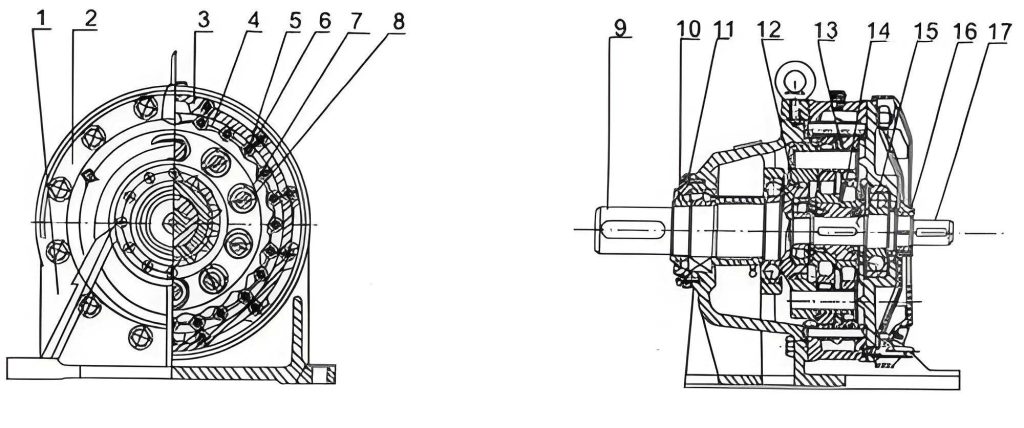
To begin, we established the foundational platform for our design work. Autodesk Inventor 7.0 is a feature-rich CAD software that supports parametric, associative, and adaptive modeling. Its key functionalities include part design, assembly modeling, drawing generation, and simulation tools, all integrated into a seamless environment. For the cycloidal drive project, we utilized features such as sketch-based modeling, extrusion, revolution, and pattern creation to build complex geometries. The software’s ability to handle equations and parameters was particularly valuable for defining the cycloidal profile, which is central to the drive’s performance. Below, we summarize the core features of Autodesk Inventor 7.0 relevant to our cycloidal drive design in a table.
| Feature | Description | Application in Cycloidal Drive Design |
|---|---|---|
| Parametric Modeling | Allows dimensions and features to be driven by parameters and equations. | Used to define the cycloidal curve and adjust gear ratios dynamically. |
| Assembly Constraints | Provides tools like mate, flush, and angle to assemble components with defined relationships. | Critical for simulating the interaction between the cycloidal disk, pins, and housing. |
| Interference Analysis | Detects clashes between parts in an assembly to prevent design flaws. | Applied to ensure smooth operation of the cycloidal drive without physical obstructions. |
| Equation-Driven Curves | Enables creation of complex curves using mathematical functions. | Essential for generating the precise cycloidal tooth profile. |
| Simulation and Motion Study | Allows virtual testing of mechanisms under realistic conditions. | Used to validate the motion of the cycloidal drive and assess wear patterns. |
The heart of the cycloidal drive is the cycloidal disk, which features a unique lobed profile that engages with pin gears to produce output rotation. Modeling this disk accurately is paramount, as any deviation can lead to inefficiency or failure. In Autodesk Inventor 7.0, we employed two methods to create the cycloidal curve: using the built-in f(x) parameter function and programming a custom solution with parametric equations. The cycloidal profile is derived from epicyclic motion, where a point on a circle rolls without slipping around another circle. The parametric equations for the cycloidal curve in Cartesian coordinates are as follows:
$$ x_0 = r_p \sin\alpha – \frac{Q_1}{v_p} \sin(v_p \alpha) $$
$$ y_0 = r_p \cos\alpha – \frac{Q_1}{v_p} \cos(v_p \alpha) $$
Here, \( r_p \) represents the pitch radius of the pin gear, \( \alpha \) is the rotation angle (typically ranging from 0 to 360 degrees), \( Q_1 \) is a factor related to the eccentricity, and \( v_p \) denotes the number of lobes on the cycloidal disk. For a standard cycloidal drive, \( v_p \) is often equal to the number of pins minus one. The actual tooth profile of the cycloidal disk is then obtained by offsetting this curve by the radius of the pins, given by:
$$ x = x_0 + r_{rp} \cos\phi $$
$$ y = y_0 – \frac{Q_1}{v_p} \cos(v_p \alpha) $$
where \( r_{rp} \) is the radius of the rolling circle, and \( \phi \) is an angle parameter. To implement this in our design, we wrote a simple C++ program to compute coordinate points at intervals of 0.5 degrees, resulting in 721 points per full revolution. These points were saved as a text file and imported into Autodesk Inventor 7.0 to generate a smooth spline curve. This parametric approach allowed us to quickly adjust design variables and observe their impact on the cycloidal drive’s geometry. Below, we present a table summarizing key parameters for a typical cycloidal disk in our project.
| Parameter | Symbol | Value | Role in Cycloidal Drive |
|---|---|---|---|
| Number of Lobes | \( v_p \) | 9 | Determines the reduction ratio and engagement with pins. |
| Pitch Radius | \( r_p \) | 50 mm | Defines the base circle for the cycloidal motion. |
| Pin Radius | \( r_{rp} \) | 5 mm | Influences the tooth thickness and contact stress. |
| Eccentricity Factor | \( Q_1 \) | 2.5 mm | Controls the offset for generating the cycloidal curve. |
| Rotation Angle Increment | \( \alpha \) | 0.5° | Affects the resolution and smoothness of the profile. |
With the cycloidal disk modeled, we proceeded to other components, such as the housing or casing. The housing of a cycloidal drive is a complex shell-like structure that encloses the internal gears and supports bearings. Its geometry often includes irregular contours, mounting flanges, and internal cavities, making 3D modeling challenging. In Autodesk Inventor 7.0, we used a combination of extrusion, revolution, shelling, and cut features to construct the housing. We started with a base sketch outlining the main profile, then applied rotational extrusion to create the cylindrical body. Next, we added bolt holes and reinforcement ribs using pattern tools to ensure uniformity. The shell feature was employed to hollow out the interior, reducing material weight while maintaining strength. Throughout this process, we adhered to theoretical calculations from mechanical design handbooks to ensure dimensions met load requirements. For instance, the wall thickness was determined based on stress analysis to prevent deformation under operational torque. The table below highlights key steps in housing modeling for the cycloidal drive.
| Modeling Step | Tool in Inventor 7.0 | Purpose | Considerations for Cycloidal Drive |
|---|---|---|---|
| Base Profile Creation | Sketch and Revolve | To form the primary cylindrical shape of the housing. | Must align with the outer diameter of the cycloidal disk assembly. |
| Internal Cavity Design | Shell and Cut | To create space for gears and reduce weight. | Ensures clearance for the cycloidal disk and pins during rotation. |
| Mounting Features | Extrude and Pattern | To add bolt holes and flanges for installation. | Critical for securing the cycloidal drive in real-world applications. |
| Reinforcement Ribs | Sweep and Fillet | To enhance structural integrity against torsional loads. | Prevents housing flexure that could misalign the cycloidal drive components. |
| Interference Check | Analysis Tools | To verify internal clearances post-modeling. | Avoids collisions between housing and moving parts of the cycloidal drive. |
After modeling all individual parts, we moved to the assembly phase. Virtual assembly simulation is a cornerstone of modern CAD, allowing designers to test fit and function before physical prototyping. For the cycloidal drive, we adopted a bottom-up approach in Autodesk Inventor 7.0, starting with sub-assemblies like the bearing-shaft units and pin-sleeve sets. Each sub-assembly was created by applying constraints such as mate, insert, and tangent to define mechanical relationships. For example, we used insert constraints to align bearings with shafts, and mate constraints to position the cycloidal disk relative to the eccentric input. This meticulous constraint setup ensured that all degrees of freedom were properly controlled, mimicking real-world assembly conditions. Once sub-assemblies were ready, we proceeded to the total assembly of the cycloidal drive. The sequence began with installing the input shaft, followed by the cycloidal disks, pins, and housing, culminating in auxiliary components like seals and covers. This order was critical to avoid conflicts and ensure a logical build process. During assembly, we frequently performed interference checks using the software’s built-in analysis tool. This involved selecting components and running checks to detect any geometric overlaps, which could indicate design flaws. For instance, we verified that the cycloidal disk rotated freely without contacting the housing interior. The ability to visualize these interactions in 3D provided invaluable insights, enabling us to make iterative improvements. Below, we summarize the assembly constraints used for key components of the cycloidal drive.
| Component Pair | Constraint Type | Function | Impact on Cycloidal Drive Performance |
|---|---|---|---|
| Cycloidal Disk to Input Shaft | Insert and Mate | Secures the disk onto the eccentric shaft for motion transfer. | Ensures precise eccentric rotation essential for cycloidal drive operation. |
| Pins to Housing | Mate and Flush | Positions pin gears radially around the cycloidal disk. | Maintains even engagement with the cycloidal disk lobes for smooth torque output. |
| Bearings to Shafts | Insert | Aligns bearings axially and radially on shafts. | Reduces friction and supports loads in the cycloidal drive assembly. |
| Housing to Base Plate | Mate and Angle | Orients the housing for mounting in external systems. | Affects the overall alignment and stability of the cycloidal drive in use. |
| Output Mechanism to Disk | Motion Constraint | Simulates the output rotation relative to input. | Validates the reduction ratio and motion kinematics of the cycloidal drive. |
To further validate our design, we conducted motion simulations within Autodesk Inventor 7.0. By applying rotational drivers to the input shaft and setting up contact sets between the cycloidal disk and pins, we could animate the assembly and observe its behavior. The simulation revealed the cycloidal drive’s characteristic motion: as the input shaft rotates eccentrically, the cycloidal disk undergoes a compound rolling action against the stationary pins, resulting in reduced output speed. We measured key metrics such as angular velocity, torque transmission, and contact forces. These insights allowed us to optimize parameters like lobe count and pin diameter for improved efficiency. For example, we adjusted the cycloidal profile to minimize stress concentrations, enhancing the durability of the drive. The integration of simulation tools underscored the power of digital design in predicting real-world performance without costly physical tests.
In addition to modeling and assembly, we leveraged Autodesk Inventor 7.0’s drawing capabilities to generate detailed engineering drawings for manufacturing. These drawings included orthographic views, sections, and annotations with geometric tolerances specific to the cycloidal drive. We also exported files in formats like STEP and IGES for compatibility with CNC machines and other CAD systems. This seamless workflow from 3D model to production documentation accelerated the prototyping phase, reducing lead times significantly. Throughout this process, we maintained a focus on the cycloidal drive’s unique requirements, such as high-precision tooth profiles and tight tolerances for bearing fits. The table below compares traditional design methods with our digital approach for the cycloidal drive.
| Aspect | Traditional Design | Digital Design with Inventor 7.0 | Benefits for Cycloidal Drive |
|---|---|---|---|
| Time for Prototyping | Weeks to months due to manual drafting and physical mock-ups. | Days to weeks with virtual models and simulations. | Faster iteration cycles for optimizing cycloidal drive parameters. |
| Error Detection | Relies on physical assembly, leading to late-stage fixes. | Early interference checks and motion analysis catch issues digitally. | Prevents misalignment in cycloidal drive components before manufacturing. |
| Cost Implications | High due to material waste and rework. | Low as virtual testing reduces physical prototypes. | Makes cycloidal drive development more economical for small batches. |
| Design Flexibility | Limited by manual revisions; changes are cumbersome. | Parametric models allow quick adjustments to cycloidal drive geometry. | Enables customization of cycloidal drive for different applications. |
| Collaboration | Challenging with paper-based drawings. | Digital files facilitate easy sharing and team input. | Improves coordination in cycloidal drive projects across disciplines. |
Reflecting on our experience, the use of Autodesk Inventor 7.0 for designing a cycloidal drive has proven transformative. The software’s comprehensive toolset enabled us to tackle complex geometries, such as the cycloidal profile, with precision and ease. By integrating parametric equations, we could dynamically explore design variations, optimizing the cycloidal drive for specific performance criteria like torque capacity and reduction ratio. The virtual assembly and simulation features provided a risk-free environment to test functionality, ensuring that the final design would operate smoothly in real applications. Moreover, the ability to generate manufacturing-ready drawings directly from 3D models streamlined the transition from design to production. This holistic digital approach not only saved time and resources but also elevated the quality of the cycloidal drive, making it more reliable and efficient.
Looking ahead, the principles we applied can be extended to other complex mechanical systems. For instance, similar methodologies could be used for designing harmonic drives or planetary gearboxes, where precise motion control is paramount. The cycloidal drive serves as an excellent case study in the power of modern CAD tools to innovate in mechanical engineering. As software continues to evolve, with enhancements in AI-driven design and cloud-based collaboration, the potential for further optimizing cycloidal drives and similar mechanisms is immense. We encourage engineers to embrace these technologies to push the boundaries of what’s possible in precision gear design.
In conclusion, our project demonstrates that Autodesk Inventor 7.0 is an invaluable asset for the design and simulation of cycloidal drives. From initial modeling to final validation, the software supported every step with robust features and intuitive workflows. By leveraging digital tools, we achieved a design that is both high-performing and manufacturable, underscoring the future of mechanical engineering in a virtualized world. The cycloidal drive, with its intricate kinematics, benefits greatly from such an approach, setting a benchmark for future innovations in reduction technology.