
As a researcher in mechanical engineering, I have extensively studied various precision transmission systems, with a particular focus on the planetary roller screw mechanism. This mechanism is renowned for its high load capacity, precision, and longevity, making it indispensable in applications ranging from aerospace to medical devices. Among its variants, the inverted planetary roller screw mechanism (IPRSM) presents a unique configuration that offers advantages in compactness and integration with electromechanical systems. In this article, I will delve into the design methodology, kinematic analysis, and virtual assembly of the inverted planetary roller screw mechanism, providing a comprehensive guide that leverages tables and formulas to encapsulate key insights. Throughout, I will emphasize the term “planetary roller screw” to underscore its centrality in this discourse.
The planetary roller screw mechanism, in its standard form, converts rotational motion to linear motion or vice versa through the engagement of threads on a screw, rollers, and a nut. The inverted planetary roller screw mechanism modifies this arrangement by employing a long nut as the rotating input and a hollow screw as the linear output. This inversion allows for seamless integration with motor rotors, enhancing the compactness of electromechanical actuators. My exploration begins with an examination of the structural principles that underpin the inverted planetary roller screw mechanism.
Structural Principles of the Inverted Planetary Roller Screw Mechanism
The inverted planetary roller screw mechanism consists of several key components: a hollow screw, multiple rollers, a long nut, a cage, and a push rod. The rollers are positioned between the hollow screw and the long nut, serving as intermediaries that transmit motion and force. In this configuration, the long nut rotates under motor drive, while the hollow screw translates axially, driven by the threaded engagement. The rollers feature a single-start thread with arc-shaped flanks, ensuring point contact with both the hollow screw and the long nut to minimize friction and wear. Additionally, the rollers incorporate helical gears at their ends that mesh with straight gears on the hollow screw, counteracting tilting moments induced by the lead angle and preventing axial slippage. This intricate interplay of components is what grants the planetary roller screw mechanism its high efficiency and reliability.
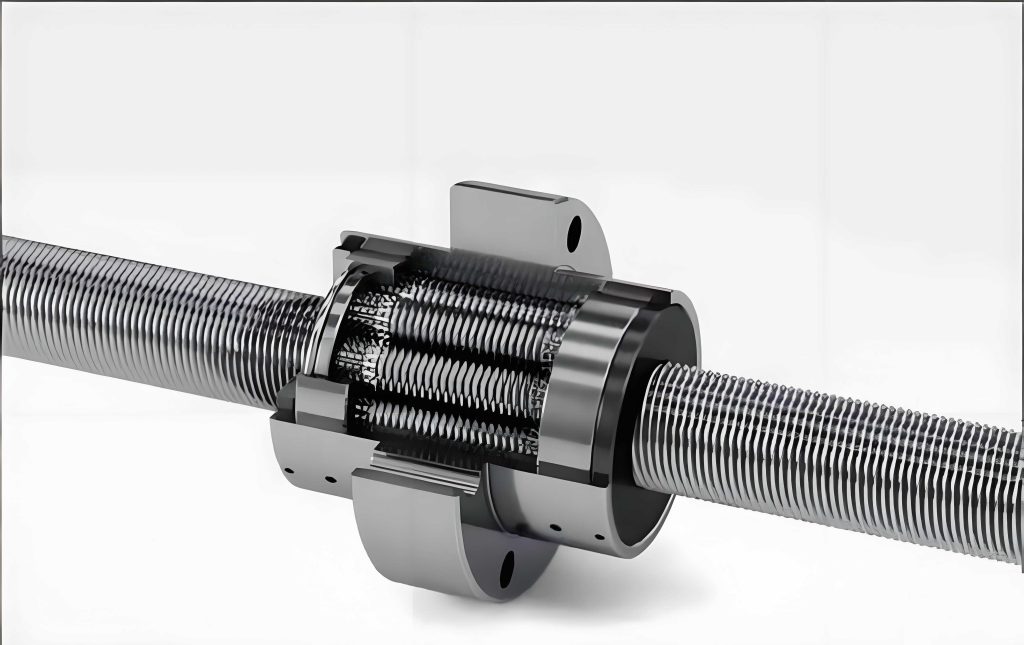
To appreciate the design nuances, it is essential to understand the parameter relationships that govern the inverted planetary roller screw mechanism. The design process revolves around ensuring compatibility among the hollow screw, rollers, and long nut, particularly in terms of thread geometry and gear dimensions. I have developed a systematic design flow that starts with the roller parameters and propagates to other components, as summarized below.
Design Methodology for the Inverted Planetary Roller Screw Mechanism
The design of the inverted planetary roller screw mechanism hinges on precise parameter matching. I begin by defining the roller dimensions, as the roller is the pivotal element that dictates the overall geometry. The roller pitch diameter is determined based on application requirements such as speed and thrust, along with the number of thread starts and pitch. For the planetary roller screw mechanism to function correctly, the threads on the hollow screw, rollers, and long nut must have consistent pitches and complementary profiles.
The roller design encompasses three aspects: the pitch diameter, the end helical gears, and the thread profile. The pitch diameter of the roller, denoted as \(d_r\), relates to the hollow screw pitch diameter \(d_s\) through the number of thread starts \(n_s\) on the hollow screw and long nut. Specifically, the relationship is given by:
$$ d_r = \frac{d_s}{n_s} $$
This equation ensures that the roller threads mesh properly with both the hollow screw and the long nut. The end helical gears on the roller must mesh with straight gears on the hollow screw, requiring their pitch diameters to align. Thus, we have:
$$ d_r = d_l = m z_r $$
$$ d_s = d_z = m z_s $$
where \(d_l\) is the pitch diameter of the roller’s helical gear, \(m\) is the gear module, \(z_r\) is the number of teeth on the roller gear, \(d_z\) is the pitch diameter of the hollow screw’s straight gear, and \(z_s\) is the number of teeth on the hollow screw gear. To avoid undercutting in gear design, the minimum number of teeth must satisfy:
$$ z_{\text{min}} = \frac{2h_a^*}{\sin^2 \alpha_n} $$
Here, \(h_a^*\) is the addendum coefficient (typically 1 for full-depth teeth), and \(\alpha_n\) is the pressure angle. For the planetary roller screw mechanism, I ensure that \(z_r > z_{\text{min}}\) to maintain gear integrity.
The thread profile on the roller is arc-shaped to facilitate point contact. The radius of this arc, \(R\), is calculated as:
$$ R = \frac{d_r}{2 \sin 45^\circ} $$
This profile reduces stress concentration and enhances the durability of the planetary roller screw mechanism. Furthermore, to allow assembly, the addendum diameter of the roller gear must not exceed the major diameter of the roller thread, expressed as:
$$ d_a = (z_r + 2h_a^*) m \leq d_R $$
where \(d_a\) is the addendum diameter, and \(d_R\) is the major diameter of the roller thread. The dedendum diameter \(d_f\) is given by:
$$ d_f = (z_r – 2h_a^* – 2c^*) m $$
with \(c^*\) being the clearance coefficient.
Moving to the hollow screw and long nut, their parameters must harmonize with the roller. The pitches are equal across all components:
$$ P_s = P_n = P_r $$
where \(P_s\), \(P_n\), and \(P_r\) are the pitches of the hollow screw, long nut, and roller, respectively. The number of thread starts on the hollow screw and long nut are identical:
$$ n_s = n_n $$
The lead angles for the roller and hollow screw are also equal due to the absence of relative axial motion:
$$ \tan \lambda_r = \tan \lambda_s = \frac{L}{\pi d} = \frac{n P}{\pi d} $$
Here, \(\lambda_r\) and \(\lambda_s\) are the lead angles, \(L\) is the lead, \(n\) is the number of starts, \(P\) is the pitch, and \(d\) is the pitch diameter. From these relations, I derive the fundamental parameter matching for the inverted planetary roller screw mechanism, as encapsulated in Table 1.
| Component | Number of Starts | Thread Profile | Thread Angle | Lead |
|---|---|---|---|---|
| Hollow Screw | \(n_s\) | Triangular Section | 90° | \(L_s\) |
| Long Nut | \(n_n = n_s\) | Triangular Section | 90° | \(L_n = L_s\) |
| Roller | 1 | Arc Section | 90° | \(L_r = L_s / n_s\) |
This table succinctly captures the symmetry and dependencies inherent in the planetary roller screw mechanism design. To further illustrate common configurations, I have compiled typical parameter combinations based on extensive analysis, presented in Table 2.
| Number of Starts on Hollow Screw and Long Nut | Relationship Between Nut and Screw Pitch Diameters | Relationship Between Roller and Screw Pitch Diameters | Number of Rollers |
|---|---|---|---|
| \(n_s = 3\) | \(d_n = 3 d_s\) | \(d_r = d_s\) | 4, 5 |
| \(n_s = 4\) | \(d_n = 2 d_s\) | \(d_r = d_s / 2\) | 7, 8, 9 |
| \(n_s = 5\) | \(d_n = (5/3) d_s\) | \(d_r = d_s / 3\) | 7 to 12 |
These combinations guide the selection of roller counts to optimize load distribution and structural integrity in the planetary roller screw mechanism. The number of rollers directly influences the stiffness and carrying capacity; hence, I typically maximize it within spatial constraints while ensuring even circumferential distribution.
Kinematic Analysis of the Inverted Planetary Roller Screw Mechanism
Understanding the motion characteristics is crucial for the planetary roller screw mechanism. In the inverted configuration, the long nut rotates, driving the rollers to both revolve around the hollow screw (publication) and rotate about their own axes (rotation). I analyze this using a simplified motion diagram where a roller starts at point A and ends at point E after one revolution of the long nut. The public diameter is \(d_c\), the angular velocity of the long nut is \(\omega_n\), the roller’s rotation angular velocity is \(\omega_r\), and its publication angular velocity is \(\omega_c\).
The pitch diameters satisfy:
$$ d_n = d_s + 2 d_r $$
Given that the hollow screw is fixed rotationally, the contact point between the roller and hollow screw is an instantaneous center of velocity. From velocity relations, I derive the publication angular velocity:
$$ \omega_c = \frac{d_n}{2 d_c} \omega_n = \frac{d_s + 2 d_r}{2(d_s + d_r)} \omega_n = \frac{n + 2}{2(n + 1)} \omega_n $$
where \(n = d_s / d_r\). For pure rolling, the arc length rolled by the roller equals that on the hollow screw, leading to:
$$ \frac{\phi_r}{\phi_c} = \frac{d_s}{d_r} = n $$
Here, \(\phi_r\) and \(\phi_c\) are the rotation and publication angles, respectively. Since angular velocities ratio similarly, the rotation angular velocity is:
$$ \omega_r = \frac{n(n + 2)}{2(n + 1)} \omega_n $$
These equations elucidate the kinematic behavior of the planetary roller screw mechanism, highlighting how the number of thread starts affects motion transmission. Such analysis is vital for predicting performance in dynamic applications.
Determining the Number of Rollers
The selection of roller count in the planetary roller screw mechanism is guided by geometric and load-bearing considerations. Rollers are arranged symmetrically around the hollow screw to ensure uniform force distribution. Based on the parameter matching in Table 2, I determine the feasible number of rollers for given start combinations. For instance, with \(n_s = 4\), the roller pitch diameter is half that of the hollow screw, allowing 7 to 9 rollers to be accommodated. This range balances spatial efficiency with mechanical advantage. In practice, I opt for higher counts within limits to enhance the load capacity of the planetary roller screw mechanism, as each roller shares the applied force, reducing stress on individual threads.
Virtual Assembly and 3D Modeling of the Inverted Planetary Roller Screw Mechanism
With the design parameters established, I proceed to virtual assembly using CAD software, such as SolidWorks. This process involves creating 3D models of each component and assembling them digitally to verify fit and function. The modeling starts with the roller, as its dimensions dictate others. For the planetary roller screw mechanism example, I choose the following parameters based on the design methodology:
- Hollow screw: pitch diameter \(d_s = 20 \, \text{mm}\), lead \(L_s = 5.08 \, \text{mm}\), starts \(n_s = 4\), pitch \(P_s = 1.27 \, \text{mm}\), straight gear teeth \(z_s = 80\).
- Roller: pitch \(P_r = 1.27 \, \text{mm}\), pitch diameter \(d_r = 5 \, \text{mm}\), helical gear teeth \(z_r = 20\).
- Long nut: pitch diameter \(d_n = 30 \, \text{mm}\), lead \(L_n = 5.08 \, \text{mm}\), starts \(n_n = 4\), pitch \(P_n = 1.27 \, \text{mm}\).
The gear module is set to \(m = 0.25\), resulting in a gear ratio of 1:4 between roller and hollow screw. The detailed parameters are summarized in Table 3.
| Component | Major Diameter | Pitch Diameter | Minor Diameter | Starts | Hand | Pitch | Module | Teeth |
|---|---|---|---|---|---|---|---|---|
| Roller | 5.4 mm | 5 mm | 4.45 mm | 1 | Right | 1.27 mm | 0.25 | 20 |
| Hollow Screw | 20.55 mm | 20 mm | 19.6 mm | 4 | Left | 1.27 mm | 0.25 | 80 |
| Long Nut | 30.55 mm | 30 mm | 29.6 mm | 4 | Left | 1.27 mm | – | – |
In modeling, I use sweep-cut features to generate threads. The helix is defined on the pitch diameter, and the cut profile is sketched on a plane perpendicular to the helix start point. For the roller, the thread profile is an arc centered on the axis, with radius \(R\) as calculated earlier. To avoid interference during assembly, I ensure that the root widths of threads on the hollow screw, roller, and long nut are identical. Adjustments to tooth thickness may be needed for proper meshing in the planetary roller screw mechanism.
The virtual assembly of the planetary roller screw mechanism requires careful attention to phase alignment between rollers and the long nut. Each roller must simultaneously engage both the thread and gear pairs. I achieve this by aligning reference planes and setting appropriate rotation angles. For a roller at position \(i\) (with \(i = 1, 2, \dots, 8\) for eight rollers), the publication angle \(\theta_i\) and rotation angle \(\beta_i\) are given by:
$$ \theta_i = (i – 1) \phi $$
$$ \beta_i = n \theta_i $$
where \(\phi\) is the angular spacing between rollers (e.g., \(45^\circ\) for eight rollers), and \(n\) is the number of starts. By adjusting these angles in the CAD environment, I ensure correct啮合. The cage holds the rollers in place, maintaining the center distance between roller and long nut axes. The final assembled 3D model validates the design, confirming that the inverted planetary roller screw mechanism operates smoothly without collisions.
Conclusions
In this article, I have presented a thorough exploration of the inverted planetary roller screw mechanism, covering its design, kinematic analysis, and virtual assembly. The planetary roller screw mechanism, in its inverted form, offers significant advantages for compact electromechanical systems, and my systematic approach ensures reliable parameter matching and performance. Through formulas and tables, I have encapsulated the critical relationships among components, such as the pitch diameter ratios and gear meshing conditions. The kinematic derivations provide insight into motion transmission, while the virtual assembly methodology facilitates digital validation. This comprehensive treatment lays the groundwork for further studies, including static and dynamic analyses of the planetary roller screw mechanism. As technology advances, the inverted planetary roller screw mechanism will continue to play a pivotal role in high-precision applications, driven by its robustness and efficiency.