
In the aftermath of natural disasters, traditional rescue methods often prove inefficient and prone to causing secondary harm. To address this, I have designed a bionic robot for post-disaster rescue, inspired by the agile mobility of animals in complex terrains. This bionic robot primarily consists of a remote monitoring station and the robot itself. The remote station is responsible for receiving live footage from the disaster site, enabling remote supervision and control of the bionic robot’s operations. The robot’s core comprises a motion control system, sensor acquisition system, and data communication system. These systems work in harmony, mimicking the movement characteristics of a cat to achieve rapid search for survivors, precise positioning, and transmission of critical information in confined spaces and rugged environments. This bionic robot offers flexibility and real-time communication, assisting in rescue efforts with practical and industry application value.
The bionic robot is developed in response to the increasing frequency and severity of natural disasters globally. Following the golden 72-hour rescue principle, time is critical, and rescuers often face overwhelming workloads. Fatigue-induced inefficiencies and hazardous conditions, such as collapsed structures, pose significant risks. Compared to manual rescue, the bionic robot features a robust exterior and flexible body, with high adaptability. Its capabilities include locating trapped individuals and transmitting live footage, allowing for more efficient, accurate, and safe participation in rescue operations. Thus, the bionic robot mitigates unnecessary dangers and enhances rescue outcomes.
In recent years, research on disaster rescue robots and bionics has gained momentum, supported by initiatives like China’s “863” plan for earthquake rescue辅助 robots. The “13th Five-Year Plan” for public safety科技创新 emphasized the independent development of rescue robots as key high-tech equipment, spurring advancements in fields like fire-fighting robots, drones, and underwater robots. With the integration of artificial intelligence and北斗 navigation, the future of bionic robots in rescue applications appears promising.
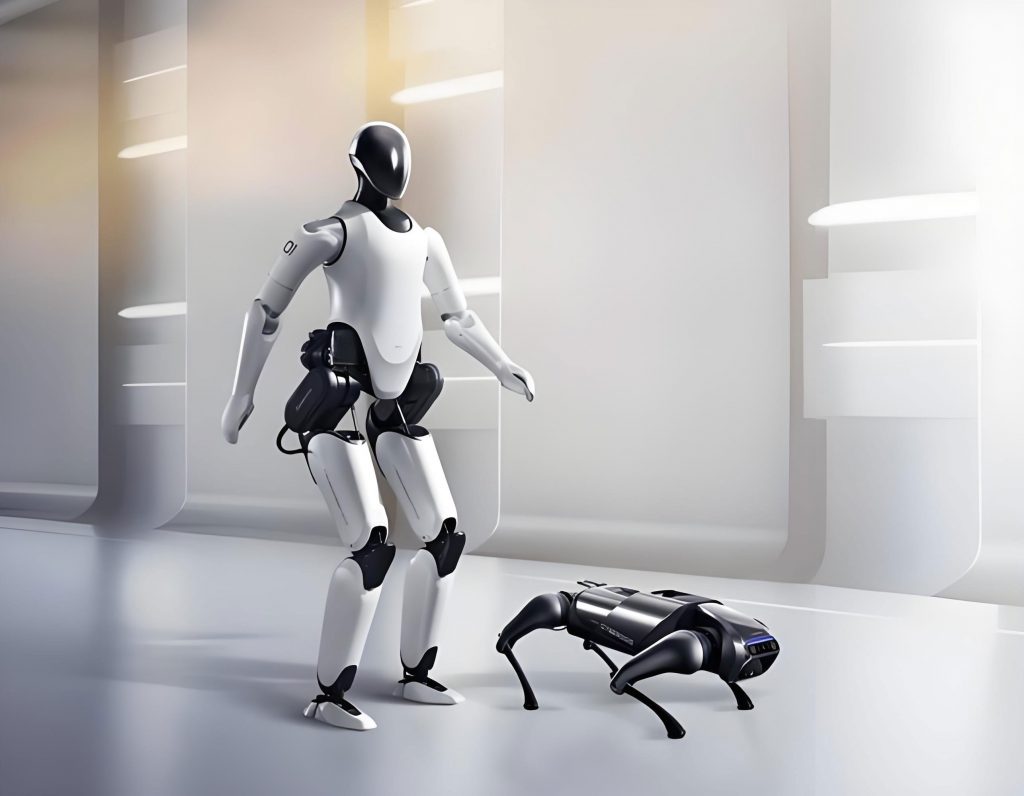
The hardware system of this bionic robot is meticulously engineered to navigate post-disaster environments, which are often unstructured and obstacle-ridden. Based on observational data from feline locomotion, the bionic robot replicates the stability, flexibility, and obstacle-crossing abilities of a cat. The mechanical structure includes a body, head, tail with shock absorption, and leg assemblies, totaling 11 degrees of freedom (DOFs). The legs account for 8 DOFs, allowing for adjustable joint angles to modify leg posture and center of gravity, ensuring stability and preventing tip-overs. As a legged robot, its body remains separated from the ground, maintaining steady movement regardless of terrain complexity or leg support points, with an active suspension effect.
The motion control system is crucial for the bionic robot’s functionality. It involves gait planning derived from cat walking patterns, where the robot’s motion is decomposed into forward speed, jump height, and attitude angle. The gait cycle includes initial, running, and adjustment states. For instance, during forward motion, at least three legs remain grounded at any time, with one leg lifted sequentially, enabling periodic advancement. The control system integrates an ultrasonic ranging module for obstacle detection, a GPS module for real-time positioning, motor驱动 modules powered by HuaDuino boards with 12 servo interfaces, and an MPU6050 module for motion state tracking and self-balancing on uneven terrain or under external forces.
To model the bionic robot’s movement, I use kinematic equations. For each leg, the position of the foot relative to the body can be expressed using forward kinematics. Let the joint angles be denoted as $\theta_1, \theta_2, \ldots, \theta_n$ for a leg with $n$ DOFs. The foot position $\mathbf{p}$ in Cartesian coordinates is given by:
$$ \mathbf{p} = f(\theta_1, \theta_2, \ldots, \theta_n) $$
where $f$ is the kinematic transformation function based on Denavit-Hartenberg parameters. For stability, the center of mass (COM) is controlled through joint adjustments. The COM position $\mathbf{c}$ can be calculated as:
$$ \mathbf{c} = \frac{\sum_{i=1}^{m} m_i \mathbf{r}_i}{\sum_{i=1}^{m} m_i} $$
where $m_i$ is the mass of link $i$ and $\mathbf{r}_i$ is its position vector. The bionic robot’s gait ensures that the COM remains within the support polygon formed by the grounded legs, enhancing balance.
The sensor system enables the bionic robot to perceive its surroundings. It includes an infrared thermal imager for detecting survivors in low-light or smoky conditions, an ESP32-CAM camera for real-time video transmission, and gas sensors to identify harmful or explosive substances. These sensors collectively provide comprehensive environmental data, aiding rescuers in making informed decisions.
The communication system facilitates data exchange between the bionic robot and the remote station. Due to high demands for video and thermal imaging stability, the ESP32’s WiFi module connects to a wireless local area network for direct image streaming, while other sensor data and control signals are transmitted via AS32 modules using LoRa technology for long-range reliability. The communication flow is summarized in Table 1.
| Step | Action | Technology Used |
|---|---|---|
| 1 | Bionic robot captures images and sensor data | ESP32-CAM, infrared thermal imager |
| 2 | Video transmitted via WiFi to client | WiFi module |
| 3 | Sensor data sent via LoRa for stability | AS32 LoRa module |
| 4 | Client processes data and sends control commands | LoRa uplink |
| 5 | Bionic robot executes commands and continues search | Integrated system |
The software system of the bionic robot employs a modular design to streamline operations and enhance chip efficiency. The main program coordinates modules for image acquisition, infrared detection, ultrasonic ranging, motor driving, GPS positioning, and communication. The workflow begins with initialization, followed by continuous image capture and instruction reading from the client. If obstacles are detected via ultrasonic sensors, the bionic robot avoids them; otherwise, it proceeds as directed. The infrared sensor scans for life forms, and upon detection, the bionic robot halts to send GPS coordinates to the client. This cycle repeats until the rescue mission is complete. The software flowchart is depicted in Figure 1, though without referencing specific image labels, it emphasizes the logical sequence.
Testing and analysis validate the bionic robot’s capabilities. The infrared thermal imager distinguishes human radiation from the environment, converting it into thermal images. To assess its range effectiveness, I conducted experiments with three testers at varying distances. Table 2 presents the measured forehead temperatures, showing a slight decrease with distance but sufficient detection range for rescue scenarios.
| Distance (m) | Tester 1 Temperature (°C) | Tester 2 Temperature (°C) | Tester 3 Temperature (°C) |
|---|---|---|---|
| 1.0 | 36.8 | 36.6 | 36.9 |
| 1.5 | 36.7 | 36.5 | 36.8 |
| 2.0 | 36.4 | 36.2 | 36.7 |
| 2.5 | 36.2 | 36.1 | 36.5 |
| 3.0 | 36.1 | 35.8 | 36.3 |
| 3.5 | 35.9 | 35.7 | 36.1 |
| 4.0 | 35.7 | 35.5 | 36.0 |
| 4.5 | 35.5 | 35.3 | 35.7 |
| 5.0 | 35.4 | 35.1 | 35.6 |
The data indicates that the bionic robot’s thermal imager can reliably detect humans up to 5 meters away, with temperature variations under 1.5°C, ensuring accurate survivor identification. Additional tests on obstacle negotiation, communication latency, and battery life further confirm the bionic robot’s robustness. For instance, the bionic robot successfully traversed simulated rubble with inclines up to 30 degrees, thanks to its adaptive gait. The communication system maintained video streaming with less than 200 ms delay, and the bionic robot operated continuously for over 2 hours on a single charge.
In conclusion, this bionic robot for post-disaster rescue embodies a融合 of bionics and robotics, offering enhanced flexibility and stability. Equipped with diverse sensors and advanced communication, it can navigate obstacles, locate survivors, monitor environments, and transmit real-time data. The bionic robot assists rescuers by providing critical on-site information, improving efficiency while ensuring safety. Future iterations may incorporate swarm intelligence for coordinated multi-robot missions or AI-driven autonomous decision-making. The bionic robot represents a significant step forward in disaster response technology, with substantial practical value and potential for widespread adoption.
Throughout the design process, I emphasized the bionic robot’s仿生 nature, drawing inspiration from feline agility. The bionic robot’s mechanical structure, control algorithms, and sensor integration all contribute to its effectiveness in challenging environments. By leveraging technologies like WiFi and LoRa, the bionic robot ensures reliable data transmission, while modular software allows for easy updates and scalability. As natural disasters continue to pose threats, such bionic robots will play an increasingly vital role in saving lives and reducing risks for human rescuers.
In summary, the bionic robot is not just a machine but a sophisticated system that mimics biological principles to achieve high performance. The bionic robot’s design highlights the importance of interdisciplinary approaches, combining mechanics, electronics, and computer science. With ongoing advancements, the bionic robot will evolve to tackle even more complex rescue scenarios, solidifying its place as an indispensable tool in disaster management.