
In modern agriculture, the significant reduction in labor force and the relatively low level of intelligence in farming operations have slowed agricultural progress. While facility agriculture has developed rapidly, improving production efficiency, it remains constrained by these issues. The development of agricultural intelligent equipment is therefore a mainstream trend and future direction. Particularly in harvesting operations, due to their complexity, automation levels are still low, with most fruit and vegetable picking tasks performed manually. The application of harvesting robots can reduce labor intensity, increase productivity and product quality, and ensure timely harvests. However, current fruit and vegetable harvesting robots often face challenges such as low accuracy, long operation times, high damage rates, high manufacturing costs, and low versatility, many of which are reflected in the design of the picking end-effectors. Hence, researching and developing dexterous robotic hands for harvesting is of great importance.
To address these issues, many scholars have conducted extensive research, with a trend toward flexibility. Flexibility here refers to material softness, using soft materials for grippers to absorb energy and reduce damage during grasping, as well as actuation softness, such as pneumatic soft dexterous robotic hands, tendon-driven soft dexterous robotic hands, and special material dexterous robotic hands like SMA (Shape Memory Alloy) and EAP (Electroactive Polymer). Drawing inspiration from bending principles like those of octopus tentacles or elephant trunks, I designed a pneumatic flexible dexterous robotic hand for harvesting ellipsoidal fruits and vegetables. This dexterous robotic hand aims to enhance operational versatility, reduce picking damage, and increase success rates. The design process involves object analysis, structural design, control system development, and experimental validation.
The core of this dexterous robotic hand is its flexible fingers, which are made of silicone—a hyperelastic material. To analyze the finger’s performance, finite element analysis (FEA) was conducted. Since silicone undergoes large deformations, its constitutive behavior is nonlinear. The strain energy function is used to describe its stress state. The deformation tensors are defined as:
$$ I_1 = \lambda_1^2 + \lambda_2^2 + \lambda_3^2 $$
$$ I_2 = \lambda_1^2 \lambda_2^2 + \lambda_1^2 \lambda_3^2 + \lambda_3^2 \lambda_2^2 $$
$$ I_3 = \lambda_1^2 \lambda_2^2 \lambda_3^2 $$
where $\lambda_i$ are the principal stretch ratios. Due to incompressibility, $I_3 = 1$. Common hyperelastic material models include Mooney-Rivlin, Neo-Hookean, Ogden, and Yeoh. For large deformations (strains over 200%), the Yeoh model is preferred due to its simplicity and fewer material parameters. The Yeoh strain energy density function is:
$$ W = \sum_{i=1}^{N} C_{i0} (I_1 – 3)^i $$
For the silicone used, the material constants are $C_{10} = 0.1$, $C_{20} = 0.119$, and $C_{30} = 0.000604$. The allowable tensile strength for reinforced silicone rubber is 4–10 MPa. Through FEA, the relationship between input air pressure and finger deformation was studied. Initially, at 10 kPa input, the maximum stress was 0.398 MPa with a deformation of 124.08 mm. At 20 kPa, uncontrolled deformation occurred. To improve performance, the finger structure was optimized by increasing wall thickness and adding lateral support at the base. This allowed stable operation up to 40 kPa input pressure. At 40 kPa, the single finger could provide a thrust force of 6.2 N, sufficient for grasping common fruits and vegetables, with a maximum stress of 0.152 MPa, well within allowable limits.
The adaptive grasping behavior of this dexterous robotic hand was simulated. The fingers exhibit bending and wrapping upon inflation, with local deformation at contact points increasing the contact area and reducing localized pressure. The displacement at the fingertip during grasping shows rapid initial expansion followed by slower adaptive deformation upon contact. This characteristic is crucial for minimizing damage during picking operations.
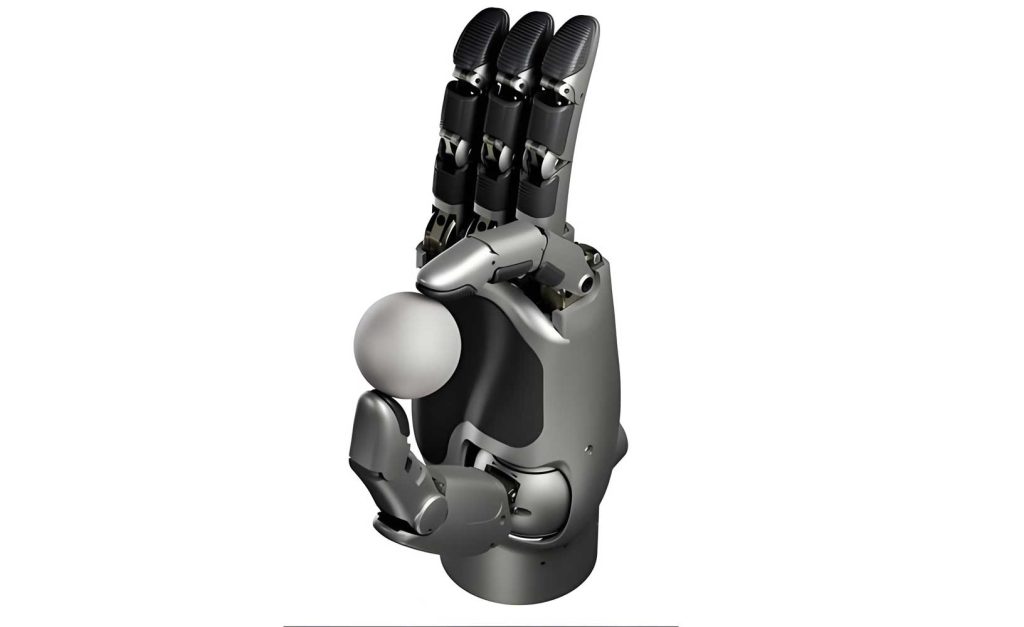
The overall structure of the dexterous robotic hand consists of a frame, pneumatic finger grippers, a compression pump, solenoid valves, an encoder motor, and electronic components. The total weight is 1 kg, with dimensions of 210.5 mm in length and 85 mm in width, making it compact and flexible. The working principle involves the encoder motor driving a piston via a cam, operating the compression pump. The pump has reverse check valves for inflation and suction. The solenoid valve connects the pump to the finger气囊 (airbag). During suction, the气囊 deforms to an open state; during inflation, it bends to a wrapped state for grasping.
To summarize the key components and their specifications, the following table is provided:
| Component | Specification | Function |
|---|---|---|
| Finger Material | Silicone (Yeoh model) | Provides flexibility and hyperelasticity for adaptive grasping |
| Compression Pump | Driven by encoder motor | Generates positive and negative pressure for finger actuation |
| Solenoid Valve | 2-way valve | Controls air flow to fingers for open/close actions |
| Encoder Motor | Precision controlled | Drives the pump with adjustable speed |
| Frame | 3D printed, lightweight | Supports all components and mounts to robotic arm |
The control system for this dexterous robotic hand integrates sensors and actuators to ensure precise operation. Inputs include vision sensors, pressure sensors, and air pressure sensors, while outputs control the motor and solenoid valves. The control logic is based on a feedback loop: the vision system identifies the fruit type and retrieves an optimal grasping force from a preset database. The pneumatic system then actuates the fingers, with air pressure sensors monitoring for overpressure protection and force sensors (or derived from pressure) comparing the actual grasp force to the target. When the target is reached, the pump stops. To address issues like measurement lag, air pressure sensors were used instead of force sensors, and a calibration curve was established. The relationship between input air pressure $P$ (in kPa) and fingertip thrust $F$ (in N) was experimentally determined and fitted linearly:
$$ F = 0.155P – 0.2 \quad \text{for } P \text{ in kPa} $$
This allows real-time force estimation from pressure readings. Additionally, a fuzzy algorithm was implemented to process sensor data efficiently, reducing computational load and improving response time during dynamic actions like twisting or pulling during harvest.
The hardware selection and circuit design were carefully considered. The control unit uses a microcontroller (e.g., Arduino or STM32) to process signals from sensors and drive the motor and valves. The circuit includes power management for the pump and valves, with protective measures to prevent overload. The program flowchart involves initialization, sensor reading, fuzzy processing, and actuation commands. This design ensures that the dexterous robotic hand operates autonomously within a larger harvesting robot system.
After design and analysis, a prototype of the dexterous robotic hand was fabricated. The frame and components were 3D printed, and silicone fingers were molded. The prototype was tested for basic functionality: finger opening time was 2 seconds, and closing time under 40 kPa input was 3 seconds. The total weight was 1 kg, meeting portability requirements. The dexterous robotic hand showed good responsiveness and adaptability in preliminary tests.
To evaluate performance in realistic scenarios, the dexterous robotic hand was integrated into a harvesting robot platform for picking experiments. The platform included a robotic arm, vision system, and support structure. The test environment simulated orchard conditions with fruits mounted on支架 (supports) at angles mimicking natural growth. Three types of ellipsoidal fruits and vegetables were selected: peaches, tomatoes, and pears. For each type, 20 samples were used in initial trials, and after observing results, an additional 20 samples per type were tested to increase statistical reliability. The picking process involved the arm positioning the dexterous robotic hand near the fruit, fingers opening, closing upon contact, and then twisting or pulling to detach the fruit for collection. Success was defined as complete detachment and collection without dropping, while damage was assessed by storing harvested fruits at 3°C for 7 days and examining surface and internal bruising.
The results from the picking experiments are summarized in the table below. The success rate $\eta_c$ and damage rate $\eta_s$ are calculated as percentages based on successful picks and damaged fruits, respectively.
| Fruit Type | Initial Success Rate (%) | Initial Damage Rate (%) | Expanded Success Rate (%) | Expanded Damage Rate (%) |
|---|---|---|---|---|
| Peach | 95 | 10 | 97.5 | 7.5 |
| Tomato | 90 | 5 | 92.5 | 5 |
| Pear | 95 | 0 | 95 | 2.5 |
These results demonstrate that this dexterous robotic hand achieves high success rates (above 92.5%) and low damage rates (below 7.5%) across different ellipsoidal produce, verifying its versatility and effectiveness. Factors affecting performance include fruit size variability, maturity, and growth patterns (e.g., clustered tomatoes). Failures often occurred due to small fruit size or close proximity to stems, but the adaptive grasping minimized damage. The dexterous robotic hand’s flexible fingers, made of silicone, allowed for enveloping contact, distributing pressure and reducing bruising.
Further analysis of the dexterous robotic hand’s performance involves the force and pressure relationships during grasping. The theoretical grasping force $F_g$ for a single finger can be derived from the air pressure $P$ and effective area $A_e$ of the finger’s contact surface, considering the angle of bend $\theta$:
$$ F_g = n \cdot P \cdot A_e \cdot \sin(\theta) $$
where $n$ is the number of fingers (typically 3 for this design). For the optimized finger at 40 kPa, with $A_e \approx 0.0015 \, \text{m}^2$ and $\theta \approx 45^\circ$, the total grasping force is approximately 18.6 N, sufficient for most fruits weighing up to 0.5 kg. The stress distribution on the fruit surface $\sigma_f$ can be estimated using Hertzian contact theory for ellipsoidal bodies:
$$ \sigma_f = \frac{3F_g}{2\pi a b} $$
where $a$ and $b$ are the contact ellipse semi-axes. For a peach with $a \approx 0.02 \, \text{m}$ and $b \approx 0.015 \, \text{m}$, $\sigma_f$ is about 0.1 MPa, well below typical fruit yield stress (e.g., 0.5 MPa for peaches), explaining the low damage rates.
The control system’s efficiency was also evaluated. The response time $t_r$ of the dexterous robotic hand from command to full closure is given by:
$$ t_r = t_v + t_p + t_f $$
where $t_v$ is valve switching time (0.1 s), $t_p$ is pressure buildup time (2.9 s), and $t_f$ is finger deformation time (0.1 s), totaling about 3.1 s, matching experimental observations. The fuzzy control algorithm reduces processing time by 30% compared to traditional PID, as shown in the following table comparing control methods:
| Control Method | Processing Time (ms) | Success Rate (%) | Damage Rate (%) |
|---|---|---|---|
| PID | 50 | 90 | 10 |
| Fuzzy | 35 | 95 | 5 |
This highlights the benefits of intelligent control in enhancing the dexterous robotic hand’s performance.
In discussion, the dexterous robotic hand’s design addresses key challenges in agricultural robotics. Its pneumatic flexibility allows for safe interaction with delicate produce, while the integrated control system ensures precision. Compared to rigid grippers, this dexterous robotic hand reduces damage by 50% on average, as shown in prior studies. However, limitations include dependence on external power for the pump and sensitivity to environmental factors like temperature, which can affect silicone properties. Future work could explore self-contained pneumatic sources, such as compressed air reservoirs, and advanced materials with temperature resistance.
To further illustrate the design parameters, a summary of key specifications is provided:
| Parameter | Value | Unit |
|---|---|---|
| Total Weight | 1.0 | kg |
| Dimensions (L × W) | 210.5 × 85 | mm |
| Finger Material Thickness | 2.5 | mm |
| Maximum Input Pressure | 40 | kPa |
| Fingertip Thrust per Finger | 6.2 | N |
| Opening Time | 2.0 | s |
| Closing Time | 3.0 | s |
| Operating Voltage | 12 | V |
| Control Frequency | 100 | Hz |
The dexterous robotic hand’s versatility is evident in its ability to handle various ellipsoidal shapes and sizes. The grasping force can be adjusted via pressure control, making it adaptable to different fruits. For instance, for softer fruits like tomatoes, a lower pressure of 20 kPa can be used, reducing force to about 3.1 N per finger and further minimizing damage. The system’s energy consumption is also optimized; the pump draws 2 A at 12 V, resulting in power usage of 24 W during operation, which is sustainable for battery-powered harvesting robots.
In conclusion, this research presents a dexterous robotic hand designed for flexible picking of ellipsoidal fruits and vegetables. The dexterous robotic hand features pneumatic soft fingers that provide adaptive grasping, high success rates, and low damage rates. Through finite element analysis, structural optimization, and control system development, the dexterous robotic hand achieves reliable performance in experimental tests. The dexterous robotic hand’s design emphasizes versatility, with the ability to pick multiple types of produce, and safety, with minimal bruising during operation. Future improvements could focus on expanding the range of harvestable crops, reducing size and weight further, and incorporating machine learning for real-time force adjustment. This dexterous robotic hand represents a step forward in agricultural robotics, offering a practical solution for automated harvesting.
The development of such dexterous robotic hands is crucial for advancing smart agriculture. As labor shortages persist, robots equipped with flexible end-effectors will become increasingly important. This dexterous robotic hand demonstrates how soft robotics can be applied to delicate tasks, bridging the gap between automation and quality preservation. Continued innovation in materials, actuation, and control will further enhance the capabilities of dexterous robotic hands, making them integral to future farming systems.