
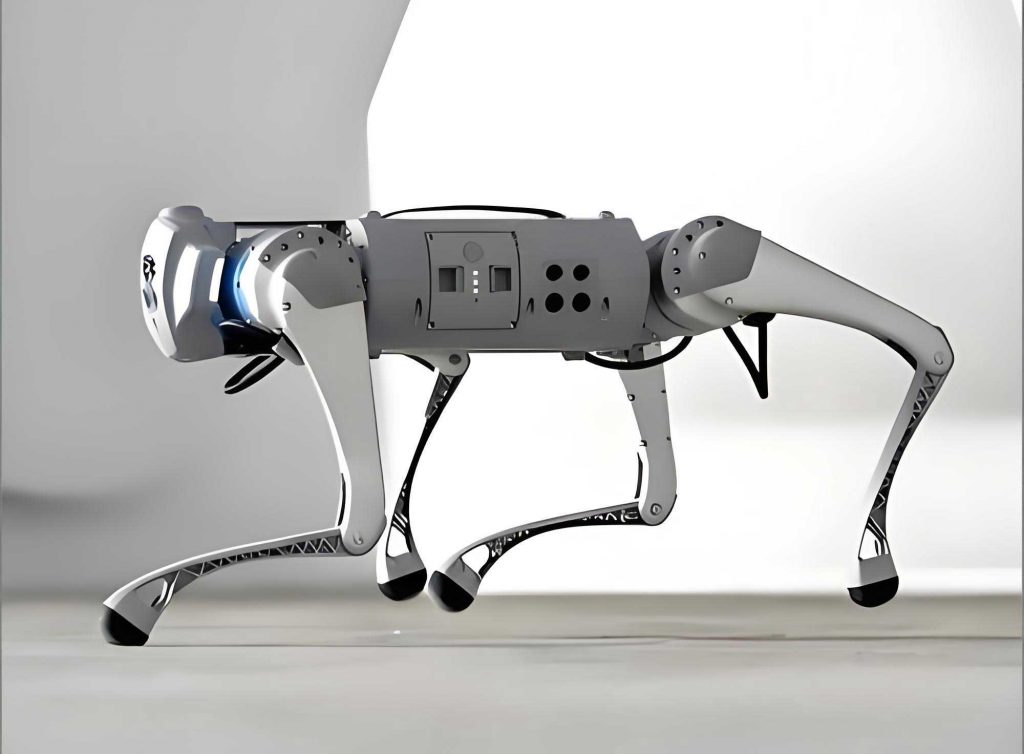
In recent years, the development of quadruped robots has gained significant attention due to their potential in traversing complex terrains and performing tasks in unstructured environments. These robot dogs mimic the locomotion of biological quadrupeds, offering advantages in agility and adaptability. However, traditional quadruped robots often lack the dynamic capabilities observed in animals, such as cheetahs, which utilize spinal flexion and extension to enhance speed and efficiency. This study focuses on designing a discrete series elastic actuated spine for quadruped robots to improve stride length and impact resistance during movement. By incorporating a bio-inspired spine with series elastic actuators (SEA), we aim to replicate the muscle-tendon characteristics of animals, providing passive compliance and energy storage. The spine features a 2-degree-of-freedom (2-DoF) discrete configuration, enabling flexion and extension motions similar to those in running gaits. Through kinematic modeling and experimental validation, we demonstrate the benefits of this design in enhancing the performance of robot dogs.
The biological inspiration for this work stems from the observation of cheetahs during high-speed running. These animals exhibit two key postures: a gathered posture where the spine flexes and limbs converge, and an extended posture where the spine extends and limbs stretch outward. This dynamic spinal movement increases stride length and optimizes energy utilization. In quadruped robots, incorporating a similar mechanism can lead to improved locomotion efficiency. Our design employs a discrete spine with SEA units positioned between the spinal box and leg joints, simulating biological compliance. The SEA uses tension springs arranged in a hexagonal array to provide linear and consistent bidirectional compliance, reducing peak forces during impacts. The overall spine structure is compact, with a weight of 3.45 kg and dimensions of 280 mm × 216.5 mm × 162.5 mm, allowing integration into standard quadruped platforms.
The series elastic actuator is a critical component of the spine design. It consists of upper and lower plates connected by six tension springs, with a deep-groove ball bearing reducing friction during rotation. The springs are made of stainless steel with a wire diameter of 1.6 mm, center diameter of 9 mm, and 15 active coils. The stiffness of each spring is calculated using the formula: $$k = \frac{G d^4}{8 n D^3}$$ where \(G\) is the shear modulus of the material, \(d\) is the wire diameter, \(n\) is the number of active coils, and \(D\) is the mean coil diameter. For our springs, the stiffness \(k\) is approximately 5.39 N/mm. The SEA is driven by a GO-M8010-6 motor, which provides a maximum torque of 23.7 N·m and a maximum speed of 30 rad/s. The equivalent stiffness of the SEA module is derived from experimental data, showing a linear relationship with a value of 1.24 N·m/°. The output torque \(T\) of the SEA can be expressed as: $$T = 3R (F_{t1} – F_{t2})$$ where \(R\) is the radius of the spring array, \(F_{t1}\) and \(F_{t2}\) are the tangential components of the spring forces for stretched and compressed springs, respectively. These forces are given by: $$F_{t1} = K_s \cos\left(60^\circ – \frac{\theta_s}{2}\right) (L_1 – L_0)$$ $$F_{t2} = K_s \cos\left(\frac{\theta_s}{2}\right) (L_2 – L_0)$$ Here, \(K_s\) is the spring stiffness, \(L_0\) is the free length, \(L_1\) and \(L_2\) are the lengths of stretched and compressed springs, and \(\theta_s\) is the compression angle ranging from 50° to 70°.
To analyze the kinematic behavior of the quadruped robot with the discrete spine, we use the Denavit-Hartenberg (D-H) parameter method. The coordinate frames are established from the base (IMU position) to the foot end, with transformations between adjacent frames represented by homogeneous transformation matrices. The general form of the transformation matrix from frame \(\{i\}\) to frame \(\{i+1\}\) is: $$^{i}_{i+1}T = \begin{bmatrix} \cos \theta_i & -\sin \theta_i \cos \alpha_i & \sin \theta_i \sin \alpha_i & a_i \cos \theta_i \\ \sin \theta_i & \cos \theta_i \cos \alpha_i & -\cos \theta_i \sin \alpha_i & a_i \sin \theta_i \\ 0 & \sin \alpha_i & \cos \alpha_i & d_i \\ 0 & 0 & 0 & 1 \end{bmatrix}$$ where \(\theta_i\) is the joint angle, \(\alpha_i\) is the twist angle, \(a_i\) is the link length, and \(d_i\) is the link offset. The D-H parameters for a single leg of the quadruped robot are summarized in the table below:
| Link | \(\theta_i\) (deg) | \(d_i\) (mm) | \(\alpha_i\) (deg) | \(a_i\) (mm) |
|---|---|---|---|---|
| 1 | — | \(d_0\) | — | \(a_1\) |
| 1′ | \(\theta_1 + 90\) | — | 90 | — |
| 2 | — | \(d_1\) | — | — |
| 3 | \(\theta_2\) | \(d_2\) | -90 | — |
| 4 | \(\theta_3\) | \(d_3\) | — | \(a_3\) |
| 5 | \(\theta_4\) | — | -90 | \(a_4\) |
The transformation from the base frame to the foot frame is obtained by multiplying individual matrices: $$^{0}_{5}T = ^{0}_{1}T \cdot ^{1}_{2}T \cdot ^{2}_{3}T \cdot ^{3}_{4}T \cdot ^{4}_{5}T$$ This results in a matrix that defines the position and orientation of the foot end in the base coordinate system. The workspace of the leg is analyzed using the Monte Carlo method, generating point clouds for the foot-end positions. With the spine active, the workspace expands significantly. For instance, the range in the y-direction increases by 49% and in the z-direction by 83% compared to a rigid spine. This enhancement allows the robot dog to achieve larger strides and better adapt to uneven terrain.
In bound gait analysis, the quadruped robot moves with synchronized front and hind legs, alternating between flight and stance phases. The foot trajectory follows a cycloid path, defined by: $$x = R(\theta – \sin \theta)$$ $$y = R(1 – \cos \theta)$$ where \(R\) is the radius of the rolling circle, and \(\theta\) is the angle parameter. For a duty cycle of 0.5 and a period of 0.4 s, the joint angles for the thigh and calf are derived through inverse kinematics. The inclusion of the spine follows a cosine function with an amplitude of 10° and the same period as the leg motion, mimicking the spinal movement of cheetahs. The stride length is calculated by comparing the extreme positions of the foot ends during the gait cycle. With the spine, the stride length range increases from 339.9–587.6 mm to 251.0–681.3 mm, representing a 73.72% improvement. This demonstrates the spine’s role in enhancing the locomotion efficiency of quadruped robots.
Experimental validation involves testing the SEA performance and the overall robot dynamics. The equivalent stiffness of the SEA is measured using a torque sensor, confirming the linear relationship with a slope of 1.24 N·m/°. Bandwidth tests show that the SEA can track sinusoidal signals up to 6.7 Hz, sufficient for dynamic motions. Impact tests compare the peak torques with and without the SEA under free-fall impacts from heights of 200 mm, 400 mm, and 600 mm. The results are summarized in the following table:
| Drop Height (mm) | Peak Torque with SEA (N·m) | Peak Torque without SEA (N·m) | Reduction Percentage (%) |
|---|---|---|---|
| 200 | 6.97 | 13.30 | 47.6 |
| 400 | 8.78 | 17.93 | 51.0 |
| 600 | 9.10 | 21.76 | 58.2 |
These results indicate that the SEA effectively reduces peak torques by up to 58.2%, providing significant buffering against impacts. For the full robot tests, the quadruped platform is equipped with the spine and tested on a treadmill under bound gait conditions. The joint angles and torques are recorded during jumping motions. With the spine, the peak torques in the leg motors are reduced: front thigh by 35.2%, front calf by 12.0%, hind thigh by 45.7%, and hind calf by 10.3%. Additionally, the standard deviations of the motor torques decrease, indicating smoother force transmission. The table below compares the torque data for key motors:
| Motor | Peak Torque with Spine (N·m) | Peak Torque without Spine (N·m) | Reduction (%) | Standard Deviation with Spine (N·m) | Standard Deviation without Spine (N·m) |
|---|---|---|---|---|---|
| Front Thigh | 3.70 | 5.71 | 35.2 | 1.09 | 1.60 |
| Front Calf | 0.52 | 2.23 | 12.0 | 2.41 | 3.31 |
| Hind Thigh | 0.37 | 1.32 | 45.7 | 1.18 | 1.81 |
| Hind Calf | 0.54 | 1.11 | 10.3 | 2.88 | 3.15 |
The kinematic model further supports these findings. The transformation matrices for the leg with spine involvement are derived using the D-H parameters, and the foot-end position \(p\) in the base frame is given by: $$p = \begin{bmatrix} p_x \\ p_y \\ p_z \end{bmatrix} = \begin{bmatrix} a_1 \cos \theta_1 + a_3 \cos(\theta_1 + \theta_2) + a_4 \cos(\theta_1 + \theta_2 + \theta_3) \\ a_1 \sin \theta_1 + a_3 \sin(\theta_1 + \theta_2) + a_4 \sin(\theta_1 + \theta_2 + \theta_3) \\ d_0 + d_1 + d_2 + d_3 \end{bmatrix}$$ For the spine, the rotation angle \(\theta_s\) is incorporated as an additional degree of freedom, modifying the base frame orientation. The overall transformation becomes: $$^{0}_{5}T = ^{0}_{s}T \cdot ^{s}_{1}T \cdot ^{1}_{5}T$$ where \(^{0}_{s}T\) represents the spine transformation. This model allows for precise control of the quadruped robot’s posture during dynamic movements.
In conclusion, the discrete series elastic actuated spine significantly enhances the performance of quadruped robots by increasing stride length and providing impact resistance. The SEA design mimics biological compliance, reducing peak torques and improving energy efficiency. Kinematic modeling confirms the expanded workspace and stride capabilities, while experimental results validate the buffering effect during dynamic motions. Future work will focus on optimizing control algorithms for spine-leg coordination to further advance the mobility of robot dogs in complex environments. This approach paves the way for more agile and resilient quadruped robots capable of emulating natural locomotion.