
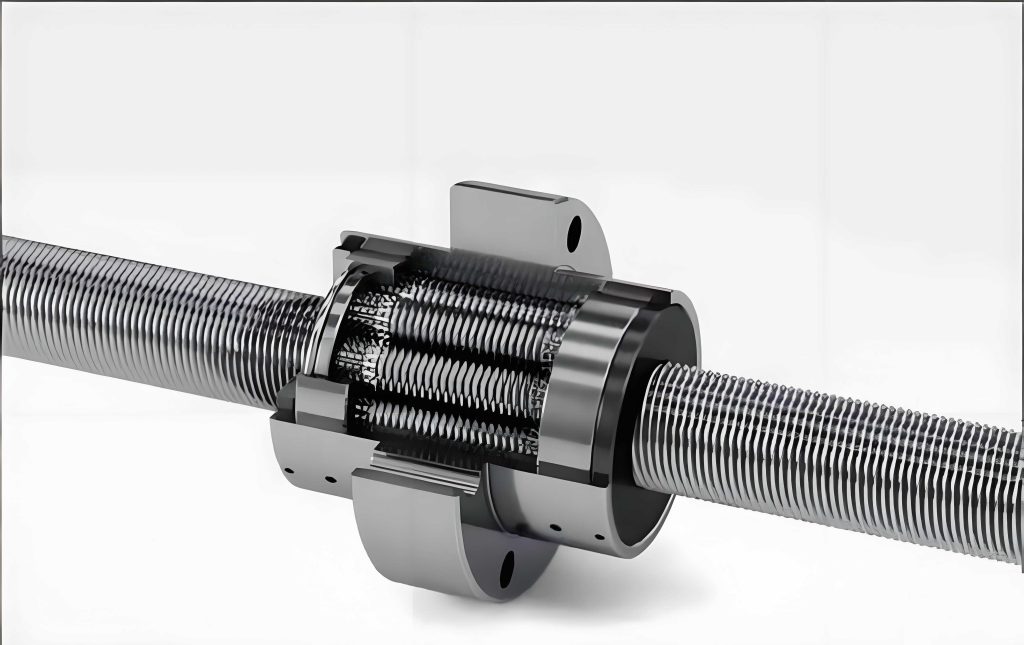
The development of advanced machinery in sectors such as aerospace, defense, and high-precision automation places ever-increasing demands on power transmission components. Among these, the planetary roller screw stands out as a superior alternative to traditional hydraulic systems and ball screws. Its unique design, which replaces rolling balls with threaded rollers, significantly increases the number of contact points, leading to exceptional load-bearing capacity, rigidity, and stability. As a key component for converting rotary motion to linear thrust and vice versa, the transmission efficiency of a planetary roller screw directly impacts the overall performance, energy consumption, and thermal design of the host system. Therefore, precise measurement of this parameter is critical for product qualification, quality control, and fundamental research. To address the need for testing planetary roller screws with nominal diameters ranging from 20 mm to 80 mm and handling input torques up to 1000 N·m, I designed and implemented a sophisticated measurement and control system. This system integrates Programmable Logic Controller (PLC)-based servo control with PC-based data acquisition and analysis, employing PID algorithms to ensure precise load application and accurate efficiency calculation.
Fundamental Principles of Transmission Efficiency Measurement
The core function of a planetary roller screw is motion conversion, which operates in two primary modes: forward drive and reverse drive. Each mode can be further tested under both clockwise and counter-clockwise rotation of the input source. The test rig is designed to measure the efficiency for both operational cases.
In the Forward Drive Efficiency Test, the screw is rotated by the prime mover (servo motor), driving the nut to perform linear motion. An axial load is applied to the nut to simulate working resistance. The forward drive efficiency, denoted as $$ \eta_1 $$, is calculated as the ratio of useful output power (linear) to input power (rotary):
$$ \eta_1 = \frac{F_1 \cdot V_1}{T_1 \cdot \omega_1} \times 100\% $$
where $$ F_1 $$ is the measured axial force on the nut (N), $$ V_1 $$ is the linear velocity of the nut (m/s), $$ T_1 $$ is the measured input torque on the screw (N·m), and $$ \omega_1 $$ is the angular velocity of the screw (rad/s).
Conversely, in the Reverse Drive Efficiency Test, the nut is driven linearly by the prime mover, which forces the screw to rotate. A resisting torque is applied to the screw shaft. The reverse drive efficiency $$ \eta_2 $$ is defined as:
$$ \eta_2 = \frac{T_2 \cdot \omega_2}{F_2 \cdot V_2} \times 100\% $$
where $$ T_2 $$ is the measured resisting torque on the screw (N·m), $$ \omega_2 $$ is the screw’s angular velocity (rad/s), $$ F_2 $$ is the input axial force applied to the nut (N), and $$ V_2 $$ is the linear velocity of the nut (m/s).
From these efficiencies, the inherent friction torque for each drive mode can be derived. For forward drive, the friction torque $$ M_1 $$ is:
$$ M_1 = T_1 \cdot (1 – \eta_1) $$
For reverse drive, the friction torque $$ M_2 $$ is:
$$ M_2 = \frac{F_2 \cdot V_2}{\omega_2} \cdot (1 – \eta_2) $$
The theoretical driving torque required for a planetary roller screw under a specific axial load is given by the standard screw equation:
$$ T = \frac{P \cdot i \cdot F}{2\pi \cdot \eta} $$
where $$ P $$ is the screw lead (m), $$ i $$ is the gear reduction ratio (if any), $$ F $$ is the axial load (N), and $$ \eta $$ is the expected transmission efficiency. This formula provides a benchmark for evaluating the measured torque values during testing.
Overall System Architecture and Design Scheme
Given the wide specification range of the planetary roller screw (20-80 mm diameter), a single test frame could not cover the entire force and torque spectrum with sufficient precision. Consequently, the system employs two distinct mechanical test frames sharing a common electronic control cabinet: a “Small Test Frame” for screws with diameters from 20 mm to 39 mm, and a “Large Test Frame” for diameters from 39 mm to 80 mm.
The measurement and control system is a classic integration of real-time data acquisition and closed-loop servo control. It can be logically segmented into three functional layers: the Sensing Layer, the Data Acquisition & Control Layer, and the Supervision & Analysis Layer.
The Sensing Layer comprises all physical transducers: torque/转速 sensors on the screw shaft, high-precision linear encoders for nut position, rotary encoders for screw angle/velocity, and high-accuracy load cells for measuring axial force. The Data Acquisition & Control Layer is the core, featuring a Siemens S7-series PLC for robust servo motion control and National Instruments (NI) data acquisition (DAQ) cards for high-fidelity, synchronized signal sampling. The Supervision & Analysis Layer is implemented in LabVIEW on a host PC, providing a graphical user interface (GUI), real-time data visualization, on-the-fly efficiency computation, data logging, and post-test analysis.
The flow of information is critical. Signals involved in closed-loop control, specifically the axial load feedback, are routed from the DAQ system to the PLC to participate in the PID control algorithm. All other signals (torque, speed, displacement) are streamed directly to the LabVIEW host for recording and display. Control commands (start, stop, speed, position setpoints) are sent from the LabVIEW interface to the PLC via a TCP/IP protocol, which then executes precise motion control through a PROFINET network to the servo drives. This architecture ensures deterministic control and high-precision, synchronized measurement.
Hardware Implementation of the Control and Measurement System
Servo Control System Core
The heart of the control system is a Siemens SIMATIC S7-1500 PLC. Its high processing speed and deterministic scan cycle are ideal for real-time servo control. The PLC is configured with digital and analog I/O modules to interface with peripheral devices and, most importantly, a communications processor for PROFINET. The servo system consists of Siemens SINAMICS S120 drives controlled by a CU320-2PN control unit. The PLC communicates motion commands over PROFINET to the CU320-2PN, which governs the motor modules. A selector switch on the control panel allows the operator to choose between the Small or Large Test Frame, activating the corresponding servo drive and sensor ranges.
PID-Based Load Control Loop
A key requirement for accurate efficiency measurement is the stable and precise application of the axial load (for forward drive) or resisting torque (for reverse drive). This is achieved through a dedicated PID control loop. For the forward drive test, the controlled variable is the axial force measured by the load cell. The control output is the excitation current supplied to a 磁粉制动器 (magnetic particle brake), which acts as the programmable load unit. The brake is connected to the nut’s translating assembly. The PID algorithm running in the PLC continuously compares the measured force from the DAQ system with the user-defined setpoint and adjusts the brake’s current via an analog output module to minimize the error. The dynamic response and stability of this brake are crucial for test accuracy. A power amplifier conditions the PLC’s analog signal to drive the brake. The parameters for the PID controller were meticulously tuned during commissioning to achieve fast response without overshoot, ensuring the load remains within ±1% of the target value throughout the test stroke.
The tuned PID parameters for the small test frame in forward drive mode are summarized below:
| Control Parameter | Value |
|---|---|
| Proportional Gain (Kp) | 1.030968 |
| Integral Time (Ti) [s] | 0.266345 |
| Derivative Time (Td) [s] | 6.690862 |
| Derivative Filter Coefficient | 0.1 |
| PID Sampling Time [s] | 1.0003 |
High-Precision Measurement Subsystem
To achieve the required measurement precision (e.g., ±0.5% FS for torque, ±1% for load), a carefully selected suite of sensors is employed, coupled with appropriate signal conditioning.
- Force Measurement: Two Riehlert R118 series load cells are used (e.g., 50 kN for small frame, 150 kN for large frame). Their signals are amplified and conditioned by T093C transducer indicators, which provide a stable ±10 V analog output proportional to the measured force. This voltage signal is acquired by a high-resolution NI PCI-6221 multi-function DAQ card.
- Torque and Speed Measurement: Non-contact torque/speed sensors from Meßtechnik (e.g., DR-2800 series) with multiple ranges (10, 50, 200, 1000 N·m) are selected based on the screw under test. These sensors directly output a ±10 V analog signal for torque and a TTL pulse train for speed, which are acquired by the DAQ system.
- Displacement and Angle Measurement: Linear displacement of the nut is measured using high-precision Heidenhain LB382 linear encoders with 1 Vpp sinusoidal signals. Rotary position and speed of the screw are measured using Heidenhain ROD420 encoders with TTL outputs. The sinusoidal encoder signals are converted to digital square waves using Heidenhain IBV101 interface boards and then fed into an NI PCI-6601 counter/timer card for precise position and velocity measurement.
The synchronization of all analog and digital measurements is a critical feature, ensured by the NI DAQ system’s hardware-timed sampling, which eliminates timing skew between channels and guarantees that all data points (force, torque, position, velocity) correspond to the same instant in time for accurate instantaneous power calculation.
The configuration of the primary sensors is outlined below:
| Measurement | Sensor Type / Model | Signal Type | DAQ Interface |
|---|---|---|---|
| Axial Force | Strain Gauge Load Cell + Transducer Indicator | ±10 V Analog | NI PCI-6221 (AI) |
| Rotary Torque | Non-contact Torque Flange | ±10 V Analog | NI PCI-6221 (AI) |
| Linear Position | Heidenhain Linear Encoder | 1 Vpp Sine (converted to digital) | NI PCI-6601 (Counter) |
| Rotary Position/Speed | Heidenhain Rotary Encoder | TTL Pulses | NI PCI-6601 (Counter) |
Software Design and Integration
LabVIEW Host Application
The LabVIEW application serves as the central hub for operator interaction, real-time monitoring, and data management. Its design emphasizes modularity, clarity, and robustness. The main GUI presents four primary functional areas: “Transmission Efficiency Test,” “System Parameter Setup,” “Historical Data Query,” and “System Exit.”
The core testing interface within the “Transmission Efficiency Test” panel allows the operator to select the test mode (Forward/Reverse), input test parameters (target load, speed profile, stroke limits), initiate the test, and observe real-time plots of force, torque, displacement, speed, and calculated efficiency. The software performs the efficiency calculations defined in the principles section on a point-by-point basis using the synchronized data stream. All data is continuously written to a structured binary file (using disk streaming techniques) to ensure no data loss at high sampling rates. The “Historical Data Query” module enables loading of previous test files, statistical analysis, generation of efficiency curves, and export of reports in standard formats.
PLC Control Program
The PLC program, developed in Siemens TIA Portal using Ladder Logic (LAD), is structured into well-defined functional blocks (FCs and FBs). Its primary responsibilities are:
- Servo Motion Control: Executing speed or position profiles for the screw-rotating or nut-driving servo motors based on commands from LabVIEW.
- PID Load Control: Implementing the PID algorithm for the magnetic particle brake, reading the force feedback from the shared memory area with the DAQ system, and outputting the control signal.
- Safety Interlocks: Monitoring limit switches, emergency stops, and system status to ensure safe operation.
- Communication Handling: Managing the PROFINET communication with the servo drives and the TCP/IP socket communication with the LabVIEW host PC for receiving commands and sending status updates.
The integration between LabVIEW and the PLC is seamless, creating a powerful hybrid system that leverages the deterministic control of the PLC and the flexible data processing and visualization of the PC.
Experimental Validation and Results Analysis
The performance of the complete measurement and control system for the planetary roller screw test rig was rigorously validated. A series of tests were conducted on the Small Test Frame in forward drive mode. A planetary roller screw with a nominal diameter of 27 mm and a lead of 10 mm was used. The objective was to maintain a constant axial load at the rated dynamic capacity (20% of max, approximately 20.78 kN) while varying the screw’s rotational speed (corresponding to nut speeds of 4, 8, and 12 mm/s). For each speed, data was collected over three different sections of the stroke to average out any local variations. The PID parameters from the table above were active during these tests.
The system successfully maintained the axial load with high precision. The following table summarizes the average results from the test runs, comparing the setpoint load with the measured values, the measured input torque, and the calculated efficiency.
| Nut Speed (mm/s) | Load Setpoint (kN) | Measured Load Avg. (kN) | Measured Torque Avg. (N·m) | Calculated Efficiency Avg. (%) |
|---|---|---|---|---|
| 4 | 20.78 | 20.794 | 44.716 | 74.1 |
| 8 | 20.78 | 20.796 | 44.195 | 75.0 |
| 12 | 20.78 | 20.744 | 43.888 | 75.6 |
The theoretical driving torque for this planetary roller screw under 20.78 kN load, assuming an 80% efficiency, is calculated as:
$$ T_{theoretical} = \frac{0.01 \cdot 1 \cdot 20780}{2\pi \cdot 0.8} \approx 41.3 \text{ N·m} $$
The slightly higher measured torque (e.g., ~44.2 N·m at 8 mm/s) corresponds well with the measured efficiency of approximately 75%, confirming the consistency of the measurements.
The results clearly demonstrate the capability of the system. The loading accuracy was maintained within the ±1% specification across all test speeds. The measured efficiency values for this specific planetary roller screw sample were around 75%, and a slight increase in efficiency with operational speed was observed, which is a typical characteristic due to lubrication regimes. The data curves for load, torque, and efficiency versus stroke were smooth and repeatable, indicating excellent stability of the PID-controlled load application and the fidelity of the data acquisition system.
Conclusion
The designed and implemented measurement and control system successfully meets the demanding requirements for testing high-torque planetary roller screw assemblies. The dual-test-frame approach provides the necessary flexibility and precision across a wide range of screw diameters. The integration of a Siemens PLC for robust, real-time closed-loop control (using an optimized PID algorithm for load application) with a National Instruments DAQ system and a LabVIEW host application for synchronized high-speed data acquisition, visualization, and analysis creates a powerful and versatile test platform. Experimental validation confirms that the system achieves precise load control (±1%) and delivers reliable, accurate measurements of torque and transmission efficiency. This system serves as an essential tool for performance evaluation, quality assurance, and research & development, contributing to the advancement and reliable application of planetary roller screw technology in high-performance mechanical systems.