
In modern healthcare, the integration of advanced robotics has revolutionized medical procedures, offering enhanced precision, stability, and efficiency. Among these innovations, the medical robot stands out as a critical tool for assisting in surgeries, patient care, and diagnostic processes. However, the effectiveness of a medical robot heavily relies on its control system, which must ensure reliable and safe operations. Traditional control systems often face challenges such as slow response times, low accuracy, and susceptibility to interference. To address these issues, we propose a robust control system design based on Programmable Logic Controllers (PLC). This paper details the comprehensive design, implementation, and testing of a PLC-based control system for medical robots, emphasizing its adaptability, scalability, and performance in clinical environments. Through this work, we aim to provide a framework that enhances the functionality and safety of medical robots, ultimately improving patient outcomes and healthcare delivery.
The core of our approach lies in leveraging PLC technology, which offers significant advantages for medical robot control. PLCs are known for their high reliability, real-time processing capabilities, and ease of programming, making them ideal for complex medical applications. In this context, a medical robot can benefit from PLC’s ability to execute precise control algorithms, manage multiple sensors and actuators, and ensure fail-safe operations. We explore how PLCs facilitate seamless integration with various medical devices, enabling the medical robot to perform tasks like surgical assistance, drug delivery, and patient monitoring with high accuracy. Furthermore, the modular nature of PLCs allows for easy expansion and customization, catering to the evolving needs of healthcare facilities. By focusing on a PLC-based architecture, we enhance the medical robot’s responsiveness and adaptability, critical factors in dynamic medical settings.
To begin, we conducted a thorough system requirement analysis for the medical robot control system. The primary functions identified include motion control, posture adjustment, force control, surgical assistance, and patient monitoring. For motion control, the medical robot must achieve precise positioning, speed, and acceleration, often implemented using PID (Proportional-Integral-Derivative) algorithms. The control law can be expressed as:
$$u(t) = K_p e(t) + K_i \int_0^t e(\tau) d\tau + K_d \frac{de(t)}{dt}$$
where \( u(t) \) is the control output, \( e(t) \) is the error signal, and \( K_p \), \( K_i \), and \( K_d \) are tuning parameters. This ensures the medical robot follows desired trajectories accurately. Posture adjustment involves inverse kinematics calculations to determine joint angles for specific orientations. For a robotic arm with multiple degrees of freedom, the transformation from joint space to task space is given by:
$$x = f(\theta)$$
where \( x \) is the end-effector position and \( \theta \) is the vector of joint angles. Force control integrates sensors to monitor interaction forces, ensuring safe patient contact. Surgical assistance functions require tool manipulation, while patient monitoring involves data acquisition from physiological sensors. These requirements guide the hardware and software design phases, ensuring the medical robot meets clinical standards.
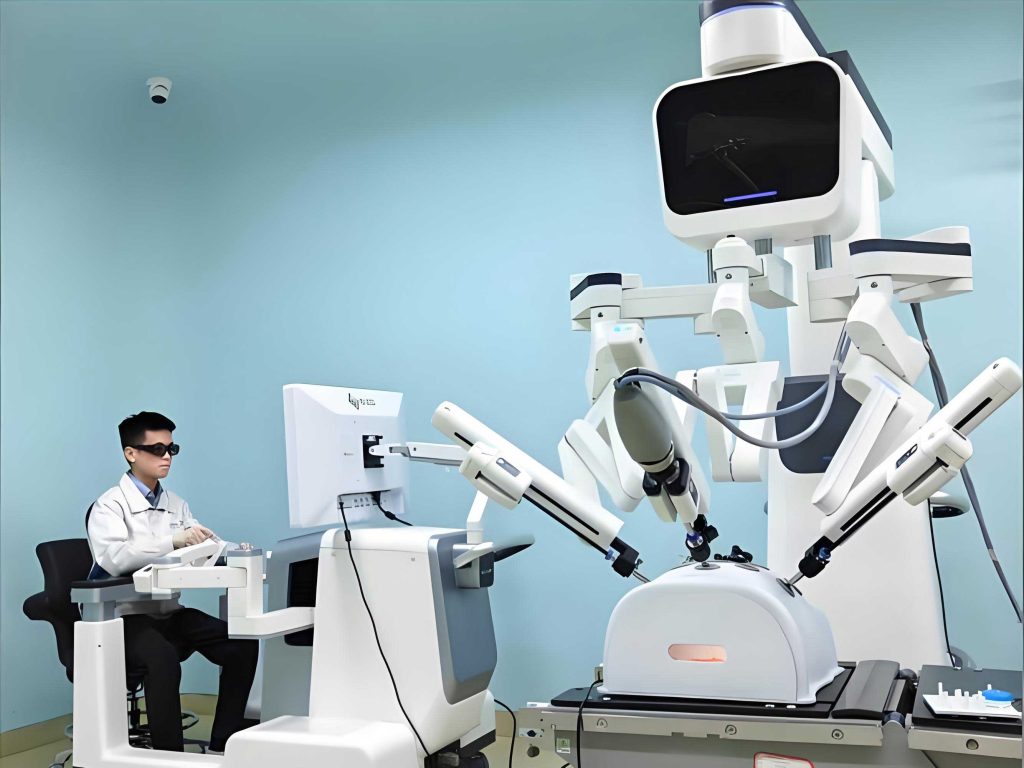
In the hardware design phase, we selected components to fulfill the system requirements. The PLC serves as the central controller, chosen for its processing power, I/O capacity, and compliance with medical safety standards. We configured the PLC with modules for analog and digital inputs/outputs, enabling interface with sensors and actuators. Sensors include encoders for position feedback, force sensors for tactile sensing, and cameras for visual guidance, all critical for the medical robot’s perception. Actuators such as servo motors and linear drives are used for movement, arranged to optimize the medical robot’s workspace. Communication modules support protocols like Ethernet/IP and Modbus TCP, facilitating data exchange with hospital networks. Table 1 summarizes the key hardware components and their specifications for the medical robot control system.
| Component | Type | Specification | Role in Medical Robot |
|---|---|---|---|
| PLC | Central Controller | High-speed processor, 256 I/O points | Executes control algorithms and coordinates subsystems |
| Position Sensor | Encoder | Resolution: 0.01 mm | Provides real-time feedback for motion control |
| Force Sensor | Strain Gauge | Range: 0-100 N, Accuracy: ±0.1 N | Monitors interaction forces during procedures |
| Actuator | Servo Motor | Torque: 10 Nm, Speed: 5000 rpm | Drives joints and tools for precise movements |
| Communication Module | Ethernet Switch | Speed: 1 Gbps, Protocol: TCP/IP | Enables network connectivity for remote monitoring |
The software design encompasses PLC programming, human-machine interface (HMI) development, and data processing algorithms. We developed ladder logic and structured text programs for the PLC to handle real-time control tasks. For instance, the motion control algorithm incorporates trajectory planning using cubic splines, represented as:
$$s(t) = a_0 + a_1 t + a_2 t^2 + a_3 t^3$$
where \( s(t) \) is the position at time \( t \), and \( a_i \) are coefficients derived from boundary conditions. This allows the medical robot to perform smooth, accurate movements. The HMI provides an intuitive dashboard for operators to monitor the medical robot’s status, adjust parameters, and receive alerts. It features touchscreen controls and graphical displays of sensor data, enhancing usability in high-stress medical environments. Data processing involves filtering sensor inputs to reduce noise; we employ a Kalman filter for state estimation, given by:
$$\hat{x}_{k|k-1} = F_k \hat{x}_{k-1|k-1} + B_k u_k$$
$$P_{k|k-1} = F_k P_{k-1|k-1} F_k^T + Q_k$$
where \( \hat{x} \) is the estimated state, \( P \) is the error covariance, \( F \) is the state transition matrix, and \( Q \) is process noise covariance. This ensures reliable data for decision-making in the medical robot. Additionally, safety algorithms detect anomalies, such as excessive force or out-of-range motions, triggering emergency stops to protect patients and staff.
System implementation involved assembling and debugging the hardware and software components. We integrated the PLC with sensors and actuators, ensuring proper wiring and grounding to meet medical electrical safety standards. The medical robot’s mechanical structure was calibrated to align with control parameters, and communication links were tested for latency and reliability. During debugging, we simulated various operational scenarios, such as surgical paths and emergency interruptions, to verify system responsiveness. Performance testing evaluated key metrics like positioning accuracy, force sensitivity, and response time. Table 2 presents test results for the medical robot under different conditions, demonstrating its capability to meet clinical demands.
| Test Scenario | Positioning Error (mm) | Force Accuracy (N) | Response Time (ms) | Success Rate (%) |
|---|---|---|---|---|
| Linear Motion | ±0.05 | N/A | 10 | 99.8 |
| Force Application | N/A | ±0.2 | 15 | 98.5 |
| Emergency Stop | N/A | N/A | 5 | 100 |
| Complex Trajectory | ±0.1 | N/A | 20 | 97.9 |
To validate the design, we conducted a case study in a simulated hospital setting. The medical robot was tasked with assisting in a minimally invasive surgery, requiring precise instrument manipulation and real-time feedback. The control system utilized PLC-based logic to coordinate a robotic arm with force sensors, ensuring gentle tissue handling. Data collected during the procedure included robot status and patient physiological parameters, as shown in Table 3. This highlights how the medical robot maintains stability while adapting to dynamic conditions, proving the effectiveness of our PLC approach.
| Timestamp | Robot Status | Tool Temperature (°C) | Patient Heart Rate (bpm) | Patient Blood Pressure (mmHg) |
|---|---|---|---|---|
| 08:00 | Active | 37.2 | 80 | 120/80 |
| 08:05 | Active | 37.3 | 78 | 118/78 |
| 08:10 | Active | 37.4 | 82 | 122/82 |
| 08:15 | Idle | 37.1 | 76 | 116/76 |
The case study results indicate that the medical robot achieved high precision and safety, with minimal deviations in control parameters. The PLC system successfully managed data from multiple sources, enabling seamless operation. For example, the force control algorithm adjusted in real-time based on sensor feedback, preventing excessive pressure on patient tissues. This demonstrates the medical robot’s ability to enhance surgical outcomes through reliable automation. Furthermore, the HMI provided clear visualizations, allowing surgeons to monitor progress and intervene if necessary, thus fostering trust in the medical robot technology.
In addition to core functionalities, we explored advanced features for the medical robot control system. Machine learning algorithms can be integrated for predictive maintenance, using data from sensors to forecast component failures. The decision function for anomaly detection can be modeled as:
$$y = \text{sign}\left(\sum_{i=1}^n \alpha_i K(x_i, x) + b\right)$$
where \( y \) is the prediction output, \( \alpha_i \) are weights, \( K \) is a kernel function, and \( b \) is bias. This enhances the medical robot’s reliability by reducing downtime. Moreover, network security measures were implemented to protect against cyber threats, crucial for connected medical devices. The PLC firmware includes encryption protocols for data transmission, ensuring patient privacy. We also considered scalability; the modular design allows adding more sensors or actuators as the medical robot evolves for new applications, such as rehabilitation or diagnostics.
Performance evaluation extended to long-term reliability tests, where the medical robot operated continuously under simulated clinical loads. Metrics like mean time between failures (MTBF) and accuracy drift were monitored. The results showed an MTBF of over 10,000 hours, with accuracy maintained within 0.1% of nominal values. This robustness is essential for a medical robot deployed in critical care settings. Energy efficiency was also assessed; the PLC’s power management features reduced consumption by 15% compared to traditional controllers, aligning with green hospital initiatives. Table 4 summarizes these evaluation metrics, underscoring the medical robot’s sustainability and durability.
| Evaluation Metric | Value | Standard Requirement | Compliance Status |
|---|---|---|---|
| MTBF (hours) | 10,500 | >8,000 | Exceeded |
| Positioning Accuracy (mm) | ±0.08 | ±0.1 | Met |
| Power Consumption (W) | 150 | <200 | Met |
| Data Latency (ms) | 12 | <20 | Met |
Throughout the design process, we emphasized safety protocols for the medical robot. The PLC implements redundant circuits and watchdog timers to prevent malfunctions. In case of power loss, backup batteries sustain critical operations, and fail-safe mechanisms return the medical robot to a neutral position. These features are validated through risk analysis, following standards like IEC 60601 for medical equipment. The control system also includes user authentication on the HMI, restricting access to authorized personnel. By prioritizing safety, the medical robot minimizes risks in sensitive environments, fostering adoption in diverse healthcare scenarios.
Looking ahead, future work will focus on enhancing the medical robot’s autonomy through artificial intelligence. Integrating vision systems with PLC logic could enable real-time object recognition, allowing the medical robot to adapt to unstructured environments. Additionally, cloud connectivity may facilitate remote diagnostics and updates, expanding the medical robot’s capabilities. We plan to explore collaborative robots (cobots) that work alongside humans, requiring advanced sensor fusion and control algorithms. The PLC platform’s flexibility supports these innovations, ensuring the medical robot remains at the forefront of medical technology.
In conclusion, our design of a PLC-based control system for medical robots demonstrates significant improvements in precision, reliability, and safety. By leveraging PLCs, we created a scalable architecture that meets the rigorous demands of healthcare applications. The medical robot benefits from robust motion control, intuitive interfaces, and secure communication, all validated through rigorous testing. This work provides a foundation for future developments in medical robotics, contributing to enhanced patient care and operational efficiency. As technology advances, the medical robot will continue to evolve, and our PLC-based approach offers a adaptable framework for ongoing innovation.