
In the field of robotics, legged systems have garnered significant attention due to their superior mobility and adaptability in unstructured environments. Among these, the quadruped robot, often inspired by biological counterparts like dogs, offers a balance of speed, stability, and obstacle-crossing capabilities. We focus on designing a leg mechanism for a robot dog that mimics canine biological features, such as limb structure and gait patterns. This approach leverages the efficiency of nature-evolved locomotion, enabling the quadruped robot to traverse rough terrain with minimal energy consumption. In this article, we present a hybrid serial-parallel leg mechanism with three degrees of freedom, driven by individual motors, and provide a comprehensive kinematic analysis using closed-loop vector methods. We validate the model through trajectory planning and simulation, ensuring its applicability in real-world scenarios for advanced robot dog systems.
The advantages of legged robots over wheeled or tracked counterparts include better maneuverability on uneven surfaces and higher energy efficiency. Specifically, quadruped robots excel in load-bearing capacity and robustness compared to bipedal or hexapod designs. By emulating mammals like dogs, which demonstrate remarkable speed and environmental adaptation, we can enhance the performance of robotic systems. Our design draws from canine hindlimb anatomy, incorporating key biological parameters to achieve a biomimetic leg structure. This not only improves the robot dog’s agility but also ensures stability during dynamic movements like trotting. The following sections detail the biological inspiration, mechanism design, kinematic modeling, and validation, with an emphasis on practical implementation for quadruped robots.
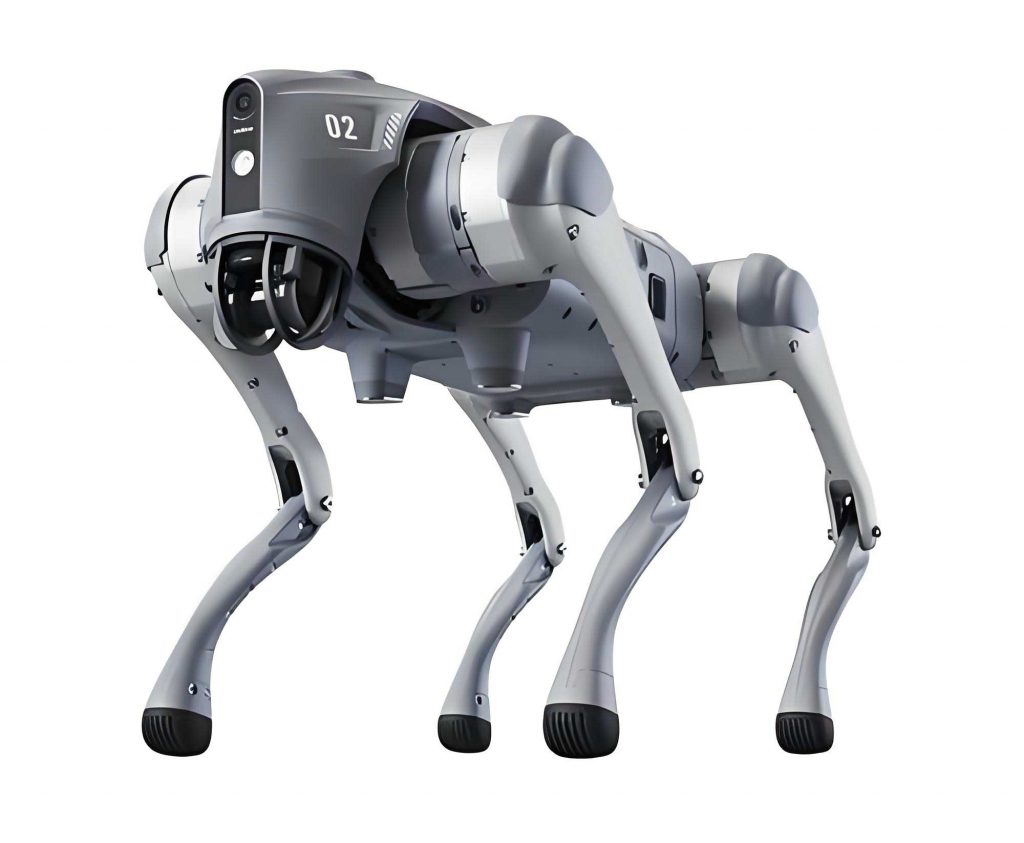
Canine biological characteristics serve as the foundation for our leg mechanism design. Studies on Labrador Retrievers and Greyhounds provide essential data on limb proportions and gait dynamics. For instance, the average mass of a Labrador Retriever is approximately 24.2 kg, with a center of mass height of 0.354 m, a trotting speed of 2.46 m/s, and a gait cycle duration of 0.43 s. These parameters inform the scaling of our robot dog’s legs to replicate natural movements. The hindlimb segments—comprising the femur, tibia, and metatarsal bones—have average lengths of 205 mm, 216 mm, and 87 mm, respectively. We adopt these dimensions for the primary links in our leg mechanism, ensuring that the quadruped robot mirrors the kinematic patterns observed in dogs. This biomimetic approach reduces development time and enhances the robot’s ability to perform in diverse environments, from urban settings to natural landscapes.
To achieve a functional leg mechanism, we analyze the trot gait, which is characterized by a two-beat pattern where diagonal leg pairs move in synchrony. For example, the left front (LF) and right hind (RH) legs form one pair, while the left hind (LH) and right front (RF) legs form the other, with a phase difference of 0.5T between pairs, where T is the gait cycle period. A duty factor of 0.5 ensures that two legs are always in the support phase, maintaining stability. This gait is efficient for the robot dog at moderate speeds and allows for smooth transitions between steps. By implementing this pattern in our quadruped robot, we can optimize control strategies and minimize energy consumption. The timing diagram for the support phases illustrates the alternating sequence, which we use to coordinate leg movements during operation.
Our leg mechanism design employs a hybrid serial-parallel configuration to balance flexibility and load capacity. The upper part consists of a five-bar linkage with two degrees of freedom, while the lower part is a single-degree-of-freedom link driven by a motor. This structure allows the robot dog to achieve a wide range of motions while supporting substantial weights. The key dimensions are derived from canine anatomy: the femur link (r1) is 205 mm, the tibia link (r2) is 216 mm, and the foot link (r6) is 87 mm. Additionally, we include auxiliary links r3 and r4, both set to 230 mm, to form the five-bar mechanism. The proportionality constant λ for the link BC to BF is 0.8, which optimizes the workspace based on inequality constraints from maximum and minimum distances between points C and E. For instance, the constraints are given by: $$ r_3 + r_4 \geq d_{CE,\text{max}} = 442 \, \text{mm} $$ and $$ |r_3 – r_4| \leq d_{CE,\text{min}} = 308 \, \text{mm} $$. This ensures that the leg can replicate the full range of canine leg motions, making the quadruped robot versatile in various tasks.
The kinematic modeling of the leg mechanism is crucial for controlling the robot dog’s movements. We use a closed-loop vector approach to derive both forward and inverse kinematics. For the forward kinematics, we consider the leg in a planar configuration, with the hip joint fixed relative to the body. The position vectors are defined in a local coordinate system {SA} attached to the hip joint. The five-bar mechanism is analyzed first, followed by the single link for the foot. The inverse kinematics computes the joint angles required to achieve a desired foot position, which is essential for trajectory planning. By solving these equations, we can simulate the leg’s behavior and verify its accuracy through numerical examples.
For the five-bar mechanism, the closed-loop vector equation is: $$ \mathbf{R}_1 + \lambda \mathbf{R}_2 = \mathbf{R}_5 + \mathbf{R}_4 + \mathbf{R}_3 $$. In component form, the position equations are: $$ r_1 \cos \theta_1 + \lambda r_2 \cos \theta_2 = -r_5 + r_4 \cos \theta_4 + r_3 \cos \theta_3 $$ and $$ r_1 \sin \theta_1 + \lambda r_2 \sin \theta_2 = r_4 \sin \theta_4 + r_3 \sin \theta_3 $$. Here, θ_i represents the angle of link r_i with respect to the X-axis of {SA}. By manipulating these equations, we derive expressions for θ_2 and θ_3. For example, θ_2 can be solved as: $$ \theta_2 = 2 \arctan \left( \frac{A_2 \pm \sqrt{A_2^2 + B_2^2 – C_2^2}}{B_2 – C_2} \right) $$, where A_2, B_2, and C_2 are coefficients derived from the position equations. Similarly, the inverse kinematics for the five-bar mechanism involves decomposing it into two open chains. For a given point C coordinates (x_C, z_C), the angles θ_1 and θ_2 are computed using geometric relations, such as: $$ \phi_1 = \arccos \left( \frac{r_1^2 + (\lambda r_2)^2 – (x_C^2 + z_C^2)}{2 r_1 \lambda r_2} \right) $$ and $$ \theta_1 = \beta_1 \mp \gamma_1 $$, where β_1 = arctan(z_C / x_C) and γ_1 is derived from the cosine rule. This allows us to determine the motor angles for any desired configuration of the robot dog leg.
The single link (foot) kinematics is simpler. The forward kinematics gives the foot position as: $$ x_{T_d} = r_1 \cos \theta_1 + r_2 \cos \theta_2 + r_6 \cos \theta_6 $$ and $$ y_{T_d} = r_1 \sin \theta_1 + r_2 \sin \theta_2 + r_6 \sin \theta_6 $$, where (x_{T_d}, y_{T_d}) is the foot point in the local coordinate system. The inverse kinematics for θ_6 is directly obtained as: $$ \theta_6 = \arccos \left( \frac{x_{T_d} – r_1 \cos \theta_1 – r_2 \cos \theta_2}{r_6} \right) $$. These equations enable precise control of the foot trajectory, which is vital for the quadruped robot to maintain stability during locomotion.
To account for the hip joint’s rotation, we incorporate coordinate transformations. The hip joint local coordinate system {SH} is related to {SA} through a rotation matrix and a position vector. For any point P on the leg, its position in {SH} is given by: $$ \mathbf{^{SH}P} = \mathbf{^{SH}_{SA}R} \cdot \mathbf{^{SA}P} + \mathbf{^{SH}p_{SA}} $$. Similarly, for inverse kinematics, the foot position in {SA} is derived from {SH} as: $$ \mathbf{^{SA}T_d} = \mathbf{^{SA}_{SH}R} \cdot \mathbf{^{SH}T_d} + \mathbf{^{SA}p_{SH}} $$. This ensures that the leg movements are integrated with the robot body’s orientation, enhancing the overall coordination of the quadruped robot.
We validate the kinematic model using a composite cycloidal foot trajectory, which provides a smooth and stable path for the robot dog during the trot gait. The trajectory is planned in the local coordinate system {SA}, with the hip joint fixed at a height of 350 mm. The stride length is set to 980 mm, corresponding to a single-leg span of 490 mm in the hip coordinate system. The position vector between {SH} and {SA} is assumed as [90, 0, -10]^T mm. The foot trajectory equations are derived to minimize impacts during landing and lifting, ensuring the quadruped robot maintains a steady gait. For example, the X and Z coordinates of the foot point over time t can be expressed as parametric equations based on cycloidal functions.
The joint angles are computed through inverse kinematics for the given foot trajectory. Specifically, the angle θ_6 for the foot link is prescribed based on biological data from dogs, while the other angles θ_1, θ_2, θ_3, and θ_4 are solved numerically. The results show smooth variations over the gait cycle, indicating that the leg mechanism can replicate natural movements. Using these angles in the forward kinematics, we obtain the trajectories of key hinge points and the foot point. For instance, the foot trajectory in the global coordinate system demonstrates a stride of 980 mm, confirming the design’s feasibility. The following table summarizes the key parameters used in the validation:
| Parameter | Value | Description |
|---|---|---|
| r1 | 205 mm | Femur link length |
| r2 | 216 mm | Tibia link length |
| r3 | 230 mm | Upper auxiliary link |
| r4 | 230 mm | Lower auxiliary link |
| r5 | 170 mm | Fixed base link |
| r6 | 87 mm | Foot link length |
| λ | 0.8 | Proportionality constant |
| H | 350 mm | Hip height |
| S | 980 mm | Total stride length |
| T | 0.43 s | Gait cycle period |
The forward kinematics results are plotted to show the paths of hinge points A, B, C, E, and F over one gait cycle. The foot trajectory in the global coordinate system exhibits a consistent pattern, with the leg achieving the desired stride without singularities. This verification underscores the accuracy of our kinematic model and the effectiveness of the hybrid leg mechanism for the robot dog. Additionally, the use of composite cycloidal trajectories ensures that the quadruped robot can handle dynamic transitions between swing and support phases, reducing the risk of tipping or slipping.
In conclusion, our design of a hybrid serial-parallel leg mechanism for a quadruped robot, inspired by canine biological characteristics, demonstrates robust performance and kinematic accuracy. The leg structure, with three degrees of freedom, enables the robot dog to emulate natural gaits like trotting, while the kinematic model provides a foundation for precise control. The validation through trajectory planning confirms that the leg can achieve a stride of 980 mm, matching biological benchmarks. Future work will focus on dynamic simulations and experimental prototypes to further refine the mechanism for real-world applications. This approach highlights the potential of biomimicry in advancing quadruped robot technology, paving the way for more agile and efficient robotic systems.
The integration of biological data into robotic design not only enhances performance but also promotes energy efficiency. For instance, by optimizing link lengths and joint angles based on canine anatomy, we reduce the power consumption of the robot dog during locomotion. The trot gait, with its inherent stability, allows the quadruped robot to maintain speed over long distances without excessive fatigue. Moreover, the hybrid mechanism offers a compromise between the simplicity of serial chains and the strength of parallel structures, making it suitable for various payloads and terrains. As robotics continues to evolve, such biomimetic strategies will play a crucial role in developing autonomous systems that can operate in challenging environments, from search and rescue missions to planetary exploration.
In summary, the key contributions of this work include a detailed kinematic analysis of a novel leg mechanism for a quadruped robot, validated through practical trajectory examples. The use of closed-loop vector methods ensures computational efficiency, while the biological inspiration guarantees relevance to real-world locomotion. We believe that this design will significantly impact the development of next-generation robot dogs, enabling them to perform complex tasks with greater autonomy and reliability. The repeated emphasis on robot dog and quadruped robot throughout this article underscores their importance in the field of legged robotics, and we anticipate further innovations building upon this foundation.