
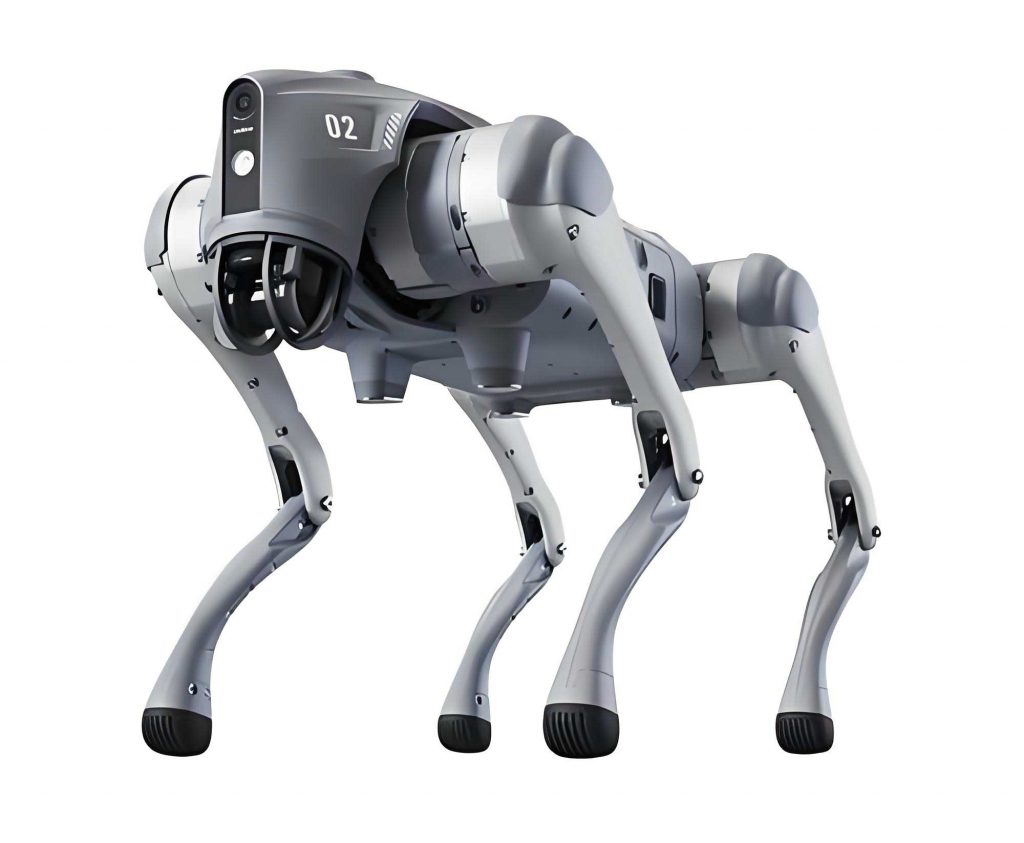
In recent years, the development of quadruped robots has gained significant attention due to their superior adaptability in unstructured environments. These robot dogs are increasingly deployed in scenarios such as search and rescue, inspection, and logistics. However, many existing quadruped robot designs lack the flexibility and efficiency observed in biological counterparts, primarily due to rigid body structures. Biological studies reveal that the spine plays a crucial role in enhancing mobility, stability, and energy efficiency in quadruped animals. For instance, the cheetah’s spine allows for substantial flexion and extension, increasing stride length and absorbing impact forces during high-speed locomotion. Inspired by these mechanisms, we designed a quadruped robot incorporating a two-degree-of-freedom (2-DOF) compliant spine to improve dynamic performance. This robot dog features a continuous flexible spine capable of bending in both horizontal and vertical directions, mimicking biological principles to achieve enhanced motion capabilities.
The overall structure of our quadruped robot adopts a full-elbow leg configuration, with the spine’s three drive motors positioned at the rear. Each leg is driven by three motors compactly arranged to reduce rotational inertia. With the hip joint rotated at 45° and the knee joint at 90°, the robot dog measures 586.6 mm in length, 368 mm in width, and 415.5 mm in height. To monitor the spine’s posture and spatial orientation, nine-axis attitude sensors are installed on the front and rear fixed plates. The spine design integrates separation disks, tension springs, actuators, flexible drive cables, and universal joints, enabling bidirectional bending. The drive cables are arranged at 120° intervals on the separation disks, allowing independent control of tension distribution via three motors. Limit mechanisms restrict the joint rotation angle between 135° and 225°, facilitating flexion, extension, and lateral bending. The leg design incorporates parallel elasticity, where energy is stored during knee flexion and released during extension, reducing actuator load and improving efficiency.
To analyze the motion characteristics of the quadruped robot, we developed a kinematic model combining coordinate transformations and the Modified Denavit-Hartenberg (MDH) method. The spine’s kinematic model defines coordinate systems on each separation disk, with transformations based on bending angles and planes. The transformation matrix between adjacent coordinate systems $O_i$ and $O_{i-1}$ is given by:
$$^{i-1}_i\mathbf{T} = \mathbf{D}(0,0,L_b) \cdot \mathbf{R}_z(\phi_i) \cdot \mathbf{R}_y(\theta_i) \cdot \mathbf{R}_z(-\phi_i) \cdot \mathbf{D}(0,0,L_b)$$
where $L_b = 41$ mm is the support distance, $\theta_i$ is the bending angle in the plane, and $\phi_i$ is the plane angle. The resulting rotation matrix $\mathbf{R}^{i-1}_i$ and translation vector $\mathbf{p}$ are:
$$\mathbf{R}^{i-1}_i = \begin{bmatrix}
\sin^2\phi_i + \cos\theta_i \cos^2\phi_i & (\cos\theta_i – 1)\sin\phi_i \cos\phi_i & \sin\theta_i \cos\phi_i \\
(\cos\theta_i – 1)\sin\phi_i \cos\phi_i & \cos\theta_i \sin^2\phi_i + \cos^2\phi_i & \sin\theta_i \sin\phi_i \\
-\sin\theta_i \cos\phi_i & -\sin\theta_i \sin\phi_i & \cos\theta_i
\end{bmatrix}$$
$$\mathbf{p} = \begin{bmatrix}
L_b \sin\theta_i \cos\phi_i \\
L_b \sin\theta_i \sin\phi_i \\
L_b (\cos\theta_i + 1)
\end{bmatrix}$$
The leg kinematics are modeled using MDH parameters. For the right front leg, the transformation from the base coordinate system $O_i$ to the foot-end coordinate system $O_{i,4}$ is computed as:
$$^{i}_{i,4}\mathbf{T} = ^{i}_{i,1}\mathbf{T} \cdot ^{i,1}_{i,1′}\mathbf{T} \cdot ^{i,1′}_{i,2}\mathbf{T} \cdot ^{i,2}_{i,3}\mathbf{T} \cdot ^{i,3}_{i,4}\mathbf{T}$$
The MDH parameters for the leg are summarized in Table 1.
| Link | $\alpha$ (rad) | $d_x$ (mm) | $\beta$ (rad) | $d_z$ (mm) |
|---|---|---|---|---|
| 1 | 0 | 0 | $\theta_1$ | 0 |
| 1′ | 0 | 0 | 0 | $L_{g1} = 109$ |
| 2 | $-\pi/2$ | 0 | $\theta_2$ | $-L_{g2} = -70$ |
| 3 | 0 | $L_{g3} = 220$ | $-\theta_3$ | 0 |
| 4 | 0 | $L_{g4} = 220$ | 0 | 0 |
Workspace analysis demonstrates the impact of the spine on the robot dog’s reachable areas. Without spine movement, the front leg’s workspace is limited, but with spine bending (0° to 15° in horizontal and vertical directions), the workspace expands significantly. For the right front leg, the X-axis range increases from 33–285 mm to -245–518 mm (a 200% expansion), the Y-axis from 136–697 mm to -88–723 mm (45% expansion), and the Z-axis from -386–95 mm to -520–397 mm (91% expansion). This enhancement improves the quadruped robot’s ability to navigate obstacles and execute complex maneuvers.
Gait planning incorporates spine movements to optimize performance. For trot and bound gaits, we use cycloidal trajectories with optimized support phases. The swing phase trajectory is defined as:
$$x = R \left( \frac{t}{T} – \frac{1}{2\pi} \sin\left(\frac{2\pi t}{T}\right) \right), \quad z = R \left( 1 – \cos\left(\frac{\pi t}{T}\right) \right)$$
where $R$ is the radius, $T$ is the gait cycle, and $t$ is time. The support phase trajectory is modified to reduce impact:
$$x = \frac{R}{2} \left( \frac{T – t}{T} \right), \quad z = A_s \left( 1 – \cos\left(\frac{\pi (T – t)}{T}\right) \right)$$
with $A_s = -1$ mm. In trot gait, spine lateral bending assists turning by creating a differential stride between left and right legs. The turning radius $r$ and stride ratio $k$ are derived as:
$$\Delta l = r \theta, \quad k = \frac{r + L_{AB}/2}{r – L_{AB}/2}$$
where $L_{AB} = 190$ mm is the distance between front leg attachment points. For bound gait, spine flexion and extension increase stride length. When the spine bends to 45°, the maximum stride extends by 195.8 mm, while the minimum stride reduces by 245.4 mm, resulting in a maximum leg span of 861.6 mm, which is 1.47 times the body length.
We conducted experiments to validate the spine’s motion performance and the quadruped robot’s overall functionality. The spine was tested for horizontal and vertical bending at 10°, 20°, and 30°. The robot dog was suspended to avoid ground friction, and leg motors were locked. Motor position tracking and IMU data confirmed that the spine achieved the desired angles with a maximum error of 3°. For turning tests, the spine was bent 30° laterally, and the right leg’s stride was set 25% longer than the left. Over 10 gait cycles, the robot dog successfully completed turns with an average rotation of 5.8° per cycle, reducing the turning radius by 37% compared to rigid-body turning. Bound gait experiments involved spine flexion from 20° to -20° synchronously with leg movements. The measured leg motor positions had errors below 0.04 rad, and spine motor errors were up to 0.21 rad. The leg span varied from 474.7 mm to 861.6 mm, demonstrating the spine’s role in extending motion range.
In conclusion, our quadruped robot with a 2-DOF compliant spine exhibits significant improvements in flexibility and performance. The continuous spine design enables bidirectional bending, enhancing workspace and gait efficiency. Kinematic modeling and experimental results validate the spine’s contribution to turning agility and stride extension. Future work will focus on weight reduction and advanced control algorithms to further optimize the robot dog’s capabilities in dynamic environments.