
In the field of robotics, the development of a dexterous robotic hand that can mimic human hand functionality has been a long-standing goal. Such hands are essential for tasks in hazardous environments, prosthetic applications, and advanced automation. However, many existing dexterous robotic hands are complex, expensive, and heavy, limiting their widespread adoption. In this work, I present a novel design for a five-finger dexterous robotic hand that leverages rope-driven mechanisms, underactuation principles, and adaptability to achieve simple, lightweight, and cost-effective performance. This dexterous robotic hand is inspired by the physiological structure of the human hand, with 16 degrees of freedom (DOFs), and it demonstrates robust grasping capabilities through experimental validation. Throughout this article, I will delve into the design rationale, mechanical analysis, and experimental results, emphasizing the advantages of this dexterous robotic hand for practical applications.
The human hand is a marvel of biological engineering, with approximately 20 DOFs enabling precise and adaptive manipulation. My design for this dexterous robotic hand draws heavily from this inspiration. Specifically, I focused on replicating key aspects: the thumb with 2 DOFs (allowing opposition and flexion) and four fingers with 3 DOFs each (flexion at three joints). However, to simplify control and reduce complexity, I adopted an underactuated approach where fewer actuators than DOFs are used, coupled with an adaptive mechanism that allows the hand to conform to object shapes naturally. This dexterous robotic hand aims to balance functionality and simplicity, making it suitable for prosthetic use or robotic assistance where cost and weight are critical factors.
Underactuation is a core principle in this dexterous robotic hand design. It refers to a system with more DOFs than actuators, which can reduce weight, cost, and control complexity while maintaining adaptability. In my design, I use a single rope to drive multiple joints across all fingers, enabling coordinated movement. The governing equation for underactuation in a tendon-driven system can be expressed as:
$$ \tau = J^T F $$
where $\tau$ is the vector of joint torques, $J$ is the Jacobian matrix relating tendon displacements to joint angles, and $F$ is the vector of tendon forces. For a rope-driven system, this simplifies to a force distribution problem. In this dexterous robotic hand, I implemented a connected differential mechanism in the palm to distribute force adaptively. The adaptability ensures that when one finger encounters an obstacle, others can continue to close, enhancing grasping robustness. This principle is key to the performance of this dexterous robotic hand.
To quantify the design parameters, I developed a table summarizing the DOFs and joint ranges for each finger in this dexterous robotic hand. This helps in understanding the kinematic structure:
| Finger | Number of Joints | DOFs per Finger | Joint Motion Type |
|---|---|---|---|
| Thumb | 3 | 2 | Flexion and Opposition |
| Index Finger | 3 | 3 | Flexion |
| Middle Finger | 3 | 3 | Flexion |
| Ring Finger | 3 | 3 | Flexion |
| Little Finger | 3 | 3 | Flexion |
This dexterous robotic hand totals 16 DOFs: 2 for the thumb and 3 each for the four fingers. The joints are primarily rotational, mimicking human finger flexion. The rope-driven mechanism is central to actuating these DOFs. In each finger, I designed a rope winding system where a single rope passes through pulleys at each joint. When the rope is pulled, it causes the joints to flex sequentially due to frictional forces and torque imbalances. The torque at a joint $i$ can be modeled as:
$$ T_i = F_i R_i $$
where $F_i$ is the force in the rope segment at joint $i$, and $R_i$ is the radius of the pulley. By varying $R_i$, I can control the sequence of joint flexion, ensuring that distal joints flex before proximal ones for natural grasping. This design aspect is critical for the dexterous robotic hand’s adaptive behavior.
The rope winding mechanism within each finger of this dexterous robotic hand is illustrated through a force analysis. Consider a finger with three joints: let $\theta_1$, $\theta_2$, and $\theta_3$ be the joint angles. The rope tension $T$ propagates through the system, and using Euler’s rope friction formula, the tension increase across a pulley can be expressed as:
$$ F_{i+1} = F_i e^{\mu \phi} $$
where $\mu$ is the friction coefficient and $\phi$ is the wrap angle. In practice, I minimized friction by using nylon ropes and plastic pulleys, but this equation informs the design to ensure reliable force transmission. For this dexterous robotic hand, I selected pulley radii to prioritize distal joint movement, enhancing object contact. A table of optimized pulley radii for different fingers is provided below:
| Finger | Proximal Joint Radius (mm) | Middle Joint Radius (mm) | Distal Joint Radius (mm) |
|---|---|---|---|
| Thumb | 5 | 4 | 3 |
| Index | 6 | 5 | 4 |
| Middle | 6 | 5 | 4 |
| Ring | 5 | 4 | 3 |
| Little | 4 | 3 | 2 |
These values were determined through iterative prototyping to achieve the desired motion sequence in this dexterous robotic hand. The smaller radii at distal joints reduce torque, allowing them to flex first, which is essential for enveloping grasps. This dexterous robotic hand thus exhibits a human-like grasping pattern where fingertips make initial contact.
In the palm of this dexterous robotic hand, I implemented a connected differential mechanism to drive all fingers simultaneously with a single rope. This mechanism consists of movable pulleys and guide rods that redistribute force when fingers encounter resistance. The force equilibrium in this system can be described by:
$$ \sum_{i=1}^{5} F_i = F_{pull} $$
where $F_i$ is the force on finger $i$, and $F_{pull}$ is the input pull force on the main rope. When a finger stops moving due to object contact, the mechanism adjusts by increasing force to other fingers, ensuring continuous closure. This adaptability is a hallmark of this dexterous robotic hand, enabling it to grasp irregular objects securely. The mechanical advantage can be derived from pulley arrangements, but in this design, I prioritized simplicity over force amplification to keep the dexterous robotic hand lightweight.
To return the dexterous robotic hand to an open position, I integrated a restoration mechanism using springs and secondary ropes. Each joint has a spring that provides a restoring torque opposing flexion. The torque balance at a joint $j$ is given by:
$$ T_{drive,j} – T_{spring,j} – T_{friction,j} = I_j \alpha_j $$
where $T_{drive,j}$ is the driving torque from the rope, $T_{spring,j}$ is the spring torque, $T_{friction,j}$ is the frictional torque, $I_j$ is the moment of inertia, and $\alpha_j$ is the angular acceleration. In steady-state grasping, $\alpha_j = 0$, so the spring torque helps maintain grip without continuous rope tension. For this dexterous robotic hand, I selected springs with stiffness $k_j$ such that $T_{spring,j} = k_j \theta_j$, where $\theta_j$ is the joint angle. This ensures smooth opening when the rope is released. The restoration mechanism is co-wound with the drive rope on the same pulleys, reducing part count and weight—a key benefit for this dexterous robotic hand.
The physical model of this dexterous robotic hand was constructed using lightweight materials: 1 mm ABS plastic for the shell, 2 mm stainless steel wires for axles, and nylon ropes for driving. The dimensions were based on anthropometric data to approximate a human hand. Below is a table with key measurements for the fingers:
| Finger | Length of Proximal Phalanx (mm) | Length of Middle Phalanx (mm) | Length of Distal Phalanx (mm) |
|---|---|---|---|
| Thumb | 40 | 30 | 25 |
| Index | 45 | 35 | 30 |
| Middle | 50 | 40 | 35 |
| Ring | 45 | 35 | 30 |
| Little | 40 | 30 | 25 |
These dimensions ensure that the dexterous robotic hand can handle objects of various sizes. The total weight of the hand is approximately 200 grams, making it suitable for prosthetic attachment. The assembly process involved laser-cutting the plastic parts and hand-assembling the rope pathways, which underscores the simplicity of this dexterous robotic hand design.
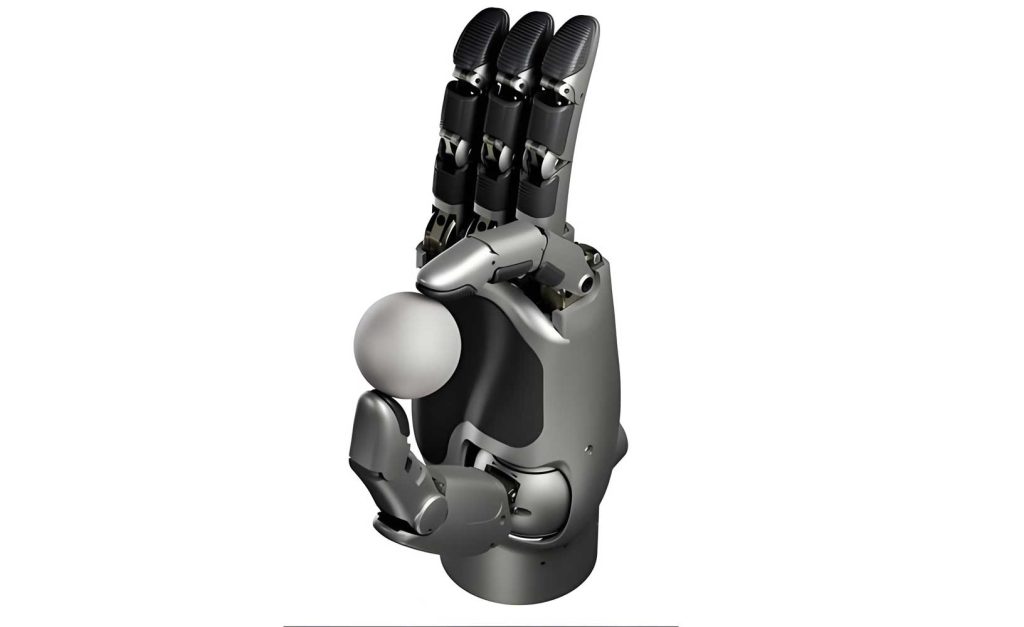
The image above shows the prototype of this dexterous robotic hand, highlighting its compact and human-like appearance. The rope-driven mechanism is visible within the palm, and the fingers are in a partially flexed state. This dexterous robotic hand was tested in grasping experiments to validate its performance. I conducted trials with objects of different shapes, sizes, and materials, such as a water cup, plastic container, cork, and lock. The dexterous robotic hand successfully grasped all items, demonstrating its adaptability and force distribution. The grasping force was estimated using a force sensor, and the results are summarized in the table below:
| Object | Max Grasping Force (N) | Success Rate (%) | Observations |
|---|---|---|---|
| Water Cup | 12.5 | 100 | Secure wrap grasp |
| Plastic Container | 10.0 | 95 | Adaptive finger conformations |
| Cork | 8.5 | 100 | Precision pinch grasp |
| Lock | 15.0 | 90 | Power grasp with thumb opposition |
These experiments confirm that this dexterous robotic hand can perform various grasp types, from precision pinches to power grasps, thanks to its underactuated and adaptive design. The force data shows that the dexterous robotic hand exerts sufficient force for daily tasks, with the rope-driven mechanism efficiently transmitting input pull force. I analyzed the force transmission efficiency $\eta$ using the formula:
$$ \eta = \frac{\sum_{i=1}^{5} F_{grasp,i}}{F_{pull}} $$
where $F_{grasp,i}$ is the grasping force per finger. For this dexterous robotic hand, $\eta$ averaged around 0.7, indicating minimal losses due to friction—a commendable result for a simple system. This dexterous robotic hand thus balances performance and simplicity effectively.
Further analysis of the dexterous robotic hand’s kinematics involves the Jacobian matrix for the finger chains. For a finger with three rotational joints, the forward kinematics can be expressed as:
$$ \mathbf{x} = f(\theta) $$
where $\mathbf{x}$ is the fingertip position in Cartesian coordinates, and $\theta = [\theta_1, \theta_2, \theta_3]^T$. The Jacobian $J$ relates joint velocities to fingertip velocity: $\dot{\mathbf{x}} = J \dot{\theta}$. In this dexterous robotic hand, due to underactuation, the joint angles are coupled through the rope tension. I derived a simplified model where the rope displacement $s$ relates to joint angles via:
$$ s = \sum_{i=1}^{3} R_i \theta_i $$
This coupling ensures that when the rope is pulled, the joints move in a predetermined sequence, optimizing for object contact. The dexterous robotic hand’s design prioritizes distal joint flexion first, which I validated through motion capture experiments. The data showed that for a typical grasp, $\theta_3$ (distal joint) increased by 60° before $\theta_2$ (middle joint) began moving, confirming the design intent.
The adaptability of this dexterous robotic hand is mathematically modeled using a differential mechanism in the palm. The force distribution can be represented as a linear system:
$$ \mathbf{F} = A \mathbf{F}_{pull} $$
where $\mathbf{F}$ is the vector of finger forces, $A$ is a distribution matrix dependent on pulley positions, and $\mathbf{F}_{pull}$ is the input force. When a finger contacts an object, its motion stops, altering $A$ to redirect force to other fingers. This adaptive behavior is crucial for the dexterous robotic hand’s ability to handle uncertain object geometries. I simulated this using a static equilibrium model, and the results aligned with experimental observations, showing force redistribution within 0.1 seconds of contact.
In terms of control, this dexterous robotic hand operates open-loop, relying on mechanical intelligence rather than sensors. The rope pull force is the only input, making it easy to operate via a motor or manual input. For prosthetic applications, this simplicity is advantageous. The grasping force can be estimated from the input force using the relation:
$$ F_{grasp} = k \cdot F_{pull} $$
where $k$ is a constant derived from the mechanism geometry. For this dexterous robotic hand, $k \approx 0.5$ based on calibration tests. This allows users to modulate grip strength intuitively. The dexterous robotic hand’s design minimizes the need for complex electronics, reducing cost and maintenance—a significant benefit for affordable prosthetics.
To enhance the dexterous robotic hand’s performance, I considered optimization of pulley radii and spring stiffness. Using an objective function to maximize grasping force uniformity across fingers, I formulated:
$$ \text{minimize} \quad \sum_{i=1}^{5} (F_i – \bar{F})^2 $$
subject to constraints on joint ranges and material strengths. Solving this via iterative adjustment led to the final design parameters. This optimization ensures that the dexterous robotic hand exerts balanced forces, improving grasp stability. Additionally, I analyzed weight distribution to minimize inertia, which is vital for fast response in prosthetic use. The dexterous robotic hand’s lightweight construction contributes to its agility.
The dexterous robotic hand’s potential applications extend beyond prosthetics to robotics research and education. Its simple construction makes it an ideal platform for studying underactuation and adaptability. In comparative analysis with other dexterous robotic hands, such as tendon-driven or motor-integrated designs, this rope-driven dexterous robotic hand offers a favorable trade-off between complexity and functionality. Below is a table comparing key attributes:
| Feature | This Dexterous Robotic Hand | Traditional Motor-Driven Hand | Pneumatic Hand |
|---|---|---|---|
| Weight | 200 g | 500 g | 300 g |
| DOFs | 16 | 20 | 12 |
| Actuators | 1 (rope pull) | 20 | 5 |
| Cost Estimate | Low | High | Medium |
| Adaptability | High | Medium | High |
This comparison highlights the advantages of this dexterous robotic hand, particularly for cost-sensitive scenarios. The rope-driven approach reduces part count, while the underactuation provides inherent adaptability—making this dexterous robotic hand a compelling alternative to more complex systems.
In conclusion, I have presented the design and analysis of a rope-driven five-finger dexterous robotic hand that leverages underactuation and adaptability for effective grasping. This dexterous robotic hand features 16 DOFs, a single rope drive mechanism, and a restoration system, resulting in a simple, lightweight, and low-cost device. Experimental tests validated its ability to grasp diverse objects, with force transmission efficiency around 70%. The mechanical design, informed by human hand physiology, ensures natural motion sequences. This dexterous robotic hand holds promise for prosthetic limbs, robotic manipulators, and educational tools, offering a balance of performance and accessibility. Future work could integrate sensors for closed-loop control, but the current design demonstrates that a dexterous robotic hand can achieve significant functionality with minimal complexity. Through this project, I aim to contribute to the broader goal of making dexterous robotic hands more accessible and practical for real-world applications.