
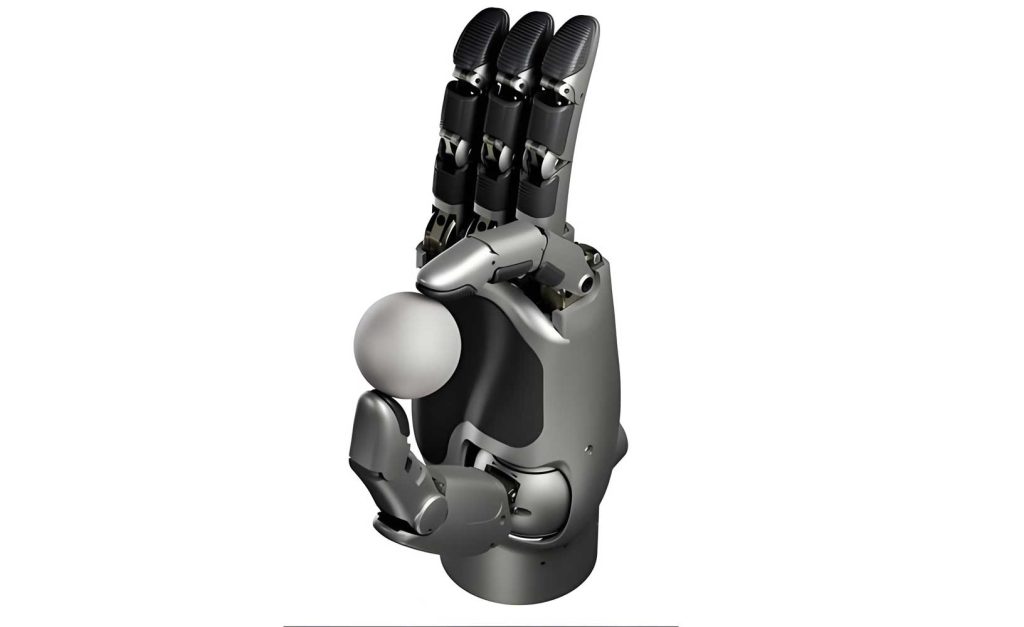
In the field of robotics, the development of end-effectors that mimic human dexterity is crucial for performing complex tasks in hazardous, intricate, or repetitive environments. Traditional grippers, while effective for simple pick-and-place operations, often lack the adaptability and flexibility required for versatile object manipulation. To address this, I have designed a tendon-driven humanoid five-fingered dexterous robotic hand, aiming to replicate the functionality of the human hand for enhanced grasping and manipulation capabilities. This dexterous robotic hand leverages tendon transmission for its actuation, offering advantages such as reduced friction, long-distance force transmission, and a lightweight structure. The design incorporates coupling mechanisms to achieve finger dexterity, and through kinematic analysis and workspace simulation, the feasibility of this dexterous robotic hand for various grasping scenarios is validated. The following sections detail the design principles, structural components, kinematic modeling, and performance evaluation of this innovative dexterous robotic hand.
The human hand is a marvel of biological engineering, comprising 27 bones arranged in the carpus, metacarpus, and phalanges, with tendons enabling precise movements. Inspired by this, my design for a dexterous robotic hand includes five fingers and a palm, each finger featuring three joints and three degrees of freedom (DOFs). This configuration allows for anthropomorphic motions such as flexion and extension. The primary goal is to create a dexterous robotic hand that can securely grasp objects of varying shapes and sizes, utilizing a tendon-driven system to mimic the tendon networks in human hands. The dexterous robotic hand is modular, with similar finger structures to simplify manufacturing and maintenance, ensuring cost-effectiveness and reliability. The overall length of the fingers does not exceed 100 mm, maintaining proportions akin to a human hand for practical applications.
Actuation methods for dexterous robotic hands include gear trains, linkage mechanisms, and tendon drives. Among these, tendon drives are preferred for this dexterous robotic hand due to their ability to transmit forces over distances with minimal friction and weight. By externalizing the actuators (e.g., motors) to the palm or forearm, the fingers become lighter and more compact, enabling intricate movements. This design choice enhances the dexterity of the robotic hand, allowing for finer control. The tendon system uses high-strength synthetic ropes or steel cables, which are anchored to joints and routed through pulleys to convert linear tension into rotational motion. This approach is common in advanced dexterous robotic hands, as it reduces inertial loads and improves dynamic response.
The tendon-driven mechanism in this dexterous robotic hand involves a coupling system for the distal interphalangeal (DIP) joint, which mimics the coupled motion observed in human fingers. Specifically, the proximal interphalangeal (PIP) and DIP joints are linked via tendons to achieve a near 1:1 transmission ratio, reducing the number of actuators required. As shown in the kinematic analysis, when the PIP joint rotates, the DIP joint follows due to tendon coupling, simplifying control and enhancing natural finger curvature. The tendons are arranged in an antagonistic pairs: for the metacarpophalangeal (MP) joint, tendons a1 and a2 control flexion and extension; for the PIP joint, tendons b1 and b2 are used; and for the DIP joint, coupling tendons c1 and c2 facilitate motion. This configuration ensures bidirectional movement and stability. The following table summarizes the tendon assignments for each joint:
| Joint | Primary Tendons | Function |
|---|---|---|
| MP Joint | a1, a2 | Flexion/Extension |
| PIP Joint | b1, b2 | Flexion/Extension |
| DIP Joint | c1, c2 (coupled) | Flexion/Extension via PIP |
The structural design of the dexterous robotic hand focuses on modularity and simplicity. Each finger consists of three phalanges: distal (20 mm), middle (30 mm), and proximal (45 mm), made from lightweight materials like aluminum or carbon fiber composites. The joints incorporate pulleys for tendon routing, with bearings to minimize friction. The MP joint allows for abduction/adduction (via a separate mechanism) and flexion/extension, though for this design, emphasis is on flexion/extension for grasping. The finger segments are connected via rotary joints, with tendon anchors secured by screws to prevent slippage. The palm houses the tendon routing guides and potential sensor interfaces. This modular approach enables easy replacement of components, enhancing the durability and adaptability of the dexterous robotic hand. Below is a table of finger dimensions and joint ranges:
| Phalanx | Length (mm) | Joint | Range of Motion (degrees) |
|---|---|---|---|
| Distal | 20 | DIP | 0 to 90 |
| Middle | 30 | PIP | 0 to 90 |
| Proximal | 45 | MP | -10 to 10 (abduction/adduction), 0 to 90 (flexion) |
Kinematic analysis is essential for understanding the motion of this dexterous robotic hand. Using the Denavit-Hartenberg (D-H) convention, I established coordinate frames for each joint. For a typical finger, the base frame (O0) is at the MP joint, followed by frames at the PIP (O1) and DIP (O2) joints, and the fingertip (O3). The D-H parameters are listed in the table below, where $a_i$ is the link length, $\alpha_i$ is the twist angle, $d_i$ is the offset, and $\theta_i$ is the joint angle. These parameters define the transformations between consecutive frames.
| Link | $a_i$ (mm) | $\alpha_i$ (rad) | $d_i$ (mm) | $\theta_i$ (degrees) |
|---|---|---|---|---|
| 1 | 5 | 0 | 0 | [-10, 10] |
| 2 | 45 | $\pi/2$ | 0 | [0, 90] |
| 3 | 30 | 0 | 0 | [0, 90] |
| 4 | 20 | 0 | 0 | [0, 90] |
The homogeneous transformation matrix from frame $i-1$ to frame $i$ is given by:
$$ ^{i-1}_i T = \begin{bmatrix} \cos\theta_i & -\sin\theta_i \cos\alpha_{i-1} & \sin\theta_i \sin\alpha_{i-1} & a_{i-1} \cos\theta_i \\ \sin\theta_i & \cos\theta_i \cos\alpha_{i-1} & -\cos\theta_i \sin\alpha_{i-1} & a_{i-1} \sin\theta_i \\ 0 & \sin\alpha_{i-1} & \cos\alpha_{i-1} & d_i \\ 0 & 0 & 0 & 1 \end{bmatrix} $$
For this dexterous robotic hand, the individual transformation matrices are computed as follows. For link 1 (MP joint to PIP joint):
$$ ^0_1 T = \begin{bmatrix} \cos\theta_1 & 0 & -\sin\theta_1 & 5\cos\theta_1 \\ \sin\theta_1 & 0 & \cos\theta_1 & 5\sin\theta_1 \\ 0 & -1 & 0 & 0 \\ 0 & 0 & 0 & 1 \end{bmatrix} $$
For link 2 (PIP joint to DIP joint):
$$ ^1_2 T = \begin{bmatrix} \cos\theta_2 & -\sin\theta_2 & 0 & 45\cos\theta_2 \\ \sin\theta_2 & \cos\theta_2 & 0 & 45\sin\theta_2 \\ 0 & 0 & 1 & 0 \\ 0 & 0 & 0 & 1 \end{bmatrix} $$
For link 3 (DIP joint to fingertip):
$$ ^2_3 T = \begin{bmatrix} \cos\theta_3 & -\sin\theta_3 & 0 & 30\cos\theta_3 \\ \sin\theta_3 & \cos\theta_3 & 0 & 30\sin\theta_3 \\ 0 & 0 & 1 & 0 \\ 0 & 0 & 0 & 1 \end{bmatrix} $$
For link 4 (additional frame at fingertip for completeness):
$$ ^3_4 T = \begin{bmatrix} \cos\theta_4 & -\sin\theta_4 & 0 & 20\cos\theta_4 \\ \sin\theta_4 & \cos\theta_4 & 0 & 20\sin\theta_4 \\ 0 & 0 & 1 & 0 \\ 0 & 0 & 0 & 1 \end{bmatrix} $$
The overall transformation from the base to the fingertip is obtained by multiplying these matrices:
$$ ^0_4 T = ^0_1 T \cdot ^1_2 T \cdot ^2_3 T \cdot ^3_4 T $$
Simplifying, the position of the fingertip in the base coordinates is derived. Let $c_i = \cos\theta_i$, $s_i = \sin\theta_i$, $c_{ij} = \cos(\theta_i + \theta_j)$, $s_{ij} = \sin(\theta_i + \theta_j)$, $c_{ijk} = \cos(\theta_i + \theta_j + \theta_k)$, and $s_{ijk} = \sin(\theta_i + \theta_j + \theta_k)$. Then:
$$ ^0_4 T = \begin{bmatrix} c_1 c_{234} & -c_1 s_{234} & s_1 & (20 c_{234} + 30 c_{23} + 45 c_2) c_1 \\ s_1 c_{234} & -s_1 s_{234} & -c_1 & (20 c_{234} + 30 c_{23} + 45 c_2) s_1 \\ s_{234} & c_{234} & 0 & -(20 s_{234} + 30 s_{23} + 45 s_2) \\ 0 & 0 & 0 & 1 \end{bmatrix} $$
The fingertip coordinates $(x, y, z)$ are extracted from the fourth column:
$$ \begin{bmatrix} x \\ y \\ z \end{bmatrix} = \begin{bmatrix} (20 c_{234} + 30 c_{23} + 45 c_2) c_1 \\ (20 c_{234} + 30 c_{23} + 45 c_2) s_1 \\ -(20 s_{234} + 30 s_{23} + 45 s_2) \end{bmatrix} $$
This kinematic model allows for precise control of the dexterous robotic hand’s finger positions, enabling trajectory planning for grasping tasks.
To evaluate the dexterity of this robotic hand, workspace analysis is conducted using the Monte Carlo method in MATLAB. By randomly sampling joint angles within their ranges, the reachable points of the fingertip are plotted to visualize the workspace. The joint limits are: $\theta_1 \in [-10^\circ, 10^\circ]$, $\theta_2 \in [0^\circ, 90^\circ]$, $\theta_3 \in [0^\circ, 90^\circ]$, and $\theta_4 \in [0^\circ, 90^\circ]$. The workspace volume indicates the dexterous robotic hand’s ability to manipulate objects in a three-dimensional space. Simulation results show a hemispherical workspace with a radius approximating the sum of link lengths (95 mm), ensuring sufficient coverage for common grasping scenarios. The workspace density is higher near the palm, reflecting the human hand’s natural dexterity. This analysis confirms that the dexterous robotic hand can achieve a variety of poses, from power grasps to precision pinches.
The tendon-driven actuation system offers several advantages for this dexterous robotic hand. First, by externalizing motors, the fingers become lightweight, reducing inertia and enabling faster movements. Second, tendon coupling simplifies the control architecture, as fewer actuators are needed for multiple joints. For instance, the DIP joint motion is passively coupled to the PIP joint, mimicking biological synergy. Third, tendons provide compliance, which is beneficial for handling fragile objects or adapting to uncertain environments. However, challenges include tendon elongation and friction, which can be mitigated using high-quality materials and proper routing. The dexterous robotic hand incorporates tension sensors to monitor tendon forces, enhancing grip stability and safety. Compared to gear-based designs, this tendon-driven dexterous robotic hand excels in weight reduction and modularity.
In terms of structural integrity, the finger joints are designed to withstand typical grasping forces. Using static analysis, the torque required at each joint can be calculated based on object weight and friction. For example, assuming a 1 N force at the fingertip, the joint torques are derived from the Jacobian matrix of the kinematic chain. The tendon tensions are then computed considering pulley radii and mechanical advantage. This ensures that the dexterous robotic hand can handle objects up to a specified weight, such as 0.5 kg, without failure. Materials like aluminum alloy (for links) and polyethylene (for tendons) are selected for their strength-to-weight ratios, ensuring durability while keeping the dexterous robotic hand lightweight.
Control strategies for this dexterous robotic hand involve both position and force control. Position control uses inverse kinematics to compute desired joint angles from fingertip trajectories, while force control adjusts tendon tensions to achieve stable grasps. A PID controller can be implemented for each tendon actuator, with feedback from encoders and tension sensors. The modular design allows for individual finger control, enabling complex manipulations like rolling or twisting objects. Simulation in ROS (Robot Operating System) or similar platforms can validate control algorithms before hardware implementation. The dexterous robotic hand’s performance is evaluated through metrics such as grasp success rate, object adaptability, and energy efficiency.
Potential applications of this dexterous robotic hand span multiple domains. In industrial settings, it can perform assembly tasks requiring delicate handling. In healthcare, it serves as a prosthetic hand or rehabilitation device, offering natural movement patterns. In exploration, such as space or underwater missions, the dexterous robotic hand can manipulate tools in extreme environments. The tendon-driven design reduces maintenance needs, as actuators are accessible and replaceable. Future enhancements include integrating tactile sensors on fingertips for haptic feedback, improving the dexterous robotic hand’s interaction with unstructured environments.
In conclusion, the design of a tendon-driven humanoid five-fingered dexterous robotic hand demonstrates significant advancements in robotic manipulation. By emulating human hand anatomy through tendon actuation and coupling mechanisms, this dexterous robotic hand achieves high dexterity with a simplified structure. Kinematic analysis and workspace simulations confirm its capability for diverse grasping tasks. The modular approach facilitates customization and scalability, making it suitable for various applications. While challenges like tendon management exist, ongoing research in materials and control systems will further enhance the performance of this dexterous robotic hand. Ultimately, this dexterous robotic hand represents a step toward more adaptive and intelligent robotic systems, bridging the gap between human and machine dexterity.