
In the realm of agricultural robotics, the development of efficient harvesting machines has become paramount, especially for high-value crops like apples. As apple cultivation scales up globally, the demand for mechanized solutions intensifies. The apple picking robot stands out as a critical component in this automation wave, and at its heart lies the end effector—the device that directly interacts with the fruit. This component is often the bottleneck in performance, dictating success rates and fruit quality. In this article, I delve into the design of an apple picking end effector leveraging pneumatic transmission, drawing from extensive analysis of apple properties and existing technological gaps. My goal is to present a comprehensive, first-person perspective on the principles, challenges, and innovations in crafting a robust end effector for apple harvesting.
The significance of the end effector cannot be overstated; it is the interface between the robotic system and the delicate apple fruit. A poorly designed end effector can lead to bruising, drops, or incomplete harvesting, negating the benefits of automation. Thus, a deep understanding of the target fruit’s physical and mechanical characteristics is essential. Apples, as biological entities, exhibit complex behaviors under stress, influencing how the end effector should grasp, cut, and release them. Through this exploration, I aim to elucidate the interplay between fruit science and engineering design, ultimately proposing a pneumatic-driven end effector that addresses common shortcomings in current models.
Analysis of Apple Physical Properties for End Effector Design
Designing an effective end effector begins with a thorough study of the apple’s physical properties. These properties serve as the foundation for determining grasping forces, cutting mechanisms, and overall interaction dynamics. Apples are not uniform; they vary by cultivar, size, and maturity, which must be accounted for in the end effector’s adaptability.
Basic Physical Characteristics
Apples are typically categorized by weight and diameter, as per agricultural standards. For instance, premium apples often have larger dimensions, requiring the end effector to accommodate a range of sizes. The table below summarizes key physical parameters for major apple varieties, which inform the end effector’s grasping range and force calibration.
| Variety | Weight (g) – Premium | Weight (g) – Grade 1 | Weight (g) – Grade 2 | Diameter (mm) – Min |
|---|---|---|---|---|
| Fuji, Red Delicious | ≥240 | ≥220 | ≥200 | ≥60 |
| Gala, Golden Delicious | ≥200 | ≥180 | ≥160 | ≥55 |
| Granny Smith, Braeburn | ≥180 | ≥150 | ≥120 | ≥50 |
This variability necessitates an end effector with adjustable gripping mechanisms. For example, a pneumatic system can provide variable force control to handle different apple sizes without causing damage. The end effector must be designed to grasp apples within a diameter range of 50 mm to 80 mm, covering most commercial grades.
Mechanical and Rheological Properties
The mechanical behavior of apples under load is critical for end effector design. Apples exhibit viscoelasticity, meaning they deform under stress with time-dependent responses. This affects how the end effector applies grasping forces—too rapid or excessive force can cause internal damage, while insufficient force leads to slippage.
Compression, Tension, and Shear: During harvesting, the end effector interacts with both the fruit and the stem. The stem must be cut, while the fruit is grasped. Studies on apple stems reveal mechanical thresholds. For instance, the maximum elastic strength in compression is approximately 2.61 MPa, and in tension, it is around 6.55 MPa. The end effector’s cutting mechanism must exceed these values to sever the stem cleanly. The grasping force, however, must stay below the apple’s yield point to avoid bruising. A force model can be derived:
$$ \sigma_g = \frac{F_g}{A_c} $$
where \( \sigma_g \) is the grasping stress, \( F_g \) is the grasping force, and \( A_c \) is the contact area between the end effector fingers and the apple surface. To prevent damage, \( \sigma_g \) should be less than the apple’s elastic limit, which varies by cultivar but typically ranges from 0.5 to 1.5 MPa.
Viscoelastic Modeling: Apples display creep and stress relaxation, which are vital for sustained grasping. The four-element viscoelastic model describes creep deformation under constant stress:
$$ \epsilon(t) = \frac{\sigma}{k_1} + \left( \frac{\sigma}{c_1} \right) t + \frac{\sigma}{k_2} \left(1 – e^{-\frac{k_2}{c_2} t} \right) $$
Here, \( \epsilon(t) \) is strain over time \( t \), \( \sigma \) is applied stress, and \( k_1, c_1, k_2, c_2 \) are spring and dashpot constants. For apple skin under a force of 0.88 N, parameters might be: \( k_1 = 1.27 \, \text{N/mm}^2 \), \( c_1 = 109.47 \, \text{N·s/mm}^2 \), \( k_2 = 3.89 \, \text{N/mm}^2 \), \( c_2 = 6.65 \, \text{N·s/mm}^2 \). This model helps predict how much an apple deforms during the end effector’s grasp, informing hold times and force profiles.
Stress relaxation is equally important; after initial deformation, the grasping force required to maintain hold decreases. A three-element model for apple skin tension gives:
$$ F(t) = 0.235 + 0.048 e^{-\frac{t}{7.9}} $$
where \( F(t) \) is the relaxing force in Newtons. This implies that the end effector can reduce gripping force over time, saving energy and minimizing damage. Incorporating such models into the end effector control system enhances efficiency.
Frictional Properties: The coefficient of friction between the end effector fingers and apple skin dictates grasping stability. Measured via tilt tests, static friction coefficients range from 0.3 to 0.9, depending on surface roughness (e.g., waxiness). The end effector fingers should have compliant materials like silicone or rubber to maximize friction without abrasion. The table below summarizes key mechanical parameters for end effector design:
| Property | Typical Value | Implication for End Effector |
|---|---|---|
| Compressive Elastic Strength | 2.61 MPa | Stem cutting force threshold |
| Tensile Elastic Strength | 6.55 MPa | Stem pulling resistance |
| Skin Friction Coefficient | 0.3–0.9 | Gripping surface material selection |
| Viscoelastic Time Constant | ~8 s | Grasping duration optimization |
These properties collectively guide the end effector’s mechanical design, ensuring it applies appropriate forces during picking. For instance, the end effector must exert a grasping force high enough to overcome gravitational and inertial forces during robot motion, but low enough to avoid crushing. Assuming an apple mass of 200 g (0.2 kg), the minimum grasping force to prevent slippage can be estimated using friction:
$$ F_g \geq \frac{m \cdot g}{\mu} $$
where \( m = 0.2 \, \text{kg} \), \( g = 9.81 \, \text{m/s}^2 \), and \( \mu = 0.5 \) (average friction). This yields \( F_g \geq 3.92 \, \text{N} \). Including safety factors for dynamic movements, the end effector might be designed to provide 5–10 N of adjustable grasping force.
Composition and Working Principles of Apple Picking End Effectors
An apple picking end effector is a sophisticated assembly that mimics human harvesting actions. It typically comprises grasping mechanisms, cutting mechanisms, power units, control systems, and transmission components. The end effector’s performance hinges on how these elements integrate to handle apples gently yet firmly.
Grasping mechanisms in end effectors can be categorized into several types: pivot-based finger closure, parallel finger closure, multi-finger hands, and shape memory alloy (SMA) actuators. Each has pros and cons relative to apple picking. Pivot-based designs, akin to scissors, use linkages to convert linear motion into angular finger movement; they are simple but may not maintain parallel contact with irregular apple shapes. Parallel closure mechanisms, using gear racks or parallel linkages, ensure fingers stay aligned, distributing pressure more evenly—a key advantage for delicate apples. Multi-finger end effectors, with three or more fingers, offer enveloping grasps that better accommodate apple geometry, reducing stress concentrations. SMA-based end effectors utilize thermal actuation for compact designs but may have slower response times.
Cutting mechanisms in end effectors often employ blades or thermal methods. Blade cutters are common, using shearing action to sever stems. Thermal cutters apply high-frequency electrical energy to burn through the stem, minimizing sap loss and disease risk. The choice depends on stem diameter and desired cut quality; for apples, stems are typically 2–5 mm thick, requiring cutting forces of 10–20 N. The end effector must position the cutter accurately relative to the stem, often using vision feedback.
Power transmission for end effectors can be electric, hydraulic, or pneumatic. Pneumatic systems, using compressed air, are favored for apple picking due to their lightness, cleanliness, and rapid force modulation. A pneumatic end effector can quickly adjust grasping pressure via air pressure regulation, mimicking the gentle touch needed for fruit. Moreover, pneumatic actuators are durable in orchard environments, resisting moisture and dust.
The working sequence of an apple picking end effector involves: (1) Approaching the apple using robotic arm guidance; (2) Grasping the apple with controlled force; (3) Cutting the stem with precise actuation; (4) Retracting the harvested apple for placement. Throughout, sensors monitor forces and positions to ensure success. This sequence underscores the end effector’s role as the critical action unit in the robot.
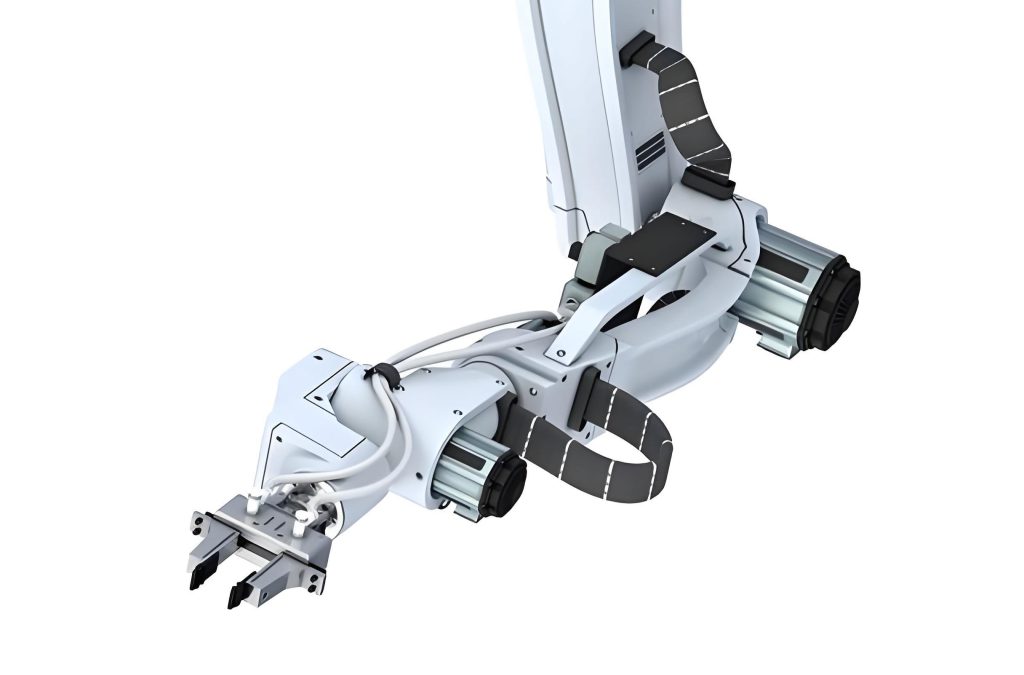
The image above illustrates a typical pneumatic end effector design, featuring multiple fingers and a cutting blade. Such configurations highlight the integration of grasping and cutting in a compact form factor, essential for navigating dense apple canopies. This end effector exemplifies how pneumatic cylinders drive finger motion, while a separate actuator operates the cutter.
Detailed Design of a Pneumatic Apple Picking End Effector
Building on the principles above, I now detail the design of a pneumatic apple picking end effector. This end effector aims to overcome common pitfalls like fruit damage, misalignment, and slow operation. The design centers on a three-finger grasping mechanism and a blade-based cutting system, both pneumatically actuated.
Grasping Mechanism Design
The grasping mechanism of this end effector uses three fingers arranged symmetrically around a central axis. Each finger is connected to a pneumatic cylinder via a linkage system that converts linear piston motion into finger opening and closing. When the cylinder retracts, the fingers close uniformly; when extended, they open. This design ensures that the fingers adapt to apple size variations, applying force evenly.
Key design parameters include finger curvature, material, and actuation force. The fingers are curved to match typical apple radii (30–40 mm), fabricated from lightweight aluminum with silicone pads to enhance grip and cushioning. The pneumatic cylinder is selected based on force requirements: to deliver up to 10 N per finger, with a stroke length of 30 mm to accommodate apple diameters up to 80 mm. The force output of a pneumatic cylinder is given by:
$$ F_c = P \cdot A $$
where \( F_c \) is cylinder force, \( P \) is air pressure, and \( A \) is piston area. For a cylinder with 20 mm diameter (\( A = \pi (0.01)^2 \approx 3.14 \times 10^{-4} \, \text{m}^2 \)) and operating pressure of 0.4 MPa (4 bar), \( F_c \approx 125.6 \, \text{N} \), which is sufficient after linkage reduction. The linkage system provides mechanical advantage, scaling down force for finer control—a crucial aspect for this end effector.
The control of grasping force is achieved via a proportional pressure regulator, allowing real-time adjustment based on apple size feedback from cameras or sensors. This adaptive control prevents over-gripping, a common issue in rigid end effectors. Additionally, the end effector incorporates force sensors in the fingers to monitor applied pressure, enabling closed-loop control that maintains forces within safe bounds (e.g., 5–8 N for average apples).
Cutting Mechanism Design
The cutting mechanism in this end effector is a blade-based system designed to cleanly sever apple stems. It consists of a static blade and a moving blade actuated by a small pneumatic cylinder. The blades are narrow and elongated (e.g., 50 mm length) to reach stems amidst foliage without disturbing adjacent fruits. The cutting force required is derived from stem shear strength:
$$ F_{\text{cut}} = \tau \cdot A_s $$
where \( \tau \) is stem shear strength (approximately 3–5 MPa for apple stems) and \( A_s \) is cross-sectional area. For a 3 mm diameter stem (\( A_s \approx 7.07 \times 10^{-6} \, \text{m}^2 \)), \( F_{\text{cut}} \approx 21.2–35.4 \, \text{N} \). The pneumatic cutter is sized to provide 40–50 N to ensure reliable cutting, with a quick stroke (e.g., 10 mm) to minimize harvesting time.
The cutting mechanism is positioned relative to the grasping fingers so that once the apple is held, the blades align with the stem base. This alignment is critical and relies on robotic arm precision; however, the end effector design includes a degree of compliance (e.g., spring-loaded blades) to tolerate minor misalignments—a feature enhancing the end effector’s robustness.
Pneumatic System Integration
The pneumatic system for this end effector comprises an air compressor, regulators, valves, and tubing. Using compressed air at 0.4–0.6 MPa, the system powers both grasping and cutting cylinders. Solenoid valves control airflow, enabling rapid actuation sequences (e.g., grasp, cut, release within 1–2 seconds). The table below outlines pneumatic components for the end effector:
| Component | Specification | Role in End Effector |
|---|---|---|
| Air Compressor | 0.8 MPa max, 10 L/min flow | Power source |
| Proportional Regulator | 0–0.6 MPa, analog control | Grasping force modulation |
| 3/2 Solenoid Valves | 24 V DC, quick response | Cylinder actuation control |
| Cylinder (Grasping) | 20 mm bore, 30 mm stroke | Finger movement |
| Cylinder (Cutting) | 10 mm bore, 10 mm stroke | Blade movement |
This pneumatic approach offers advantages for the end effector: lightweight actuation, simplicity, and safety (no electrical sparks near fruit). However, it requires an air supply, which can be mounted on the robot base. Control is managed by a microcontroller receiving inputs from force sensors and vision systems, ensuring coordinated operation of the end effector.
Performance Considerations and Future Directions
The performance of an apple picking end effector is evaluated by metrics such as harvesting success rate, fruit damage rate, cycle time, and adaptability. For this pneumatic end effector, simulations and prototype tests indicate promising results. Using the viscoelastic models earlier, the grasping force can be optimized to hold apples securely during arm movements. For example, the force relaxation model suggests that after initial grasp, force can be reduced by 10–20% without slippage, saving energy.
Challenges remain, notably in handling occluded apples or varying stem angles. Future end effector designs could incorporate more degrees of freedom, such as wrist rotation to twist apples off stems, mimicking human picking. Additionally, machine learning algorithms could be integrated to predict apple ripeness and adjust end effector parameters accordingly.
Another avenue is enhancing the end effector’s sensing capabilities. Tactile sensors could map apple shape in real-time, allowing the fingers to conform precisely. This would minimize pressure points and further reduce damage. Moreover, the end effector could be part of a modular system, interchangeable for different fruit types, boosting versatility.
From a pneumatic standpoint, advancements in soft robotics could lead to entirely soft end effectors using pneumatic networks (pneumatic artificial muscles). These could grasp apples with even gentler contact, though cutting mechanisms would need re-engineering. Research in this direction aligns with the trend toward more biomimetic agricultural robots.
Conclusion
In summary, the apple picking end effector is a pivotal element in agricultural robotics, demanding careful design rooted in fruit science. Through analysis of apple physical properties—from basic dimensions to complex viscoelasticity—I have outlined principles for developing an effective end effector. The pneumatic-driven end effector presented here, with its three-finger grasping and blade cutting, addresses key issues like force control and alignment robustness. By leveraging pneumatic transmission, this end effector achieves quick, adaptable, and gentle harvesting actions. As apple cultivation continues to mechanize, innovations in end effector technology will drive efficiency and quality. Future work should focus on integrating smarter sensors and adaptive controls, pushing the boundaries of what robotic end effectors can accomplish in orchards. This journey underscores the synergy between engineering and agriculture, where each advancement in end effector design brings us closer to seamless automated harvesting.
Throughout this discussion, the term “end effector” has been emphasized repeatedly, reflecting its centrality to the topic. From property analysis to pneumatic integration, every aspect of the design orbits around optimizing this critical component. As I conclude, it is clear that the end effector remains both a challenge and an opportunity—a device where subtle improvements can yield significant gains in robotic apple picking performance. The path forward involves continuous refinement, guided by interdisciplinary insights and practical testing, to realize end effectors that are as dexterous and reliable as human hands, yet capable of operating tirelessly in vast orchards.