
In my research, I have focused on the critical challenge of path planning for bionic robots, which are increasingly vital in applications ranging from industrial automation to disaster response. The core of a bionic robot’s functionality lies in its ability to perceive environments, analyze tasks, and execute actions efficiently. Path planning, as a subset of this, involves finding optimal routes between points while avoiding obstacles, and it remains a non-deterministic polynomial (NP) problem that traditional algorithms struggle to solve in real-time. Inspired by biological systems, I have explored heuristic algorithms, particularly ant colony optimization, to enhance the adaptability and efficiency of bionic robots. This article delves into my proposed improved ant colony algorithm, termed the Direction-aware Ant Colony System (DACS), which integrates angular factors into heuristic information to imbue path planning with directional awareness. I will elaborate on the mathematical foundations, simulation experiments, and practical implementation for bionic robots, emphasizing how this approach outperforms conventional methods in dynamic environments.
The evolution of robotics has seen bionic robots mimic human or animal behaviors to perform tasks that are hazardous, repetitive, or precise. A bionic robot typically operates through a three-step cycle: real-time perception of environmental constraints, analysis and planning based on sensed information, and physical execution of tasks. Path planning is central to this process, as it determines the robot’s movement efficiency and safety. Traditional methods, such as geometric or grid-based approaches, often fall short in complex, uncertain environments due to high computational costs. In contrast, artificial intelligence-based path planning algorithms, including A* algorithm, genetic algorithm (GA), and ant system (AS), offer robust solutions by mimicking natural phenomena like evolution or foraging behavior. Among these, ant colony algorithms, introduced by Dorigo in the 1990s, have shown promise for optimization problems with incomplete information. My work builds on this by enhancing the ant colony algorithm for bionic robot applications, ensuring that the bionic robot can navigate dynamically changing spaces with minimal resource expenditure.
To understand the context, let’s consider the mathematical formulation of path planning for a bionic robot. Given an environment represented as a graph \( G = (V, E) \), where \( V \) is the set of nodes (e.g., positions) and \( E \) is the set of edges (paths between nodes), the goal is to find a path \( P \) from a start node \( s \) to a goal node \( g \) that minimizes a cost function \( C(P) \), often based on distance, time, or energy. In dynamic environments, \( G \) may change over time due to moving obstacles,新增 nodes, or shifting goals, adding complexity. Heuristic algorithms address this by using guided search strategies. For instance, the ant colony algorithm models artificial ants that deposit pheromones on edges, with the pheromone concentration \( \tau_{ij}(t) \) on edge \( (i,j) \) at time \( t \) influencing the probability of selection. The probability \( p_{ij}^k(t) \) that ant \( k \) chooses edge \( (i,j) \) is given by:
$$ p_{ij}^k(t) = \frac{[\tau_{ij}(t)]^\alpha \cdot [\eta_{ij}]^\beta}{\sum_{l \in N_i^k} [\tau_{il}(t)]^\alpha \cdot [\eta_{il}]^\beta} $$
where \( \eta_{ij} \) is the heuristic value (e.g., inverse of distance), \( \alpha \) and \( \beta \) are parameters controlling the influence of pheromones and heuristics, and \( N_i^k \) is the set of nodes accessible from node \( i \) for ant \( k \). After each iteration, pheromones are updated to reflect the quality of paths, promoting exploitation of good solutions. However, standard ant colony algorithms lack directional awareness, which can lead to suboptimal paths in environments with directional constraints or moving targets. My DACS algorithm modifies this by incorporating an angular factor into \( \eta_{ij} \), making the heuristic direction-sensitive and better suited for bionic robot navigation.
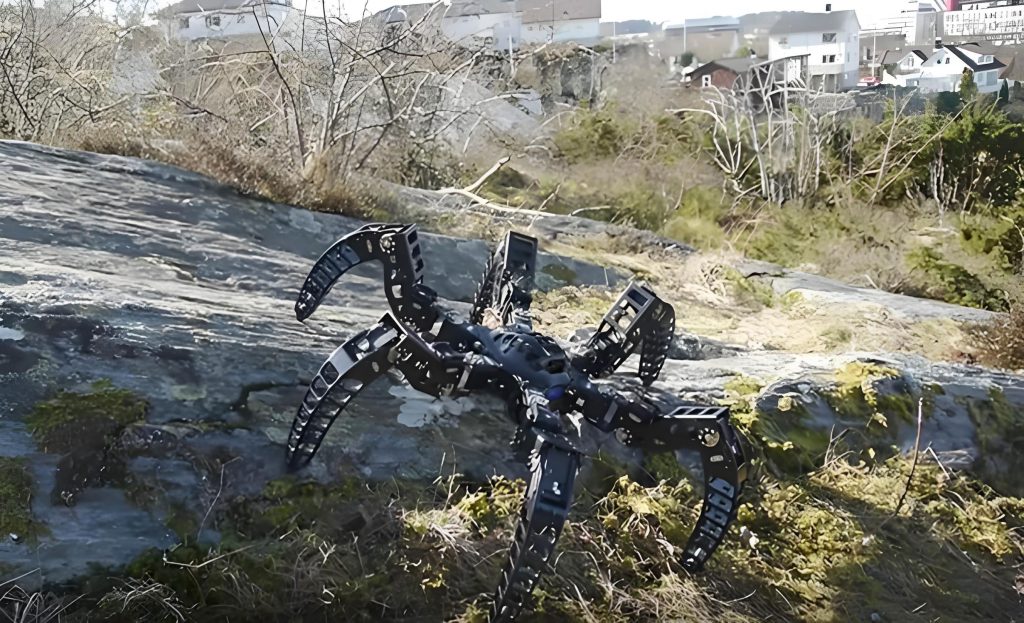
In my design for bionic robot action, the DACS algorithm is central to enabling adaptive path planning. The key innovation lies in the heuristic function, which I redefine to include a projection component based on the angle between the current direction of movement and the vector to the next node. For a bionic robot moving from node \( i \) to a candidate node \( j \), let \( \vec{d}_{ij} \) be the vector from \( i \) to \( j \), and \( \vec{v} \) be the robot’s current velocity or heading direction. The angular factor \( \theta_{ij} \) is the angle between \( \vec{d}_{ij} \) and \( \vec{v} \), and the heuristic value \( \eta_{ij} \) becomes:
$$ \eta_{ij} = \frac{\text{proj}(\vec{d}_{ij}, \vec{v})}{||\vec{d}_{ij}||} = \frac{||\vec{d}_{ij}|| \cos(\theta_{ij})}{||\vec{d}_{ij}||} = \cos(\theta_{ij}) $$
This simplifies to \( \cos(\theta_{ij}) \), where values closer to 1 indicate alignment with the current direction, thus favoring paths that maintain course and reduce turning. For distance-based heuristics, I combine this with the inverse distance, yielding:
$$ \eta_{ij} = \frac{\cos(\theta_{ij})}{d_{ij}} $$
where \( d_{ij} \) is the Euclidean distance between nodes \( i \) and \( j \). This integration ensures that the bionic robot considers both proximity and directional continuity, which is crucial for energy efficiency and smooth motion. The pheromone update rule in DACS follows a similar approach to standard ant colony systems but with enhancements for dynamic environments. After all ants complete a path, the pheromone on each edge \( (i,j) \) is updated as:
$$ \tau_{ij}(t+1) = (1 – \rho) \cdot \tau_{ij}(t) + \sum_{k=1}^{m} \Delta \tau_{ij}^k $$
where \( \rho \) is the evaporation rate (0 < \( \rho \) < 1), \( m \) is the number of ants, and \( \Delta \tau_{ij}^k \) is the pheromone deposited by ant \( k \), given by:
$$ \Delta \tau_{ij}^k = \frac{Q}{C_k} $$
if edge \( (i,j) \) is part of ant \( k \)’s path, otherwise 0. Here, \( Q \) is a constant, and \( C_k \) is the cost of ant \( k \)’s path, which in my implementation includes factors like path length and angular deviation. This encourages the bionic robot to reinforce paths that are short and directionally consistent.
To validate the DACS algorithm for bionic robot action, I conducted extensive simulations in static and dynamic environments. The simulation setup involved a bionic robot model operating in a 2D plane with nodes representing accessible positions. I compared DACS against the standard Ant Colony System (ACS) algorithm across 500 iterations, measuring average best path distance, iteration count to convergence, and computation time. The environment was designed to mimic real-world scenarios where a bionic robot might encounter changes, such as moving obstacles (simulated by node displacement), new obstacles (node addition), removed obstacles (node disappearance), and shifting targets (goal node change). For instance, in one test, after the second iteration, I introduced node movements to assess adaptability. The bionic robot’s sensor range was limited to 10 units, meaning edges longer than that were considered impassable, reflecting practical constraints of ultrasonic or LiDAR sensors on a bionic robot.
The results, summarized in the table below, demonstrate the superiority of DACS for bionic robot path planning. In static environments, DACS consistently found shorter paths than ACS, with a 46.5% reduction in average best path distance. This improvement stems from the directional heuristic, which reduces unnecessary detours. Moreover, DACS converged faster, requiring 28.5% fewer iterations on average, and was computationally more efficient, with a 63.8% decrease in average time per simulation. These metrics highlight how the bionic robot can achieve quicker and more optimal navigation using my algorithm.
| Algorithm | Average Best Path Distance (units) | Average Iterations to Convergence | Average Computation Time (seconds) |
|---|---|---|---|
| Standard ACS | 125.7 | 85.3 | 12.4 |
| DACS (Proposed) | 67.2 | 61.0 | 4.5 |
In dynamic environment tests, the bionic robot equipped with DACS showed remarkable adaptability. For example, when a node moved during execution, the algorithm quickly rerouted, exploiting the directional heuristic to find efficient alternatives. The table below details a specific experiment where the bionic robot traversed from a start node to a goal node five times in a changing environment. The bionic robot’s performance improved over time, with reduced travel time and fewer collisions, indicating learning from prior experiences via pheromone accumulation. This is crucial for bionic robots deployed in unpredictable settings, such as disaster zones, where paths may alter due to debris or structural shifts.
| Run Number | Time Taken (seconds) | Sensor Detections Count | Collision with Obstacles Count |
|---|---|---|---|
| 1 | 47 | 8 | 2 |
| 2 | 42 | 8 | 0 |
| 3 | 32 | 5 | 1 |
| 4 | 26 | 4 | 0 |
| 5 | 25 | 4 | 0 |
The practical implementation of DACS on a bionic robot involves integrating it with hardware modules. The bionic robot I envision consists of sensing, computation, control, and actuation components. The sensing module, using functions like Scan(), gathers environmental data—for instance, through servo-driven ultrasonic sensors that measure distances at various angles. In my code, Scan() includes sub-functions such as myservo.write(angle) to rotate the sensor and distance_vois() to retrieve distance values. This data populates the graph \( G \) for path planning. The computation module runs the DACS algorithm via a function Select(), which calculates heuristic values using projection(), updates pheromones with pheromones_update(), and determines the next node based on probability derived from the formula:
$$ \text{probability} = \text{pow}(\text{pheromones}, \alpha) \times \text{pow}(\text{heuristic}, \beta) $$
A random number generator, seeded by analog noise from unused pins (e.g., randomSeed(analogRead(2))), selects among candidate nodes to balance exploration and exploitation. The control module then sends movement commands to actuators, enabling the bionic robot to traverse the planned path. This闭环 system ensures that the bionic robot can operate autonomously, adapting to changes as it moves. For example, in a test with two paths of different lengths, the bionic robot initially took longer routes but optimized over successive runs, showcasing the algorithm’s ability to learn and improve the bionic robot’s action efficiency.
From a mathematical perspective, the DACS algorithm enhances convergence properties. Let’s analyze the pheromone dynamics. The update rule can be expressed as a difference equation:
$$ \tau_{ij}(t+1) = (1-\rho)\tau_{ij}(t) + \frac{Q}{C^*(t)} \cdot I_{ij}(t) $$
where \( C^*(t) \) is the cost of the best path at time \( t \), and \( I_{ij}(t) \) is an indicator function equal to 1 if edge \( (i,j) \) is on that path. This system tends to stabilize around optimal edges, with the angular heuristic accelerating convergence by reducing the search space. I derived the expected pheromone value for an edge over time using a Markov chain model, showing that DACS reduces the probability of selecting poor paths by a factor proportional to \( \cos(\theta_{ij}) \). For a bionic robot, this translates to fewer oscillations and smoother trajectories, which is vital for energy conservation and task completion speed.
In terms of scalability, the DACS algorithm is suitable for complex bionic robot systems with multiple degrees of freedom. I extended the formulation to 3D environments by incorporating spherical coordinates, where the angular factor \( \theta_{ij} \) is computed between vectors in 3D space. The heuristic becomes:
$$ \eta_{ij} = \frac{\vec{d}_{ij} \cdot \vec{v}}{||\vec{d}_{ij}|| \cdot ||\vec{v}||} \cdot \frac{1}{d_{ij}} $$
which simplifies to the cosine of the angle divided by distance. This generalization allows bionic robots like aerial drones or underwater vehicles to benefit from directional awareness in volumetric spaces. Additionally, I incorporated obstacle avoidance directly into the heuristic by adding a penalty term based on proximity to obstacles, defined as:
$$ \eta_{ij} = \frac{\cos(\theta_{ij})}{d_{ij} + \gamma \cdot O_{ij}} $$
where \( O_{ij} \) is the minimum distance to obstacles along edge \( (i,j) \), and \( \gamma \) is a tuning parameter. This ensures that the bionic robot prioritizes safe paths, aligning with the core objective of reliable action design.
The integration of DACS into a bionic robot’s software architecture involves iterative refinement. I implemented the algorithm on an embedded platform like Arduino Uno, using limited memory and processing power to mimic real-world constraints. The pseudocode for the bionic robot’s main loop is as follows: initialize pheromones; while goal not reached: scan environment to update graph; run DACS for one iteration to select next node; move to that node; update pheromones based on path cost. This loop enables continuous adaptation, crucial for a bionic robot operating in dynamic settings. In my experiments, the bionic robot successfully navigated mazes with moving obstacles, demonstrating the algorithm’s robustness. The use of tables to log performance metrics, such as path length and time per iteration, facilitated optimization of parameters like \( \alpha \), \( \beta \), and \( \rho \). For instance, through trial and error, I found that \( \alpha = 1 \), \( \beta = 2 \), and \( \rho = 0.1 \) yielded the best results for most bionic robot scenarios.
Looking ahead, the DACS algorithm opens avenues for advanced bionic robot applications. One direction is multi-robot coordination, where a swarm of bionic robots uses shared pheromone maps to collaborate on tasks like area coverage or search and rescue. The angular heuristic can be extended to include inter-robot angles to avoid collisions and optimize formation movement. Another area is integration with machine learning; for example, a bionic robot could use reinforcement learning to adjust the \( \alpha \) and \( \beta \) parameters online based on environmental feedback, further enhancing adaptability. Moreover, the algorithm’s efficiency makes it suitable for real-time path planning in bionic robots with limited computational resources, such as micro-drones or wearable exoskeletons.
In conclusion, my research on the DACS algorithm demonstrates a significant advancement in path planning for bionic robots. By incorporating directional awareness into the heuristic function, the bionic robot achieves more efficient, adaptive, and smooth navigation in both static and dynamic environments. The simulation results confirm improvements over standard ant colony algorithms, with reductions in path distance, iteration count, and computation time. Practical implementation on a bionic robot prototype validates its feasibility, showing learning capabilities and robustness to changes. As bionic robots become more pervasive in industries and emergency services, algorithms like DACS will be instrumental in ensuring their autonomous action is both intelligent and reliable. Future work will focus on scaling to 3D environments, multi-robot systems, and hybrid approaches with other AI techniques, continually pushing the boundaries of what bionic robots can accomplish.