
In recent years, the aging population has become a critical social issue globally, with the proportion of elderly individuals living alone, often referred to as empty nesters, increasing significantly. As researchers in industrial design and human-computer interaction, we have observed that this demographic often experiences loneliness, anxiety, and other psychological distress due to lack of companionship, which can adversely affect their physical health. To address these challenges, we focus on developing intelligent companion robots that leverage emotional computation to provide emotional support and practical assistance. Our goal is to create a harmonious human-robot interaction environment that enhances the well-being of empty nesters. This article presents our comprehensive research, including theoretical foundations, model construction, system design, and practical applications, all aimed at advancing the field of companion robots for elderly care.
Emotional computation is a interdisciplinary field that studies emotions, their generation, and influencing factors, with the aim of enabling machines to recognize, understand, express, and adapt to human emotions. We define emotional computation as a process that quantifies human emotions through computer simulation techniques, allowing for appropriate feedback. This involves several key steps: emotion elicitation, emotion recognition, emotion modeling, and emotion expression. In the context of companion robots, emotional computation can be formalized as a function mapping input signals (e.g., facial expressions, voice tones) to emotional states and subsequent responses. For instance, let $E$ represent the emotional state, derived from sensory inputs $S$, such that $E = f(S)$, where $f$ is the emotional computation model. By integrating this, companion robots can establish better relationships with users, moving beyond mere functional interactions to empathetic engagements.
To design effective companion robots, we first analyze the physiological and psychological characteristics of empty nesters. Physiologically, aging leads to declines in perception, cognition, and motor abilities. For example, sensory acuity decreases, cognitive processing slows, and physical mobility reduces. Psychologically, empty nesters often face heightened emotional vulnerabilities due to isolation, lack of social support, and reduced self-esteem. These factors contribute to lower subjective well-being compared to non-empty nesters. We summarize these traits in Table 1 to provide a clear overview for design considerations.
| Aspect | Key Characteristics | Impact on Design |
|---|---|---|
| Physiological | Reduced perception, cognitive decline, decreased motor skills | Simplify interfaces, enhance sensory feedback, ensure safety |
| Psychological | Loneliness, anxiety, low self-esteem, need for emotional support | Incorporate empathy, provide companionship, foster social connection |
The current market for companion robots offers various types, including health monitoring, remote surveillance, and interactive models. However, we identify several limitations: many robots rely on basic voice commands, lack deep emotional engagement, and use colors and forms that may alienate elderly users. For instance, cold colors like blue or gray can evoke a sense of detachment, while rigid designs fail to stimulate curiosity. To illustrate, we categorize existing companion robots in Table 2, highlighting their primary functions and shortcomings.
| Robot Type | Primary Functions | Common Issues |
|---|---|---|
| Health Monitoring | Medical assistance, vital sign tracking | Limited emotional interaction, complex operation |
| Remote Surveillance | Video calls, activity monitoring | Passive engagement, privacy concerns |
| Interactive | Voice dialogue, simple commands | Shallow emotional depth, impersonal feedback |
To overcome these issues, we propose a design流程 based on emotional computation. This流程 involves constructing an emotional interaction Agent model specifically for empty nesters. The model comprises five components: perception system, cognitive system, action system, emotional system, and human-robot interface. The perception system collects data through sensors, cameras, and microphones, capturing facial expressions, gestures, and speech. The cognitive system processes this data to recognize emotional states, such as happiness, sadness, or anger, using algorithms for feature extraction. For example, emotion recognition can be modeled as a classification problem: if $X$ is the input feature vector, then the emotional state $C$ is determined by $C = \arg\max_{c} P(c|X)$, where $P$ is the probability distribution over emotion classes. The action system then generates appropriate responses, such as comforting words or gestures, based on the identified emotion. This cycle enables the companion robot to adapt dynamically to user needs.
We further elaborate on the emotional computation system architecture, which integrates technologies like sensors, facial expression recognition, and intelligent speech recognition. Sensors play a crucial role in detecting environmental and user cues, allowing the companion robot to perceive context. Facial expression recognition involves three steps: image acquisition, feature extraction, and expression classification. Mathematically, this can be represented as $F = g(I)$, where $I$ is the input image, $g$ is the recognition function, and $F$ is the extracted facial feature vector. Similarly, speech recognition converts audio signals into text, enabling emotion analysis from vocal tones. The overall system architecture ensures that the companion robot can proactively understand and respond to emotions, reducing the cognitive load on elderly users. We present this architecture in a formulaic summary: let $S$ be sensor data, $F$ be facial features, $V$ be voice data, then the emotional output $E_{out}$ is computed as $E_{out} = h(S, F, V)$, where $h$ integrates multiple recognition modules.
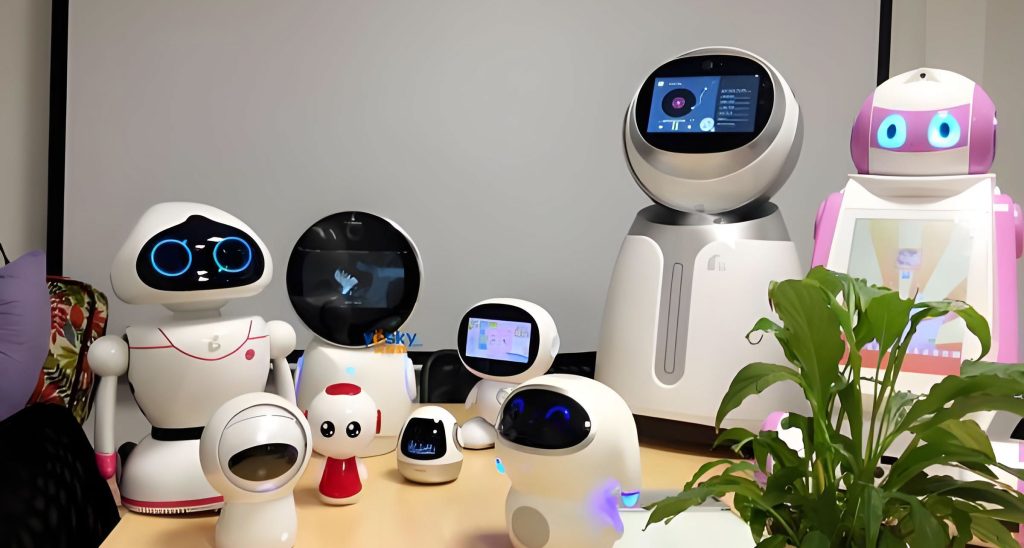
In our design practice, we apply these principles to develop a companion robot tailored for empty nesters. Our design定位 emphasizes practicality, ease of use, and safety. The companion robot is equipped with functions like emotional recognition, remote communication, health monitoring, and interactive dialogue. For example, using emotional computation, it can detect when a user is sad and respond with empathetic speech or suggest activities to uplift mood. Colors are chosen to be warm, such as orange-yellow, which is easier for elderly eyes to discern, avoiding short-wavelength colors like blue that may cause strain. The form features smooth, rounded shapes to convey approachability and care. We also incorporate人文关怀 by minimizing learning curves and enhancing emotional connectivity, ensuring the companion robot feels like a genuine companion rather than a machine.
To quantify the emotional interaction, we model the user’s emotional state over time. Let $E_t$ be the emotional state at time $t$, influenced by the robot’s response $R_t$. The dynamics can be described as $E_{t+1} = \alpha E_t + \beta R_t + \epsilon$, where $\alpha$ and $\beta$ are coefficients representing emotional persistence and robot impact, respectively, and $\epsilon$ is noise. This helps in optimizing the companion robot’s feedback机制. Additionally, we use tables to summarize design specifications, as shown in Table 3, which outlines key features of our companion robot prototype.
| Feature | Specification | Rationale |
|---|---|---|
| Emotional Recognition | Uses cameras and microphones for real-time analysis | Enables proactive emotional support |
| Voice Interaction | Natural language processing for dialogue | Reduces complexity for elderly users |
| Safety Mechanisms | Fall detection, emergency alerts | Addresses physical vulnerabilities |
| Design Aesthetics | Warm colors, rounded forms | Enhances emotional appeal and usability |
In conclusion, our research demonstrates the potential of emotional computation in designing companion robots for empty nesters. By focusing on deep emotional engagement, we aim to move beyond superficial interactions to provide meaningful companionship. The emotional interaction Agent model and system architecture offer a framework for future developments in this field. As we continue to refine these technologies, we believe that companion robots will play an increasingly vital role in supporting the emotional and physical well-being of the elderly, fostering a more inclusive and compassionate society. We encourage further exploration into adaptive algorithms and user-centered design to enhance the efficacy of companion robots.