
The comprehensive advancement of industrial robotics has led to its widespread adoption across diverse sectors. In exploring new research frontiers, our project team proposes integrating visual recognition technology with industrial robotics for application in end-of-life vehicle (ELV) dismantling. Building upon robotic tooling technology, this work initiates from the design of a specialized dismantling manipulator end effector. Utilizing SOLIDWORKS for 3D modeling, we construct a virtual dismantling environment for ELV wheel connections. Process simulation and analysis of the dedicated end effector are then conducted using ADAMS simulation software. The simulation results demonstrate that the structural design of the dismantling manipulator is rational, its strength meets operational requirements, and it ensures stability and accuracy during the dismantling task.
Applying visual recognition technology integrated with a manipulator to the ELV wheel dismantling process focuses primarily on the removal of wheel hub bolts. Starting from the design of specialized tools and the application of simulation technology, the dismantling process is completed within a virtual environment. Using the actions of a vision-guided dismantling robot as the method, we study the dismantling process and procedures, performing action simulations for the wheel dismantling manipulator in this virtual setting. Research on ELV dismantling techniques within a virtual environment can reduce initial capital investment, allow for repeated testing to perfect the bolt removal process, and subsequently derive optimized dismantling planning theories. This provides a foundational theoretical platform for researching vision-based robotic dismantling of ELV wheel connection bolts, aiming to enhance dismantling efficiency and promote the development of the ELV recycling industry.
1. Technical Requirements Analysis
Industrial robots, a general term for manipulators, are extensively used across various fields. They execute tasks based on pre-programmed instructions, relying primarily on external power and control systems. With continuous upgrades, they are progressively moving towards greater automation and intelligence. The wheel dismantling manipulator shares significant similarities in arm structure and function with manipulators used in other industrial applications, such as welding or palletizing robots. The key distinction lies in the functional differences of the end effector or “hand.” Therefore, the arm should possess general manipulator capabilities, supplemented by technical features specific to wheel dismantling tasks.
The wheel dismantling manipulator we designed primarily targets the removal of threaded wheel hub connections during ELV processing, specifically for wheels with 4-bolt and 5-bolt patterns. Its operational workflow involves using a vision system to identify whether the wheel has a 4 or 5-bolt pattern, determining the specific size and position of the lug nuts/bolts. The manipulator control system then governs the arm movement and the actuation of the end effector, finally executing a planned path to successfully remove the connection bolts. However, the dismantling process may encounter issues like corroded bolts, necessitating that the manipulator’s end effector incorporates overload protection functionality. Given that ELV dismantling often involves assembly-line operations, the dismantling manipulator must adapt to efficient workflow, featuring omnidirectional mobility, while the end effector requires precise identification and positioning capabilities. As the work involves alternating between positioning and dismantling, the wheel dismantling manipulator should also possess expandable interfaces for modular control implementation.
Based on the above, the structure and function of the wheel dismantling manipulator are defined as follows.
Structurally, the wheel dismantling manipulator primarily consists of multiple joints, forming a multi-degree-of-freedom (DOF) closed-chain spatial mechanism. Generally, dismantling is the reverse process of assembly. Considering practical industrial assembly manipulators, a design with six DOFs and a fixed base is common. Therefore, our wheel dismantling manipulator is also designed with six DOFs and a fixed base. The most significant distinction lies in the end effector mechanism. Consequently, the end effector for dismantling ELV wheel threaded connections is an improved design based on specialized dismantling tools.
Functionally, the wheel dismantling manipulator must be compatible with a visual recognition system. The recognition rate for target wheel bolt patterns and sizes should exceed 90% to meet practical application standards. During operation, the control system must provide real-time monitoring and feedback for the vision camera and drive motors. The entire control system should exhibit good stability and a degree of expandability. Furthermore, the end effector must integrate with the types of threaded connections for 4-bolt and 5-bolt wheels, designing a specialized device capable of synchronous dismantling. It should perform preliminary identification and judgment based on visual recognition, adapt to variations in bolt circle diameter and lug nut/bolt sizes, make corresponding adjustments, and finally complete the dismantling task quickly and stably.
2. Visual Recognition System Design
2.1 Vision Sensor Selection
The vision sensor is a crucial component of the visual recognition module, primarily responsible for acquiring information through image recognition. Generally, selecting a vision sensor requires comprehensive comparison of factors such as resolution, signal type, frame rate, and transmission interface. Current signal transmission methods mainly involve analog or digital signals. Analog signals are susceptible to interference during transmission, so digital cameras with stronger anti-interference performance are often preferred in vision modules. Resolution impacts image clarity, while frame rate affects the number of images captured per second, directly influencing recognition speed. The transmission interface is also a determining factor for image data transfer size. Based on actual requirements, after comparing comprehensive performance and analyzing relevant parameters, the selected camera should possess a high frame rate. Furthermore, camera selection must consider seamless integration with the manipulator control system.
For the visual recognition module selection, we compared Kinect v1 and Kinect v2. Kinect v1 uses an active depth-sensing technology called Time-of-Flight (ToF), calculating target distance by analyzing the time required for infrared light reflection. Kinect v2 calculates depth by analyzing the reflection pattern of a speckled infrared laser, forming a depth image. Kinect v1’s method is more susceptible to strong light interference compared to Kinect v2. Moreover, Kinect v2 offers higher resolution and typically uses a USB 3.0 interface. Kinect v2 is a sensor capable of simultaneously capturing both color and depth image information.
| Feature | Kinect v1 | Kinect v2 |
|---|---|---|
| Depth Technology | Time-of-Flight (ToF) | Structured Light (Laser Speckle) |
| RGB Resolution | 640 x 480 @ 30Hz | 1920 x 1080 @ 30Hz |
| Depth Resolution | 320 x 240 / 640 x 480 | 512 x 424 |
| Interface | USB 2.0 | USB 3.0 |
| Light Interference | More susceptible | Less susceptible |
2.2 Target Recognition Principle and Positioning Method
For target recognition tasks, two cameras are typically arranged in a stereo configuration, denoted as \(C_l\) (left) and \(C_r\) (right). For any point \(M(X, Y, Z)\) in space, its projection points on \(C_l\) and \(C_r\) are \(m_l(u_l, v_l)\) and \(m_r(u_r, v_r)\), respectively. According to the pinhole camera model, with optical centers \(O_l\) and \(O_r\), point \(M\) is the intersection of lines \(O_l m_l\) and \(O_r m_r\). Points \(M\), \(O_l\), \(m_l\), \(O_r\), and \(m_r\) are coplanar (the epipolar plane). Since the coordinates of \(O_l\), \(m_l\), \(O_r\), and \(m_r\) are known, the 3D coordinates \((X, Y, Z)\) of point \(M\) can be solved using triangulation principles derived from the camera calibration parameters and the disparity \(d = u_l – u_r\). The fundamental equations involve the camera projection matrices \(P_l\) and \(P_r\):
$$
\lambda_l \begin{bmatrix} u_l \\ v_l \\ 1 \end{bmatrix} = P_l \begin{bmatrix} X \\ Y \\ Z \\ 1 \end{bmatrix}, \quad \lambda_r \begin{bmatrix} u_r \\ v_r \\ 1 \end{bmatrix} = P_r \begin{bmatrix} X \\ Y \\ Z \\ 1 \end{bmatrix}
$$
where \(\lambda_l\) and \(\lambda_r\) are scaling factors (depth from the camera). The world coordinates \((X, Y, Z)\) can be recovered by solving this system. For a simplified model with cameras aligned on a horizontal baseline \(B\), with focal length \(f\), the depth \(Z\) is given by:
$$
Z = \frac{f \cdot B}{d}
$$
where \(d = u_l – u_r\) is the disparity. The coordinates \(X\) and \(Y\) are then:
$$
X = \frac{Z \cdot u_l}{f}, \quad Y = \frac{Z \cdot v_l}{f}
$$
This principle allows the end effector to be precisely guided to the target bolt’s 3D location.
3. Dismantling Manipulator System Design
3.1 Manipulator Arm Structure Selection
The manipulator arm is a critical executive component of the wheel dismantling manipulator, primarily supporting the wrist joint and end effector. It is responsible for moving the end effector along a planned path to the vicinity of the target ELV wheel and holding position until the bolt removal process is complete. Typically, the arm consists of links connected by a series of joints, each often equipped with an independent drive unit, although some designs centralize the drives.
Manipulator arms come in various types with different operational modes and application scopes. They can be classified based on their coordinate systems. After comparing factors such as workspace volume, positioning accuracy, physical footprint, and suitability for the actual working conditions, an articulated (anthropomorphic) robot arm structure was selected.
| Structure Type | Workspace Shape | Positioning Accuracy | Footprint vs. Reach | Suitability for Task |
|---|---|---|---|---|
| Cartesian | Rectangular Prism | Very High | Large footprint for reach | Less flexible for multi-direction access |
| Cylindrical | Cylindrical Section | High | Moderate | Good for overhead access |
| SCARA | Cylindrical Volume | High in-plane | Compact | Excellent for fast, in-plane assembly |
| Articulated (6-axis) | Near-Spherical | High | Compact for reach | **Excellent flexibility, suitable for complex poses required for wheel access** |
3.2 Structural Design of the Dismantling End Effector
The most vital part of the overall wheel dismantling manipulator design is the end effector. Our work applies industrial robotics technology. Based on analyzing robot parameters and principles, we constructed a virtual robot using the ABB IRB 2400 model as a prototype, matching key parameters such as a payload capacity of 7-20 kg and a maximum reach of 1.8 m. The robot’s end effector is then innovatively designed, specifically targeting 4-bolt and 5-bolt wheels. This led to the design of a 4-bolt dismantling device and a 5-bolt dismantling device, enabling synchronous removal of all bolts on a wheel. Compared to existing sequential methods, our design allows for synchronous multi-bolt removal, incorporates overload protection for safety, and is specifically tailored for ELV wheel threaded connections. Through the overall structural design of the wheel dismantling manipulator, combined with the arm selection and the specialized end effector application design, we used SOLIDWORKS to create a 3D model and complete the overall assembly and detailed 2D drawings.
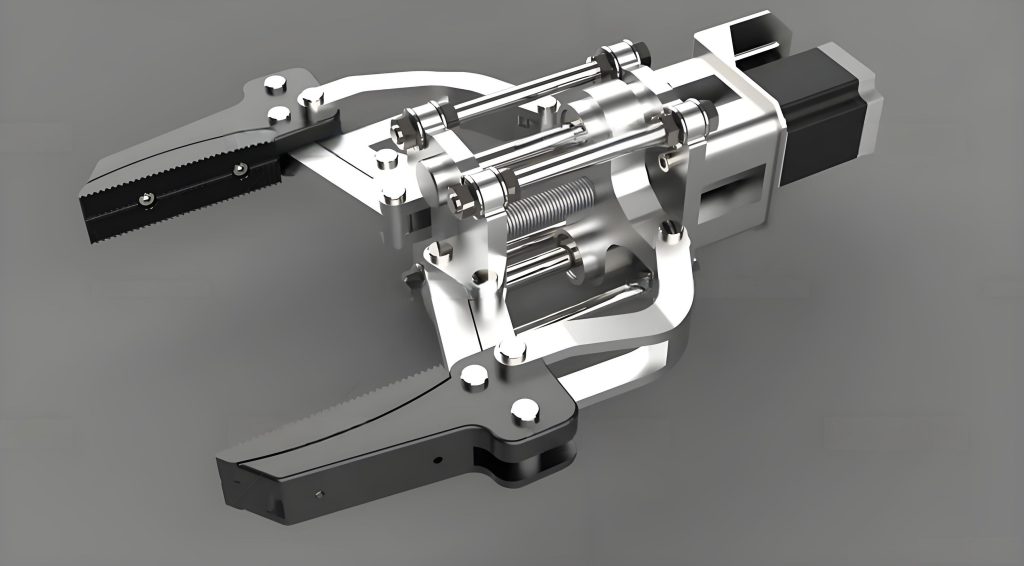
The end effector is the mechanism that directly contacts the 4-bolt or 5-bolt wheel and performs the threaded connection removal task. Current research on dedicated wheel dismantling end effectors is limited, with most existing concepts focusing on sequential, single-bolt removal. These can be categorized by drive type: electric nut runners using a motor-driven socket, or pneumatic tools using air pressure to control rotation direction for bolt removal.
The structural diagram of a single tool head within our end effector is shown above. Through improved design, multiple such tool heads are arranged into dedicated 4-bolt and 5-bolt dismantling units, which are then mounted onto the manipulator’s wrist as a novel wheel dismantling end effector. The power module for the tool head uses an AC servo motor, chosen for its wide power range and smooth operation. Considering the need for automatic tool head changing, the front connector is designed as a standard female 14mm / male 12mm hex interface. The control system features various I/O, A/D, and D/A interfaces to control the torque sensor, motor start/stop, speed, and activation of the overload protection mechanism.
We designed a dual-turret, flexible structure end effector, divided into left and right sections. The left turret carries the 4-bolt dismantling unit, and the right turret carries the 5-bolt dismantling unit. A pneumatic cylinder drives a linkage mechanism to adjust the gripper’s aperture, adapting to different bolt circle diameters. The 4-bolt unit comprises four motor-driven bolt removers, and the 5-bolt unit comprises five, each equipped with an overload protection device, enabling synchronous positioning and dismantling. This end effector primarily consists of the turrets, adjustment cylinders, and the socket wrench units, mounted on the manipulator arm’s wrist. During operation, the vision camera identifies the coordinates and specifications of the wheel lug nuts/bolts. Based on this feedback, the manipulator uses automatic tool changing technology to rotate either the first (4-bolt) or second (5-bolt) turret into position. The corresponding bolt removers then synchronously rotate to loosen the bolts. Subsequently, a separate gripping mechanism adjusts and clamps the wheel to detach it from the vehicle body. Finally, the manipulator arm, potentially with a secondary tool, transfers the loosened bolts to a disposal bin, completing one full dismantling cycle.
4. Finite Element Analysis of Key Components
Generally, structural strength is critically important for the reliable operation of a manipulator; it can be a decisive factor for normal functionality. Structural strength is inherently tied to material selection, making material choice a prerequisite for structural design. Considering the requirements for a lightweight and agile wheel dismantling manipulator, the manipulator arm primarily uses high-strength polymer composites, while the end effector’s connection parts use aluminum alloy. Both materials offer low weight. However, aluminum alloy has the drawback of relatively lower mechanical strength. Therefore, analysis of key components is especially necessary to design a manipulator that meets strength requirements with reasonable structural dimensions.
Torque is transmitted sequentially from the base upwards through the manipulator arm to the end effector. The overall mechanical structure resembles a cantilever beam. The joint connecting to the end effector bears the critical dismantling loads. Therefore, performing a finite element analysis (FEA) on the connection between the end effector and the final joint is essential to verify structural strength and comprehensively validate the design’s rationality.
The balance frame, serving as the mounting base for both the 4-bolt and 5-bolt dismantling units, has a structural strength that directly impacts the stability and accuracy of the manipulator during operation.
The end effector’s main housing is a key component that controls the bolt circle adjustment and dampens vibrations during operation. Therefore, FEA of this housing is also necessary. The analysis results for the end effector assembly are conceptually summarized below.
The simulation shows that during motion, stress is concentrated in the area where the load is applied from the final joint. The central region of the joint connector experiences the highest stress, but the area is small and away from fixed regions, indicating good stress distribution with overall low stress levels. Stress in the end effector housing is distributed evenly, primarily manifesting as root stress near the connection. Stress levels decrease rapidly away from the root area. Calculations confirm that all structural components experience stresses far below their yield strength under the applied operational loads. Consequently, deformation across the entire end effector assembly and its components is minimal, confirming the overall structure is safe and meets strength requirements.
The von Mises stress \(\sigma_v\) is a key metric in FEA, calculated from the stress tensor components \((\sigma_{xx}, \sigma_{yy}, \sigma_{zz}, \tau_{xy}, \tau_{yz}, \tau_{zx})\):
$$
\sigma_v = \sqrt{ \frac{(\sigma_{xx}-\sigma_{yy})^2 + (\sigma_{yy}-\sigma_{zz})^2 + (\sigma_{zz}-\sigma_{xx})^2 + 6(\tau_{xy}^2 + \tau_{yz}^2 + \tau_{zx}^2)}{2} }
$$
The safety factor \(SF\) is then given by:
$$
SF = \frac{\sigma_{yield}}{\sigma_{v_{max}}}
$$
where \(\sigma_{yield}\) is the yield strength of the material (e.g., Aluminum 6061-T6: \(\sigma_{yield} \approx 275 \, \text{MPa}\)). Our analysis confirmed \(SF > 2.5\) for all critical components, validating the design.
5. Control System and Simulation Integration
The integration of the vision system, manipulator arm, and specialized end effector necessitates a robust control architecture. A hierarchical control system is proposed. The high-level planner receives the bolt pattern identification and 3D coordinates from the vision module. It then generates a trajectory for the manipulator arm and the synchronous action commands for the end effector. The low-level controllers execute these commands, managing servo motors for the arm joints and the individual tool head drivers. Feedback from encoders, torque sensors on each tool head, and the vision system (for final verification) closes the control loop.
The dynamics of the 6-DOF articulated manipulator can be described by the following equation of motion:
$$
M(q)\ddot{q} + C(q, \dot{q})\dot{q} + G(q) = \tau – J^T(q)F_{ext}
$$
where:
\(q, \dot{q}, \ddot{q}\) are the joint position, velocity, and acceleration vectors.
\(M(q)\) is the inertia matrix.
\(C(q, \dot{q})\) is the Coriolis and centripetal matrix.
\(G(q)\) is the gravity vector.
\(\tau\) is the vector of joint torques.
\(J(q)\) is the geometric Jacobian matrix.
\(F_{ext}\) is the external wrench (force/torque) applied at the end effector, which includes interaction forces during dismantling.
For the end effector’s synchronous bolt removal, the control for each of the \(n\) tool heads (where \(n=4\) or \(5\)) aims to maintain equal torque \(\tau_{tool}\) on each bolt until a specified breakaway torque \(T_{set}\) is reached, triggering the overload clutch. A simplified model for the motor-tool dynamics is:
$$
J_m \ddot{\theta}_m + b \dot{\theta}_m = K_t i – \tau_{tool}/N
$$
where \(J_m\) is motor inertia, \(b\) is damping, \(\theta_m\) is motor angle, \(K_t\) is torque constant, \(i\) is motor current, and \(N\) is gear ratio. The controller uses a PI algorithm to regulate current to achieve the desired torque: \(i = K_p (T_{set} – \tau_{sensor}) + K_i \int (T_{set} – \tau_{sensor}) dt\).
| Subsystem | Control Method | Key Components / Sensors | Performance Target |
|---|---|---|---|
| Manipulator Arm | Proportional-Integral-Derivative (PID) on joint angles / velocities | AC Servo Drives, Absolute Encoders | Path following error < 0.5 mm |
| End Effector Turret Selection | On/Off Control via PLC | Pneumatic Valve, Proximity Sensor | Turret index time < 1.5 s |
| Individual Tool Head | PI Torque Control | Brushless DC Motor, Planetary Gearbox, Torque Sensor, Slip Clutch | Torque accuracy ±5%, Overload response < 10 ms |
| Vision-Guided Positioning | Vision Servoing (Position-Based) | Kinect v2, Image Processing Unit (GPU) | Bolt center positioning error < 1.0 mm |
The ADAMS simulation environment integrates multi-body dynamics with the control system model. The virtual prototype, including the detailed end effector model, performs the complete task: moving to the visually identified wheel position, engaging the correct tool heads, applying synchronous torque, and retracting. The simulation outputs critical data such as joint torques, end effector path deviation, stresses on components, and cycle time. This virtual testing allows for extensive iteration and optimization of control gains, trajectory planning, and even mechanical design parameters before physical prototype construction, significantly reducing development cost and time while ensuring the end effector meets all performance and safety criteria.