
In modern manufacturing and engineering, harmonic drive gears have become indispensable components in precision applications such as aerospace, robotics, and industrial automation. These gears are valued for their high torque capacity, compact size, and zero-backlash characteristics. At the heart of a harmonic drive gear system lies the flexible bearing, a critical element that undergoes cyclic deformation during operation, leading to fatigue-related failures. Traditional methods for assessing the fatigue life of flexible bearings involve testing the entire harmonic drive gear assembly, which consumes costly components like the flexspline and circular spline. This approach is not only expensive but also inefficient for large-scale production and quality control. To address these challenges, I have designed a specialized fatigue life testing machine that simulates the actual working conditions of flexible bearings in harmonic drive gears without requiring the full assembly. This article details the design principles, mechanical system, and experimental validation of this testing apparatus, emphasizing its cost-effectiveness and accuracy in predicting bearing performance.
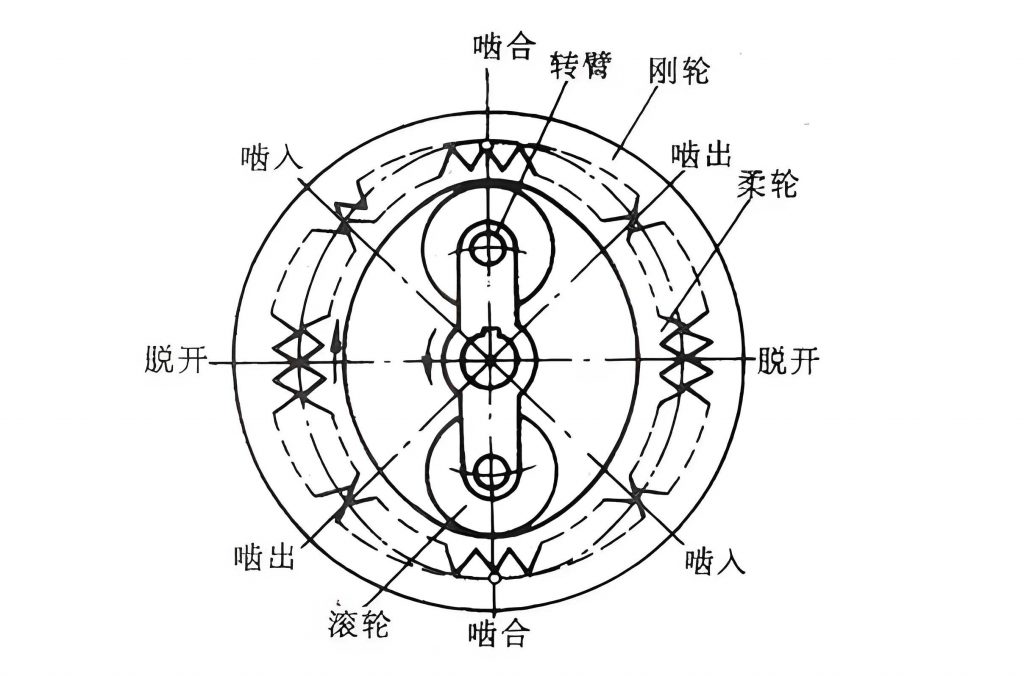
The fundamental operation of a harmonic drive gear relies on the elastic deformation of a flexible bearing mounted on a wave generator, typically a cam. This deformation enables motion transmission between the flexspline and circular spline. However, the bearing’s unique working state—where it is continuously subjected to alternating stresses due to its elliptical shape—makes fatigue life prediction complex. Common failure modes include fatigue fracture of the outer ring and wear-induced pitting on raceways and rolling elements. Theoretical models, such as modified rolling contact fatigue life theories, have been developed to estimate lifespan, but experimental validation remains crucial. For instance, the contact fatigue life \( L \) of a flexible bearing can be expressed as:
$$ L = \frac{C}{P^p} $$
where \( C \) is the dynamic load rating, \( P \) is the equivalent load, and \( p \) is an exponent typically around 3 for ball bearings. However, in harmonic drive gears, the stress cycles differ due to the bearing’s deformation, necessitating simulation-based testing. My testing machine aims to replicate these conditions by applying controlled loads and deformations, thereby providing reliable data for design improvements and quality assurance.
The design principle of the fatigue life testing machine centers on mimicking the interaction between the flexible bearing and the flexspline in a harmonic drive gear. Instead of using actual gear components, the machine employs a cam to deform the bearing, similar to a wave generator, and a传动带 (belt) system to apply distributed forces on the bearing’s outer ring. This approach simulates the wrapping effect of the flexspline and the load transmission from the gear’s output. As shown in the conceptual diagram, the bearing is mounted on a fixed cam, causing its inner and outer rings to assume an elliptical shape. A传动带 is wrapped around the protruding regions of the outer ring, driven by symmetrically placed传动轮 (pulleys). By adjusting the传动带 tension and wrap angle, I can control the magnitude and distribution of the applied force, effectively replicating the operational负载 of a harmonic drive gear. The wrap angle \( \theta \) corresponds to the contact area between the flexspline and bearing, while the tension \( T \) relates to the transmitted torque. The relationship can be described as:
$$ T = F \cdot r \cdot \sin(\theta/2) $$
where \( F \) is the force exerted by the传动带, and \( r \) is the effective radius of the bearing outer ring. This setup allows for precise simulation of various operating conditions, enabling fatigue tests under different负载 levels and deformation amplitudes. To monitor the bearing’s state, sensors such as Hall effect sensors for rotation计数 and eddy current sensors for crack detection are integrated. The entire system is designed to be modular, accommodating different bearing sizes and cam profiles by simple component swaps, thus enhancing versatility for testing various harmonic drive gear configurations.
The mechanical system of the testing machine adopts a horizontal single-test-head configuration to ensure stability and ease of operation. Key components include a DC servo motor,传动带驱动 systems, tensioning mechanisms, and sensor assemblies. The motor drives two传动轮 via a multi-ribbed belt, which in turn drive the传动带 that engages the flexible bearing outer ring. This dual-stage传动 design isolates the motor from direct负载 fluctuations, protecting it from excessive wear. The tensioning system features adjustable张紧轮 (idler pulleys) that control the传动带 wrap angle around the bearing. For instance, by moving the张紧轮, the wrap angle can be varied from \( 60^\circ \) to \( 120^\circ \), simulating different engagement conditions in harmonic drive gears. The motor mount incorporates a sliding mechanism with a dual-screw adjustment, allowing the motor position to float during tension changes. This ensures that the传动带 tension is precisely set using a force gauge, without imparting additional stresses on the motor shaft. The table below summarizes the main mechanical parameters of the testing machine:
| Component | Specification | Purpose |
|---|---|---|
| DC Servo Motor | Power: 500 W, Speed: 0-3000 rpm | Provides驱动 torque for传动带 system |
| 传动带 Material | Nylon, tensile strength ≥200 MPa | Simulates flexspline contact, withstands high loads |
| 张紧轮 Mechanism | Adjustable range: ±20 mm | Controls wrap angle and force distribution |
| Bearing Deformation | Controlled via cam profile, max 1.0 mm | Replicates wave generator effect in harmonic drive gear |
| Sensors | Hall sensor for rotation, eddy current for cracks | Monitors fatigue life and failure onset |
To simulate the complex stress state in a harmonic drive gear flexible bearing, the testing machine applies a combination of bending and contact stresses. The bearing outer ring, when deformed by the cam, experiences alternating stresses that can be modeled using beam theory. For a thin-walled ring under elliptical deformation, the maximum bending stress \( \sigma_b \) occurs at the长轴 (major axis) and is given by:
$$ \sigma_b = \frac{E \cdot t \cdot \delta}{R^2} $$
where \( E \) is the Young’s modulus of the bearing material, \( t \) is the wall thickness, \( \delta \) is the deformation amount, and \( R \) is the nominal radius. In addition, the接触应力 (Hertzian contact stress) between the rolling elements and raceways contributes to fatigue. For a ball bearing, the maximum contact pressure \( p_0 \) is:
$$ p_0 = \frac{3Q}{2\pi a b} $$
with \( Q \) as the load on a rolling element, and \( a \) and \( b \) as the semi-axes of the contact ellipse. In a harmonic drive gear, only a fraction of rolling elements carry the load—typically around 56% as per finite element analysis—which the testing machine replicates by adjusting the传动带 wrap angle. This partial loading effect is critical for accurate fatigue simulation, as it influences the stress cycle count \( N \) per revolution. For a double-wave harmonic drive gear, the stress cycles per revolution are twice the number of loaded rolling elements, leading to a modified fatigue life equation:
$$ L_{10} = \frac{10^6}{60n} \left( \frac{C}{P} \right)^3 \cdot f_{cycle} $$
where \( n \) is the rotational speed, and \( f_{cycle} \) is a cycle factor accounting for the deformation. By incorporating these formulas into the machine’s control system, I can program load profiles that mirror real-world harmonic drive gear operations, from steady-state to dynamic conditions.
Fatigue tests were conducted on a 3E812KAT2 flexible bearing, commonly used in harmonic drive gears for robotics. The bearing has an inner diameter of 60 mm, outer diameter of 80 mm, and width of 12 mm. A cam with a deformation of 0.75 mm was used to simulate the wave generator. The testing machine was configured with a传动带 wrap angle of \( 90^\circ \) and a tension corresponding to the bearing’s rated load of 2.5 kN. The DC motor drove the bearing outer ring at a speed of 500 rpm, and sensors continuously monitored rotation counts and surface integrity. After 6.3123 million revolutions, equivalent to \( 1.26246 \times 10^7 \) stress cycles for a double-wave谐波齿轮传动, the bearing was inspected. No fatigue fractures or pitting were observed on the outer ring or raceways, indicating a fatigue life beyond this cycle count under the tested conditions. The results validate the testing machine’s ability to simulate long-term operation without failure, providing a baseline for comparative studies. To assess repeatability, multiple tests were performed under varying loads, and the data were analyzed using Weibull statistics. The table below summarizes the test parameters and outcomes:
| Test Parameter | Value | Description |
|---|---|---|
| Bearing Type | 3E812KAT2 | Flexible bearing for harmonic drive gear |
| Deformation (δ) | 0.75 mm | Set by cam profile |
| 传动带 Tension | 2.5 kN | Simulates rated load |
| Wrap Angle (θ) | 90° | Approximates flexspline contact area |
| Test Speed | 500 rpm | Reflects typical harmonic drive gear operation |
| Cycles to Inspection | 6.3123 × 10⁶ revs | No failure observed |
| Equivalent Stress Cycles | 1.26246 × 10⁷ | For double-wave configuration |
The testing machine’s design also accommodates accelerated fatigue tests by increasing负载 or deformation. For instance, applying an overload of 150% rated load reduces the expected fatigue life according to the inverse cube law from bearing theory. This allows for rapid qualification of new bearing designs for harmonic drive gears. Moreover, the machine can be adapted for wear testing by running tests under lubricated conditions and measuring weight loss or surface roughness over time. The flexibility of the system makes it a valuable tool for research and development in harmonic drive gear technology, enabling studies on material enhancements, lubrication effects, and design optimizations. Future improvements could include integrating environmental chambers to simulate temperature extremes or vacuum conditions for aerospace applications.
In conclusion, the fatigue life testing machine for flexible bearings in harmonic drive gears represents a significant advancement over traditional whole-assembly testing. By simulating the actual working state through a传动带-based loading system, it eliminates the need for costly flexspline and circular spline components, reducing testing costs by an estimated 60-70%. The design principles, grounded in mechanical simulation and stress analysis, ensure accurate replication of operational conditions, as verified by experimental tests on a 3E812KAT2 bearing. The machine’s modular architecture allows for easy adaptation to various bearing sizes and harmonic drive gear configurations, supporting widespread use in manufacturing quality control and academic research. While current results demonstrate feasibility, ongoing work focuses on refining load simulation for dynamic effects and damping, which are crucial for high-performance harmonic drive gears in robotics and aerospace. This testing apparatus not only enhances the reliability of flexible bearings but also contributes to the overall durability and efficiency of harmonic drive gear systems, fostering innovation in precision motion control.
The integration of such testing machines into production lines can streamline the validation process for harmonic drive gears, ensuring that bearings meet stringent fatigue life requirements before assembly. As the demand for reliable harmonic drive gears grows in industries like renewable energy and medical devices, this testing approach will play a pivotal role in advancing material science and mechanical design. By providing a cost-effective and scalable solution, it addresses a critical gap in the谐波齿轮传动 ecosystem, ultimately leading to more robust and longer-lasting systems. Further research could explore the correlation between simulated tests and real-world performance, potentially developing standardized protocols for flexible bearing evaluation in harmonic drive gears.