
In the field of robotics, the development of a dexterous robotic hand that mimics human hand functionality is crucial for performing complex tasks in various environments, such as space exploration, industrial automation, and healthcare. A dexterous robotic hand with five fingers offers enhanced versatility and adaptability, enabling it to grasp and manipulate objects with precision. This article focuses on the design of a force compliance control system for a single finger of a space five-fingered dexterous hand, employing impedance control methods to achieve active compliance. Active compliance allows the dexterous robotic hand to interact safely with objects by adjusting its behavior based on contact forces, ensuring stable and reliable grasping. The control strategies explored include tendon-space and joint-space impedance control, which are simulated and analyzed to evaluate their performance. Throughout this discussion, the term ‘dexterous robotic hand’ will be emphasized to highlight the central theme of this research.
The dexterous robotic hand discussed here is designed with a tendon-driven mechanism, similar to the human hand’s musculotendinous system. This design provides flexibility and compactness, making it suitable for space applications where weight and size constraints are critical. The hand consists of five fingers attached to a palm, with the thumb and other fingers having different joint configurations for optimal functionality. The thumb features five degrees of freedom, while the index and middle fingers have four, and the ring and little fingers have three. This modular design facilitates ease of manufacturing, assembly, and maintenance. The overall structure of the dexterous robotic hand is illustrated below, showcasing its anthropomorphic features and tendon routing.
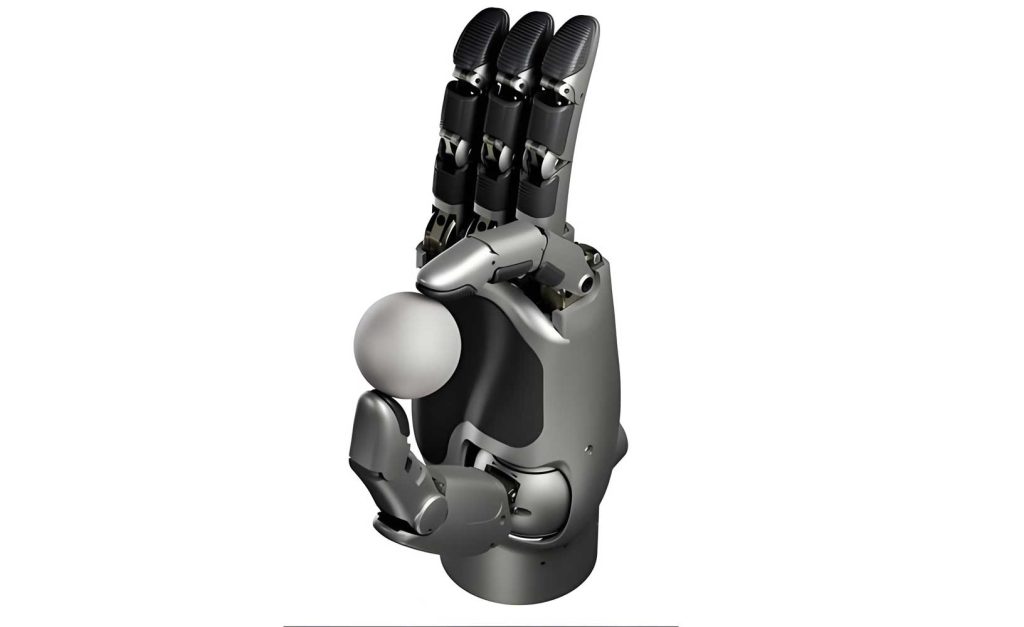
To achieve force compliance in the dexterous robotic hand, impedance control is a widely adopted method. Impedance control establishes a relationship between position and force, allowing the hand to exhibit compliant behavior during object interaction. Unlike direct force control, which requires precise dynamic models and complex algorithms, impedance control integrates force and position control into a unified framework, making it more practical for real-time applications. This article delves into two impedance control approaches: tendon-space and joint-space control. The tendon-space method controls individual tendon tensions, while the joint-space method decouples the joint dynamics for improved tracking. Both methods are implemented on a single finger of the dexterous robotic hand, and their effectiveness is validated through simulation studies.
The kinematics and dynamics of the dexterous robotic hand finger are essential for control system design. For instance, consider the index finger, which has multiple joints driven by tendons. Using the Newton-Euler iterative dynamics algorithm, the dynamic equations of the finger can be derived. This algorithm involves outward and inward iterations to compute joint torques based on link parameters. The dynamic model accounts for link masses, lengths, and inertias, as summarized in Table 1. These parameters are critical for simulating the behavior of the dexterous robotic hand under various control strategies.
| Parameter | Value | Unit |
|---|---|---|
| L1 (Link 1 Length) | 0.009 | m |
| L2 (Link 2 Length) | 0.045 | m |
| L3 (Link 3 Length) | 0.030 | m |
| L4 (Link 4 Length) | 0.021 | m |
| m1 (Link 1 Mass) | 0.00465 | kg |
| m2 (Link 2 Mass) | 0.0278 | kg |
| m3 (Link 3 Mass) | 0.0123 | kg |
| m4 (Link 4 Mass) | 0.0115 | kg |
| Total Mass | 0.0562 | kg |
The dynamic equations for the finger joints can be expressed using the following general form derived from the Newton-Euler algorithm. For outward iteration (i from 1 to 4), the angular velocity, angular acceleration, linear acceleration, and forces are computed. The equations are:
$$ \omega_{i+1} = ^{i+1}_i R \omega_i + \dot{\theta}_{i+1} \hat{Z}_{i+1} $$
$$ \dot{\omega}_{i+1} = ^{i+1}_i R \dot{\omega}_i + ^{i+1}_i R \omega_i \times \dot{\theta}_{i+1} \hat{Z}_{i+1} + \ddot{\theta}_{i+1} \hat{Z}_{i+1} $$
$$ \dot{v}_{i+1} = ^{i+1}_i R (\dot{\omega}_i \times P_{i+1} + \omega_i \times (\omega_i \times P_{i+1}) + \dot{v}_i) $$
$$ \dot{v}_{C_{i+1}} = \dot{\omega}_{i+1} \times P_{C_{i+1}} + \omega_{i+1} \times (\omega_{i+1} \times P_{C_{i+1}}) + \dot{v}_{i+1} $$
$$ F_{i+1} = m_{i+1} \dot{v}_{C_{i+1}} $$
$$ N_{i+1} = I_{i+1} \dot{\omega}_{i+1} + \omega_{i+1} \times I_{i+1} \omega_{i+1} $$
For inward iteration (i from 4 to 1), the joint forces and torques are calculated:
$$ f_i = ^i_{i+1} R f_{i+1} + F_i $$
$$ n_i = N_i + ^i_{i+1} R n_{i+1} + P_{C_i} \times F_i + P_i \times ^i_{i+1} R f_{i+1} $$
$$ \tau_i = n_i \hat{Z}_i $$
Here, $ \tau_i $ represents the joint driving torque, and $ ^{i+1}_i R $ is the rotation matrix between links. These equations form the basis for the control system design of the dexterous robotic hand.
Impedance control for the dexterous robotic hand typically involves a position-based approach, which consists of an inner position control loop and an outer impedance control loop. The impedance relationship is defined as:
$$ M_d (\ddot{X}_r – \ddot{X}_d) + B_d (\dot{X}_r – \dot{X}_d) + K_d (X_r – X_d) = F_d – F_a $$
where $ M_d $, $ B_d $, and $ K_d $ are the target inertia, damping, and stiffness matrices, respectively. $ X_r $, $ \dot{X}_r $, and $ \ddot{X}_r $ are the actual fingertip position, velocity, and acceleration, while $ X_d $, $ \dot{X}_d $, and $ \ddot{X}_d $ are the desired values. $ F_a $ is the actual contact force, and $ F_d $ is the desired force. This equation can be transformed into the frequency domain to derive the impedance controller output, which adjusts the desired position based on force errors. The block diagram of the impedance control system is shown in Figure 3, illustrating how the dexterous robotic hand achieves compliance by modulating position commands.
In tendon-space impedance control, the control law is designed to regulate individual tendon tensions. The desired tendon tensions $ f_d $ are derived from the desired joint torques $ \tau_d $ using the relationship $ f_d = P^{-1} \bar{\tau}_d $, where $ P $ is the tendon mapping matrix. A PD compensator is used to generate motor voltage commands $ u $ based on tendon tension errors:
$$ u = -k_p (f – f_d) – k_d \dot{x} $$
where $ k_p $ and $ k_d $ are scalar gains, and $ \dot{x} $ is the tendon velocity. This control law avoids integral terms to reduce lag, but it may suffer from steady-state errors. Additionally, a stiffness controller is employed in the outer loop to generate desired torques proportional to joint errors:
$$ \tau_d = -K (q – q_d) $$
with $ K $ as a diagonal stiffness matrix. This approach allows the dexterous robotic hand to maintain tension within safe limits while tracking joint positions.
Joint-space impedance control, on the other hand, maps the actuator model to an augmented joint space to decouple the dynamics. The control law in joint space is formulated as:
$$ \tilde{u} = -K_p (\bar{\tau} – \bar{\tau}_d) – K_d \dot{\tilde{q}} $$
where $ \tilde{u} = P^{-T} u $ is the joint-space equivalent motor command, and $ K_p $ and $ K_d $ are diagonal gain matrices. Transforming back to actuator space gives:
$$ u = -P^T [K_p (\bar{\tau} – \bar{\tau}_d) + k_d \dot{\tilde{q}}] = -P^T K_p (\bar{\tau} – \bar{\tau}_d) + k_d \dot{x} $$
This control law uses the transpose of $ P $ instead of its inverse, effectively decoupling the joint interactions and improving stability. The use of tendon velocity $ \dot{x} $ instead of joint velocity $ \dot{q} $ further enhances performance by accounting for unmodeled tendon-transmission characteristics.
To evaluate these control strategies, simulation experiments were conducted using MATLAB Simulink. The parameters for the dexterous robotic hand finger were set as follows: tendon stiffness coefficient of 700 N/cm, $ k_p = 0.4 $, and $ k_d = 10 $. The simulation modeled the finger’s dynamics and control loops, with results analyzed for joint position tracking, tendon tension, and joint torque. For tendon-space control, the joint angles and tendon tensions were tracked over time, as shown in Figures 7 and 8. The controller managed to follow desired trajectories, with tendon tensions remaining within bounds. However, the base joint exhibited overshoot and reverse motion initially, indicating coupling effects inherent in tendon-space control.
In contrast, joint-space control demonstrated superior performance, as seen in Figures 9, 10, and 11. The joint positions, tendon tensions, and joint torques were tracked accurately without significant coupling issues. The elimination of coupling in joint-space control led to better response speed and precision, making it more suitable for high-performance applications of the dexterous robotic hand. Table 2 summarizes the comparison between the two control methods based on simulation results.
| Aspect | Tendon-Space Control | Joint-Space Control |
|---|---|---|
| Coupling Effects | Present, causes overshoot and instability | Eliminated, leading to decoupled dynamics |
| Tracking Performance | Moderate, with steady-state errors | High, with accurate trajectory following |
| Stability | Lower due to unmodeled tendon effects | Higher with damped responses |
| Complexity | Simpler, independent tendon control | More complex, requires joint mapping |
| Suitability for Dexterous Robotic Hand | Adequate for basic grasping tasks | Ideal for precise and compliant manipulation |
The simulations confirm that both control methods are viable for the dexterous robotic hand, but joint-space control offers distinct advantages in terms of performance and robustness. The dexterous robotic hand can benefit from this approach in scenarios requiring fine force control, such as handling fragile objects or operating in unstructured environments. Future work could explore adaptive impedance control, where parameters like $ M_d $, $ B_d $, and $ K_d $ are adjusted online based on object properties or task requirements. This would further enhance the adaptability of the dexterous robotic hand.
In conclusion, the design of a force compliance control system for a dexterous robotic hand involves careful consideration of dynamics and control strategies. Tendon-space and joint-space impedance control methods were investigated for a single finger of a space five-fingered dexterous hand. While both methods achieved desired control objectives, joint-space control proved superior by decoupling joint interactions and providing better tracking performance. The dexterous robotic hand, equipped with such control systems, can perform complex manipulation tasks with enhanced safety and reliability. As robotics technology advances, the integration of these control methods will continue to improve the capabilities of dexterous robotic hands in various applications, from space exploration to domestic assistance.
Further research directions include implementing sensor fusion techniques for better force estimation, incorporating machine learning for autonomous grip adjustment, and extending the control framework to multi-finger coordination. The dexterous robotic hand represents a significant step toward human-like manipulation, and ongoing innovations in control algorithms will drive its evolution. By emphasizing impedance control and dynamic modeling, this article highlights the critical aspects of developing effective compliance systems for the dexterous robotic hand, ensuring it meets the demands of real-world operations.