
This paper details a user-centered design process for an elderly companion robot, employing an integrated approach of Innovation Product Development (INPD) and Kansei Engineering (KE). The goal is to systematically translate the multifaceted needs of the aging population into a tangible, emotionally resonant, and functionally effective product. The methodology progresses through four key phases: identifying a product opportunity, understanding it, conceptualizing the product, and finally, implementing the design. Each stage leverages specific analytical tools to ensure the final companion robot design is both innovative and aligned with user sensibilities.
1. Introduction and Methodological Framework
The global demographic shift towards an aging population presents significant societal challenges. For many elderly individuals, particularly those living alone, maintaining independence while ensuring safety and mitigating loneliness are paramount concerns. A well-designed companion robot can address these issues by providing physical assistance, safety monitoring, and social interaction. This project aims to create such a product by fusing two powerful design methodologies.
INPD provides a structured roadmap for breakthrough innovation, focusing on identifying and exploiting product opportunity gaps based on Social, Economic, and Technological (SET) trends. It ensures the project is grounded in real-world viability and user value. Kansei Engineering, conversely, offers a mechanism to quantify and integrate users’ subjective, emotional responses (“Kansei”) into objective design parameters. By combining INPD’s strategic, opportunity-driven approach with KE’s empathetic, user-feeling-driven analysis, we develop a comprehensive and scientifically rigorous design process for the companion robot.
2. Phase One: Identifying the Product Opportunity
The first phase aims to pinpoint the most promising gap in the market for an elderly companion robot. We begin with a SET factor analysis to scan the macro-environment for trends that signal potential opportunities.
| SET Factor | Trend Analysis | Implication for Companion Robot Design |
|---|---|---|
| Social (S) | Rising number of empty-nest elders; increased desire for independent living; heightened awareness of elderly health & safety. | Demand for in-home support that promotes autonomy, provides companionship, and ensures safety without intrusion. |
| Economic (E) | Growth of the “silver economy”; increased purchasing power of some elderly; higher costs for professional in-home care. | Market for affordable, multifunctional home assistant devices that can supplement or delay the need for expensive human care. |
| Technological (T) | Advancements in AI, voice interaction, SLAM navigation, lightweight robotics, IoT, and cloud data platforms. | Enables creation of intelligent, mobile, interactive, and connected robots capable of complex tasks and personalized service. |
Based on this analysis, we brainstormed and refined eight initial Product Opportunities (POs). To select the most viable one, we used a weighted decision matrix. Each PO was scored (1-5) against key criteria, and a weighted average was calculated. The criteria and weights were: User Demand Expectation (20%), Product Innovation Potential (20%), Technical Feasibility (30%), Potential Market Scale (10%), and Team Interest (20%).
| Product Opportunity (PO) | Weighted Average Score |
|---|---|
| PO-03: A new method for assisted intelligent fetching of items | 3.16 |
| PO-01: New service to help elders improve health habits | 3.15 |
| PO-05: New product for assisting personalized living habits | 3.14 |
| PO-06: New experience for outdoor usage scenarios | 3.04 |
| PO-04: New method for assisted convenient travel | 2.93 |
| PO-02: New product to ensure home safety for those living alone | 2.80 |
| PO-07: Platform for community engagement and sharing in healthy living | 2.86 |
| PO-08: New state of companionship for deep emotional care | 2.68 |
PO-03, “A new method for assisted intelligent fetching of items,” emerged with the highest score. This opportunity addresses a critical, everyday challenge for many elderly individuals: the difficulty and potential hazard of bending down to pick up objects or reaching for items on high shelves, often exacerbated by conditions like arthritis. A companion robot capable of this function directly promotes independence and safety.
3. Phase Two: Understanding the Opportunity
With the core opportunity identified, this phase focuses on deeply understanding user needs and translating them into design requirements. We conducted surveys and interviews with target users (aged 60-80) to build a hierarchical model of needs for a fetch-and-carry companion robot.
The primary needs were categorized into three groups: Subjective Functions (A1), Objective Functions (A2), and Market Feedback (A3). Each category contained sub-needs. To prioritize them, we employed the Analytic Hierarchy Process (AHP). Pairwise comparison matrices were constructed for each category to determine the local weight (w) of each need. The consistency ratio (CR) for each matrix was calculated to ensure judgment reliability. The standard formula for the consistency check is:
$$ CR = \frac{CI}{RI} $$
where \( CI = \frac{\lambda_{max} – n}{n – 1} \) is the Consistency Index, \( \lambda_{max} \) is the principal eigenvalue of the comparison matrix, \( n \) is the number of criteria, and \( RI \) is the Random Index. A CR value less than 0.1 is acceptable.
The local weights from the second-level categories (A1, A2, A3) and their sub-criteria were then synthesized to obtain global weights, revealing the overall priority across all needs.
| Need Category & Sub-need | Local Weight (w) | Global Weight | Rank |
|---|---|---|---|
| A1: Subjective Functions (0.637) | |||
| B3: Item fetching and placement | 0.4437 | 0.2827 | 1 |
| B1: Companionship and chatting | 0.3652 | 0.2326 | 2 |
| B4: Remote alerts and data sharing with family | 0.1276 | 0.0813 | 4 |
| B2: Entertainment functions | 0.0634 | 0.0404 | 7 |
| A2: Objective Functions (0.258) | |||
| C3: Safety and stability | 0.5894 | 0.1522 | 3 |
| C1: Simple and intuitive interaction | 0.2921 | 0.0754 | 5 |
| C2: Long battery life | 0.1185 | 0.0306 | 8 |
| A3: Market Feedback (0.105) | |||
| D3: Simple and friendly appearance | 0.6201 | 0.0649 | 6 |
| D4: Easy to clean and maintain | 0.1509 | 0.0158 | 9 |
| D2: Affordable price | 0.1459 | 0.0153 | 10 |
| D1: Brand reputation | 0.0831 | 0.0087 | 11 |
The analysis clearly shows that the core functional needs—item fetching, companionship chatting, safety/stability, and remote family connectivity—are the highest priorities, forming the essential value proposition of the companion robot.
4. Integrating Kansei Engineering for Form Design
To ensure the companion robot’s form elicits positive emotional responses, we integrated Kansei Engineering. First, a Kansei vocabulary was built from user interviews. Using a 5-point Likert scale survey, six key adjective pairs were identified as most significant for the target users: Safe-Dangerous, Streamlined-Bulky, Friendly-Aloof, Technological-Traditional, Simple-Complex, and Refined-Crude.
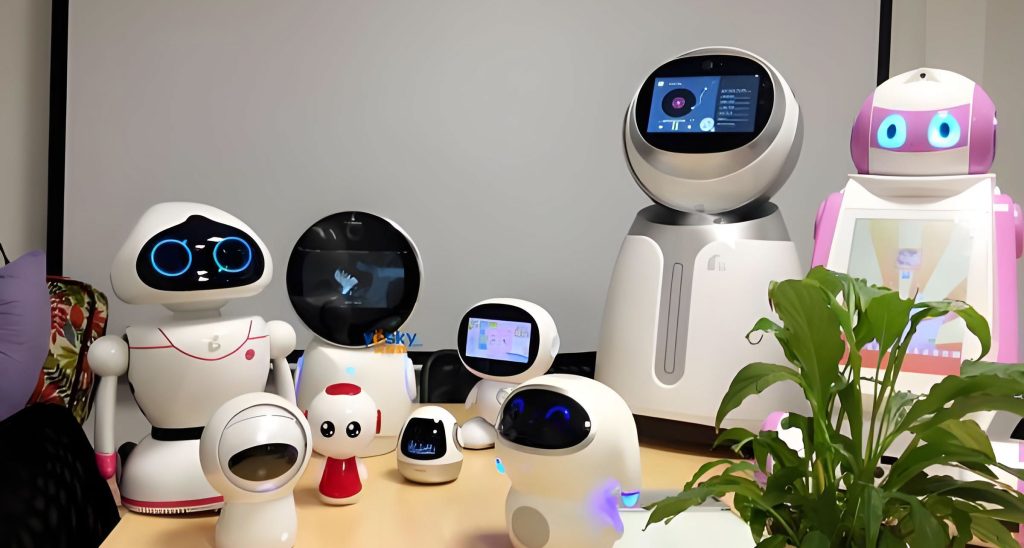
Next, 12 existing companion or service robot images were selected as representative samples. Their morphological features were deconstructed into design elements across six units: Head, Torso, Arm, Abdomen, Base, and Interface Screen. Each element was coded (e.g., X15 for a specific head shape).
A Semantic Differential (SD) survey was then conducted, where users rated each of the 12 robot samples against the six Kansei word pairs. The mean scores revealed which sample best embodied each positive Kansei quality.
| Kansei Word Pair (Positive) | Best Representative Sample | Key Morphological Features Extracted |
|---|---|---|
| Safe | Sample 1 | Strong overall sense of enclosure; use of soft, rounded lines and contours. |
| Streamlined | Sample 6 | Fluid, continuous main body contour lines; integrated form. |
| Friendly | Sample 1 | Abundant use of curves, arcs, and large fillets; absence of sharp edges. |
| Technological | Sample 9 | Strategic use of straight lines, bevels, and clean splits; combination of materials. |
| Simple | Sample 8 | Clean, uncluttered surfaces; minimal and well-defined parting lines. |
| Refined | Sample 6 | Layering of forms; use of small, precise fillets and double-curvature surfaces. |
This analysis provided a direct link between desired emotional impressions and tangible design elements, creating a “form language” guide for our companion robot.
5. Phase Three: Product Opportunity Conceptualization
In this phase, insights from Phases 1 and 2 converged to generate concrete product concepts. The product was defined as: A home-use companion robot for the elderly, focusing on stable and safe assisted fetching, featuring simple and friendly interaction, and possessing an affinity-inducing appearance.
Brainstorming sessions generated multiple concepts for key subsystems (mobility, manipulation, etc.). A concept screening matrix was used to evaluate options against core requirements like stability, safety, and indoor suitability.
- Mobility Base: A wheeled axle system was chosen over treads or bipedal legs. Wheels offer a good balance of stability, quiet operation, and simplicity for indoor use on flat surfaces, which aligns with the high-priority need for safety.
- Manipulator Arm: A human-inspired multi-jointed arm with a versatile gripper was selected to handle a variety of household items, directly addressing the top-ranked need for item fetching.
- Form Integration: The KE analysis guided the overall form. The design integrates a cohesive, enveloping shell using flowing arcs (for safety and friendliness) contrasted with precise technological bevels. The form avoids complex protrusions to achieve simplicity.
- Color Scheme: A primary white body with black accents was chosen for a clean, neutral, and friendly domestic presence. A muted “Crab Shell Blue” (from the Morandi palette) is used for interactive lighting and details, adding a subtle, refined technological accent.
6. Phase Four: Implementing the Product Opportunity
The final design was realized through 3D modeling and rendering. The companion robot features a unified, organic form. The head unit houses the main interface screen and sensors. The fetching arm retracts neatly into the torso when not in use. The wide, stable wheeled base ensures balance during movement and fetching operations.
The user interface on the screen and accompanying mobile app adheres to principles of gerontechnology. Displays use high-contrast, large fonts (14-16pt), simplified menus, and intuitive icons to reduce cognitive load. The companion robot connects via cloud to a dedicated app, allowing family members to check in, receive alerts, and monitor the elder’s interaction patterns, fostering a sense of connection and security.
7. Conclusion
This project successfully demonstrated the efficacy of integrating the structured, opportunity-focused INPD process with the empathetic, quantitative analysis of Kansei Engineering for the design of an elderly companion robot. The process began by identifying “assisted intelligent fetching” as a critical opportunity gap through SET and weighted matrix analysis. Deep user understanding was achieved through hierarchical need modeling and AHP, prioritizing core functions like fetching, safety, and companionship. Kansei Engineering translated vague emotional desires into specific morphological guidelines, ensuring the final form was perceived as safe, friendly, and refined. The final concept embodies these insights into a practical, aesthetically pleasing, and emotionally resonant companion robot. This integrated methodology offers a replicable, scientifically-grounded framework for developing innovative products that meet the complex functional and emotional needs of specific user groups like the elderly.