
As a designer deeply passionate about integrating technology with education, I embarked on a journey to create an intelligent companion robot that redefines how children learn and interact. This companion robot is not just a toy; it is a holistic system built on the philosophy of “learning through play,” aiming to foster curiosity, strengthen family bonds, and ensure safety. In this article, I will elaborate on the design process, functionalities, and technical underpinnings of this companion robot, emphasizing its role as a versatile learning partner. Throughout this exploration, the term “companion robot” will be central, as it encapsulates the essence of a device that accompanies, educates, and protects.
The core idea behind this companion robot is to merge educational content with engaging interactions, making learning a joyful experience for children. In today’s digital age, children are often exposed to passive screen time, which can hinder active cognitive development. My goal was to design a companion robot that encourages active participation, critical thinking, and emotional connection. This companion robot serves as a bridge between traditional learning methods and modern technology, leveraging artificial intelligence to adapt to each child’s unique needs. By prioritizing the child’s perspective, I ensured that every feature of this companion robot contributes to a nurturing environment.
To understand the design requirements, I conducted extensive research on child development, parental concerns, and educational trends. The findings highlighted several key aspects: children crave interactive and responsive play, parents seek tools for remote connection and safety monitoring, and educators emphasize the importance of foundational skills like language and logic. These insights shaped the multi-functional approach of the companion robot, which I will detail in the following sections. Below is a table summarizing the primary design objectives and their corresponding features in the companion robot.
| Design Objective | Companion Robot Feature | Expected Outcome |
|---|---|---|
| Enhance learning engagement | Interactive voice-based Q&A | Improved knowledge retention and curiosity |
| Strengthen family bonds | Parent-child messaging system | Increased emotional closeness despite physical distance |
| Provide early education foundation | Curated content library (songs, stories, games) | Development of language and cognitive skills |
| Ensure child safety | Real-time spatial monitoring | Peace of mind for parents and secure environment |
The companion robot’s design is rooted in a user-centered methodology, where I iteratively prototyped and tested with children and parents. This process revealed that children respond positively to anthropomorphic features, such as expressive lights and gentle voice tones, which make the companion robot feel like a friendly entity. However, I avoided over-personification to maintain a focus on functionality. The physical form of the companion robot is ergonomic, with soft edges and durable materials to withstand playful interactions. Its compact size allows it to fit seamlessly into a child’s room, becoming a constant presence in their daily routine.
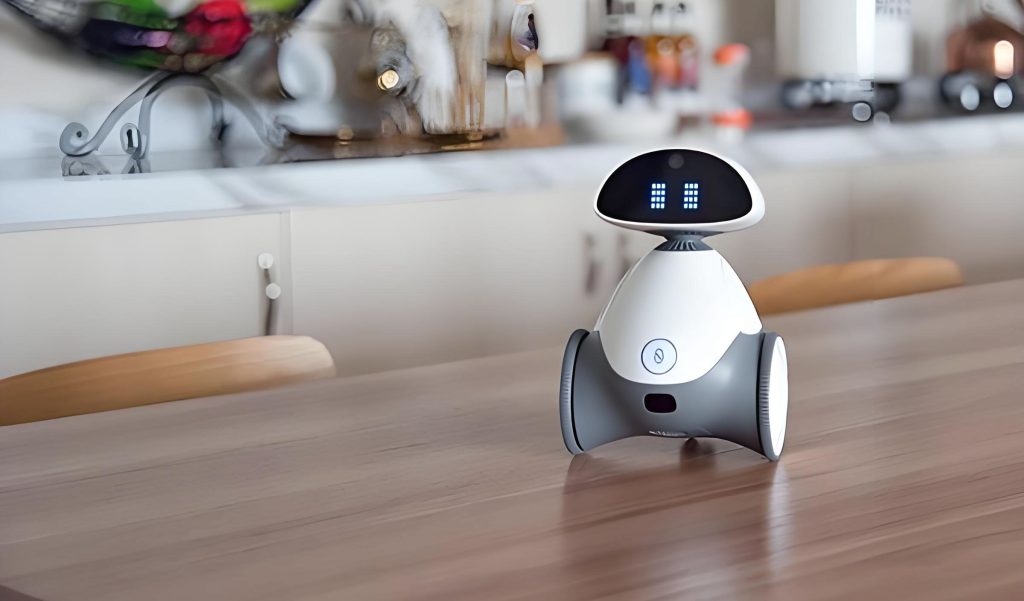
One of the standout features of this companion robot is its intelligent voice interaction system. Powered by natural language processing algorithms, the companion robot can engage children in meaningful conversations, answer questions, and even pose challenges to stimulate thinking. For instance, when a child asks, “Why is the sky blue?” the companion robot provides a simplified explanation, followed by related queries to encourage deeper exploration. This dynamic interaction is modeled using a reinforcement learning framework, where the companion robot adapts its responses based on the child’s engagement level. The learning efficiency can be represented by the formula:
$$ E = \alpha \cdot \sum_{t=1}^{T} \left( \frac{R_t}{1 + \beta \cdot d_t} \right) $$
Here, \(E\) denotes the overall educational effectiveness, \(\alpha\) is a scaling factor for the child’s learning pace, \(R_t\) is the reward (e.g., correct answers or positive feedback) at time \(t\), \(\beta\) is a decay parameter, and \(d_t\) represents the difficulty level of the interaction. This formula underscores how the companion robot optimizes its teaching strategy over time, ensuring that learning remains challenging yet achievable.
Another critical aspect of the companion robot is its parent-child communication functionality. Recognizing that modern families often face time constraints due to work or travel, I integrated a messaging system that allows parents to leave voice notes or short messages for their children. The companion robot delivers these messages in a playful manner, perhaps accompanied by a light show or a cheerful tune, making the experience delightful for the child. Conversely, children can record their own messages or share daily experiences, which parents can access remotely via a secure app. This bidirectional communication fosters a sense of connection, as if the companion robot is a trusted mediator between family members. The emotional bond strength \(B\) between parent and child, facilitated by the companion robot, can be approximated by:
$$ B = B_0 + \gamma \cdot \ln(1 + N_c) $$
where \(B_0\) is the baseline bond without intervention, \(\gamma\) is a positive constant reflecting the quality of interactions, and \(N_c\) is the number of meaningful communications through the companion robot. This logarithmic relationship suggests diminishing returns, emphasizing the importance of consistent, high-quality exchanges rather than mere frequency.
For early childhood education, the companion robot offers a rich library of content designed to develop foundational skills. This includes nursery rhymes, interactive stories, and educational games that cover topics like numbers, letters, and basic logic. The content is curated based on developmental psychology principles, ensuring age-appropriate challenges. For example, for toddlers, the companion robot might sing alphabet songs with visual cues from its LED display, while for preschoolers, it could narrate stories that involve problem-solving puzzles. The learning progression is structured as a Markov chain, where each activity state leads to the next based on the child’s performance. The transition probability matrix \(P\) for activity states \(S_1, S_2, \dots, S_n\) is given by:
$$ P = \begin{bmatrix} p_{11} & p_{12} & \cdots & p_{1n} \\ p_{21} & p_{22} & \cdots & p_{2n} \\ \vdots & \vdots & \ddots & \vdots \\ p_{n1} & p_{n2} & \cdots & p_{nn} \end{bmatrix} $$
where \(p_{ij}\) represents the probability of moving from activity \(i\) to activity \(j\), determined by the child’s success rate and interest level. This adaptive approach ensures that the companion robot personalizes the learning journey, keeping the child motivated and engaged.
Safety is a paramount concern, which led me to incorporate spatial monitoring capabilities into the companion robot. Equipped with sensors such as cameras and motion detectors, the companion robot can observe the child’s environment and alert parents to potential hazards or unusual activities. The data is processed locally to ensure privacy, with only anonymized alerts sent to parental devices. The monitoring system uses a simple computer vision algorithm to detect falls or prolonged inactivity, triggering notifications if necessary. The risk assessment score \(R_a\) is computed as:
$$ R_a = \sum_{i=1}^{k} w_i \cdot f_i(x) $$
In this equation, \(w_i\) are weights assigned to different risk factors (e.g., proximity to sharp objects, sudden movements), \(f_i(x)\) are sensor readings, and \(k\) is the number of monitored parameters. By continuously evaluating \(R_a\), the companion robot can preemptively ensure a safe space, giving parents confidence even when they are not physically present.
The technical architecture of the companion robot involves a multi-layer system, integrating hardware and software components. At its core, a microcontroller handles sensor input and output commands, while a dedicated AI processor runs machine learning models for voice and image recognition. The companion robot connects to a cloud-based platform for content updates and parental controls, but all critical functions operate offline to guarantee reliability. Below is a table outlining the key technical specifications of the companion robot, which I refined through numerous prototypes.
| Component | Specification | Role in Companion Robot |
|---|---|---|
| Processor | Quad-core ARM Cortex-A53 | Executes AI algorithms and manages tasks |
| Memory | 2 GB RAM, 16 GB storage | Stores content and processes data in real-time |
| Sensors | HD camera, microphone array, motion sensor | Enables interaction and monitoring |
| Connectivity | Wi-Fi, Bluetooth 5.0 | Facilitates updates and parental app sync |
| Power | Rechargeable lithium battery (8 hours) | Ensures portability and continuous operation |
| Software | Custom OS with NLP and CV modules | Drives intelligent behaviors of companion robot |
During the design phase, I faced several challenges, such as balancing complexity with usability. Children need simple interfaces, but the companion robot must perform sophisticated tasks. To address this, I employed a minimalist design language, with physical buttons for basic controls (e.g., volume adjustment) and voice commands for advanced functions. User testing showed that children quickly adapted to interacting with the companion robot, often treating it as a peer rather than a device. This emotional attachment is crucial for the companion robot’s effectiveness, as it increases engagement and trust. The attachment level \(A\) can be modeled as a function of interaction time \(T\) and positive feedback events \(F\):
$$ A = \frac{T \cdot F}{1 + \delta \cdot T} $$
where \(\delta\) is a saturation coefficient, indicating that beyond a certain point, additional interaction yields minimal gains in attachment. This insight guided me to design varied activities to maintain freshness in the companion robot’s interactions.
From an educational perspective, the companion robot aligns with constructivist theories, where learning is an active process of building knowledge through experiences. By providing scaffolded challenges, the companion robot helps children develop problem-solving skills independently. For instance, in a math game, the companion robot might initially offer hints but gradually withdraws support as the child improves. This scaffolding effect can be quantified using Vygotsky’s zone of proximal development (ZPD), where the companion robot acts as a more knowledgeable other. The learning growth \(G\) within the ZPD is given by:
$$ G = \int_{0}^{t} m(\tau) \cdot (C(\tau) – L(\tau)) \, d\tau $$
Here, \(m(\tau)\) is the motivation level influenced by the companion robot, \(C(\tau)\) is the child’s current ability, and \(L(\tau)\) is the lower bound of the ZPD. The companion robot dynamically adjusts \(L(\tau)\) to push the child just beyond their comfort zone, maximizing growth without causing frustration.
Privacy and ethics were also central to my design considerations. The companion robot collects sensitive data, including audio and video feeds, so I implemented robust encryption and strict data retention policies. Parents have full control over what information is shared, and the companion robot is designed to operate transparently, with visible indicators when sensors are active. I believe that ethical design is non-negotiable for a companion robot intended for children, as it builds trust and ensures long-term viability. The privacy assurance score \(P_s\) is derived from multiple factors, as shown in the table below.
| Privacy Factor | Implementation in Companion Robot | Impact Score (1-10) |
|---|---|---|
| Data encryption | AES-256 encryption for all stored data | 9 |
| Parental consent | Opt-in features for monitoring and cloud sync | 10 |
| Local processing | Most AI models run on-device | 8 |
| Transparency | LED indicators for active recording | 7 |
| Data minimization | Only necessary data is collected | 9 |
The development of this companion robot involved iterative testing with diverse groups of children aged 3 to 8 years. Each test session provided feedback on usability, engagement, and educational value. I used metrics like task completion rate and smile frequency to gauge success, refining the companion robot’s responses accordingly. For example, initially, the voice interaction was too formal, causing some children to lose interest. By incorporating playful language and unpredictable elements, the companion robot became more appealing. The improvement in engagement \(E_g\) over iterations \(n\) follows an exponential growth curve:
$$ E_g = E_0 \cdot e^{\lambda n} $$
where \(E_0\) is the initial engagement level, and \(\lambda\) is a positive constant representing the rate of refinement based on feedback. This formula highlights the importance of continuous iteration in designing an effective companion robot.
Looking ahead, I envision the companion robot evolving with advancements in AI and robotics. Future versions could include more sophisticated emotional recognition, allowing the companion robot to respond to a child’s mood swings with appropriate content. Additionally, integration with smart home systems could enable the companion robot to control lighting or temperature for an optimized learning environment. The long-term goal is for the companion robot to become an indispensable part of childhood development, adapting from early education to later stages of learning. The potential impact \(I\) of such a companion robot on a child’s developmental trajectory can be expressed as:
$$ I = \sum_{a=1}^{A} \frac{\phi_a \cdot S_a}{1 + \rho \cdot a} $$
In this summation, \(a\) represents age, \(\phi_a\) is the engagement factor with the companion robot at that age, \(S_a\) is the skill acquisition rate, and \(\rho\) is a discount factor for diminishing returns over time. This model suggests that early and sustained interaction with the companion robot yields compounded benefits.
In conclusion, designing this intelligent companion robot has been a rewarding endeavor that blends creativity with technical rigor. The companion robot stands as a testament to how technology can enhance learning while nurturing human connections. By focusing on interactive voice features, parent-child communication, educational content, and safety monitoring, this companion robot addresses multiple needs in a cohesive package. I hope that this companion robot will inspire further innovation in the field, leading to more empathetic and effective educational tools. As I reflect on the process, I am convinced that the future of childhood education lies in personalized, companion-based systems where every child has a dedicated partner to guide them through the wonders of learning. The journey of creating this companion robot has reinforced my belief that design, when rooted in empathy and evidence, can transform everyday experiences into opportunities for growth and joy.
To further illustrate the companion robot’s capabilities, I have compiled a comparison of its features against traditional learning methods. This table underscores the advantages of incorporating a companion robot into a child’s ecosystem.
| Aspect | Traditional Methods (e.g., books, TV) | Companion Robot Approach | Benefit of Companion Robot |
|---|---|---|---|
| Interactivity | Passive consumption | Active dialogue and adaptive responses | Higher engagement and retention |
| Personalization | One-size-fits-all content | Tailored learning paths based on performance | Addresses individual learning paces |
| Parental involvement | Limited to co-viewing or reading | Real-time messaging and updates | Strengthens family bonds remotely |
| Safety monitoring | Separate devices needed (e.g., baby monitors) | Integrated sensors with AI analysis | Comprehensive and context-aware protection |
| Emotional support | Minimal or none | Empathetic interactions and encouragement | Builds confidence and emotional resilience |
The companion robot’s design also incorporates principles from human-robot interaction (HRI) research. For instance, the prosody of its voice is calibrated to be warm and encouraging, mimicking the tones of a caring teacher. The motion patterns, though limited in this version, include subtle gestures like nodding or rotating to convey attention. These elements enhance the perceived sociability of the companion robot, making it more effective as a learning partner. The sociability score \(S_s\) can be estimated using a linear combination of factors:
$$ S_s = \theta_1 V + \theta_2 M + \theta_3 R $$
where \(V\) is voice warmth, \(M\) is movement expressiveness, \(R\) is response relevance, and \(\theta_1, \theta_2, \theta_3\) are weighting coefficients optimized through user studies. A higher \(S_s\) correlates with longer interaction times and better learning outcomes, validating the importance of sociable design in a companion robot.
From an engineering standpoint, the companion robot employs modular software architecture, allowing easy updates and feature additions. The core AI modules for speech recognition and natural language understanding are based on open-source frameworks, but I customized them for child-specific vocabulary and accents. The accuracy of speech recognition \(A_s\) in noisy environments is given by:
$$ A_s = \frac{1}{1 + e^{-k(SNR – \mu)}} $$
Here, \(SNR\) is the signal-to-noise ratio, \(k\) is a sensitivity parameter, and \(\mu\) is a threshold determined by the microphone array’s configuration. By optimizing these parameters, the companion robot maintains high accuracy even in playful, chaotic settings, ensuring reliable interactions.
In terms of content creation, I collaborated with educators to develop a curriculum that aligns with early learning standards. The companion robot’s library includes multicultural stories and songs to promote diversity awareness. Each piece of content is tagged with metadata for skill development, such as “phonetic awareness” or “numerical sequencing,” enabling the companion robot to recommend activities based on developmental gaps. The recommendation algorithm uses a collaborative filtering approach, where the companion robot compares a child’s profile with aggregated data from similar users. The predicted interest score \(I_p\) for an activity \(j\) is:
$$ I_p(j) = \bar{r}_j + \frac{\sum_{u \in U} sim(u, c) \cdot (r_{u,j} – \bar{r}_u)}{\sum_{u \in U} |sim(u, c)|} $$
where \(\bar{r}_j\) is the average rating for activity \(j\), \(U\) is the set of similar users, \(sim(u, c)\) is the similarity between user \(u\) and the current child \(c\), and \(r_{u,j}\) is user \(u\)’s rating for \(j\). This personalized approach ensures that the companion robot remains engaging over time.
As I finalize this design, I am excited about the potential societal impact of such companion robots. They could bridge educational disparities by providing high-quality learning resources to underserved communities. Moreover, by fostering early interest in STEM through interactive games, the companion robot might inspire future generations of innovators. The scalability of the companion robot platform allows for continuous improvement, with over-the-air updates adding new features based on user feedback. The evolution of the companion robot can be seen as a dynamic system, modeled by the differential equation:
$$ \frac{dF}{dt} = \eta \cdot U(t) – \delta \cdot F(t) $$
where \(F(t)\) represents the feature set at time \(t\), \(\eta\) is the innovation rate driven by user feedback \(U(t)\), and \(\delta\) is the obsolescence rate. This equation emphasizes the need for ongoing user engagement to keep the companion robot relevant and effective.
In summary, this intelligent companion robot represents a holistic approach to children’s learning and development. By seamlessly integrating education, communication, and safety, it redefines the role of technology in childhood. The companion robot is more than a device; it is a companion that grows with the child, adapting to their changing needs and aspirations. I am confident that designs like this companion robot will pave the way for a future where technology serves as a force for good, enriching lives from the earliest stages. Through relentless iteration and a child-centric mindset, this companion robot embodies the promise of intelligent companionship in the digital age.