
In the rapidly evolving fields of robotics, aerospace, and automotive industries, the demand for high-precision and reliable transmission systems has never been greater. Among these, the rotary vector reducer, commonly known as the RV reducer, stands out due to its large transmission ratio, minimal backlash, and high stiffness, making it a critical component in robotic joints. As robotic applications advance towards higher levels of automation and precision, the performance evaluation of rotary vector reducers becomes paramount. However, much of the existing research focuses on theoretical aspects, such as transmission accuracy and error analysis, with limited comprehensive experimental studies. Current test rigs often lack automation, versatility, and the ability to conduct multifaceted evaluations, including mechanical performance, fault diagnosis, and fatigue life testing. This gap highlights the need for an advanced experimental setup that can provide holistic insights into the behavior and optimization of rotary vector reducers.
To address this, I developed a dedicated experimental rig for rotary vector reducers, designed to automate mechanical performance testing, enable fault monitoring and diagnosis, and facilitate fatigue life experiments. This rig aims to bridge the theoretical and practical divides by offering a platform for rapid, accurate, and multi-dimensional analysis. By leveraging this setup, I seek to uncover failure mechanisms, performance degradation patterns, and potential improvements for rotary vector reducers, ultimately contributing to enhanced design and manufacturing processes. In this article, I detail the development of the experimental rig, its components, and the comprehensive testing conducted on a domestic SHPŔ-20E rotary vector reducer, with results validating the rig’s efficacy and precision.
The experimental rig for rotary vector reducers is engineered as an open-loop system, prioritizing stability, reliability, and accuracy over energy recovery, which is more suited for low-power applications like rotary vector reducers. It comprises three integral subsystems: the mechanical system, the measurement and control system, and the software system. Together, these enable automated data acquisition and analysis for various performance parameters. The rig supports testing of rotary vector reducers from different manufacturers, allowing for comparative studies and feedback into design iterations. Below, I outline the key technical specifications of the setup, which underscore its capability to handle diverse testing scenarios.
| Parameter | Specification |
|---|---|
| Test Object | Rotary Vector Reducer (20E Series) |
| Input Speed Range | 0 to 3,000 rpm |
| Loading Torque Range | 0 to 500 N·m |
| Input Torque Sensor Range | 0 to 20 N·m |
| Output Torque Sensor Range | 0 to 500 N·m |
| Angular Sensor Resolution | 18 bits |
| Acceleration Sensor Range | 100 m/s² per axis |
| Noise Sensor Range | 16 to 134 dB(A) |
| Temperature Sensor Range | 0 to 400°C |
The mechanical system forms the backbone of the experimental rig, ensuring structural integrity and alignment for precise measurements. It is built on a cast-iron base, chosen for its mass and resistance to deformation, which minimizes vibrations and enhances stability during operation. Adjustable pads are placed between the base and supports, allowing fine adjustments in the X and Y directions to achieve optimal shaft alignment—a critical factor for reducing experimental errors and ensuring smooth operation. High-precision elastic diaphragm couplings connect the shafts, compensating for minor misalignments and absorbing shocks to protect sensitive components. The supports house various elements of the measurement and control system, such as the drive unit, loading mechanism, and sensors, facilitating easy integration and maintenance. This modular design enables quick setup and adaptation for different rotary vector reducer models, making the rig versatile for extensive testing campaigns.
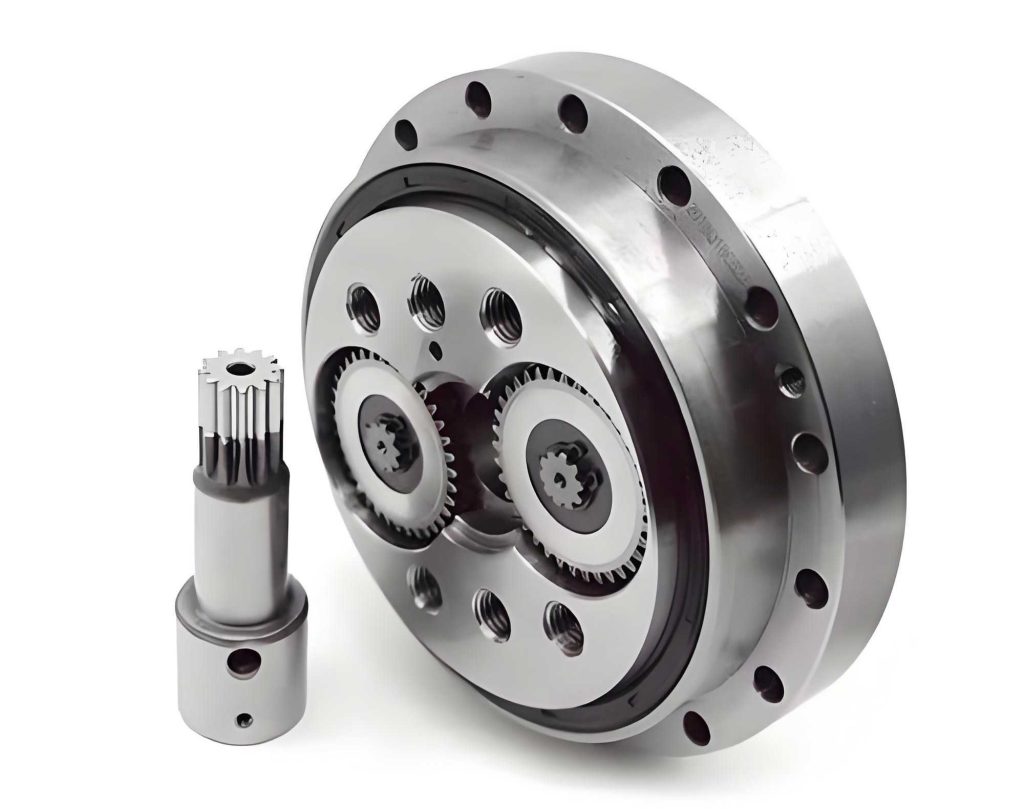
The measurement and control system is the core of the experimental rig, responsible for generating inputs, applying loads, and capturing data. It consists of the drive unit, loading unit, and a comprehensive sensor array for data acquisition. The drive unit includes a servo motor, servo driver, and a programmable logic controller (PLC), which together enable automated start-stop cycles, speed regulation, and directional changes. This unit provides the mechanical input to the rotary vector reducer, simulating real-world operating conditions. The loading unit employs a magnetic powder brake controlled by a programmable controller, allowing precise torque application from 0 to 500 N·m. To prevent overheating during prolonged tests, a water-cooling system is integrated with the brake. Sensors are strategically installed on both the input and output sides of the rotary vector reducer: torque sensors measure speed and torque, while angular sensors capture rotational positions. Additionally, vibration accelerometers, temperature sensors, and a microphone are placed on the reducer’s housing to monitor dynamic responses, thermal behavior, and acoustic emissions. All sensor signals are routed to a data acquisition system and then to an industrial computer for processing, enabling real-time analysis and storage.
The software system, developed using virtual instrumentation and high-precision data acquisition technologies, runs on a Windows platform and interfaces seamlessly with the hardware. It is divided into parameter configuration, user management, and data analysis modules. Through this system, I can automate the calculation of mechanical performance metrics—such as transmission efficiency, transmission error, and backlash—from the acquired sensor data. The software also supports advanced signal processing techniques, including spectral analysis, frequency response, octave analysis, cepstrum analysis, and correlation studies for vibration signals. For temperature and noise data, it generates trend curves to identify anomalies. This integrated approach allows for rapid evaluation of rotary vector reducer performance, aiding in fault diagnosis and life prediction. The software’s user-friendly interface facilitates efficient experimentation, making it a powerful tool for researchers and engineers aiming to optimize rotary vector reducers.
To validate the experimental rig, I conducted a series of mechanical performance tests on a domestic SHPŔ-20E rotary vector reducer, with specifications including a reduction ratio of 141, rated output torque of 168 N·m, and a backlash of 1 arc-minute. The tests focused on transmission efficiency, transmission error, and backlash, following standardized procedures to ensure accuracy and repeatability. Each test leveraged the automation capabilities of the rig, minimizing human intervention and enhancing reliability. In the following sections, I detail the methodologies, formulas, and results for each performance parameter, demonstrating the rig’s effectiveness in characterizing rotary vector reducers.
Transmission efficiency is a key indicator of a reducer’s energy performance, defined as the ratio of output power to input power under rated conditions. For the rotary vector reducer, this can be expressed using torque measurements from the input and output shafts. Let \( T_1 \) be the input torque and \( T_2 \) be the output torque, with \( i \) denoting the reduction ratio. The transmission efficiency \( \eta \) is calculated as:
$$ \eta = \frac{T_2}{i \times T_1} \times 100\% $$
However, to account for losses in couplings and bearings, the overall efficiency \( \eta_{\text{total}} \) measured by the rig must be adjusted. If \( \eta_1 \) and \( \eta_2 \) represent the efficiencies of the couplings and bearings, respectively, the true efficiency of the rotary vector reducer \( \eta_{\text{RV}} \) is:
$$ \eta_{\text{RV}} = \frac{\eta_{\text{total}}}{\eta_1 \eta_2} $$
In testing, I operated the servo motor at a constant input speed of 500 rpm. Starting under no-load conditions, data was collected for 0.5 hours to establish baseline values. Subsequently, loads were applied in increments of 25%, 50%, 75%, and 100% of the rated output torque (168 N·m), each maintained for 0.5 hours while recording torque readings. The results, after correcting for auxiliary losses, are summarized in the table below, showcasing the efficiency trends across different load levels.
| Load Level (% of Rated Torque) | Output Torque \( T_2 \) (N·m) | Input Torque \( T_1 \) (N·m) | Transmission Efficiency \( \eta_{\text{RV}} \) (%) |
|---|---|---|---|
| 0 | 5.8406 | 0.2504 | — |
| 25 | 42.582 | 0.5410 | 81.23 |
| 50 | 84.357 | 0.8416 | 84.67 |
| 75 | 125.62 | 1.1623 | 86.45 |
| 100 | 168.41 | 1.5230 | 87.14 |
The data indicates that the transmission efficiency of the rotary vector reducer peaks at 87.14% under full load, aligning with expectations for such devices. This efficiency curve can be plotted to visualize performance optimization points, aiding in design improvements. The automated data collection process ensured high measurement efficiency, with results accurate to within ±0.5%, as verified through repeated trials.
Transmission error, which reflects the deviation between the theoretical and actual output angles, is critical for precision applications like robotics. It is defined as the difference between the theoretical output angle (based on input angle and reduction ratio) and the measured output angle. Let \( \varphi_1 \) be the actual input angle and \( \varphi_2 \) be the actual output angle. The transmission error \( E \) is given by:
$$ E = \frac{\varphi_1}{i} – \varphi_2 $$
Transmission accuracy is then the range between the maximum and minimum values of \( E \) over a full rotation. In this test, I programmed the servo motor to rotate the input shaft in steps of 705° (theoretical output step of 5° given \( i = 141 \)), using high-resolution angular sensors (18-bit encoders with ±7.5 arc-second accuracy) to capture positions. Data was collected at 5° intervals over 360° of output rotation, resulting in the error values tabulated below. The transmission accuracy is derived from the extremes of these errors.
| Output Angle (degrees) | Transmission Error (arc-minutes) | Output Angle (degrees) | Transmission Error (arc-minutes) |
|---|---|---|---|
| 5 | -0.265 | 185 | 0.900 |
| 10 | 0.625 | 190 | -0.710 |
| 15 | 1.105 | 195 | 0.760 |
| 20 | -0.060 | 200 | 0.010 |
| 25 | 1.105 | 205 | -0.865 |
| 30 | -0.540 | 210 | 0.860 |
| 35 | 0.830 | 215 | -0.995 |
| 40 | -0.470 | 220 | -0.815 |
| 45 | -0.545 | 225 | -0.640 |
| 50 | 0.530 | 230 | 0.485 |
| 55 | 0.255 | 235 | -1.020 |
| 60 | 0.680 | 240 | 1.045 |
| 65 | -0.570 | 245 | -1.090 |
| 70 | 0.550 | 250 | 0.970 |
| 75 | -0.730 | 255 | -1.095 |
| 80 | 0.145 | 260 | 0.695 |
| 85 | 0.010 | 265 | -0.200 |
| 90 | -0.905 | 270 | 0.145 |
| 95 | 0.145 | 275 | -0.965 |
| 100 | -0.195 | 280 | -0.335 |
| 105 | -0.820 | 285 | 0.935 |
| 110 | 0.970 | 290 | -0.755 |
| 115 | -0.540 | 295 | 0.275 |
| 120 | 0.350 | 300 | -1.025 |
| 125 | -1.020 | 305 | 0.420 |
| 130 | -0.545 | 310 | -0.470 |
| 135 | 0.350 | 315 | 0.145 |
| 140 | 1.120 | 320 | -0.065 |
| 145 | -1.170 | 325 | 0.010 |
| 150 | -0.475 | 330 | 0.735 |
| 155 | 0.695 | 335 | -0.955 |
| 160 | -1.025 | 340 | 0.515 |
| 165 | -0.540 | 345 | 0.350 |
| 170 | -0.130 | 350 | 0.560 |
| 175 | 0.490 | 355 | -0.130 |
| 180 | -1.120 | 360 | 0.320 |
From the table, the maximum transmission error is 1.170 arc-minutes, and the minimum is -1.170 arc-minutes, yielding a transmission accuracy of 2.340 arc-minutes. This value, though acceptable for many applications, indicates areas for precision enhancement in the rotary vector reducer. The error curve, when plotted, shows periodic variations that may be linked to gear meshing characteristics or assembly tolerances, providing insights for further analysis.
Backlash, or lost motion, is the angular lag in the output shaft when the input direction reverses, crucial for dynamic performance. For a rotary vector reducer, backlash \( j \) can be measured indirectly by monitoring input angles under light loading. The formula involves angles recorded at positive and negative torques:
$$ j = \frac{\theta^+_{\text{in}} – \theta^-_{\text{in}}}{i} – (\theta^+_{\text{out}} – \theta^-_{\text{out}}) $$
where \( \theta^+_{\text{in}} \) and \( \theta^-_{\text{in}} \) are input angles at +3% and -3% of rated torque, respectively, and \( \theta^+_{\text{out}} \) and \( \theta^-_{\text{out}} \) are corresponding output angles. In practice, to simulate operational conditions, I measured backlash by rotating the input shaft at low speed (10 rpm) first clockwise and then counterclockwise while the output shaft was held stationary, capturing the input angle difference. This method, validated through simulations, provides a close approximation of the actual backlash. Three trials were conducted under no-load conditions, with results as follows.
| Trial Number | Backlash (arc-minutes) |
|---|---|
| 1 | 0.77 |
| 2 | 1.03 |
| 3 | 0.98 |
The average backlash is approximately 0.93 arc-minutes, which is slightly below the rated value of 1 arc-minute, demonstrating the rotary vector reducer’s compliance with specifications. This test highlights the rig’s ability to perform sensitive measurements with high repeatability, essential for quality control in manufacturing.
Beyond mechanical performance, the experimental rig enables advanced studies such as fault diagnosis and fatigue life testing. For fault diagnosis, vibration signals from accelerometers mounted on the rotary vector reducer housing are analyzed using time-domain and frequency-domain techniques. Common faults like gear wear, bearing defects, or misalignment manifest as specific spectral components, which can be identified through fast Fourier transform (FFT) or envelope analysis. The software system facilitates this by computing power spectral densities and harmonic indices. For instance, if a rotary vector reducer develops a fault, the vibration spectrum might show increased amplitudes at meshing frequencies or sidebands, allowing early detection. Similarly, temperature and noise sensors provide supplementary data; anomalous temperature rises or acoustic emissions can serve as failure precursors. In fatigue life testing, the rig applies accelerated stress conditions—such as 2.5 times the rated torque or elevated speeds—while monitoring performance degradation over time. Failure criteria might include a drop in transmission efficiency below a threshold or excessive vibration levels. By conducting such tests, I can derive life distributions and failure modes for rotary vector reducers, informing design durability improvements. The integration of these capabilities makes the rig a comprehensive tool for reliability engineering.
The development and testing of this experimental rig have yielded significant insights into the performance of rotary vector reducers. The rig successfully automates the measurement of key mechanical parameters—transmission efficiency, transmission error, and backlash—with high accuracy and efficiency, as evidenced by the tests on the SHPŔ-20E model. Compared to imported counterparts, the domestic rotary vector reducer shows slightly lower efficiency and higher transmission errors, indicating areas for refinement in design or manufacturing. However, the results are within acceptable ranges, validating the rig’s utility for quality assessment. The open-loop mechanical design ensures stability, while the sophisticated measurement and control system allows for versatile testing scenarios. The software further enhances productivity by enabling real-time data processing and analysis. This rig not only serves as a platform for performance evaluation but also supports research into fault mechanisms and life prediction, contributing to the advancement of rotary vector reducer technology. Future work may involve expanding the rig’s capabilities to include environmental testing, such as temperature cycling, or integrating machine learning algorithms for predictive maintenance. Ultimately, this experimental setup aims to foster innovation in the field, helping to elevate the global competitiveness of rotary vector reducers in robotic and precision applications.