
The pursuit of creating a robotic end-effector that mirrors the versatility and capability of the human hand remains a fundamental challenge in robotics. At the heart of this challenge lies the development of a highly integrated, modular, and high-performance finger control system. The inherent space constraints within a human-sized dexterous robotic hand demand an unprecedented level of electronic integration, while the requirement for stable, precise, and fast manipulation imposes stringent demands on computational power, control bandwidth, and sensor fusion. Traditional control architectures, often relying on microcontrollers with dedicated driver chips or slower programmable logic, struggle to meet these simultaneous demands for compactness and performance. This article details the design and implementation of a novel, modular, and embedded finger control system for a five-fingered dexterous robotic hand, leveraging a synergistic Digital Signal Processor (DSP) and Field-Programmable Gate Array (FPGA) architecture. This approach eliminates bulky driver ICs, integrates all electronics within the finger’s mechanical structure, and achieves a robust, high-speed control loop essential for advanced manipulation tasks.
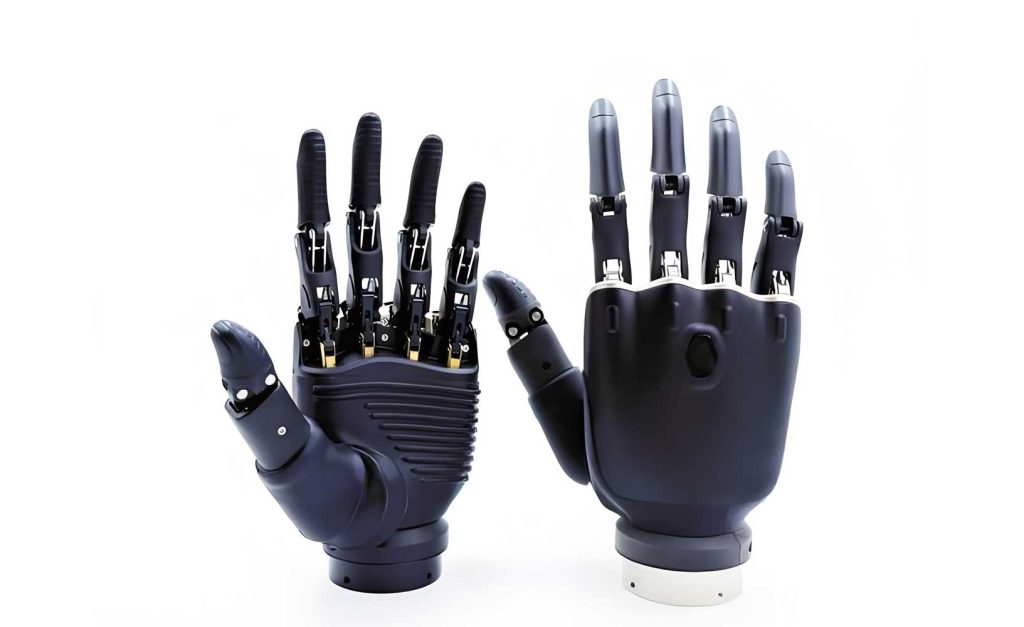
The control system for each finger in this advanced dexterous robotic hand is decomposed into two primary, cooperative modules reflecting the finger’s mechanical joints: the Distal/Proximal Interphalangeal Joint Module and the Metacarpophalangeal (Base) Joint Module. This modular partitioning aligns hardware responsibility with functional complexity.
DSP+FPGA Control Architecture: A Synergistic Partnership
The core innovation of this finger control system is the dedicated use of a DSP for the two distal joints and an FPGA for the complex base joint. This partitioning exploits the inherent strengths of each processor type.
- Distal/Proximal Joint Module (DSP-Centric): This module controls the two simpler hinge-like joints. A Texas Instruments TMS320F280xx series DSP is employed. This processor is selected for its exceptional computational speed in fixed-point arithmetic, ideal for executing complex control algorithms (e.g., PID, impedance control) within extremely short cycle times. Its integrated peripherals, such as high-resolution Pulse-Width Modulation (PWM) modules, analog-to-digital converters (ADCs), and serial communication interfaces, reduce component count. Its primary responsibilities are:
- Executing high-bandwidth current, velocity, and position control loops for its two assigned brushless DC (BLDC) motors.
- Sampling and processing integrated joint sensors (absolute position, temperature).
- Managing high-level communication with the base joint FPGA via a robust serial link.
- Base Joint Module (FPGA-Centric): The base joint, often implementing abduction/adduction and flexion/extension via differential mechanisms, requires management of multiple motors and more complex kinematic coordination. An Altera Cyclone series FPGA is used. Its strength lies in parallel processing and extreme flexibility in creating custom hardware peripherals. A 32-bit Nios II soft-core processor is instantiated within the FPGA fabric, running C-code for control logic, while dedicated hardware blocks described in VHDL handle time-critical, parallel tasks. Its responsibilities include:
- Coordinating the control of two BLDC motors for the differential base joint.
- Implementing low-level motor commutation logic and PWM signal generation directly in hardware.
- Interfacing with a multitude of base-joint sensors (6-axis force/torque, tactile arrays).
- Managing the communication link with the distal DSP and the central hand controller.
The collaboration can be summarized by the following relationship, where system performance $P_{sys}$ is a function of DSP algorithmic speed $S_{DSP}$ and FPGA hardware efficiency $E_{FPGA}$:
$$P_{sys} = f(S_{DSP}, E_{FPGA}) \quad \text{where} \quad S_{DSP} \propto \frac{1}{\text{Control Cycle Time}}, \quad E_{FPGA} \propto \text{Parallel Task Throughput}$$
The separation of concerns allows the DSP to focus on numerical-intensive control laws, while the FPGA handles real-time signal generation and multi-sensor I/O, leading to a deterministic and efficient system. The benefits of this architecture for a dexterous robotic hand are quantified in the following table:
| Feature | DSP Contribution | FPGA Contribution | System-Level Benefit |
|---|---|---|---|
| Computational Speed | High-frequency control loop execution (~200 µs cycle). | Parallel processing of sensor data and motor driving logic. | Ultra-fast system response, enabling dynamic manipulation. |
| Hardware Integration | Utilizes integrated ADCs, PWMs, and communication ports. | Replaces multiple discrete driver and glue-logic ICs with customizable logic. | Drastic reduction in PCB size and component count, enabling in-finger embedding. |
| Flexibility & Modularity | Software-based control allows easy algorithm updates. | Hardware architecture can be reconfigured for different motor types or sensor suites. | Easy maintenance, upgradeability, and adaptation for different dexterous robotic hand designs. |
| Deterministic Timing | Predictable interrupt and computation latency. | Hardware-level signal generation ensures jitter-free PWM and commutation. | Highly stable and repeatable motor control, crucial for fine manipulation. |
Motor Drive and Control: Direct Drive and Advanced Sensing
Each finger module drives three small, high-torque BLDC motors (Maxon EC-20). A significant departure from conventional designs is the elimination of dedicated motor driver ICs. Instead, the DSP and FPGA directly generate the six PWM signals to control the gates of MOSFETs in three half-bridge circuits. This “direct drive” approach is a key enabler for miniaturization. The commutation sequence for the three-phase, trapezoidal back-EMF BLDC motors is derived directly from the motors’ integrated Hall-effect sensors by the FPGA/DSP hardware logic.
Accurate and fast current sensing is critical for implementing torque control and ensuring motor safety. A major challenge in a full-bridge PWM drive is that the DC bus current is discontinuous and does not always reflect a phase current. The proposed solution uses a single, low-side current sensing shunt resistor ($R_{shunt}$) and a high-side current sensor (ZXCT1030). The key innovation is the strategic timing of the ADC sampling instant.
During standard six-step commutation with PWM chopping, the phase current is proportional to the bus current only when the PWM signal for the low-side MOSFET is ON. However, sampling during the ON period can be noisy due to switching transients. Therefore, the sampling is programmed to occur precisely at the midpoint of the PWM ON pulse, where the current through the shunt resistor has stabilized and accurately represents the active phase current. This timing is managed by synchronizing the ADC start-of-conversion trigger with the PWM time-base counter.
Let $T_{PWM}$ be the PWM period, $D$ be the duty cycle, and $t_{sample}$ be the sampling instant. The optimal sampling point is:
$$t_{sample} = \frac{D \cdot T_{PWM}}{2}$$
The sensed voltage $V_{sense}(t_{sample})$ across $R_{shunt}$ is:
$$V_{sense}(t_{sample}) = I_{phase}(t_{sample}) \cdot R_{shunt}$$
This voltage is amplified by the ZXCT1030 with gain $G=10$, producing $V_{out}$. The DSP/FPGA ADC converts $V_{out}$ to a digital value $ADC_{current}$:
$$ADC_{current} \propto V_{out} = G \cdot R_{shunt} \cdot I_{phase}(t_{sample})$$
This value is used for closed-loop current control.
Furthermore, the ZXCT1030 provides a hardware over-current protection (OCP) feature. An external reference voltage $V_{ref,OCP}$ sets the trip threshold. If $V_{out} > V_{ref,OCP}$, the chip’s open-drain output pulls low, generating an immediate fault signal to the processor’s protection pin. This triggers a hardware interrupt that forces all PWM outputs to a pre-defined safe state (e.g., all MOSFETs off). This hardware protection works in tandem with software protection, where the processor compares $ADC_{current}$ to a software threshold. This dual-layer protection scheme is essential for the safety and longevity of the compact actuators in a dexterous robotic hand.
Multi-Interrupt Differential Communication System
Stable, high-speed, and noise-immune communication between the DSP and FPGA within the electrically noisy environment of a dexterous robotic hand is paramount. A Serial Communication Interface (SCI/UART) protocol is implemented over an RS-485 physical layer. The RS-485 standard, using differential signaling (lines A and B), provides excellent common-mode noise rejection, allowing reliable communication over just two wires and enabling the modules to be separated by several centimeters within the finger structure.
The primary challenge is the high data throughput required within a tight 200 µs control cycle. The data packet for exchanging joint commands, sensor data, and status information is 17 bytes long. At a baud rate of 6.25 Mbps, transmitting 17 bytes takes approximately 21.8 µs, and receiving takes the same time. A simple polled communication method would consume over 40 µs of the cycle, leaving insufficient time for control computations.
The solution leverages the DSP’s SCI module, which includes 16-level deep First-In-First-Out (FIFO) buffers for both transmission and reception, and a sophisticated multi-interrupt scheme:
- Receiver Design: The 17-byte packet has a specific structure. The first byte is an address/header byte (Addr=1), followed by 16 data bytes. The SCI is configured to generate a specific “receiver break” interrupt (RXBKINT) upon receiving a byte with its address-match bit set. This interrupt service routine (ISR) reads the header byte and then re-configures the SCI to generate a standard “FIFO receive” interrupt when its 16-byte buffer is full. The second ISR then reads all 16 data bytes at once. This two-stage interrupt process efficiently handles the 17-byte packet without buffer overrun.
- Transmitter Design: To prevent overwhelming the receiver and to ensure packet boundaries are clear, transmission is also interleaved with interrupts and deliberate delays. The 17-byte packet is split: one interrupt transmits the address byte, and the next transmits the 16 data bytes from the TX FIFO. A timer interrupt inserts a fixed 3 µs gap between consecutive data packets, guaranteeing the FPGA receiver has time to process each packet. After the last data packet, two additional dummy interrupts are executed before disabling the RS-485 transmitter driver, ensuring the final byte is completely shifted out before the bus goes idle.
The communication protocol ensures robustness. The main control loop continuously monitors communication health; if a valid packet is not received within a timeout window, the finger enters a fail-safe state (e.g., motors disabled), preventing uncontrolled motion. The efficiency of this scheme is summarized below, showing the dramatic reduction in CPU time spent on communication overhead:
| Communication Method | Time per 17-Byte Packet | CPU Involvement | Suitability for 200µs Cycle |
|---|---|---|---|
| Simple Polled I/O | > 40 µs (Tx + Rx) | CPU actively waits for each byte. | Poor (consumes >20% of cycle). |
| Basic Interrupt (per byte) | ~40 µs (electrical) | CPU interrupted 34 times per cycle. | Fair (high interrupt overhead). |
| Proposed Multi-Int. with FIFO | ~40 µs (electrical) | CPU interrupted only ~4-5 times for full duplex. | Excellent (low overhead, high reliability). |
Sensor Integration and Digital Interface
A true dexterous robotic hand requires rich sensory feedback. Each finger in this system is equipped with a comprehensive sensor suite: absolute position sensors (e.g., Hall-effect or capacitive) at each joint, temperature sensors on the motor drivers, a miniaturized 6-axis force/torque sensor at the base, and a tactile sensor array on the fingertip. To maximize reliability and minimize analog signal degradation in the noisy, compact environment, a “digitize-at-the-source” philosophy is adopted.
Each sensor cluster has its own local, tiny microcontroller or ASIC that performs signal conditioning, calibration, and analog-to-digital conversion. The processed digital data is then transmitted to the main finger processors (DSP/FPGA) via robust digital serial buses like SPI (Serial Peripheral Interface) or I²C. This approach:
- Improves Noise Immunity: Digital signals are far less susceptible to EMI from motor currents and PWM signals than low-voltage analog signals.
- Simplifies Wiring: Reduces the number of delicate analog traces running through the finger’s moving joints.
- Enables Modularity: Sensor modules can be replaced or upgraded independently.
- Offloads Processing: The main processors receive clean, calibrated data, reducing their computational burden.
The sensor data fusion occurs within the DSP and FPGA. For instance, the DSP fuses the absolute joint position with the motor’s Hall sensor counts for high-resolution, drift-free position feedback. The FPGA aggregates data from the force/torque and tactile sensors to form a preliminary contact state estimation before sending it to the central hand controller.
System Integration and Performance Evaluation
The culmination of this modular, DSP+FPGA design is a fully self-contained finger assembly where all electronics are embedded within the mechanical links and palm structure. The previous generation of hands required separate, larger controller boards. The integration level achieved here enables the construction of a complete five-fingered dexterous robotic hand with a size and form factor comparable to a human hand.
Experimental validation confirms the system’s performance:
- Current Sensing: The midpoint PWM sampling technique produces a clean, stable phase current reading, crucial for smooth torque control. Direct sampling without this timing results in a noisy, unreliable signal.
- Communication Integrity: Oscilloscope measurements of the differential RS-485 lines (A and B) show clean, well-defined waveforms with minimal ringing, even during intense motor activity, confirming the noise immunity of the link.
- Control Performance: A PD position control experiment demonstrates the system’s capability. The finger is commanded to track a trajectory from an initial pose $\Theta_0 = (0^\circ, 0^\circ, -10^\circ)$ to a target pose $\Theta_r = (70^\circ, 70^\circ, 10^\circ)$ and back. The results show excellent tracking performance:
- Joints 1 & 2 (primary flexion): Tracking error $< \pm 0.3^\circ$, response time $< 3 ms$.
- Joint 3 (abduction/adduction, part of a differential pair): Tracking error $< \pm 1.0^\circ$, response time $< 5 ms$.
The slight difference in performance for Joint 3 is expected and acceptable, as the control priority and mechanical bandwidth are typically tuned for the primary flexion/extension axes in a dexterous robotic hand.
The overall performance metrics of the finger control system are summarized as follows:
| Performance Metric | Value / Achievement | Significance for Dexterous Manipulation |
|---|---|---|
| Control Cycle Time | 200 µs (5 kHz rate) | Enables very high bandwidth for force and impedance control, allowing dynamic interaction. |
| Position Tracking Error | < ±0.3° (main joints) | Allows for precise fingertip positioning, essential for delicate tasks like peg-in-hole or tool use. |
| Communication Baud Rate | 6.25 Mbps (Differential RS-485) | Supports high-speed data exchange for multi-sensor feedback without bottleneck. |
| Protection Response | Hardware OCP < 1 µs, Software < 10 µs | Ensures actuator safety during collisions or jams, protecting the delicate hand mechanics. |
| Level of Integration | All control electronics embedded in-finger | Enables human-scale form factor, reduces external wiring, and improves reliability. |
Conclusion and Future Directions
The presented modular, embedded finger control system, founded on a synergistic DSP+FPGA architecture, successfully addresses the critical challenges of size, performance, and reliability for an advanced dexterous robotic hand. By eliminating intermediate driver chips and employing direct gate driving, intelligent single-sensor current detection with dual protection, and a robust multi-interrupt differential communication system, the design achieves a level of integration that allows all electronic components to reside within the finger links themselves. This enables the practical realization of a compact, five-fingered dexterous robotic hand with human-like dimensions.
The system provides a stable and powerful hardware platform capable of executing advanced control algorithms at high speed, processing data from a rich suite of digital sensors, and communicating reliably under electrically noisy conditions. The modular nature of the design, both in hardware partitioning and software structure, offers significant advantages for maintenance, testing, and future evolution. Potential future enhancements include the integration of more advanced sensor fusion algorithms directly on the DSP/FPGA, the implementation of adaptive and learning-based control strategies to improve manipulation skills, and the further miniaturization of components to allow for even more actuators and sensors within the same volume, pushing the capabilities of the next generation of dexterous robotic hands ever closer to their biological inspiration.