
The evolution of robotic systems has entered a new era, driven by advancements in computing and automation. In industrial applications, the end-effector, typically a simple gripper, is a core component. However, such grippers are often limited to specific grasping actions, suffering from low precision, poor stability, and insufficient dexterity. These limitations hinder their ability to meet the demands of modern industrial tasks requiring versatile, complex, and precise manipulation.
A multi-fingered dexterous robotic hand distinguishes itself through its remarkable dexterity. This manifests in two key aspects: the ability to conform to objects of varying shapes without structural modification, and the capacity to manipulate and re-orient a grasped object. Consequently, the development of dexterous robotic hands has become a focal point in robotics research. While significant progress has been made, resulting in highly integrated and dexterous hands like the Shadow Hand, Gifu-III Hand, and UBH3 Hand, these designs predominantly utilize serial structures with tendon-driven underactuation. This approach often compromises payload capacity, precision, and stability. Alternative designs employing traditional geared drives improve performance but increase mechanical complexity and control difficulty. Parallel mechanisms, renowned for their high stiffness, superior payload-to-weight ratio, excellent precision, and dynamic response, offer a promising solution to these shortcomings. Several researchers have explored parallel structures for dexterous robotic hands or grippers, aiming to enhance load capacity and accuracy. Nevertheless, these designs sometimes sacrifice the inherent dexterity of serial hands and often lack the structural biomimicry of a human finger.
To address these challenges—specifically, to achieve a dexterous robotic hand with high load capacity, precision, dynamic performance, good dexterity, and human-like anatomical features—this work presents a novel humanoid parallel finger mechanism and subsequently designs a complete dexterous robotic hand based on this mechanism.
Mechanism Design of the Humanoid Parallel Finger
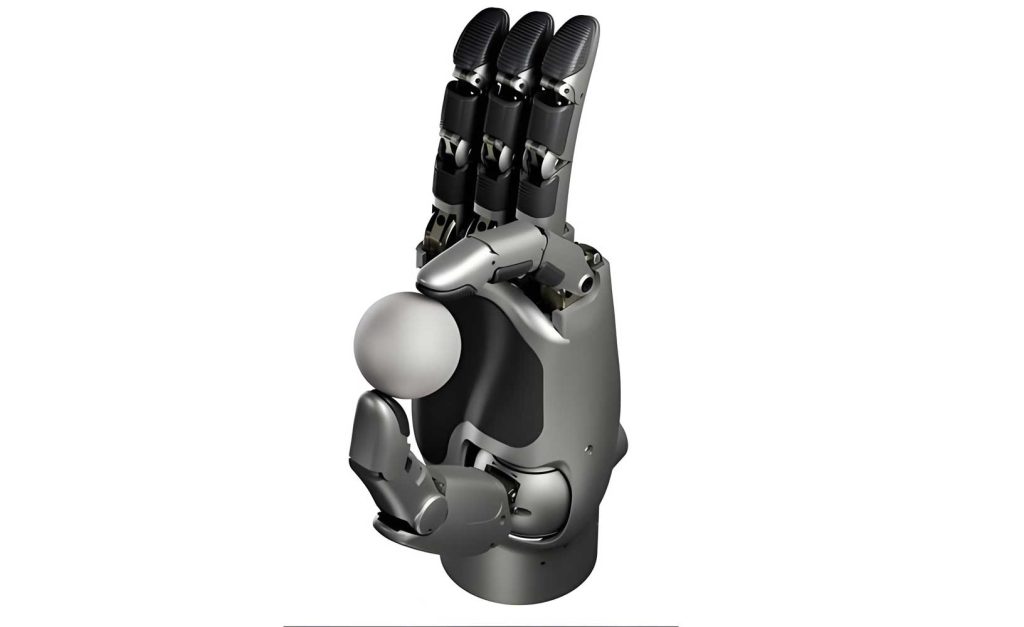
The proposed dexterous robotic hand consists of a palm and three identical humanoid parallel finger mechanisms. The fingers are arranged on the palm in a parallel,交错 layout: the middle finger and index finger are oriented in the same direction, while the thumb is positioned on the symmetry axis of the index and middle fingers and is oriented in the opposite direction.
The core innovation lies in the design of the humanoid parallel finger mechanism, depicted in the figure. It is a planar mechanism replicating the structure of a human finger, comprising upper, middle, and lower phalanges. The mechanism can be conceptually decomposed and then combined. The first part is a five-bar linkage featuring an L-shaped intermediate link. The second part consists of a base five-bar linkage connected to a distal parallelogram structure, which links to the fingertip to provide synchronous rotation. These two subsystems are combined by superimposing them such that they share a common rotary actuator. The L-shaped link from the first five-bar is rigidly connected to a corresponding link in the parallelogram of the second subsystem. The resulting integrated mechanism is a fully actuated system with three independent actuators: one rotary and two linear. This configuration grants the fingertip three degrees of freedom within its plane: two translational and one rotational. This mechanism is designated as the (RR-RPR)R-RPRR parallel finger mechanism.
Degree-of-Freedom Analysis
As the entire finger mechanism operates in a plane, its mobility F can be calculated using the Grübler-Kutzbach criterion for planar mechanisms:
$$ F = 3n – (2p_l + p_h) $$
where n is the number of moving links, pl is the number of lower pairs (revolute and prismatic joints), and ph is the number of higher pairs. The finger mechanism has 9 moving links, 2 prismatic joints, and 10 revolute joints. There are no higher pairs, local freedoms, or redundant constraints. Therefore:
$$ F = 3 \times 9 – 2 \times (2 + 10) = 3 $$
This confirms the finger mechanism possesses three degrees of freedom, requiring three independent actuators, which aligns with its design.
Kinematic Analysis
A schematic of the finger mechanism is established in the coordinate system {S} (O-XYZ), with the mechanism lying in the YOZ plane. Key geometric parameters are defined: length OC = a at angle θ; fixed points A and B are located at a distance d from the X-axis; lengths of prismatic actuators AD and BE are l1 and l2; link DCN is L-shaped with sides DC = e and CN = b; link EC has length f and forms angle α with the Z-axis; links EQ and QN form a parallelogram with EC and CN; the fingertip platform QNP is triangular with NP = c, also at angle α; point P is the fingertip center.
Inverse Position Analysis
Given the fingertip position $^S\mathbf{P} = (Y_P, Z_P)^T$ and orientation α, find the actuator variables θ, l1, l2. The position of point N is:
$$ ^S\mathbf{N} = \begin{bmatrix} Y_N \\ Z_N \end{bmatrix} = \begin{bmatrix} Y_P – c\cos\alpha \\ Z_P – c\sin\alpha \end{bmatrix} $$
The position of point C is $^S\mathbf{C} = (a\cos\theta, a\sin\theta)^T$. Applying the constant distance constraint between C and N yields:
$$ (Y_C – Y_N)^2 + (Z_C – Z_N)^2 = b^2 $$
Substituting the expressions for $^S\mathbf{C}$ and $^S\mathbf{N}$ into this equation allows solving for the rotary actuator angle θ. With θ known, $^S\mathbf{C}$ is determined. The coordinates of D and E can then be derived from geometry:
$$ ^S\mathbf{D} = \begin{bmatrix} Y_D \\ Z_D \end{bmatrix} = \begin{bmatrix} Y_C – e\frac{Z_N – Z_C}{b} \\ Z_C + e\frac{Y_N – Y_C}{b} \end{bmatrix}, \quad ^S\mathbf{E} = \begin{bmatrix} Y_E \\ Z_E \end{bmatrix} = \begin{bmatrix} Y_C – f\sin\alpha \\ Z_C + f\cos\alpha \end{bmatrix} $$
Since points A and B are fixed at $^S\mathbf{A} = ^S\mathbf{B} = (-d, 0)^T$, the actuator lengths are:
$$ l_1 = \sqrt{(Y_D – Y_A)^2 + (Z_D – Z_A)^2}, \quad l_2 = \sqrt{(Y_E – Y_B)^2 + (Z_E – Z_B)^2} $$
Forward Position Analysis
Given actuator variables θ, l1, l2, find the fingertip pose ($Y_P, Z_P, \alpha$). Points D and E are found by solving the closure equations of the two lower-loop five-bars. For point D:
$$ \begin{cases} (Y_D – a\cos\theta)^2 + (Z_D – a\sin\theta)^2 = e^2 \\ (Y_D + d)^2 + (Z_D)^2 = l_1^2 \end{cases} $$
A similar set of equations yields $^S\mathbf{E}$. The orientation α is then obtained from the coordinates of E and C:
$$ \alpha = \arccos\left(\frac{Z_E – Z_C}{f}\right) $$
The position of N is derived from points D and C:
$$ ^S\mathbf{N} = \begin{bmatrix} Y_N \\ Z_N \end{bmatrix} = \begin{bmatrix} Y_C + b\frac{Z_D – Z_C}{e} \\ Z_C + b\frac{Y_C – Y_D}{e} \end{bmatrix} $$
Finally, the fingertip center position is:
$$ ^S\mathbf{P} = \begin{bmatrix} Y_P \\ Z_P \end{bmatrix} = \begin{bmatrix} Y_N + c\cos\alpha \\ Z_N + c\sin\alpha \end{bmatrix} $$
Velocity Jacobian Matrix
The Jacobian matrix $\mathbf{J}$ relates the output velocity vector $\dot{\mathbf{x}} = (v_{Py}, v_{Pz}, \omega_\alpha)^T$ to the input actuator velocity vector $\dot{\mathbf{q}} = (\omega_\theta, v_1, v_2)^T$ such that $\dot{\mathbf{x}} = \mathbf{J} \dot{\mathbf{q}}$. Through systematic differentiation of the kinematic constraints for points C, D, E, and N, and using the relationships between these points and the fingertip P, the complete Jacobian is derived in the form:
$$ \mathbf{J}_x \dot{\mathbf{x}} = \mathbf{J}_q \dot{\mathbf{q}} \quad \Rightarrow \quad \dot{\mathbf{q}} = \mathbf{J}^{-1}_q \mathbf{J}_x \dot{\mathbf{x}} = \mathbf{J} \dot{\mathbf{x}} $$
where $\mathbf{J}_x$ and $\mathbf{J}_q$ are configuration-dependent matrices constructed from the geometric parameters and the instantaneous posture of the dexterous robotic hand’s finger. The explicit symbolic form of $\mathbf{J}$ is extensive but is crucial for performance analysis.
Acceleration Analysis
Differentiating the velocity relation yields the acceleration model. Let $\mathbf{A} = (\varepsilon_\theta, \alpha_1, \alpha_2)^T$ be the actuator acceleration vector and $\mathbf{A}_x = (\alpha_{Py}, \alpha_{Pz}, \varepsilon_\alpha)^T$ be the fingertip output acceleration vector. The relationship is:
$$ \mathbf{A} = \mathbf{J}^{-1}_q \mathbf{J}_x \mathbf{A}_x + \mathbf{J}^{-1}_q \dot{\mathbf{J}}_x \dot{\mathbf{x}} – \mathbf{J}^{-1}_q \dot{\mathbf{J}}_q \dot{\mathbf{q}} $$
This equation enables the computation of required actuator accelerations for a desired fingertip trajectory of the dexterous robotic hand.
Performance Analysis of the Parallel Finger
Workspace
The reachable workspace, defining the maximum range of motion for the fingertip, is a critical performance metric for any dexterous robotic hand. Using parameters scaled to a human index finger proportion ($a$=130mm, $b$=114mm, $c$=100mm, $d$=70mm, $e$=50mm, $f$=50mm), the workspace is determined via a coordinate search algorithm subject to actuator limits ($\theta \in (90^\circ, 135^\circ)$, $l_1, l_2 \in (80mm, 190mm)$) and link interference constraints. The resulting workspace is a large, contiguous crescent-shaped region in the upper half of the search area, spanning approximately $Y \in (-200mm, 200mm)$, with no internal voids, indicating smooth, continuous motion capability for the dexterous robotic hand’s fingers.
Singularity Analysis
Singularities, where the mechanism gains or loses degrees of freedom, must be identified and avoided for stable operation of the dexterous robotic hand. Singularities occur when either $\mathbf{J}_q$ (inverse kinematic singularity) or $\mathbf{J}_x$ (forward kinematic singularity) becomes singular.
The inverse kinematic singularity condition is $\det(\mathbf{J}_q)=0$, which simplifies to:
$$ \det(\mathbf{J}_q) = -\frac{b}{e} (\mathbf{a} \cdot \mathbf{e}) (\mathbf{l}_1 \cdot \mathbf{w}_1) (\mathbf{l}_2 \cdot \mathbf{w}_2) = 0 $$
where bold symbols denote vectors (e.g., $\mathbf{a}$ is vector OC). This condition is met only when $\mathbf{a} \cdot \mathbf{e} = 0$, i.e., when links OC and CD are perpendicular. This configuration can be avoided by proper workspace planning.
The forward kinematic singularity condition is $\det(\mathbf{J}_x)=0$, leading to:
$$ \det(\mathbf{J}_x) = |\mathbf{e} \times \mathbf{l}_1| \cdot |\mathbf{f} \times \mathbf{l}_2| = 0 $$
This occurs if link AD is parallel to CD, or if link BE is parallel to CE. However, given the mechanism’s dimensional parameters and actuator limits, these configurations are outside the feasible workspace. Therefore, the finger mechanism for the dexterous robotic hand is free from forward kinematic singularities within its operational range.
Dexterity Analysis
Dexterity, or the efficiency of motion/force transmission, is evaluated using the condition number of the Jacobian. For mechanisms with mixed translational and rotational outputs, the local condition number for the translational ($\kappa_{J_v}$) and rotational ($\kappa_{J_\omega}$) parts of the Jacobian are analyzed separately.
$$ \kappa_{J_v} = \|\mathbf{J}_V\| \cdot \|\mathbf{J}_V^{+}\|, \quad \kappa_{J_\omega} = \|\mathbf{J}_\omega\| \cdot \|\mathbf{J}_\omega^{+}\| $$
where $\mathbf{J}_V$ and $\mathbf{J}_\omega$ are sub-matrices of $\mathbf{J}$ relating actuator velocities to linear and angular velocities, respectively, and $\mathbf{J}^{+}$ denotes the generalized inverse. A condition number of 1 indicates isotropic performance. Analysis shows that $\kappa_{J_\omega} = 1$ across the workspace, meaning rotational motion transmission is isotropic and excellent. The distribution of $\kappa_{J_v}$ is highly favorable over most of the workspace for a wide range of orientation angles $\alpha$, with only small, specific regions showing higher values. This indicates that the proposed finger for the dexterous robotic hand maintains good overall kinematic dexterity.
| Performance Aspect | Characteristic | Implication for Dexterous Robotic Hand |
|---|---|---|
| Workspace | Large, contiguous, crescent-shaped | Enables grasping of a wide variety of object sizes and positions. |
| Inverse Singularity | Occurs when OC ⟂ CD | Avoidable via trajectory planning. |
| Forward Singularity | Non-existent in workspace | Ensures stable control throughout operation. |
| Rotational Dexterity ($\kappa_{J_\omega}$) | Isotropic (=1 everywhere) | Excellent and uniform orientation control. |
| Translational Dexterity ($\kappa_{J_v}$) | Generally low across workspace | Good motion fidelity for positioning tasks. |
Static Force Analysis
The force transmission capability from the actuators to the fingertip is vital for a dexterous robotic hand. Using the virtual work principle, the relationship between the actuator force/torque vector $\boldsymbol{\tau} = (\tau_1, F_1, F_2)^T$ and the fingertip output wrench $\mathbf{F}_{out} = (f_y, f_z, n_x)^T$ is:
$$ \mathbf{F}_{out} = \mathbf{J}^T \boldsymbol{\tau} $$
Given a desired output wrench, the required actuator efforts are $\boldsymbol{\tau} = (\mathbf{J}^T)^{-1} \mathbf{F}_{out}$. Analyzing this for a sample output force $\mathbf{F}_{out} = (-10N, 5N, 5N)^T$ across the workspace reveals the distribution of actuator loads. The linear actuator forces are converted to required motor torques $T_i$ assuming a ball screw drive with lead $l$ and efficiency $\eta$:
$$ T_i = \frac{F_i \cdot l}{2\pi\eta}, \quad i=1,2 $$
The analysis shows that the required torque for the rotary actuator $\tau_1$ is significantly larger than the converted torques $T_1$ and $T_2$ for the linear actuators across the workspace. This indicates that the output force capability of this dexterous robotic hand finger is primarily governed by the torque capacity of the rotary drive motor.
| Actuator | Typical Required Torque Range (Nm) | Primary Role in Force Output |
|---|---|---|
| Rotary Joint ($\tau_1$) | Higher magnitude, varies with pose | Dominant contributor to fingertip force. |
| Prismatic Joint 1 ($T_1$) | Lower magnitude | Mainly adjusts kinematics; minor force role. |
| Prismatic Joint 2 ($T_2$) | Lower magnitude | Mainly adjusts kinematics; minor force role. |
Coordinated Manipulation Analysis of the Dexterous Robotic Hand
The dexterous robotic hand performs grasping and in-hand manipulation via coordinated motion of its three fingers. The analysis focuses on precision grasping, where fingertips make point contact with the object.
Grasping Model and System DOF
Each 3-DOF parallel finger is modeled as an equivalent 3-R open kinematic chain. A fixed point contact is modeled as a spherical joint (S) connecting the finger to the object. Thus, the three-fingered hand grasping a rigid object is kinematically equivalent to a 3-RRRS parallel mechanism, where the object is the moving platform. Applying screw theory to this equivalent mechanism reveals that the grasped object, when held by the dexterous robotic hand, possesses three operational degrees of freedom: rotation about the X-axis of the palm, and translation along the Y and Z axes.
Coordinated Kinematics
Let the base frame {B} be on the palm. The position $\mathbf{p}_{si}$ and velocity $\mathbf{v}_{si}$ of the $i$-th finger’s contact point in {B} are derived from the finger’s kinematics and its mounting pose on the palm. For a fixed point contact, the position constraint is:
$$ \mathbf{p}_{si} = \mathbf{p}_{ti} = \mathbf{r}_{ot} + \mathbf{r}_{ti} $$
where $\mathbf{p}_{ti}$ is the object contact point, $\mathbf{r}_{ot}$ is the object center position, and $\mathbf{r}_{ti}$ is the vector from the object center to the contact point. Differentiating gives the velocity constraint:
$$ \mathbf{v}_{si} = \mathbf{v}_{ti} = \mathbf{v}_t + \boldsymbol{\omega}_t \times \mathbf{r}_{ti} = [\mathbf{I} \quad -\hat{\mathbf{r}}_{ti}] \mathbf{V}_t $$
where $\mathbf{V}_t = [\mathbf{v}_t^T, \boldsymbol{\omega}_t^T]^T$ is the object’s generalized velocity, and $\hat{\mathbf{r}}$ is the skew-symmetric matrix of $\mathbf{r}$. Since $\mathbf{v}_{si} = \mathbf{J}_{v_{si}} \dot{\mathbf{q}}_i$, we have for three fingers:
$$ \mathbf{J}_n \dot{\mathbf{Q}} = \mathbf{J}_t \mathbf{V}_t \quad \Rightarrow \quad \dot{\mathbf{Q}} = \mathbf{J}_n^{-1} \mathbf{J}_t \mathbf{V}_t $$
where $\dot{\mathbf{Q}} = [\dot{\mathbf{q}}_1^T, \dot{\mathbf{q}}_2^T, \dot{\mathbf{q}}_3^T]^T$, $\mathbf{J}_n = \text{blkdiag}(\mathbf{J}_{v_{s1}}, \mathbf{J}_{v_{s2}}, \mathbf{J}_{v_{s3}})$, and $\mathbf{J}_t = [ [\mathbf{I}, -\hat{\mathbf{r}}_{t1}]^T, [\mathbf{I}, -\hat{\mathbf{r}}_{t2}]^T, [\mathbf{I}, -\hat{\mathbf{r}}_{t3}]^T ]^T$. This equation provides the fundamental coordination model for the dexterous robotic hand, allowing calculation of required finger actuator velocities for a desired object motion. The acceleration relationship can be derived similarly by further differentiation.
Coordinated Operation Space
The coordinated operation space is the intersection of the individual finger workspaces, transformed to the palm base frame {B}. Using the mounting parameters ($L_1$=100mm, $L_2$=100mm, $L_3$=80mm), the combined workspace is obtained. This space defines the volume within which the dexterous robotic hand can manipulate an object using all three fingers in coordination, representing its effective in-hand manipulation range.
| Finger | Mounting Position in {B} (mm) | Orientation in {B} |
|---|---|---|
| Thumb (Finger 1) | $\mathbf{O}_1 = (0, -L_1, 0)^T$ | Identity Rotation |
| Index (Finger 2) | $\mathbf{O}_2 = (L_3, L_2, 0)^T$ | Rotated 180° about Z |
| Middle (Finger 3) | $\mathbf{O}_3 = (-L_3, L_2, 0)^T$ | Rotated 180° about Z |
Kinematic Simulation and Validation
To validate the kinematic models, a virtual prototype of the dexterous robotic hand was built in ADAMS dynamics software. A simulation was performed where the fingertip was commanded to follow a trajectory defined by $Y_P(t) = Y_{P0} + 5t$ mm over 6 seconds, starting from an initial configuration ($\theta=120^\circ$, $l_1=l_2=120$mm). The resulting actuator displacements from ADAMS were compared with those calculated from the theoretical inverse kinematic model in MATLAB. The results were in excellent agreement, confirming the correctness of the inverse kinematic solution. A second validation was performed for velocity. The fingertip was commanded with a velocity function $\mathbf{v} = (5t, -2t^2, -t)^T$ (mm/s, mm/s, rad/s). The actuator velocities obtained from ADAMS simulation matched precisely with those computed using the derived Jacobian matrix in MATLAB. This validates the velocity model and, by extension, the foundation for all subsequent performance and coordination analyses of the dexterous robotic hand.
Conclusion
This work presented the design and comprehensive analysis of a novel dexterous robotic hand based on humanoid parallel finger mechanisms. The key contributions and findings are summarized as follows:
1. A novel (RR-RPR)R-RPRR parallel finger mechanism was proposed, replicating the 2T1R (two translational, one rotational) motion pattern of a human finger within its plane. A three-fingered dexterous robotic hand was constructed using this mechanism in an anthropomorphic layout.
2. Complete kinematic models for the finger, including forward/inverse position solutions, velocity Jacobian matrix, and acceleration relations, were derived and successfully validated via dynamic simulation in ADAMS.
3. Performance analysis demonstrated that the finger possesses a large, singularity-free workspace with excellent rotational dexterity ($\kappa_{J_\omega}=1$) and good translational dexterity over most of its operating range. Static analysis indicated that the output force is predominantly governed by the rotary actuator.
4. A coordinated manipulation model for the three-fingered dexterous robotic hand was established, showing the grasped object has three operational degrees of freedom. The kinematic coordination equations linking object motion to individual finger actuator motions were derived, enabling motion planning for in-hand manipulation tasks.
The proposed dexterous robotic hand design effectively combines the advantages of parallel structures—high stiffness, precision, and payload capacity—with the dexterity and biomimetic configuration necessary for versatile manipulation. The analytical and simulation results confirm its feasibility and promising performance characteristics for advanced industrial applications.