
The integration of robotic technology with traditional therapeutic practices presents a significant frontier in medical robotics. Among these, robotic systems capable of performing Traditional Chinese Medicine (TCM) massage, or Tuina, offer the potential for standardized, tireless, and repeatable therapy. While considerable research has focused on the robotic arm’s macroscopic positioning and movement, the end-effector—the part directly interacting with the human body—remains a critical area for innovation. This work details the comprehensive design, kinematic analysis, and simulation of a novel multi-fingered dexterous robotic hand specifically engineered for autonomous massage applications. The primary objective is to transcend the limitations of single-modality, rigid end-effectors by creating a versatile dexterous robotic hand capable of executing a wide repertoire of massage manipulations with high fidelity.
The proposed dexterous robotic hand is architected with four independent fingers: thumb, index, middle, and ring fingers. A key design philosophy is to balance dexterity with control simplicity. Consequently, while each finger possesses two joints (a metacarpophalangeal or palm-knuckle joint and an interphalangeal joint), the motions of the index, middle, and ring fingers are synchronized. Their first joints are linked to a common actuator, and their second joints are linked to another, effectively reducing the hand’s active degrees of freedom (DOF) to four. This design provides sufficient configurability for massage while simplifying the control architecture. A central innovation lies in the actuation mechanism for the interphalangeal joints. Instead of direct rotary actuation, a crank-rocker mechanism is employed. This converts the continuous rotary motion of a motor into an oscillatory, back-and-forth motion of the fingertip. This is particularly advantageous for manipulations like kneading and pinching, ensuring smooth, periodic motion, avoiding frequent motor reversals, and thereby enhancing durability.
Design Criteria and Requirements Analysis
The design of a dexterous robotic hand for massage diverges fundamentally from the goals of a general-purpose anthropomorphic hand designed for grasping and fine manipulation. The target is not universal object manipulation but the precise replication of a set of defined therapeutic gestures. An analysis of mainstream TCM massage techniques reveals a finite set of postures and contact modalities. The hand typically engages the body with specific regions: the fingertip (for point pressure), the palmar surface (for palm kneading), the medial/lateral sides of the fingers (for pinching and grasping), the palm root (for pushing), or the hypothenar eminence (for rolling). The required hand postures are largely confined to three archetypes: a pincer posture with the thumb opposing the other fingers, a flat-hand posture with all fingers coplanar with the palm, and an L-shaped posture with the thumb perpendicular to the palm. The requirements for executing key techniques are summarized in the table below.
| Massage Manipulation | Primary Contact Region | Fingers Actively Used | Required Posture Type |
|---|---|---|---|
| Point Pressure (Dian Fa) | Fingertip | 1 | L-shaped / Pincer |
| Palm Kneading (Zhang Rou Fa) | Palmar Surface | 0 (Palm) | Flat-hand |
| Pinching (Nie Fa) | Lateral Finger Surface | 4 (Thumb + 3 Fingers) | Pincer |
| Pushing (Tui Fa) | Palm Root | 0 (Palm) | L-shaped / Pincer |
| Digital Kneading (Zhi Rou Fa) | Fingertip | 1 | L-shaped / Pincer |
| Rolling (Gun Fa) | Hypothenar Eminence | 0 (Hand Side) | Flat-hand |
| Grasping (Na Fa) | Finger Surface | 4 (Thumb + 3 Fingers) | Pincer |
This analysis clarifies that a highly complex, 20+ DOF anthropomorphic hand is unnecessary. A simplified, dexterous robotic hand with fewer fingers and actuators can be optimally designed to cover this specific set of functions, resulting in a more robust, cost-effective, and easier-to-control system.
Mechanism Design of the Dexterous Robotic Hand
The embodiment of the design criteria results in a four-fingered dexterous robotic hand. The thumb, index, middle, and ring fingers are retained as they are primarily involved in the required manipulations. Each finger is modeled with two rotational joints:
$$ J_{1i}: \text{The metacarpophalangeal (MCP) joint connecting finger } i \text{ to the palm.} $$
$$ J_{2i}: \text{The proximal interphalangeal (PIP) joint of finger } i. $$
For the three fingers (index, middle, ring), the axes of $J_{1i}$ and $J_{2i}$ are parallel, allowing flexion/extension in the same plane. The thumb’s $J_{1\text{thumb}}$ axis is oriented perpendicularly to the other fingers’ $J_{1}$ axes and lies within the palm plane, providing opposition. The thumb’s $J_{2\text{thumb}}$ axis is perpendicular to its $J_{1\text{thumb}}$ axis.
The actuation strategy is designed for functional efficiency. The three fingers (index, middle, ring) are slaved together: all $J_1$ joints are driven by a single actuator ($\alpha_1$), and all $J_2$ joints are driven by another ($\alpha_2$). The thumb’s two joints are independently driven by actuators $\beta_1$ and $\beta_2$, respectively. Therefore, the total active degrees of freedom for the entire dexterous robotic hand is four: $(\alpha_1, \alpha_2, \beta_1, \beta_2)$. This provides the necessary posture variability while minimizing control complexity.
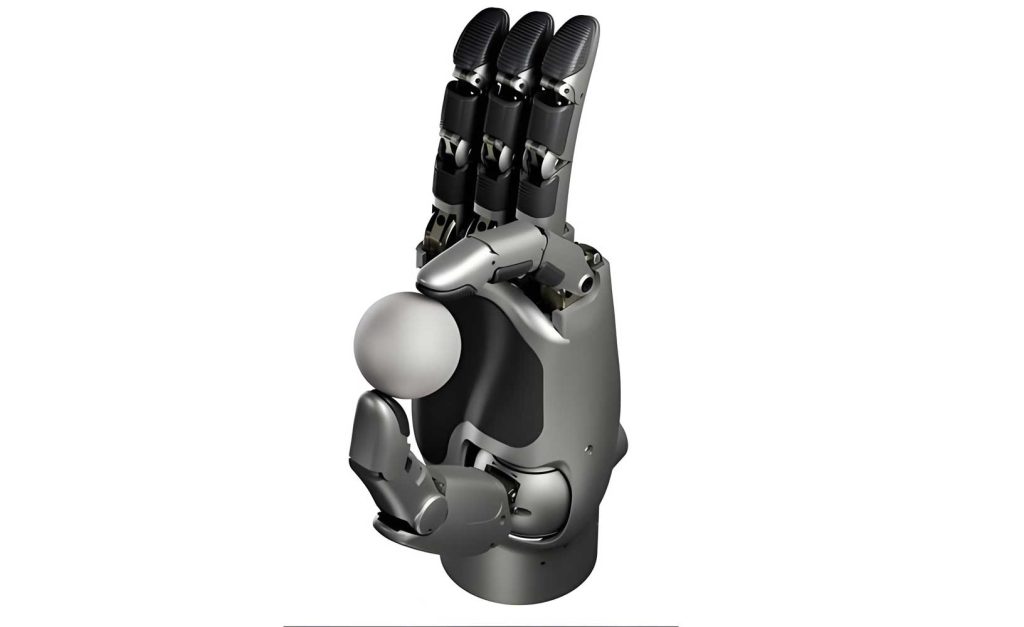
The most distinctive feature of this dexterous robotic hand is the mechanism for driving the second joint ($J_2$) of each finger. Inspired by the need for rhythmic, oscillatory motion in techniques like pinching, a crank-rocker four-bar linkage is integrated into each finger’s proximal link. The motor and crank are mounted on the first phalanx (link following $J_1$), which acts as the mechanism’s ground link. The rocker is rigidly connected to the second phalanx. As the motor rotates the crank continuously, the rocker (and hence the fingertip) oscillates through a fixed angle. This design offers major advantages: it naturally produces smooth, periodic oscillation perfect for massage rhythms; it protects the motor from the wear associated with frequent start-stop-reverse cycles; and it allows a compact, integrated design. The parameters for the linkage in the index finger are: Crank $l_1 = 3 \text{ mm}$, Coupler $l_2 = 22 \text{ mm}$, Rocker $l_3 = 12 \text{ mm}$, with ground link offsets $h_1 = 6 \text{ mm}$ and $h_2 = 18 \text{ mm}$. The swing angle $\theta_2$ of the rocker (which equals the PIP joint angle $\alpha_2$ or $\beta_2$) is a function of the crank input angle $\varphi$.
Kinematic Modeling and Position Analysis
A precise kinematic model is essential for controlling the dexterous robotic hand and planning its motions. The Denavit-Hartenberg (D-H) convention is applied to model the serial chain of each finger relative to the fixed palm coordinate frame {0}.
Thumb Kinematics
The D-H parameters for the thumb are established as follows:
| Link $i$ | $\theta_i$ | $d_i$ | $a_i$ | $\alpha_i$ |
|---|---|---|---|---|
| 1 | $\beta_1$ | $h_2$ | 0 | $-90^\circ$ |
| 2 | $\beta_2$ | $h_1$ | $d_1$ | $+90^\circ$ |
The homogeneous transformation from the palm frame {0} to the thumb’s fingertip frame {2} is:
$$ T_{02} = T_{01} \cdot T_{12} = \begin{bmatrix}
c\beta_1 c\beta_2 & -c\beta_1 s\beta_2 & s\beta_1 & d_1 c\beta_1 \\
s\beta_2 & c\beta_2 & 0 & h_2 \\
-s\beta_1 c\beta_2 & s\beta_1 s\beta_2 & c\beta_1 & -d_1 s\beta_1 \\
0 & 0 & 0 & 1
\end{bmatrix} $$
where $c\beta_i = \cos(\beta_i)$ and $s\beta_i = \sin(\beta_i)$. $d_1$ is the length of the thumb’s first phalanx. The position of the thumb fingertip $D$ in the palm frame is found by transforming its location in frame {2}, $^2D = [d_2, -h_2, 0, 1]^T$, where $d_2$ is the second phalanx length:
$$ ^0D = T_{02} \cdot \, ^2D = \begin{bmatrix}
d_1 c\beta_1 + d_2 c\beta_1 c\beta_2 + h_2 c\beta_1 s\beta_2 \\
h_2 – h_2 c\beta_2 + d_2 s\beta_2 \\
-d_1 s\beta_1 – d_2 s\beta_1 c\beta_2 – h_2 s\beta_1 s\beta_2 \\
1
\end{bmatrix} $$
Index Finger Kinematics
The three-finger group shares the same kinematics. Analyzing the index finger as representative, the D-H parameters are:
| Link $i$ | $\theta_i$ | $d_i$ | $a_i$ | $\alpha_i$ |
|---|---|---|---|---|
| 1 | $\alpha_1$ | $h_1$ | $a_1$ | $-90^\circ$ |
| 2 | $\alpha_2$ | $h_2$ | $a_2$ | $+90^\circ$ |
An initial offset $a_0$ along the palm’s y-axis is included. The composite transformation is:
$$ M_{02} = M_{01} \cdot M_{12} = \begin{bmatrix}
0 & 0 & -1 & 0 \\
c(\alpha_1-\alpha_2) & -s(\alpha_1-\alpha_2) & 0 & a_0 + a_1 c\alpha_1 – h_2 s\alpha_1 \\
-s(\alpha_1-\alpha_2) & -c(\alpha_1-\alpha_2) & 0 & -a_1 s\alpha_1 – h_2 c\alpha_1 \\
0 & 0 & 0 & 1
\end{bmatrix} $$
The position of the index fingertip $E$ in the palm frame, given $^2E = [a_2, -h_2, 0, 1]^T$, is:
$$ ^0E = M_{02} \cdot \, ^2E = \begin{bmatrix}
0 \\
a_0 + a_1 c\alpha_1 – h_2 s\alpha_1 + a_2 c(\alpha_1 + \alpha_2) + h_2 s(\alpha_1 + \alpha_2) \\
-a_1 s\alpha_1 – h_2 c\alpha_1 – a_2 s(\alpha_1 + \alpha_2) + h_2 c(\alpha_1 + \alpha_2) \\
1
\end{bmatrix} $$
Crank-Rocker Joint Relationship
The second joint angle ($\alpha_2$ or $\beta_2$) is not directly controlled but is the output of the four-bar linkage. For a crank input angle $\varphi$, the output rocker angle $\theta_2$ is derived from closed-loop geometry:
$$ \theta_2 = f(\varphi) = \frac{\pi}{2} – 2 \arctan\left( \frac{G + \sqrt{F^2 + G^2 – H^2}}{F – H} \right) + \gamma $$
where:
$$ F = l_4 – l_1 \cos(\varphi + \gamma), \quad G = -l_1 \sin(\varphi + \gamma) $$
$$ H = \frac{F^2 + G^2 + l_3^2 – l_2^2}{2 l_3}, \quad \gamma = \arctan\left(\frac{h_1}{h_2}\right), \quad l_4 = \sqrt{h_1^2 + h_2^2} $$
Thus, $\alpha_2 = \beta_2 = \theta_2 = f(\varphi)$, where $\varphi$ is the controlled motor angle.
Simulation and Performance Validation for Pinching Manipulation
The pinching technique (Nie Fa) is used as a representative case to validate the performance of the dexterous robotic hand. The manipulation involves the thumb pad opposing the pads of the index, middle, and ring fingers to squeeze a limb or muscle tissue rhythmically. The operational requirements are: a preparatory posture where the thumb is roughly perpendicular to the palm and the other fingers are partially flexed, followed by a rhythmic, opposed opening and closing of the thumb and finger group at a frequency of 60-120 cycles per minute.
For simulation, the dimensions of the dexterous robotic hand are set as: first phalanx length $a_1 = d_1 = 60 \text{ mm}$, second phalanx length $a_2 = d_2 = 32 \text{ mm}$, and thumb-index palm offset $a_0 = 75 \text{ mm}$. The motion profile is programmed in two phases:
Phase 1 (0-1 second): Posture configuration. The thumb’s MCP joint rotates at constant speed to $\beta_1 = 90^\circ$, positioning it perpendicular to the palm. Simultaneously, the three-finger MCP joints rotate to $\alpha_1 = 60^\circ$, creating the classic pincer shape.
Phase 2 (t > 1 second): Rhythmic pinching. The crank motors for the thumb ($\varphi_{\text{thumb}}$) and the three-finger group ($\varphi_{\text{index}}$) rotate continuously at 60 RPM. Their phases are set $180^\circ$ apart to produce opposed motion.
The relative displacement between the thumb tip ($^0D$) and the index tip ($^0E$) is the key metric, computed from the derived kinematic equations:
$$ \Delta_x = -\, ^0D_x $$
$$ \Delta_y = \, ^0E_y – \, ^0D_y $$
$$ \Delta_z = \, ^0E_z – \, ^0D_z $$
Substituting the joint angles ($\beta_1=\frac{\pi}{2}t$, $\alpha_1=\frac{\pi}{3}t$ for $t \in [0,1]$, and $\alpha_2=\beta_2=f(\varphi)$) into these equations yields the theoretical trajectory.
A dynamic model of the dexterous robotic hand was developed in Creo 3.0 and imported into ADAMS for motion simulation. The measured relative displacement curves from ADAMS were in perfect agreement with the curves generated via numerical computation of the above equations in MATLAB, confirming the accuracy of the kinematic model.
The results demonstrate that during Phase 1, the relative displacement has components in all three axes as the hand reconfigures. During Phase 2, the motion is confined primarily to the Y-Z plane (the pinching plane), with the X-component displacement oscillating around zero. The Y and Z displacements show clean, periodic oscillations at exactly 1 Hz (60 cycles per minute). This confirms that the dexterous robotic hand with its crank-rocker driven fingers can successfully generate the continuous, rhythmic, and opposed motion required for authentic pinching manipulation, meeting all prescribed kinematic requirements.
Conclusion and Future Perspective
This work presents the full-cycle development of a specialized dexterous robotic hand for robotic massage therapy. Moving beyond conventional rigid end-effectors, the design successfully integrates multiple fingers with four active degrees of freedom to achieve the postural configurations necessary for a wide range of TCM techniques. The innovative use of crank-rocker mechanisms for finger flexion is a significant contribution, providing inherent, motor-friendly periodicity ideal for therapeutic rhythms. The kinematic model, validated by simulation, provides a precise foundation for control and trajectory planning. This dexterous robotic hand represents a substantial step towards highly automated, multi-modal massage robots, promising greater consistency and accessibility in therapeutic applications. Future work will focus on the integration of force/tactile sensors for closed-loop impedance control, the development of robust control algorithms for seamless transition between manipulation techniques, and clinical trials to evaluate therapeutic efficacy compared to human practitioners.