
In the evolving landscape of home service robotics, the integration of dexterous robotic hands into domestic environments is becoming increasingly vital. Our research focuses on addressing the current limitations in pressure control for such systems, as studies in our region are still in early stages. Traditional robotic grippers, often relying on simple clamping mechanisms, fail to provide versatile grasping capabilities or real-time pressure modulation. The inherent complexity of a dexterous robotic hand, with each finger typically possessing three degrees of freedom and one driving degree, introduces significant uncertainty in finger positioning. This unpredictability is exacerbated during object grasping, where finger motions adapt to varied object geometries, and contact forces can arise at any point on the finger surfaces. Accurate measurement of these distributed contact forces remains a challenge with conventional methods. Consequently, we have designed and validated an intelligent pressure control system for a dexterous robotic hand utilizing Force Sensing Resistors (FSR), a development we believe holds substantial practical and research significance.
The fundamental concept of our pressure control system is to employ FSR sensors attached to each finger segment. These sensors convert mechanical force into resistance changes, which are then transformed into voltage variations via amplification circuits. A primary control microcontroller digitizes these voltage signals through analog-to-digital conversion (ADC) and transmits them to an upper computer (host PC). The host software compares the received data against pre-determined pressure thresholds to generate real-time control commands for the actuators (e.g., motors), thereby enabling adaptive and stable grasping. The overall control architecture is structured around this closed-loop feedback principle.
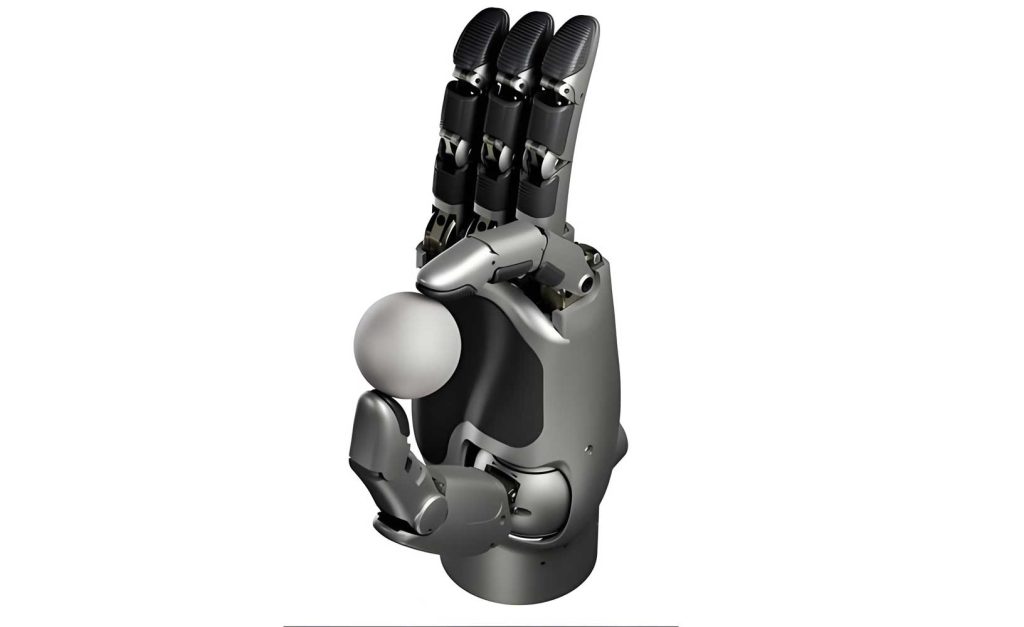
For clarity in design and discussion, we consider a three-fingered dexterous robotic hand model. Each finger is segmented into three phalanges: distal (fingertip), middle, and proximal (base). We assign a systematic numbering scheme: the thumb is finger 1, the middle finger is finger 2, and the little finger is finger 3. Correspondingly, the phalanges are numbered 1 (distal), 2 (middle), and 3 (proximal) for each finger. This nomenclature allows precise reference to each of the nine sensing points on the dexterous robotic hand.
| Finger Designation | Finger Number | Distal Phalanx (1) | Middle Phalanx (2) | Proximal Phalanx (3) |
|---|---|---|---|---|
| Thumb | 1 | 11 | 12 | 13 |
| Middle Finger | 2 | 21 | 22 | 23 |
| Little Finger | 3 | 31 | 32 | 33 |
The hardware design for each finger unit centers on the FSR sensors. All three phalanges share a common electrical ground, while each phalanx has a dedicated signal feedback path connected to an amplification circuit. This setup converts the resistance change of each FSR under pressure into a variable voltage signal. These analog voltage signals are fed into the microcontroller’s analog input pins. The onboard ADC module converts them into digital values, which are subsequently transmitted serially to the host PC. The host software performs threshold comparison and issues appropriate commands to the motor drives to achieve correct grasping force application. The signal feedback pathway for a single finger is essentially a voltage divider network where the FSR acts as the variable resistor.
We selected the FSR408 model from Interlink Electronics for this dexterous robotic hand application. This polymer thick-film device exhibits a decreasing resistance with increasing applied force, typically ranging from >1 MΩ (no load) to around 1 kΩ at maximum force. The FSR408 is supplied as a long strip (622.3 mm) that can be cut to custom lengths, making it adaptable to the different phalanx sizes of a dexterous robotic hand. Its nominal width is 15.24 mm with a thickness of 0.34 mm. The force sensitivity range is 0.1 N to 10.02 N, with an activation force of 0.1 N, which aligns well with the expected grasping force range of 0–5 N for our dexterous robotic hand. Key advantages include low cost, simplicity, and a maximum allowable current density of 1 mA/cm². To enhance performance and durability, we applied a stepped rubber foam layer atop each sensor. The central, taller foam layer efficiently transmits force to the active sensor area, while the surrounding lower foam provides cushioning against excessive pressure and helps concentrate force within the sensor’s effective zone.
| Phalanx Type | FSR Length (mm) | Effective Width (mm) | Effective Area (cm²) | Max Allowable Current (mA) |
|---|---|---|---|---|
| Distal (Fingertip) | 16.0 | 5.08 | 0.813 | 0.813 |
| Middle | 16.0 | 5.08 | 0.813 | 0.813 |
| Proximal (Base) | 16.0 | 5.08 | 0.813 | 0.813 |
Characterizing the Force-Resistance (F-R) relationship of the integrated FSR sensors is crucial for calibration. We applied calibrated weights (simulating force) to each sensorized phalanx and measured the corresponding resistance. Data was collected at an ambient temperature of 23°C. The F-R curves for corresponding phalanges across different fingers of the dexterous robotic hand were plotted and analyzed.
The generalized behavior can be modeled. For forces above approximately 1.96 N (200g weight), the relationship is largely linear. We can express this as:
$$ R_{FSR}(F) = R_0 – k \cdot F \quad \text{for} \quad F \geq F_{min} $$
where \( R_{FSR} \) is the sensor resistance in ohms (Ω), \( F \) is the applied force in Newtons (N), \( R_0 \) is the extrapolated resistance at zero force in the linear region, \( k \) is the sensitivity coefficient in Ω/N, and \( F_{min} \) is the lower limit of the linear region (~1.96 N). Below \( F_{min} \), the resistance is very high and non-linear. The total theoretical gripping force for the nine-phalanx dexterous robotic hand, assuming uniform force distribution, is \( 9 \times 1.96\,\text{N} = 17.64\,\text{N} \). For a vertical grasp where gripping force is perpendicular to gravity, with a static friction coefficient μ of 0.6, the maximum holdable mass \( m \) is given by:
$$ m \cdot g = \mu \cdot F_{total} $$
$$ m = \frac{\mu \cdot F_{total}}{g} = \frac{0.6 \times 17.64}{9.8} \approx 1.08\,\text{kg} $$
where \( g = 9.8\,\text{m/s}^2 \). In practice, the dexterous robotic hand can grasp lighter objects because force is not uniformly distributed; some phalanges may not contact the object. Our operational target for maximum object mass was set at 500g, which keeps the FSR resistance within a manageable 2–4 kΩ range. Variations in the F-R characteristics were observed due to temperature and slight differences in the effective sensor area despite our standardization efforts. Furthermore, the sensor response is influenced by the contactor’s geometry, with sharp edges potentially causing measurement anomalies compared to flat or curved surfaces.
The signal transmission from the dexterous robotic hand’s fingers to the processing unit is implemented using a multi-conductor cable. For each finger, four wires are used: one common ground for all three phalanges and three signal wires (one per phalanx). This approach minimizes weight and complexity by avoiding individual PCBs at each joint, relying instead on robust soldering within the finger assembly.
The core of the signal conditioning hardware is a two-stage operational amplifier (op-amp) circuit designed to convert the FSR resistance change into a scaled voltage signal compatible with the microcontroller’s ADC input range (0-3.3V or 0-5V). The system is powered by a 5V regulated supply. The primary design constraint is to keep the current through any FSR below its maximum rating \( I_{max} = 0.813\,\text{mA} \).
First-Stage Amplifier (Voltage Reference): A voltage divider followed by a unity-gain buffer (voltage follower) generates a stable, low-voltage reference \( U_{in} \) to excite the FSR. The circuit ensures:
$$ U_{in} = U_{supply} \cdot \frac{R_2}{R_1 + R_{F1}} $$
where \( U_{supply} = 5\,\text{V} \), \( R_1 = 4.5\,\text{kΩ} \), \( R_2 = 1\,\text{kΩ} \), and \( R_{F1} \) is a tunable potentiometer. To limit \( I_{FSR} \) and set \( U_{in} = 0.5\,\text{V} \), we solve:
$$ 0.5 = 5 \cdot \frac{1000}{4500 + R_{F1}} $$
$$ R_{F1} = 5.5\,\text{kΩ} \quad \text{(Theoretical)} $$
A 10 kΩ potentiometer for \( R_{F1} \) allows adjustment to the desired value, experimentally found to be around 5.2 kΩ.
Second-Stage Amplifier (Signal Amplification): This stage uses an inverting amplifier configuration to scale the voltage drop across the FSR. The output voltage \( U_{out} \) is given by:
$$ U_{out} = – U_{in} \cdot \frac{R_{F2}}{R_{FSR}} $$
Since \( U_{in} \) is fixed at 0.5V and \( R_{FSR} \) decreases with force, \( U_{out} \) magnitude increases with force. A potentiometer \( R_{F2} \) (10 kΩ) is included to fine-tune the gain for each phalanx, compensating for minor variations in FSR strip length and characteristics to achieve consistent Force-Voltage (F-U) curves across all nine sensors on the dexterous robotic hand. The negative sign indicates phase inversion, which is handled digitally. We target a maximum \( U_{out} \) of around 3.8V when the dexterous robotic hand applies force corresponding to a 500g object, ensuring good resolution for the 10-bit ADC.
| Phalanx Identifier | Potentiometer \( R_{F2} \) Adjusted Value (kΩ) |
|---|---|
| 11 (Thumb Distal) | 8.2 |
| 12 (Thumb Middle) | 7.5 |
| 13 (Thumb Proximal) | 8.8 |
| 21 (Middle Finger Distal) | 8.1 |
| 22 (Middle Finger Middle) | 7.4 |
| 23 (Middle Finger Proximal) | 8.7 |
| 31 (Little Finger Distal) | 8.3 |
| 32 (Little Finger Middle) | 7.6 |
| 33 (Little Finger Proximal) | 8.9 |
The calibrated Force-Voltage (F-U) characteristics were measured after circuit adjustment. For forces above 1.96 N, the relationship is linear. The sensitivity \( S \) (voltage change per unit force) varies slightly by phalanx type due to mechanical differences in the dexterous robotic hand structure. It can be expressed as:
$$ U_{out}(F) = U_0 + S \cdot F $$
where \( U_0 \) is the output voltage at the minimum linear force. Approximate sensitivities derived from our data are: \( S_{distal} \approx 0.3\,\text{V/100g} \), \( S_{middle} \approx 0.4\,\text{V/100g} \), and \( S_{proximal} \approx 0.28\,\text{V/100g} \). Therefore, the applied force can be estimated from the ADC reading \( V_{ADC} \) (proportional to \( U_{out} \)) as:
$$ F = \frac{V_{ADC} \cdot K_{conv} – U_0}{S} $$
where \( K_{conv} \) is the conversion factor from ADC counts to voltage.
The software control system is implemented on a dsPIC30F6010A microcontroller, chosen for its integrated 10-bit ADC, multiple analog channels, and UART modules. The nine analog voltage signals from the dexterous robotic hand’s phalanges are connected to pins AN3 through AN11 (using AN0-AN2 for other functions). The ADC is configured in auto-scanning mode to sequentially sample all nine channels. After each complete set of nine conversions, an interrupt service routine (ISR) is triggered. The ISR reads the conversion results from registers ADCBUF0 to ADCBUF8, packages them into a data frame, and transmits the frame via UART to the host PC at a baud rate of 115200. The data frame structure includes start and end delimiters (0xFE and 0xFD) for synchronization. The host PC software, developed in a high-level language, continuously parses incoming frames, extracts the nine pressure values, and compares each against its predefined threshold. Based on the comparison logic (e.g., PID control or state machine), the host sends motor control commands back to the microcontroller via the same serial link, completing the real-time control loop for the dexterous robotic hand.
The main program flow on the microcontroller initializes peripherals (ADC, UART, Timers), configures interrupts, and then enters a low-power idle loop, waiting for ADC scan completion interrupts or UART receive commands. This event-driven architecture ensures responsive and efficient operation of the dexterous robotic hand control system.
We conducted extensive experimental validation on the developed dexterous robotic hand pressure control system. Initial tests involved applying known forces to individual phalanges and monitoring the serial output. For example, applying pressure to phalanx 11 (thumb distal) yielded ADC values corresponding to output voltages of 2.6V and 1.4V for different force levels, as expected from the calibration curve. The host software successfully displayed and logged these values in real-time.
Comprehensive object grasping experiments were performed with various everyday items (e.g., plastic cup, marker pen, small ball, block). For each grasp, the steady-state ADC values (proportional to voltage/force) for all contacting phalanges were recorded over 100 trials to compute average values. The dexterous robotic hand demonstrated the ability to adapt its grip force based on the feedback, preventing slip or excessive force that could damage delicate objects. A subset of the results is summarized below.
| Object (Mass) | Grasp Type | Contacting Phalanges (Identifier) | Average ADC Value (Hex) | Estimated Voltage (V) | Estimated Force per Phalanx (N) |
|---|---|---|---|---|---|
| Plastic Cup (50g) | Power Grasp | 11, 13, 21, 23, 31, 33 | 1A | 2.6 | ~2.2 |
| Marker Pen (20g) | Precision Grasp | 11, 21, 31 | 0E | 1.4 | ~1.0 |
| Rubber Ball (100g) | Enveloping Grasp | All 9 phalanges | 10-18 | 1.6-2.4 | ~1.3-1.9 |
| Wooden Block (200g) | Lateral Grasp | 12, 22, 32 | 20 | 3.2 | ~3.0 |
The system exhibited key performance attributes essential for a functional dexterous robotic hand. Measurement Accuracy: The linear F-U relationship in the operational force range provided consistent and repeatable readings. The 10-bit ADC resolution offered a force resolution better than 0.05 N per phalanx. Response Speed: The combined hardware response (FSR time constant < 5ms) and software cycle (complete ADC scan and transmission < 10ms) enabled a control bandwidth sufficient for quasi-static and slow dynamic grasping tasks. Environmental Adaptability: While FSR characteristics are temperature-sensitive, the use of individual gain calibration potentiometers (\( R_{F2} \)) allowed for on-site compensation. The stepped foam layer also improved consistency across different contact geometries, enhancing the dexterous robotic hand’s ability to handle diverse objects. The primary limitation identified was the non-linearity and high resistance at very low forces (< 1.96 N), which could be addressed in future iterations by using FSR models with a lower activation threshold or implementing non-linear digital compensation curves.
Further mathematical analysis of the system’s stability and sensitivity can be conducted. The control loop essentially implements a discrete-time feedback system. Let \( F_d[k] \) be the desired force vector for all phalanges at time step \( k \), and \( F_m[k] \) be the measured force vector from the FSRs. The error vector \( e[k] = F_d[k] – F_m[k] \) is computed by the host. A simple proportional control law for the motor command \( u[k] \) could be:
$$ u[k] = K_p \cdot e[k] $$
where \( K_p \) is a diagonal gain matrix. Considering the actuator dynamics and the force-displacement relationship of the dexterous robotic hand fingers, a more advanced controller (e.g., PID, impedance control) would be beneficial for dynamic interaction. The sensitivity of the output voltage to changes in force, from the combined sensor and circuit, is a critical parameter. Differentiating the overall transfer function:
$$ \frac{dU_{out}}{dF} = \frac{d}{dF} \left( U_{in} \cdot \frac{R_{F2}}{R_{FSR}(F)} \right) = – U_{in} \cdot R_{F2} \cdot \frac{1}{[R_{FSR}(F)]^2} \cdot \frac{dR_{FSR}}{dF} $$
Given \( \frac{dR_{FSR}}{dF} = -k \) in the linear region, we get:
$$ \frac{dU_{out}}{dF} = U_{in} \cdot R_{F2} \cdot \frac{k}{[R_0 – kF]^2} $$
This shows that the sensitivity increases as the applied force \( F \) increases (since \( R_{FSR} \) decreases), which is desirable for detecting small force changes at higher preloads during stable grasping with the dexterous robotic hand.
In conclusion, the design and implementation of this FSR-based pressure control system represent a significant step towards enabling sophisticated manipulation capabilities for dexterous robotic hands. The system successfully addresses the challenge of real-time, distributed contact force measurement through a practical integration of commercial FSR sensors, custom analog conditioning electronics, and microcontroller-based digital processing. The experimental results confirm its functionality in accurate force measurement, fast response, and adaptive grasping. While there is room for improvement in linearity at low forces and long-term durability, the presented approach offers a cost-effective and reliable solution. Future work will focus on integrating more advanced control algorithms, miniaturizing the electronics for embedded placement within the dexterous robotic hand structure, and conducting long-term reliability tests in varied environmental conditions. The continued development of such sensory feedback systems is paramount for realizing truly autonomous and versatile dexterous robotic hands capable of complex interactions in human-centric environments.