
In the field of robotics, the development of a dexterous robotic hand that mimics human hand capabilities has long been a focal point of research. Traditional dexterous robotic hands often rely on complex driving transmission mechanisms and control methods, which limit their compliance and adaptability in unstructured environments. To address these challenges, I propose a novel design and control approach for a five-fingered dexterous robotic hand based on rigid-flexible coupling principles, leveraging soft robotics technology. This work aims to simplify the mechanical structure and control of the dexterous robotic hand while enhancing its grasping compliance and stability.
The human hand exhibits remarkable dexterity and adaptability, enabling a wide range of grasping and manipulation tasks. Inspired by this, my design integrates pneumatic soft fingers with rigid palm and wrist joints, creating a hybrid dexterous robotic hand with eight degrees of freedom. This approach balances flexibility and precision, allowing for compliant interactions with objects. The dexterous robotic hand is designed to achieve human-like motions, such as multi-finger opposition and delicate grasping, without the need for intricate mechanisms. In this article, I will detail the structural design, control system, and experimental validation of this dexterous robotic hand, emphasizing its potential in applications like prosthetics, collaborative robots, and service robotics.
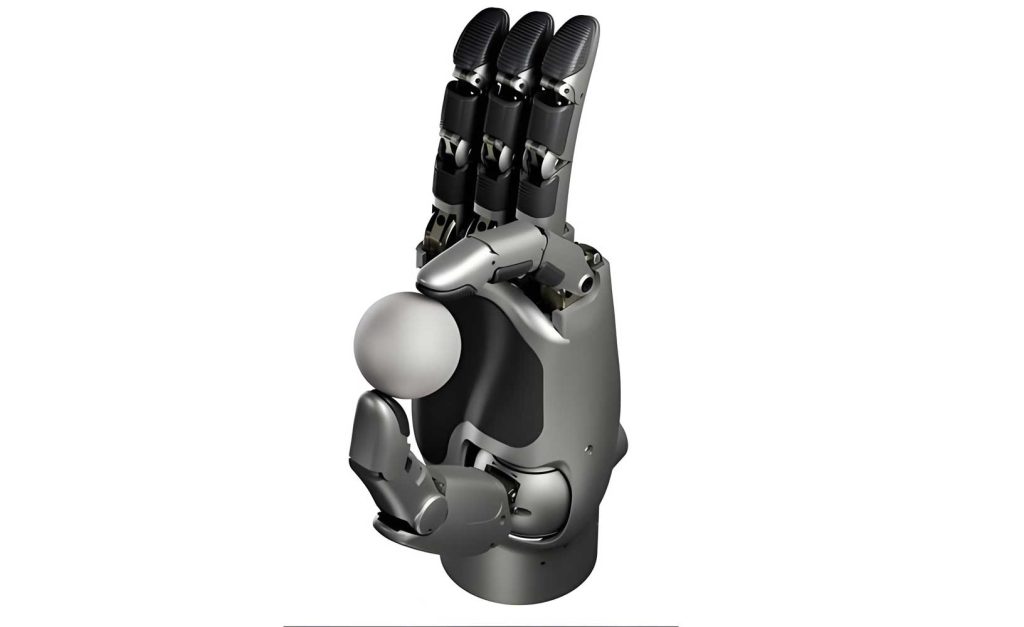
The core innovation lies in the rigid-flexible coupling architecture, which combines the benefits of soft actuators for compliance and rigid joints for precise motion. This dexterous robotic hand features five pneumatic soft fingers, each designed to mimic the bending kinematics of human fingers. By discretizing the restraining layers with carbon fiber plates, the soft fingers exhibit joint-like segments during flexion, closely resembling the human finger morphology. The pneumatic actuation provides inherent compliance, allowing the dexterous robotic hand to adapt to object shapes passively. Meanwhile, the rigid palm joint enables thumb opposition through two rotational degrees of freedom, and the rigid wrist joint offers an additional rotational degree for enhanced manipulation. This design simplifies the overall structure of the dexterous robotic hand, reducing weight and complexity compared to traditional fully actuated hands.
To quantify the performance of the soft fingers, I conducted experiments to characterize their bending angle and load capacity. The bending angle $\theta$ as a function of internal pressure $P$ can be modeled using the following empirical equation derived from experimental data:
$$ \theta(P) = \alpha \cdot P^2 + \beta \cdot P + \gamma $$
where $\alpha$, $\beta$, and $\gamma$ are constants determined through curve fitting. For instance, at a maximum pressure of 100 kPa, the soft finger achieves a bending angle of approximately 190°, with a minimum inscribed circle diameter of 28 mm. The load capacity $F$ at full flexion can be expressed as:
$$ F(P) = k \cdot P $$
where $k$ is a proportionality constant related to the finger’s material properties and geometry. In tests, the dexterous robotic hand’s soft fingers could lift a 200 g weight, demonstrating sufficient force for everyday grasping tasks. These characteristics make the dexterous robotic hand suitable for compliant and stable interactions.
The rigid palm joint of the dexterous robotic hand is designed to provide opposition capabilities, essential for human-like grasping. It consists of two rotational joints: a trapezometacarpal (TM) joint and a metacarpophalangeal (MP) joint. The forward kinematics of this two-link chain can be described using homogeneous transformation matrices. Let $\theta$ represent the rotation angle of the TM joint (link 1) about the $z_1$-axis, and $\gamma$ represent the rotation angle of the MP joint (link 2) about the $z_2$-axis. The transformation from the base frame to the end-effector (thumb tip) is given by:
$$ A^0_2 = A^0_1 A^1_2 $$
where $A^0_1$ and $A^1_2$ are the transformation matrices for the TM and MP joints, respectively. These matrices are defined as:
$$ A^0_1 = R_z(\theta) R_x(-\alpha) $$
$$ A^1_2 = R_y(\gamma) R_x(-\beta) $$
Here, $R_z$, $R_x$, and $R_y$ are rotation matrices about the z, x, and y axes, and $\alpha$ and $\beta$ are fixed angles based on the joint geometry. The position vector $\mathbf{e}$ of the thumb tip in the base frame is:
$$ \mathbf{e} = l_1 \mathbf{e}_0 + l_2 \mathbf{e}_3 $$
where $l_1$ and $l_2$ are the link lengths, $\mathbf{e}_0$ is the z-axis vector of $A^0_1$, and $\mathbf{e}_3$ is the third column vector of $A^0_2$. Substituting the values, the workspace of the thumb can be plotted, showing effective coverage for opposition movements. This kinematic analysis ensures that the dexterous robotic hand can achieve various grasping postures.
The rigid wrist joint of the dexterous robotic hand incorporates a gear transmission system to provide rotational motion while allowing passage for pneumatic tubes and wires. Its design focuses on compactness and high torque output. The torque $\tau$ generated by the wrist joint can be approximated as:
$$ \tau = \eta \cdot N \cdot \tau_m $$
where $\eta$ is the gear efficiency, $N$ is the gear ratio, and $\tau_m$ is the motor torque. With a gear ratio optimized for speed reduction, the wrist joint achieves a locking torque of 5.2 kg·cm and a stall torque of 6.3 kg·cm, enabling stable manipulation of objects. The integration of this joint enhances the overall dexterity of the dexterous robotic hand, allowing for orientations that mimic human wrist movements.
The control system for the dexterous robotic hand is a critical component that ensures precise and stable operation. It comprises a pneumatic drive subsystem and a control subsystem, working together to regulate finger pressure and joint motions. The pneumatic subsystem includes pumps, valves, and pressure sensors, capable of independently controlling the pressure in each soft finger from 0 to 100 kPa. The control subsystem implements a feedback strategy based on bang-bang control to maintain pressure stability and resist disturbances. The control law for each finger is defined as:
$$ s(t) =
\begin{cases}
\text{output inflation signal}, & \text{if } e(t) < i(t) – \text{band} \\
\text{output deflation signal}, & \text{if } e(t) > i(t) + \text{band} \\
\text{output keeping signal}, & \text{otherwise}
\end{cases} $$
where $s(t)$ is the control signal, $e(t)$ is the actual pressure, $i(t)$ is the desired pressure, and $\text{band}$ is the allowable error margin set to 1.5 kPa. This approach enables rapid response and minimal overshoot, crucial for the compliant grasping of the dexterous robotic hand. The system communicates with an upper computer via USB, allowing for real-time command transmission and data logging.
To validate the performance of the dexterous robotic hand, I conducted three sets of experiments: multi-finger opposition, dexterous grasping based on a standard test set, and practical manipulation tasks. The opposition experiments demonstrated the hand’s ability to achieve thumb-to-finger contacts, such as index, middle, ring, and little finger opposition. During these tests, the pressure in each soft finger was monitored to assess stability. The results are summarized in Table 1, showing that the actual pressures deviated by less than 0.8 kPa from the desired values, with standard deviations below 0.6 kPa. This confirms the effectiveness of the control system in maintaining pressure stability for the dexterous robotic hand.
| Experiment | Thumb | Index Finger | Middle Finger | Ring Finger | Little Finger |
|---|---|---|---|---|---|
| Index Opposition | 29.4 ± 0.5 | 30.7 ± 0.3 | 0.3 ± 0.0 | 0.5 ± 0.1 | 0.3 ± 0.0 |
| Middle Opposition | 29.3 ± 0.4 | 0.3 ± 0.1 | 34.9 ± 0.6 | 0.3 ± 0.1 | 0.3 ± 0.1 |
| Ring Opposition | 29.6 ± 0.5 | 0.4 ± 0.0 | 0.3 ± 0.1 | 37.7 ± 0.5 | 0.5 ± 0.0 |
| Little Opposition | 29.4 ± 0.7 | 0.2 ± 0.0 | 0.3 ± 0.0 | 0.2 ± 0.1 | 45.8 ± 0.4 |
The dexterous grasping experiments involved replicating 33 grasp types from the GRASP taxonomy, which classifies human hand grasps. The dexterous robotic hand successfully achieved 30 of these grasps, including precision grips like pinch and power grips like wrap. This versatility highlights the hand’s adaptability to various object shapes and sizes. For instance, in a precision grasp, the soft fingers conform to small objects without excessive force, while in a power grasp, they envelop larger items securely. The compliance of the dexterous robotic hand allows it to passively adjust to object geometry, reducing the need for complex control algorithms. Table 2 provides a summary of the grasp types achieved, along with key parameters such as required finger pressures and joint angles.
| Grasp Type | Description | Average Pressure (kPa) | Thumb Angle (°) | Wrist Angle (°) |
|---|---|---|---|---|
| Pinch | Tip-to-tip contact for small objects | 25-30 | 15-30 | 0 |
| Palmar | Object held against palm | 40-60 | 45-60 | 10-20 |
| Lateral | Side-of-finger grip | 20-25 | 10-20 | 5-15 |
| Wrap | Enveloping grasp for large objects | 70-100 | 60-90 | 20-30 |
The manipulation experiment involved grasping a 500 g water bottle and performing a pouring task. This test assessed the synergy between the soft fingers and rigid joints, as well as the hand’s load capacity and stability. During the task, the pressure in the soft fingers was controlled using the bang-bang feedback strategy, and the wrist joint rotated to tilt the bottle. The pressure variations over time were recorded and compared to an open-loop control strategy. The results, illustrated in Figure 1, show that the feedback control reduced pressure fluctuations to within 3 kPa during wrist movement and maintained steady pressure when idle. In contrast, the open-loop strategy exhibited a pressure drop of 7 kPa due to leakage. This demonstrates the robustness of the control system in the dexterous robotic hand, ensuring reliable performance in dynamic scenarios.
The performance metrics of the dexterous robotic hand components are consolidated in Table 3. These parameters underscore the hand’s lightweight design and functional capabilities, making it suitable for integration into robotic systems. The soft fingers weigh only a few grams each, while the entire hand system remains compact. The dexterous robotic hand’s ability to combine compliance with precision opens up new possibilities for human-robot interaction and automated manipulation.
| Component | Weight (g) | Range of Motion | Max Load/ Torque | Key Feature |
|---|---|---|---|---|
| Soft Finger | ~5 | Bending up to 190° | 200 g | Discrete restraining layers |
| Palm Joint | 43.9 | θ: 105°, γ: 95° | 5.2 N | Two-DOF opposition |
| Wrist Joint | 109.8 | Rotation 360° | 6.3 kg·cm | Integrated gear system |
| Control System | 88.0 | Pressure 0-100 kPa | 20 Hz valve frequency | Bang-bang feedback |
From a theoretical perspective, the dynamics of the dexterous robotic hand can be modeled using Lagrangian mechanics to analyze energy efficiency and motion planning. For a soft finger under pneumatic actuation, the strain energy $U$ due to inflation can be approximated as:
$$ U = \frac{1}{2} \int_V \sigma \epsilon \, dV $$
where $\sigma$ is the stress tensor and $\epsilon$ is the strain tensor, both dependent on the internal pressure and material properties. This energy formulation helps in optimizing the finger design for maximum bending with minimal pressure. Similarly, the rigid joints follow standard robotic dynamics equations. The overall dynamic model of the dexterous robotic hand can be expressed as:
$$ \mathbf{M}(\mathbf{q}) \ddot{\mathbf{q}} + \mathbf{C}(\mathbf{q}, \dot{\mathbf{q}}) \dot{\mathbf{q}} + \mathbf{G}(\mathbf{q}) = \boldsymbol{\tau} $$
where $\mathbf{q}$ is the vector of joint angles, $\mathbf{M}$ is the mass matrix, $\mathbf{C}$ accounts for Coriolis and centrifugal forces, $\mathbf{G}$ represents gravitational forces, and $\boldsymbol{\tau}$ is the torque vector from actuators. This model is useful for simulating the hand’s behavior and refining control strategies. However, due to the complexity introduced by soft actuators, simplified models are often employed in practice for the dexterous robotic hand.
In terms of control theory, the bang-bang strategy used for pressure regulation is a form of variable structure control. Its stability can be analyzed using Lyapunov functions. For the pressure error $e(t) = i(t) – e(t)$, consider a Lyapunov candidate $V = \frac{1}{2} e^2$. The derivative $\dot{V}$ is negative definite when the control law switches appropriately, ensuring convergence to the desired pressure band. This theoretical guarantee supports the empirical stability observed in experiments for the dexterous robotic hand. Additionally, the integration of rigid joint control with pressure control can be framed as a hybrid system, where continuous dynamics (pressure changes) interact with discrete events (valve switching). This hybrid approach enhances the adaptability of the dexterous robotic hand in uncertain environments.
The design philosophy behind this dexterous robotic hand emphasizes modularity and scalability. Each soft finger can be easily replaced or reconfigured, and the rigid joints use standard components for maintainability. This makes the dexterous robotic hand a platform for further research into soft-rigid hybrid systems. Potential improvements include embedding sensors for tactile feedback or using variable stiffness materials to adjust compliance on demand. Such advancements could lead to next-generation dexterous robotic hands with even greater versatility.
In conclusion, the rigid-flexible coupling dexterous robotic hand presented in this work demonstrates a significant step forward in robotic manipulation. By combining pneumatic soft fingers with rigid palm and wrist joints, it achieves a balance of compliance and precision that simplifies control and enhances grasping adaptability. The bang-bang feedback control system ensures stable pressure regulation, enabling reliable performance in various tasks. Experimental results confirm the hand’s ability to perform multi-finger opposition, dexterous grasping, and practical manipulation, validating its design and control approach. This dexterous robotic hand offers a promising solution for applications requiring human-like dexterity, and future work will focus on integrating sensory feedback and advanced learning algorithms to further improve its autonomy and functionality.