
The development of anthropomorphic multi-fingered dexterous robotic hands is a cornerstone of advanced robotics, holding significant promise for applications ranging from prosthetics for amputees to sophisticated manipulation in humanoid robots. These systems, which mimic the human hand’s multi-jointed structure, are capable of executing complex grasping and in-hand manipulation tasks. However, this dexterity comes with considerable engineering challenges, primarily centered around actuation and control. Traditional actuation methods each present significant drawbacks: purely motor-driven systems, while offering precise control, often result in complex, bulky, and heavy designs when multiple motors are required for each degree of freedom. Hydraulic systems can deliver high force but are typically large and require extensive ancillary equipment. Pneumatic systems, though capable of compliant actuation, present difficulties in achieving fine control and require a compressed air source.
To overcome these limitations, a novel composite actuation paradigm is proposed. This system synergistically combines a micro disc-type brushless DC motor with a thermally controlled Shape Memory Alloy (SMA) spring actuator. This hybrid approach leverages the precise, fast, and easily controllable nature of the electric motor with the simple, lightweight, and high force-to-weight ratio characteristics of the SMA spring. By applying this composite drive system to the fingers of an anthropomorphic dexterous robotic hand, the overall mechanical complexity is substantially reduced, the total mass is decreased, and the control architecture is simplified and optimized. The dexterous robotic hand’s functionality is thus enhanced through a more biomimetic and efficient design.
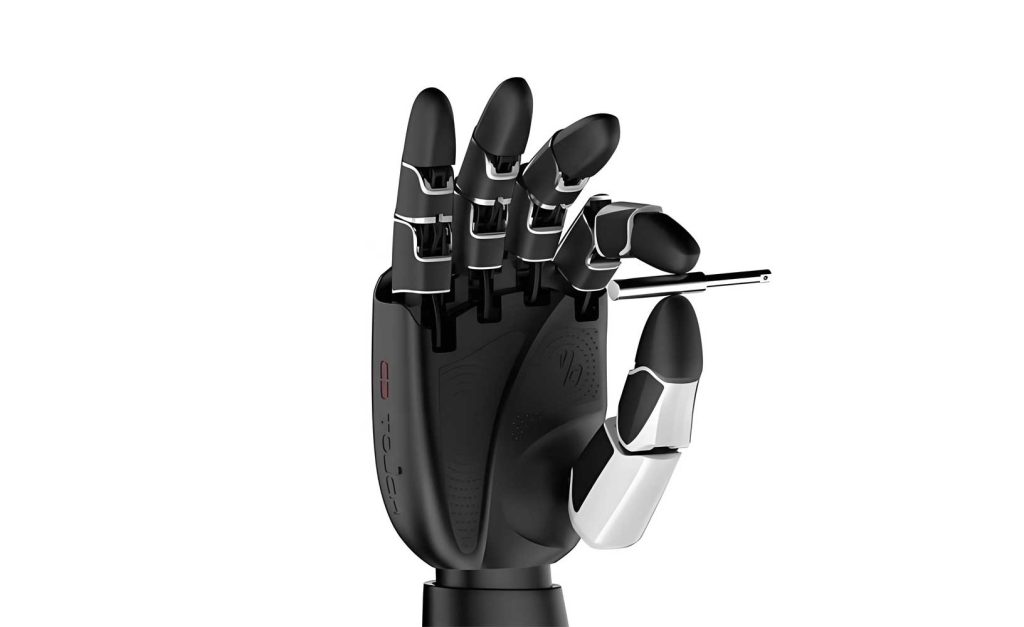
This work delves into the core mechanics and control of such a system. It investigates the relationship between the restoring force and working displacement of the SMA spring, a critical non-linear characteristic. A comprehensive static analysis of the finger mechanism is performed, establishing the kinematic transformation between finger segments and identifying the key factors influencing the contact force during object grasping. To manage the non-linearities and ensure coordinated motion, an intelligent control strategy blending Sliding Mode Control (SMC) and Proportional-Integral-Derivative (PID) control is implemented. Finally, dynamic simulations of the multi-fingered dexterous robotic hand model are conducted to validate the feasibility and performance of the proposed composite actuation approach, laying a solid foundation for its further development and application.
1. Composite Actuation System for the Dexterous Robotic Hand
The proposed dexterous robotic hand is an evolution of existing tendon-driven designs. Its most significant innovation lies in the actuation of the four fingers (index, middle, ring, and little). Each of these fingers utilizes a single SMA spring as the primary actuator for flexion. This spring is connected to a tendon routed along the finger. When electrically heated, the SMA spring contracts, pulling the tendon and generating a flexion torque at each joint the tendon crosses. This elegantly simple design eliminates the need for motors, gearboxes, or other complex transmission elements for these fingers, dramatically reducing part count, weight, and complexity compared to a fully motorized dexterous robotic hand.
Each finger consists of three phalanges (distal, medial, proximal) forming three revolute joints, analogous to the human finger’s DIP, PIP, and MCP joints. A passive extension spring is housed within each phalange. Upon cessation of the SMA spring’s thermal activation and subsequent cooling, the stored energy in these extension springs provides the force to return the finger to its extended state. This creates a self-contained, single-tendon, antagonistic actuation system for each of the four fingers, constituting a compact active (SMA) / passive (extension spring) composite drive.
The stiffness of the extension springs is not uniform. To mimic the natural curling motion of a human finger and to maximize the dexterous robotic hand’s functional workspace, the spring constants are carefully tuned. A specific ratio is adopted: $K_{distal} = K_{medial} = 1.56 \cdot K_{proximal}$. This configuration ensures a biologically inspired, orderly flexion sequence: upon tendon pull, the proximal joint bends first, followed by the medial and then the distal joint.
The thumb requires more complex functionality, including abduction/adduction for opposition. Therefore, its design incorporates a different composite strategy. It features four joints: an additional abduction/adduction joint at the base, followed by the three flexion/extension joints. The abduction/adduction joint is actively driven by a micro DC motor through a reducer and a bevel gear pair. A torsion spring connects the output gear to the thumb’s mounting bracket. Initially, motor rotation drives the thumb into an opposed position (adduction) with minimal flexion. Once a mechanical limit is reached, continued motor torque overcomes the torsion spring’s preload, and the motor begins to actuate the flexion tendon, causing the three finger segments to curl in the prescribed sequence. The extension of these three joints is again passive, driven by internal extension springs. Thus, the thumb implements a single-motor-driven, active/active-passive composite system capable of coordinated multi-joint movement, a crucial feature for a fully functional dexterous robotic hand.
| Finger | Primary Actuator (Flexion) | Secondary Actuator (Extension) | Joints Actuated | Actuation Type |
|---|---|---|---|---|
| Index, Middle, Ring, Little | SMA Spring (One per finger) | Passive Extension Springs | 3 Flexion/Extension | Single-Tendon, Active/Passive Composite |
| Thumb | Micro DC Motor (One for thumb) | Passive Extension Springs + Torsion Spring | 1 Abduction/Adduction + 3 Flexion/Extension | Single-Motor, Active/Active-Passive Composite |
2. Static Analysis and Force Modeling
A rigorous static analysis is essential for understanding the force transmission, grasping capabilities, and design requirements of the dexterous robotic hand. We begin with the force-displacement characteristics of the SMA spring actuator.
2.1. Shape Memory Alloy Spring Mechanics
The restoring force $F$ generated by an SMA spring is a function of its working displacement $\lambda$ and its temperature-dependent material properties. The fundamental relationship is given by:
$$ F = \frac{\lambda G d^4}{8 D^3 n} $$
where:
- $D$ is the mean coil diameter of the spring.
- $G$ is the shear modulus of the SMA material.
- $d$ is the diameter of the spring wire.
- $n$ is the number of active coils.
- $\lambda$ is the working displacement (contraction).
The critical factor is the shear modulus $G$, which varies significantly with temperature $T$ during the phase transformation between martensite (M) and austenite (A) phases:
$$
G(T) =
\begin{cases}
G_M, & T < A_s \\
G_{\xi}, & A_s \leq T \leq A_f \\
G_A, & T > A_f
\end{cases}
$$
Here, $A_s$ and $A_f$ are the austenite start and finish temperatures, respectively. $G_A$ and $G_M$ are the shear moduli in pure austenite and martensite phases, related to their Young’s moduli $E_A$, $E_M$ and Poisson’s ratio $\mu$:
$$ G_A = \frac{E_A}{2(1+\mu)}, \quad G_M = \frac{E_M}{2(1+\mu)} $$
For a NiTi alloy, typical values are $E_A = 45.9 \text{ GPa}$, $E_M = 17.1 \text{ GPa}$, and $\mu \approx 0.3$. The transition can be modeled by a continuous approximation:
$$ G(T) = G_M + \frac{G_A – G_M}{2} \left[ 1 + \sin\left( \frac{\pi}{A_f – A_s} \left( T – \frac{A_s + A_f}{2} \right) \right) \right] $$
This non-linear relationship makes the force $F$ a function of both displacement $\lambda$ and temperature $T$, which is the primary control input: $F = F(\lambda, T)$. The graph of this function shows that for a given displacement, the force increases dramatically as the SMA transforms to austenite, providing the powerful contraction needed for the dexterous robotic hand.
2.2. Finger Kinematics and Statics
We model one of the four fingers (index, middle, ring, little) as a planar 3R serial chain. The following parameters are defined for each joint $i$ (where $i=1$: proximal, $i=2$: medial, $i=3$: distal):
- $\theta_i$: Joint rotation angle.
- $a_{i-1}$: Link length (phalange length). $a_0$ is the length of the proximal phalange, etc.
- $r_i$: Moment arm of the tendon at joint $i$.
- $r_0$: Radius of the joint pulley/spool where the tendon tension generates torque.
- $K_i$: Stiffness of the extension spring in phalange $i$.
- $\lambda_i’$: Pre-extension of spring $i$.
- $\lambda_i$: Additional extension of spring $i$ during flexion.
The homogeneous transformation matrix from frame $\{i-1\}$ to frame $\{i\}$ is:
$$ ^{i-1}_{i}\mathbf{T} =
\begin{bmatrix}
\cos\theta_i & -\sin\theta_i & a_{i-1} \\
\sin\theta_i & \cos\theta_i & 0 \\
0 & 0 & 1
\end{bmatrix}
$$
The rotation matrix is simply:
$$ ^{i-1}_{i}\mathbf{R} =
\begin{bmatrix}
\cos\theta_i & -\sin\theta_i \\
\sin\theta_i & \cos\theta_i
\end{bmatrix}
$$
The overall transformation to the base frame $\{0\}$ is: $^0_i\mathbf{T} = ^0_1\mathbf{T} \, ^1_2\mathbf{T} \, \cdots \, ^{i-1}_i\mathbf{T}$.
Assuming a static equilibrium for the finger under tendon tension $T$ (assumed constant along the tendon if friction in the sheath is neglected for low speeds and curvature), the torque balance at each joint $i$ is:
$$ \tau_i = T r_0 – K_i (\lambda_i + \lambda_i’) r_0 $$
The relationship between the spring extensions $\lambda_i$ and the joint angles $\theta_i$ is determined by the tendon routing geometry. For a simplified straight-line routing, $\lambda_i$ is approximately proportional to $\theta_i$ and $r_i$.
2.3. Grasping Contact Force Analysis
To analyze the grasping capability of the dexterous robotic hand, we consider the finger making contact with an object at three points, one on each phalange. In the local frame of phalange $i$, the contact point is $\,^i\mathbf{P}_i = [x^i_t, y^i_t, 1]^T$ and the contact force (assuming no friction, only normal force) is $\,^i\mathbf{F}_i = [0, f_i, 1]^T$.
These are transformed to the base frame:
$$ ^0\mathbf{P}_i = \, ^0_i\mathbf{T} \, ^i\mathbf{P}_i, \quad ^0\mathbf{F}_i = \, ^0_i\mathbf{R} \, ^i\mathbf{F}_i $$
The Jacobian matrix $^0\mathbf{J}_i(\mathbf{q})$ relates joint velocities to the velocity of contact point $i$: $ ^0\dot{\mathbf{P}}_i = \, ^0\mathbf{J}_i(\mathbf{q}) \dot{\mathbf{q}}$, where $\mathbf{q} = [\theta_1, \theta_2, \theta_3]^T$.
By the principle of virtual work, $\boldsymbol{\tau}^T \delta \mathbf{q} = \mathbf{F}^T \delta \mathbf{P}$, we derive the fundamental grasp equation:
$$ \boldsymbol{\tau} = \mathbf{J}^T(\mathbf{q}) \mathbf{F} = \sum_{i=1}^{3} \left( ^0\mathbf{J}_i(\mathbf{q}) \right)^T \, ^0_i\mathbf{R} \, ^i\mathbf{F}_i $$
where $\boldsymbol{\tau} = [\tau_1, \tau_2, \tau_3]^T$ is the vector of net joint torques from Eq. (1).
Solving this system for the contact forces $f_i$ yields complex expressions that reveal their dependencies. For a simplified case with symmetric contact points and specific tendon routing, the solutions can be approximated. Generally, the contact forces are functions of:
$$ f_i = f_i \left( a_i, M, \mathbf{P}_i, \theta_i, K_i, \lambda_i’, r_i, r_0 \right) $$
where $M = T r_0$ is the input torque from the tendon at the base. This analysis is crucial for the design of the dexterous robotic hand, as it informs the selection of spring stiffness, tendon routing, and actuator sizing to achieve stable and sufficient grasping forces.
| Symbol | Description | Unit |
|---|---|---|
| $F$ | SMA Spring Restoring Force | N |
| $\lambda$ | SMA Spring Working Displacement | m |
| $G(T)$ | Temperature-Dependent Shear Modulus | Pa |
| $A_s, A_f$ | Austenite Transformation Start/Finish Temp. | °C |
| $\theta_i$ | Rotation Angle of Joint i | rad |
| $a_i$ | Length of Link (Phalange) i | m |
| $\tau_i$ | Net Torque at Joint i | Nm |
| $T$ | Tendon Tension | N |
| $r_i$ | Tendon Moment Arm at Joint i | m |
| $K_i$ | Stiffness of Extension Spring i | N/m |
| $f_i$ | Normal Contact Force on Phalange i | N |
3. Intelligent Control Strategy
The control of the composite-actuated dexterous robotic hand must address two distinct subsystems with different dynamics: the fast, precise brushless DC motor of the thumb and the slower, non-linear, thermally-activated SMA springs of the four fingers. Furthermore, coordinated motion between fingers is essential for effective grasping. A hierarchical and intelligent control strategy is therefore employed.
3.1. Overall Coordinated Control Architecture
The coordination aims to synchronize the motion of the thumb with the other fingers. A master-slave coordination scheme can be implemented. The controller first commands the thumb’s DC motor to initiate the opposition movement (adduction). A position sensor (e.g., encoder) provides feedback until the desired adduction angle is reached. Once the thumb is prepositioned, a signal is sent to the SMA thermal control systems of the other fingers to initiate their flexion. The angular velocities of specific joints (e.g., the metacarpophalangeal joints) on the index finger and the thumb are compared. The resulting velocity error is fed back to the thumb’s motor controller, which adjusts its speed to achieve synchronized motion with the closing fingers, ensuring the dexterous robotic hand envelops an object smoothly and reliably.
3.2. SMA Spring Temperature Control
The SMA spring is controlled by regulating its temperature via Joule heating (electrical current). A standard PID controller is well-suited for this task due to the relatively slow thermal dynamics. The control law is:
$$ I(t) = K_p e(t) + K_i \int_0^t e(\tau) d\tau + K_d \frac{de(t)}{dt} $$
where $I(t)$ is the control current, $e(t) = T_{desired} – T_{measured}(t)$ is the temperature error. For a typical NiTi spring system, tuned parameters such as $K_p=1.75$, $K_i=0.0125$, $K_d=3$ can provide a stable and responsive performance with minimal overshoot (e.g., < 0.5%). The step response of this controller shows a quick rise time and excellent steady-state accuracy, making it suitable for the dexterous robotic hand’s finger actuation.
3.3. DC Motor Intelligent Speed Control
To control the thumb’s brushless DC motor with high performance—combining rapid response, robustness to disturbances, and precise tracking—a hybrid intelligent controller merging Sliding Mode Control (SMC) and PID control is adopted. SMC is excellent for handling non-linearities and uncertainties but can cause chattering. PID is simple and effective near the setpoint.
The control strategy switches based on the magnitude of the tracking error $e_a(k)$:
$$
\text{Control Mode} =
\begin{cases}
\text{Sliding Mode Control}, & |e_a(k)| > H \\
\text{PID Control}, & |e_a(k)| \leq H
\end{cases}
$$
where $H$ is a predefined boundary layer width.
Sliding Mode Control Design: Define a sliding surface $s$ based on the speed error. For a first-order system model of the motor speed $\omega$:
$$ s = e_a = \omega_{ref} – \omega $$
A common reaching law is used to ensure the system trajectory reaches the sliding surface:
$$ \dot{s} = -\eta \, \text{sgn}(s) – k s $$
where $\eta$ and $k$ are positive constants. The resulting control signal (e.g., voltage or duty cycle) derived from the motor’s dynamic equation will include a discontinuous $\text{sgn}(s)$ term to reject disturbances. This hybrid SMC-PID strategy provides faster convergence from large errors than pure PID and smoother, chatter-free operation near the setpoint than pure SMC, enhancing the overall responsiveness and precision of the dexterous robotic hand’s thumb.
4. Dynamic Simulation and Performance Validation
To validate the proposed concepts, a multi-body dynamics simulation of the dexterous robotic hand model was performed using a software tool like ADAMS. The simulation focused on the coordinated grasping motion between the thumb and the index finger.
The simulation models incorporated the non-linear force-displacement-temperature characteristics of the SMA spring (approximated by a look-up table or fitted polynomial based on Eq. (1)), the stiffness of the passive extension springs, and the dynamics of the DC motor drive. The prescribed control strategy was implemented to generate the actuator inputs.
4.1. Simulation Results and Analysis
The simulation results clearly demonstrated the feasibility of the composite actuation concept for the dexterous robotic hand. The angular velocity profiles of the finger joints, plotted against time, confirmed the intended sequential flexion: the proximal joint (MCP) began moving first, followed by the medial (PIP) and then the distal (DIP) joints. This order is a direct consequence of the carefully tuned extension spring stiffness ratio ($K_3 = K_2 = 1.56 K_1$), which causes the joint with the softest opposing spring to rotate first for a given tendon pull. This biomimetic, adaptive curling motion is a key advantage of the tendon-driven antagonistic setup.
The displacement, velocity, and acceleration trajectories of the center point of each phalange were also obtained. The plots showed smooth motion profiles during the main flexion phase. Notably, the acceleration plots for the motor-driven thumb exhibited more pronounced transient spikes or “jitters” at the start and end of movements compared to the SMA-driven index finger. This can be attributed to the inherent flexibility and damping characteristics of the SMA spring material itself, which acts as a natural low-pass filter, smoothing out abrupt changes in force. This inherent compliance is a beneficial feature for the dexterous robotic hand, as it can lead to more stable and robust contact interactions with objects, reducing the risk of knocking them away or causing high-impact forces.
The coordination between the thumb and index finger was successfully demonstrated, with both digits closing in on a virtual object within the simulated workspace. The intelligent motor controller effectively adjusted the thumb’s speed based on the feedback from the index finger’s motion, achieving a synchronized enveloping grasp.
4.2. Comparative Advantages and Design Implications
The simulation reinforces the theoretical advantages of the composite-actuated dexterous robotic hand. Compared to a design where one motor drives multiple fingers via complex linkages, this design offers superior independent controllability and flexibility for each finger. When compared to the traditional “one motor per finger” paradigm, it achieves a massive reduction in mechanical complexity, part count, and weight for the four fingers, as the SMA springs and passive springs are far simpler and lighter than motor-gearbox assemblies.
The static force analysis provides crucial design guidelines. The derived expressions for contact force $f_i$ indicate that for a stronger grasp, one can:
- Increase the input tendon torque $M$ (stronger SMA actuator or motor).
- Optimize the tendon routing to increase moment arms $r_i$ where needed.
- Adjust the contact point location $\mathbf{P}_i$ on the phalange (e.g., via compliant or shaped fingertip pads).
- Carefully select the passive extension spring preloads $\lambda_i’$ and stiffness $K_i$ to balance the resting posture, flexion sequence, and available grasping force.
The presence of minor vibrations, particularly in the motor-driven joints, highlights an area for future improvement. Potential solutions include refining the control algorithm’s gain scheduling, adding physical damping elements, or incorporating force/torque sensors for impedance control, moving towards an even more advanced and adaptive dexterous robotic hand.
5. Conclusion and Future Perspectives
This study has presented a comprehensive investigation into a novel composite actuation system for an anthropomorphic dexterous robotic hand. The system successfully integrates the high-performance control of a brushless DC motor with the simple, high-force-density actuation of Shape Memory Alloy springs. This synergy addresses key limitations of traditional single-mode actuation methods, resulting in a dexterous robotic hand design that is structurally simplified, lightweight, and capable of adaptive, biomimetic finger motions.
The detailed static modeling elucidated the complex relationship between actuator input, finger kinematics, and output grasping forces, providing a valuable analytical foundation for optimizing the mechanical design of future iterations. The proposed intelligent hybrid control strategy, combining PID for thermal management of SMAs with a switching SMC-PID algorithm for motor control, effectively handles the system’s non-linearities and ensures coordinated inter-digit movement, which is critical for the dexterous robotic hand’s practical functionality.
Dynamic simulation results validated the core concepts, demonstrating orderly sequential joint flexion, inherent compliance from the SMA elements, and feasible coordinated grasping. The composite approach proves to be a compelling alternative, balancing performance, complexity, and weight effectively.
Future work will focus on several fronts to advance this technology. Prototyping and experimental validation with physical sensors (temperature, angle, force) are the immediate next steps. The control system can be enhanced with adaptive or learning algorithms to better manage the hysteresis and long-term drift effects inherent in SMA actuators. Exploring different SMA geometries (e.g., multiple springs in parallel) or hybrid cooling methods (e.g., forced air, Peltier elements) could improve the actuation speed of the fingers. Finally, integrating tactile sensing on the fingertips and implementing higher-level grasp planning algorithms will transform the composite-actuated dexterous robotic hand from a capable mechanism into an intelligent, autonomous manipulation tool, unlocking its full potential in prosthetic and robotic applications.