
The field of bionic robotics has evolved significantly, moving from simple functional mimics to complex, lifelike machines that integrate advanced mechanics, electronics, and control. Among various morphologies, the bipedal form presents a unique and challenging platform due to its inherent dynamic balancing requirements. This document details the comprehensive design and control of a bipedal, dinosaur-inspired bionic robot. This specific bionic robot leverages a multi-link parallel mechanism and cam transmission principles to achieve biologically inspired motion. The design philosophy centers on merging mechanical engineering with artistic aesthetics, aiming to create a robot that is not only functionally robust—exhibiting strong stability, dynamic performance, and terrain adaptability—but also possesses a compelling, lifelike appearance. The future trajectory for such bionic robots points towards greater intelligence, incorporating advanced capabilities like visual recognition, terrain mapping, and precise localization.
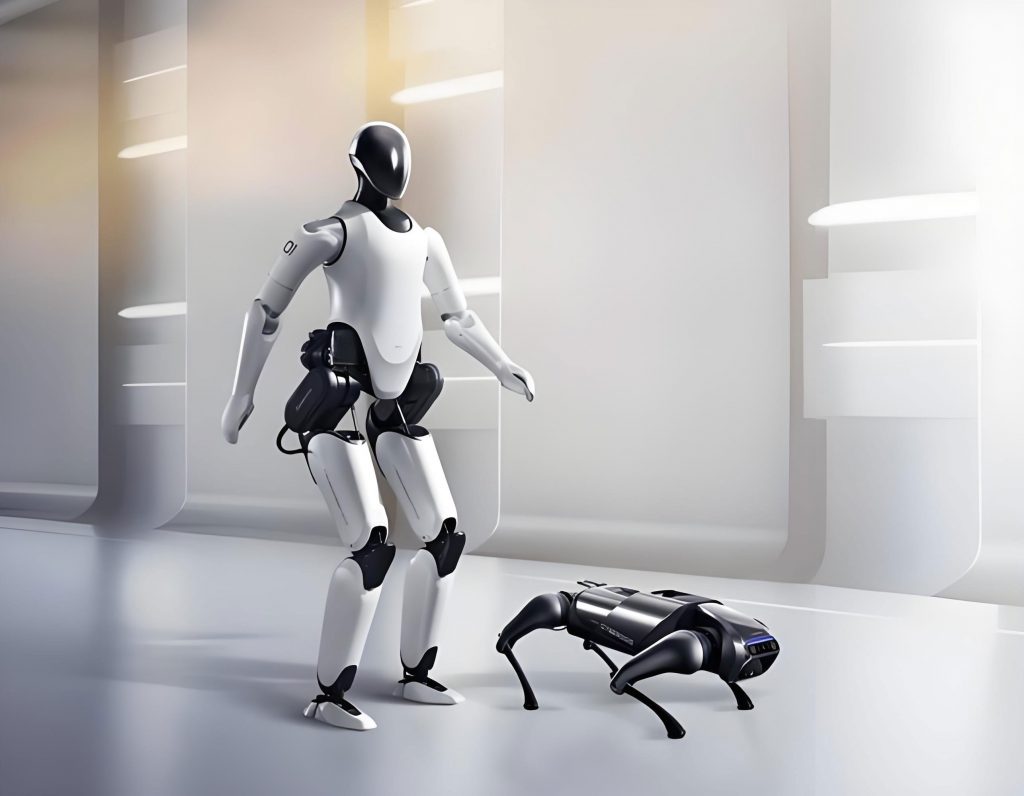
The creation of this mechanical bionic robot is a multidisciplinary endeavor, synthesizing knowledge from mechanical design, electromechanical actuation, automatic control, and biomimetics. The goal is to produce a precise, feature-accurate machine that uses its internal structure to transmit motion and execute a predefined set of lifelike actions. While multi-legged (quadruped, hexapod, etc.) bionic robots offer greater static stability, the bipedal form was chosen for its dynamic potential and specific challenge, focusing on a crawling dinosaur gait as the foundational behavioral model.
Hardware System Architecture
Principle Analysis
The core functionality of this bionic robot is realized through meticulously designed mechanical kinematic pairs and a sophisticated动力 control system. The design process involves carefully defining the degrees of freedom (DOF) for each motion joint, ensuring their stability and coordination during operation. This meticulous control over the motion副 is what grants the bionic robot its flexibility and fluidity. The internal execution is achieved via a combination of planar multi-bar linkages and cam mechanisms, driven by independent actuator modules.
Mechanical Structure Design
The overall architecture of the dinosaur bionic robot is modular. It is decomposed into several independent functional units—torso, legs, tail, and head—each equipped with its own dedicated drive system. This modularity facilitates assembly, maintenance, and potential future modifications. The interconnection of these moving components allows the bionic robot to perform a series of biomimetic actions, vividly showcasing the characteristic movements of its inspiration.
Chassis and Body Frame Design
The primary support structure for the bipedal bionic robot is a polygonal truss framework constructed entirely from aluminum alloy. This material choice provides an optimal balance of low mass, high strength, and excellent rigidity, which is crucial for dynamic motion. A key consideration in shaping the main body was dynamic balance. The two legs on either side of the central torso serve as the primary balance支撑点. The head and tail structures were profiled and weighted to achieve a relatively balanced state in both stationary poses and during motion. The hollow interior of the frame is reserved for installing the control and动力 systems, including the main controller, actuators, servo motors, linkage mechanisms, and cam assemblies.
Leg Mechanism Design
The leg design is central to the locomotion of this bionic robot. Each of the two walking legs is composed of a planar linkage mechanism coupled with a crank-rocker system. They are mounted on opposite sides of the body. The assembly employs a phase-shift design principle: when the leg on one side is in the stance phase (supporting the body on the ground), the leg on the opposite side is in the swing phase (lifted and moving forward). This alternating gait enables stable walking for the bionic robot.
The step length and, consequently, the walking speed are directly related to the angular displacement of the leg joints relative to the torso. For a fixed foot length, a larger angular sweep results in a longer step. The total forward rotation angle of the leg is the sum of the thigh’s rotation and the calf’s rotation relative to the thigh. This design enhances the walking speed capability of the bionic robot. Kinematically, each leg’s crank-linkage system possesses 2 degrees of freedom. The动力 system directly drives a cam mechanism, which in turn engages a gear train to actuate the planar linkages, controlling the rotation angles of each joint. This ensures synchronized direction and speed for both legs, optimizing stride and velocity.
To minimize friction and energy consumption, all major leg joints are equipped with bearings, ensuring smooth motion of the planar linkages. The end of each leg features a flat, triangular-shaped foot pad to provide stable contact with the ground and support the body’s weight effectively.
Tail Mechanism Design
The tail of the bionic robot is designed based on biological morphology, balancing aesthetic form with functional utility. Its purposes include contributing to overall dynamic balance, executing expressive motions, and aiding in agility. The design prioritizes unobstructed movement with reasonable motion amplitude. The mechanism employs a combination of flexible steel strips and cable-driven tensioning within a fixed external loop structure, segmented into front and rear parts. This results in a lightweight, simple construction with fast dynamic response. A single servo motor controls the tail, enabling it to perform relatively complex motions: pitch (up/down) and yaw (left/right), each with a maximum angular range of approximately 45°. This allows the tail to form “S” and “C” shapes, with both speed and position being fully controllable. This flexibility aids in重心 adjustment, enhancing walking stability. The outer skin is made from a single-piece molded,新型 material that is tactile, soft, and durable.
Head Mechanism Design
Similar to the tail, the head is designed for biomimetic form and balance maintenance. It is controlled by three servo motors, allowing for pitch (nodding up/down) and yaw (turning left/right) movements. The designed ranges are up to 90° for pitch and 80° for yaw. The internal frame is fabricated using 3D printing technology, while the outer skin uses the same整体成型, soft material as the tail for a lifelike appearance and feel.
Throughout the structural design process, factors beyond mere motion capability were considered, including safety, reliability, balance, braking, and maintainability. The selection of the drive method is also critical. The table below compares common actuation methods for such a bionic robot:
| Drive Method | Advantages | Disadvantages | Suitability for This Bionic Robot |
|---|---|---|---|
| Electric | Low cost, low noise, easy control, minimal site restrictions. | Lower power-to-weight ratio, higher fault rate in some components, less suitable for very large scales. | Selected. Offers the best balance of control precision, power requirement, and cost for this mid-scale design. |
| Pneumatic | High power-to-weight ratio, clean, fast response. | Requires compressed air supply (compressor), noisy, less precise position control. | Not selected due to need for external air source and control complexity. |
| Hydraulic | Very high power and force output. | Very high cost, potential for leaks, requires hydraulic power unit, heavy. | Overpowered and impractical for this application. |
Control System Design
The control system is the vital component that enables effective and stable biomimetic behavior in the bionic robot. It must be economical, responsive, practical, stable, and allow for future functional expansion.
Hardware Architecture
The control hardware is composed of several key modules: the Main Controller, Communication Interface, Motion Control Module, and Power Module. The central processing unit is an STM32F407 microcontroller, chosen for its high performance, rich peripheral set (I/O, timers, communication interfaces), and relatively low power consumption, making it ideal for comprehensive control of this bionic robot.
The power module uses a 36V, 1500mAh Lithium battery pack, providing the necessary voltage and capacity for the controller and all actuators. Motion control for the servos is achieved via PWM signals. The system requires control for multiple servos (head, tail) and the main leg actuators. To generate sufficient PWM channels, two PCA9685 servo driver chips are used, interfaced with the main controller via I²C protocol, allowing simultaneous control of up to 32 servo channels.
The leg drive system employs compact, integrated DC servo motor modules. These modules feature built-in protection against stall and overcurrent, use isolated CAN bus communication (EasyCAN protocol at 1Mbps), and support profile position and cyclic synchronous modes. Crucially, they can retain position data upon power loss and return to that position upon reboot. The specifications are tailored for the bipedal bionic robot: rated torque of 1 Nm, 100W power, peak speed of 1500 RPM, and operation at 36V.
| Component | Specification/Model | Key Feature |
|---|---|---|
| Main Controller | STM32F407 Microcontroller | ARM Cortex-M4 core, high-speed processing, multiple communication interfaces. |
| Servo Driver | PCA9685 (x2) | I²C-controlled 16-channel PWM driver. |
| Leg Actuator | Custom DC Servo Module | 36V, 1Nm, CAN bus, position memory. |
| Power Source | 36V Li-ion Battery Pack | Powers controller and all motor systems. |
| Head/Tail Actuator | Standard Digital Servos | Controlled via PWM from PCA9685. |
Software Architecture and Control Algorithm
The software was developed in the Keil MDK environment following a layered control philosophy. The system is structured into application layer (gait and behavior planning), control layer (trajectory generation and stability control), and driver layer (direct hardware communication for servos and sensors).
The motion control algorithm is the core of the bionic robot’s behavior, integrating walking, along with coordinated neck and tail motions. The walking control algorithm for this bipedal bionic robot is based on a pre-planned trajectory approach combined with real-time balance maintenance.
1. Kinematic Modeling and Gait Planning:
The leg is modeled as a 2-DOF planar serial chain (thigh and calf). The forward kinematics from joint angles $(\theta_1, \theta_2)$ to foot position $(x_f, z_f)$ relative to the hip are:
$$ x_f = L_1 \cos(\theta_1) + L_2 \cos(\theta_1 + \theta_2) $$
$$ z_f = L_1 \sin(\theta_1) + L_2 \sin(\theta_1 + \theta_2) $$
where $L_1$ and $L_2$ are thigh and calf lengths, respectively. For gait planning, a desired foot trajectory $(x_f^d(t), z_f^d(t))$ is defined for the swing phase (a cycloid or polynomial for smooth lift and placement) and a stationary point for the stance phase. The required joint angles are then calculated using inverse kinematics:
$$ \theta_2^d = \cos^{-1}\left( \frac{{x_f^d}^2 + {z_f^d}^2 – L_1^2 – L_2^2}{2 L_1 L_2} \right) $$
$$ \theta_1^d = \atan2(z_f^d, x_f^d) – \atan2\left( L_2 \sin(\theta_2^d), L_1 + L_2 \cos(\theta_2^d) \right) $$
This planned trajectory forms the reference input for the joint-level controllers.
2. Stability and Balance Control (Inverted Pendulum Model):
To ensure stable walking, the dynamics of the bionic robot’s torso are simplified using a Linear Inverted Pendulum Model (LIPM). The key metric for balance is the Zero-Moment Point (ZMP). For stable walking, the ZMP must remain within the support polygon formed by the feet. The ZMP position $x_{zmp}$ in the sagittal plane can be approximated as:
$$ x_{zmp} \approx x_{com} – \frac{z_{com}}{g} \ddot{x}_{com} $$
where $(x_{com}, z_{com})$ is the Center of Mass (CoM) position and $g$ is gravity. The control strategy involves planning a CoM trajectory $x_{com}^d(t)$ that keeps the corresponding $x_{zmp}^d$ safely within the support polygon. The actual robot’s waist (torso) is then controlled to track this planned CoM motion. Assuming the CoM’s position relative to the waist is fixed, the desired waist motion is directly derived from $x_{com}^d(t)$. The leg in the stance phase adjusts its joint angles slightly to realize this waist motion, effectively “pushing” the torso along the desired stable trajectory. The foot placement for the next step is also planned based on the current state to maintain future stability.
3. Coordination with Auxiliary Motions:
During walking, the tail and head motions are coordinated with the leg movements to aid balance (e.g., tail swing counteracts torso rotation) and provide lifelike expression. Their motions are scheduled relative to the gait cycle. When the bionic robot is stationary, the head and tail can move with larger amplitudes. If these motions threaten balance, the leg controllers can initiate small adjusting steps to reposition the support polygon under the shifted CoM. The mathematical integration is handled by superimposing these motion patterns within the overall task-space trajectory planner for the bionic robot.
Simulations in MATLAB/Simulink were conducted to validate the gait plan and stability control algorithm. The simulations confirmed that the bionic robot could walk stably with the designed trajectories, showing sufficient stability margins to handle minor disturbances, thereby verifying the feasibility of the mechanical and control design before physical implementation.
Future Perspectives
The development of this bipedal dinosaur-inspired bionic robot is a step towards more advanced and capable legged machines. The principles explored here—modular design, efficient linkage-based actuation, and model-based balance control—have broad applicability. Future iterations of such bionic robots will integrate more sophisticated sensors (LiDAR, stereo vision, IMU arrays) to enable true autonomous navigation in complex, unstructured environments. The bionic robot platform could be adapted for various purposes beyond entertainment and education. For instance, with added manipulators and sensors, a similar bionic robot could be deployed for disaster response, navigating rubble where humans cannot go, using thermal imaging to locate survivors. In domestic or industrial settings, bipedal bionic robots could perform tasks like cleaning, inspection, or logistics in spaces designed for humans. The path forward involves deepening the integration of perception, learning, and adaptive control, moving from pre-programmed mimicry to intelligent, goal-oriented behavior in the bionic robot, ultimately creating machines that can interact with and assist in our world with unprecedented versatility.