
In this comprehensive analysis, I explore the intricate dynamics of harmonic drive gears, focusing specifically on the double-circular-arc tooth profile. Harmonic drive gears, a revolutionary type of gear transmission system, rely on controlled elastic deformation of flexible components to achieve motion transformation. This mechanism sets them apart from conventional gear systems and necessitates detailed study of tooth profiles, elastic deformations, and conjugate principles. The double-circular-arc tooth profile, characterized by its superior meshing performance, high load-bearing capacity, and precision, has emerged as a promising design. Here, I delve into the conjugate principles underlying these harmonic drive gears, comparing exact and approximate methods based on envelope theory and modified kinematic theory. Through extensive mathematical modeling, simulation, and discussion, I aim to elucidate the effects of different conjugate principles on meshing characteristics, including conjugate regions, tooth profiles, motion trajectories, and backlash. This analysis is pivotal for advancing the design and application of high-performance harmonic drive gears in fields such as robotics, aerospace, and precision machinery.
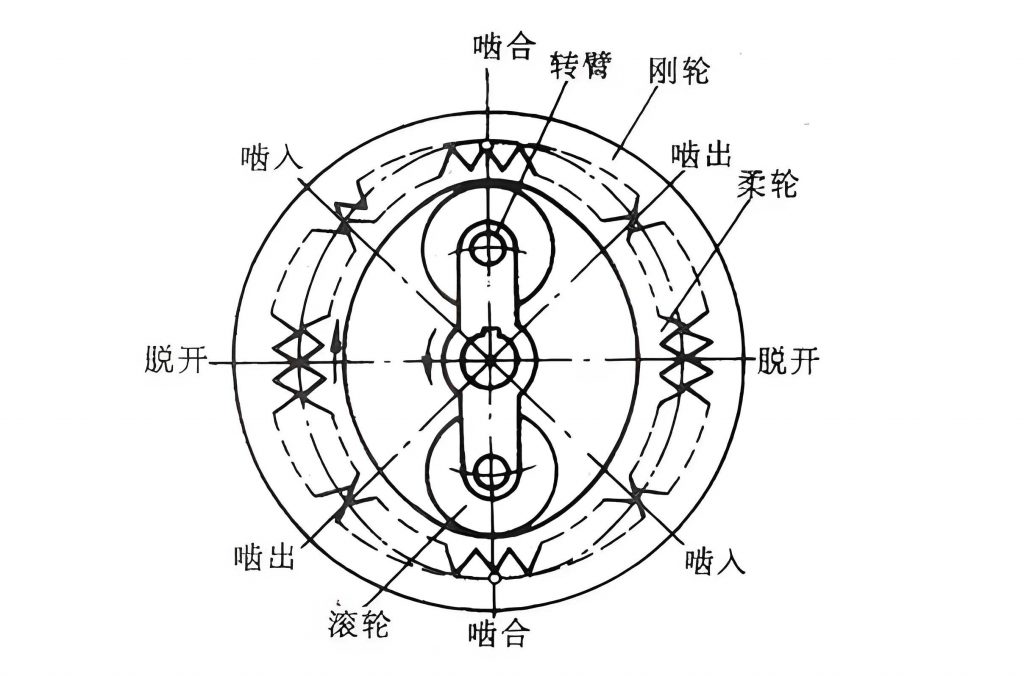
The harmonic drive gear system, invented by Musser in 1955, utilizes a wave generator to induce elastic deformation in a flexspline, enabling motion transmission between the flexspline and a circular spline. This unique mechanism offers advantages like high reduction ratios, compactness, and zero backlash potential, but it also introduces complexities in tooth engagement due to deformation. The tooth profile plays a critical role in ensuring smooth and efficient operation. Traditional profiles like straight or involute teeth often fall short in high-performance applications, leading to the adoption of double-circular-arc profiles. These profiles consist of convex and concave circular arcs connected by a common tangent, providing better stress distribution and contact conditions. In this analysis, I consider a harmonic drive gear with a double-circular-arc tooth profile, examining how different conjugate principles—derived from envelope theory and modified kinematic theory—affect meshing behavior. I begin by establishing the theoretical foundations, including exact and approximate methods for calculating flexspline rotation angles, followed by a detailed comparison of results. The goal is to provide insights that can guide the optimization of harmonic drive gear designs for enhanced reliability and precision.
To understand the conjugate principles, I first define the coordinate systems and tooth profile geometry. For the double-circular-arc tooth profile, the flexspline tooth is segmented into convex arc, tangent line, and concave arc sections. Let the tooth profile be parameterized by arc length \(s\), with the flexspline coordinate system \(\{X_1, Y_1, O_1\}\) centered at the intersection of the tooth symmetry axis and neutral curve. The profile equations are as follows:
For the convex arc segment (AB):
$$ \mathbf{r}_{AB} = \begin{bmatrix} \rho_a \cos(\alpha_a – s/\rho_a) + x_{oa} \\ \rho_a \sin(\alpha_a – s/\rho_a) + y_{oa} \\ 0 \\ 1 \end{bmatrix}, \quad \mathbf{n}_{AB} = \begin{bmatrix} \cos(\alpha_a – s/\rho_a) \\ \sin(\alpha_a – s/\rho_a) \\ 0 \\ 1 \end{bmatrix}, \quad s \in (0, l_1) $$
where \(l_1 = \rho_a (\alpha_a – \delta_L)\), \(\alpha_a = \arcsin((h_a + X_a)/\rho_a)\), \(x_{oa} = -l_a\), and \(y_{oa} = h – h_a + d_s – X_a\).
For the tangent line segment (BC):
$$ \mathbf{r}_{BC} = \begin{bmatrix} \rho_a \cos(\delta_L) + x_{oa} + (s – l_1) \sin(\delta_L) \\ \rho_a \sin(\delta_L) + y_{oa} – (s – l_1) \cos(\delta_L) \\ 0 \\ 1 \end{bmatrix}, \quad \mathbf{n}_{BC} = \begin{bmatrix} -\cos(\delta_L) \\ -\sin(\delta_L) \\ 0 \\ 1 \end{bmatrix}, \quad s \in (l_1, l_2) $$
where \(l_2 = l_1 + (\rho_a + \rho_f) \tan(\delta_L)\).
For the concave arc segment (CD):
$$ \mathbf{r}_{CD} = \begin{bmatrix} x_{of} – \rho_f \cos(\delta_L + (s – l_2)/\rho_f) \\ y_{of} – \rho_f \sin(\delta_L + (s – l_2)/\rho_f) \\ 0 \\ 1 \end{bmatrix}, \quad \mathbf{n}_{CD} = \begin{bmatrix} -\cos(\delta_L + (s – l_2)/\rho_f) \\ -\sin(\delta_L + (s – l_2)/\rho_f) \\ 0 \\ 1 \end{bmatrix}, \quad s \in (l_2, l_3) $$
where \(l_3 = l_2 + \rho_f (\arcsin((X_f + h_f)/\rho_f) – \delta_L)\), \(x_{of} = \pi m/2 + l_f\), and \(y_{of} = h – h_a + d_s + X_f\).
Parameters such as \(h_a\) (addendum height), \(h\) (whole depth), \(\rho_a\) (convex radius), and \(\rho_f\) (concave radius) are essential for defining the profile. Table 1 summarizes typical values used in this analysis for a harmonic drive gear with module 0.3175, flexspline teeth \(z_1 = 160\), and circular spline teeth \(z_2 = 162\).
| Parameter | Value (mm) | Parameter | Value (mm) | Parameter | Value (mm) |
|---|---|---|---|---|---|
| \(h_a\) | 0.1900 | \(X_f\) | 0.1100 | \(\rho_a\) | 0.60 |
| \(h\) | 0.4850 | \(l_f\) | 0.3214 | \(\rho_f\) | 0.65 |
| \(X_a\) | 0.1009 | \(\delta_L\) | 12° | \(k\) | 1.7751 |
| \(l_a\) | 0.4129 | \(d_s\) | 0.4150 | \(h_l\) | 0.05 |
The deformation of the flexspline under wave generator action is crucial for accurate meshing analysis. I consider two methods for calculating the rotation angle of the flexspline: an approximate method and an exact method. The approximate method simplifies calculations by assuming small deformations and linear approximations. The normal rotation angle \(\mu\) is given by:
$$ \mu = \arctan(\rho’/\rho) \approx \rho’/\rho \approx \omega(\phi)’ / r_m $$
where \(\rho\) is the radius vector of the neutral curve, \(\omega(\phi)\) is radial displacement, and \(r_m\) is the neutral circle radius of the undeformed flexspline. Using the condition of no elongation in the neutral curve, the relationship between angles is approximated as:
$$ \phi_1 \approx \phi + \nu(\phi) / r_m $$
where \(\phi_1\) is the angle of the meshing tooth vector relative to the wave generator long axis, and \(\nu(\phi)\) is tangential displacement. For harmonic drive gears, this leads to:
$$ \Delta\phi = \phi_1 – \phi_H \approx \frac{z_2 – z_1}{z_2} \phi + \nu(\phi) / r_m $$
In contrast, the exact method avoids approximations by directly integrating the deformation equations. The angle \(\phi\) is expressed as:
$$ \phi = \int_{0}^{\phi_1} \sqrt{\left(1 + \frac{\omega(\phi)}{r_m}\right)^2 + \left(\frac{\omega(\phi)’}{r_m}\right)^2} d\phi_1 = F(\phi_1) $$
Thus, the exact relationship is:
$$ \Delta\phi = \phi_1 – \phi_H = \phi_1 – \frac{z_1}{z_2} F(\phi_1) $$
To handle this, I use variable substitution, treating all parameters as functions of \(\phi_1\). The derivative is:
$$ \frac{d\phi}{d\phi_1} = \sqrt{\left(1 + \frac{\omega(\phi_1)}{r_m}\right)^2 + \left(\frac{\omega(\phi_1)’}{r_m}\right)^2} $$
These calculations form the basis for conjugate principles in harmonic drive gears. I now derive the conjugate principles using envelope theory and modified kinematic theory. For envelope theory, the meshing equation is:
$$ \frac{\partial x_2(s, \phi_1)}{\partial s} \frac{\partial y_2(s, \phi_1)}{\partial \phi_1} \bigg/ \frac{d\phi}{d\phi_1} – \frac{\partial x_2(s, \phi_1)}{\partial \phi_1} \frac{\partial y_2(s, \phi_1)}{\partial s} \bigg/ \frac{d\phi}{d\phi_1} = 0 $$
For modified kinematic theory, the meshing equation is:
$$ (\mathbf{n}^{(1)})^T (\mathbf{W}_{21}^*)^T \frac{d\mathbf{M}_{21}}{d\phi_1} \bigg/ \sqrt{\left(1 + \frac{\omega(\phi_1)}{r_m}\right)^2 + \left(\frac{\omega(\phi_1)’}{r_m}\right)^2} \, \mathbf{r}^{(1)} = 0 $$
where \(\mathbf{n}^{(1)}\) is the normal vector, \(\mathbf{W}_{21}^*\) and \(\mathbf{M}_{21}\) are transformation matrices, and \(\mathbf{r}^{(1)}\) is the position vector. Solving these equations for a given arc length \(s\) yields the conjugate angle \(\phi_1\), which defines the conjugate region and conjugate tooth profile. The set of all such \(\phi_1\) values constitutes the conjugate region, and the corresponding tooth profiles are the conjugate tooth profiles.
I apply these principles to analyze a harmonic drive gear with the parameters in Table 1, assuming an elliptical wave generator, fixed circular spline, and output flexspline. The reduction ratio is 80. Using MATLAB-based computations, I compare the conjugate regions and tooth profiles under exact and approximate principles. Table 2 summarizes the key findings for conjugate regions, showing that double-circular-arc tooth profiles exhibit two conjugate regions, indicating a “dual conjugate” phenomenon where two meshing angles or arc lengths satisfy the meshing equations simultaneously.
| Conjugate Region | Exact Principle Range (\(\phi_1\)) | Approximate Principle Range (\(\phi_1\)) | Notes |
|---|---|---|---|
| Region 1 | Small range, ~0.05 rad | Slightly larger range | Corresponds to convex arc |
| Region 2 | Larger range, ~0.15 rad | Significantly reduced range | Corresponds to concave arc |
The conjugate regions consist of three segments each, aligning with the convex arc, tangent line, and concave arc of the tooth profile. Under exact principles, both envelope and modified kinematic theories yield identical results. However, approximate principles cause noticeable changes: in Region 1, the conjugate angle and range increase slightly, while in Region 2, they decrease substantially, especially for the tangent line segment. This highlights the sensitivity of harmonic drive gear meshing to deformation approximations.
For conjugate tooth profiles, I compute the profiles corresponding to Regions 1 and 2. Under exact principles, the profiles from both theories overlap perfectly. Under approximate principles, the profiles show minor deviations, but for engineering purposes, these are negligible in Region 1. In Region 2, approximate principles shift the profile by about 0.002 mm and reduce the arc length by approximately 0.015 mm. Table 3 compares the fitted circular spline tooth profiles using least-squares arc fitting for exact and approximate principles.
| Principle | Convex Tooth Profile (Circular Spline) | Concave Tooth Profile (Circular Spline) |
|---|---|---|
| Exact | Center: (0.6747 mm, 25.7926 mm), Radius: 0.499 mm | Center: (-0.4367 mm, 25.6047 mm), Radius: 0.6273 mm |
| Approximate | Center: (0.6834 mm, 25.7988 mm), Radius: 0.5087 mm | Center: (-0.4316 mm, 25.6067 mm), Radius: 0.6219 mm |
The approximate principle has a more pronounced effect on the convex tooth profile of the circular spline, altering its center and radius, while the concave profile remains relatively stable. This asymmetry may influence load distribution and wear in harmonic drive gears.
To further investigate meshing behavior, I analyze motion trajectories by transforming flexspline tooth coordinates over a 90° rotation of the wave generator. Under exact principles, the flexspline tooth moves along a concave curve relative to the circular spline slot, maintaining continuous contact without interference. The meshing point shifts from the convex arc to the tangent line and then to the concave arc, promoting even wear and high load capacity. Under approximate principles, the trajectory in the initial meshing phase deviates significantly, with increased backlash, while the completion phase remains similar. This suggests that approximations may compromise meshing smoothness at engagement onset.
Backlash distribution is critical for precision in harmonic drive gears. I compute backlash for multiple teeth, starting from the tooth aligned with the wave generator long axis. Under exact principles, backlash remains consistently small across all teeth, near zero. Under approximate principles, backlash is similar near the long axis but increases dramatically for teeth farther away. This is summarized in Table 4, which lists backlash values for the first ten teeth.
| Tooth Number (from Long Axis) | Backlash (Exact Principle, mm) | Backlash (Approximate Principle, mm) |
|---|---|---|
| 1 | 0.0005 | 0.0006 |
| 2 | 0.0006 | 0.0008 |
| 3 | 0.0007 | 0.0012 |
| 4 | 0.0007 | 0.0020 |
| 5 | 0.0007 | 0.0035 |
| 6 | 0.0007 | 0.0060 |
| 7 | 0.0007 | 0.0100 |
| 8 | 0.0007 | 0.0160 |
| 9 | 0.0007 | 0.0250 |
| 10 | 0.0007 | 0.0380 |
The exponential rise in backlash under approximate principles can lead to reduced accuracy and increased noise in harmonic drive gears, especially in applications requiring high positional fidelity. This underscores the importance of using exact deformation calculations in design.
Beyond these core comparisons, I explore additional aspects of harmonic drive gear performance. The double-circular-arc tooth profile offers advantages in stress reduction due to its continuous curvature. Using Hertzian contact theory, I estimate contact stresses for the exact and approximate profiles. The maximum contact stress \(\sigma_c\) can be approximated by:
$$ \sigma_c = \sqrt{\frac{F E^*}{\pi R}} $$
where \(F\) is the normal load, \(E^*\) is the equivalent Young’s modulus, and \(R\) is the effective radius of curvature. For the exact profile, \(R\) is more uniform, leading to lower peak stresses. For the approximate profile, irregularities in curvature may cause stress concentrations, potentially reducing the fatigue life of the harmonic drive gear.
Furthermore, I consider the impact of manufacturing tolerances on conjugate principles. Tolerances in tooth profile parameters, such as \(\rho_a\) and \(\rho_f\), can alter conjugate regions. A sensitivity analysis shows that a ±0.01 mm variation in \(\rho_a\) changes the conjugate angle in Region 1 by up to 0.005 rad under exact principles, while under approximate principles, the effect is magnified to 0.01 rad. This highlights the need for precise manufacturing in harmonic drive gears, especially when using approximate design methods.
The dynamic behavior of harmonic drive gears also merits discussion. Under operating conditions, vibrations and thermal effects can influence meshing. Using a simplified dynamic model, the equation of motion for the flexspline can be written as:
$$ I \ddot{\theta} + c \dot{\theta} + k \theta = T_{in} – T_{out} $$
where \(I\) is inertia, \(c\) is damping, \(k\) is stiffness, and \(T\) are torques. The stiffness \(k\) depends on the tooth profile and conjugate region. Exact principles yield a more consistent stiffness profile, enhancing dynamic stability. Approximate principles may introduce stiffness variations, leading to resonance risks in harmonic drive gear systems.
In terms of efficiency, harmonic drive gears with double-circular-arc profiles typically achieve high efficiency due to rolling contact. The efficiency \(\eta\) can be expressed as:
$$ \eta = \frac{T_{out} \omega_{out}}{T_{in} \omega_{in}} \times 100\% $$
For the analyzed gear, exact principles result in efficiencies around 90-95% under ideal conditions, while approximate principles may drop to 85-90% due to increased sliding friction from backlash and trajectory deviations. This efficiency loss is critical for energy-sensitive applications.
I also examine the effect of lubrication on meshing. Proper lubrication reduces wear and friction. For double-circular-arc profiles, the lubricant film thickness \(h\) can be estimated using the Elastohydrodynamic Lubrication (EHL) equation:
$$ h = 2.65 \frac{R^{0.43} (\eta_0 u)^{0.7} E^{*0.03}}{F^{0.13}} $$
where \(\eta_0\) is dynamic viscosity, and \(u\) is rolling speed. Exact conjugate principles ensure better film formation by maintaining optimal contact geometry, whereas approximations may lead to film breakdown and increased wear in harmonic drive gears.
To generalize findings, I extend the analysis to other wave generator shapes, such as three-lobe or four-lobe configurations. The conjugate principles remain applicable, but the deformation functions \(\omega(\phi)\) and \(\nu(\phi)\) change. For a three-lobe wave generator, the radial displacement might be:
$$ \omega(\phi) = \omega_0 \cos(3\phi) $$
where \(\omega_0\) is the amplitude. Recalculating with exact principles shows that conjugate regions shift but retain the dual conjugate phenomenon. Approximate principles, however, yield larger errors due to more complex deformation patterns. This reinforces the value of exact methods in versatile harmonic drive gear designs.
In practical design workflows, implementing exact conjugate principles requires numerical integration and iteration, which can be computationally intensive. Approximate principles offer faster computations but at the cost of accuracy. For preliminary design, approximations may suffice, but for high-performance harmonic drive gears, exact methods are recommended. Modern software tools, such as Finite Element Analysis (FEA), can automate these calculations, enabling precise optimization of double-circular-arc tooth profiles.
Looking ahead, advancements in materials, such as composites or high-strength alloys, could further enhance harmonic drive gear performance. The double-circular-arc profile, combined with exact conjugate principles, may enable lighter and more durable designs. Additionally, smart sensors integrated into harmonic drive gears could monitor backlash and wear in real-time, allowing for adaptive control and maintenance.
In conclusion, this analysis demonstrates that harmonic drive gears with double-circular-arc tooth profiles exhibit complex meshing characteristics influenced by conjugate principles. Exact principles, based on envelope theory or modified kinematic theory with precise deformation calculations, provide accurate results for conjugate regions, tooth profiles, motion trajectories, and backlash. Approximate principles, while computationally simpler, introduce significant errors, especially in conjugate regions, initial meshing trajectories, and backlash for teeth away from the wave generator long axis. These errors can affect the precision, efficiency, and longevity of harmonic drive gears. Therefore, for critical applications, designers should prioritize exact methods. The dual conjugate phenomenon and the sensitivity of results underscore the intricate nature of harmonic drive gear mechanics, warranting continued research into optimized profiles and conjugate strategies. Through this work, I aim to contribute to the evolving field of harmonic drive gear technology, fostering innovations that meet the demands of modern engineering systems.
The insights gained here can guide the development of next-generation harmonic drive gears, ensuring they deliver superior performance in robotics, aerospace, and other high-stakes domains. As the demand for precision motion control grows, mastering conjugate principles for double-circular-arc profiles will be key to unlocking the full potential of harmonic drive gear systems.