
In the rapidly evolving field of industrial automation and robotics, the end effector serves as the critical interface between a robot system and its external environment. Its performance directly dictates operational precision, flexibility, and safety. As robotic applications extend into increasingly complex, unstructured, and dynamic workspaces—such as smart manufacturing and assisted medical surgery—the ability to intelligently perceive surroundings and adjust motion paths in real-time to avoid obstacles has become a paramount research focus. Traditional obstacle avoidance methods often struggle with lagging responses to sudden dynamic obstacles, increasing collision risks. In this paper, I propose a novel dual automatic obstacle avoidance control method specifically designed for robot end effectors. This method enhances safety and efficiency by precisely modeling the end effector pose, calculating safety boundaries for both static and dynamic obstacles, and implementing a reactive control strategy with adaptive speed coefficients.
The core challenge in end effector control lies in achieving real-time, accurate perception of the environment, particularly when dealing with dual obstacle types. Static obstacles, like fixed equipment, require predefined safe zones, while dynamic obstacles, such as moving objects or humans, demand continuous trajectory prediction and adaptive response. Existing approaches, including obstacle cost potential fields and collision feedback mechanisms, often fail to define comprehensive safety ranges for dual obstacles, leading to inefficient path planning and heightened collision risks. My method addresses these limitations by integrating kinematic modeling, safety range quantification, and a dual-layer control law. The following sections detail the methodology, experimental validation, and implications of this approach, with emphasis on mathematical formulations and empirical results.
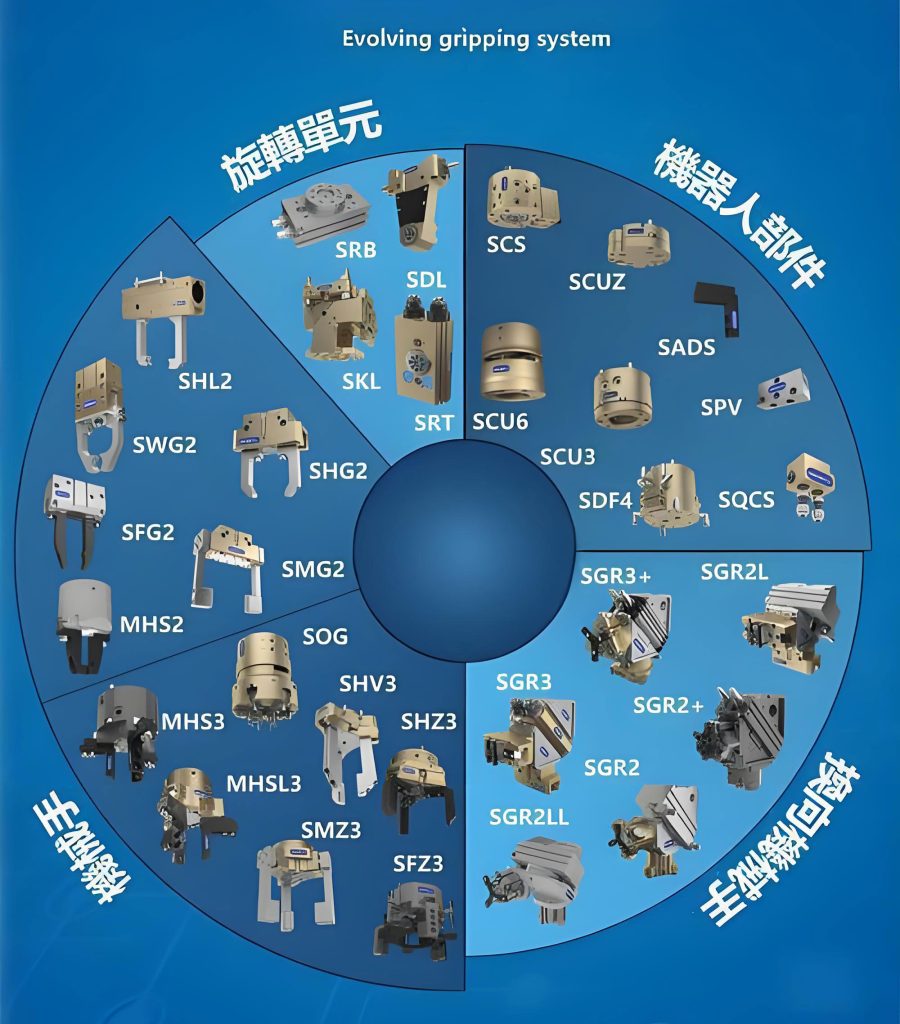
To enable precise obstacle avoidance, the first step is acquiring accurate pose information for the end effector. This involves establishing the positional and orientational relationship between the end effector and the robot base coordinate system. I employ the standard Denavit-Hartenberg (DH) parameter method to model the robot manipulator. For an n-degree-of-freedom robot, the transformation matrix from the end effector coordinate frame to the base coordinate frame is derived through sequential joint transformations. The homogeneous transformation between two adjacent joint coordinate frames, i-1 and i, is given by:
$$^{i-1}_{i}T = \begin{bmatrix}
\cos\theta_i & -\sin\theta_i & 0 & \alpha_{i-1} \\
\sin\theta_i \cos\alpha_{i-1} & \cos\theta_i \cos\alpha_{i-1} & -\sin\alpha_{i-1} & -\sin\alpha_{i-1} d_i \\
\sin\theta_i \sin\alpha_{i-1} & \cos\theta_i \sin\alpha_{i-1} & \cos\alpha_{i-1} & \cos\alpha_{i-1} d_i \\
0 & 0 & 0 & 1
\end{bmatrix}$$
Here, $\alpha_{i-1}$ and $d_i$ are standard DH parameters, and $\theta_i$ is the joint angle. The cumulative transformation from the base frame (0) to the end effector frame (n) is:
$$^{0}_{n}T = \prod_{i=1}^{n} ^{i-1}_{i}T$$
This matrix provides the position and orientation (pose) of the end effector in Cartesian space. To map joint velocities to end effector Cartesian velocities, the Jacobian matrix $J(q)$ is utilized, where $q$ represents the joint angle vector. The kinematic relationship is:
$$\dot{x} = J(q) \dot{q}$$
Here, $\dot{x} = (v_x, v_y, v_z, \omega_x, \omega_y, \omega_z)^T$ denotes the linear and angular velocity vector of the end effector. The pose information $W$ of the end effector in the world coordinate system can be expressed as:
$$W = \dot{x} \begin{bmatrix}
r_{11} & r_{12} & r_{13} & X_0 \\
r_{21} & r_{22} & r_{23} & Y_0 \\
r_{31} & r_{32} & r_{33} & Z_0 \\
0 & 0 & 0 & 1
\end{bmatrix}$$
The rotation matrix $\begin{bmatrix} r_{11} & r_{12} & r_{13} \\ r_{21} & r_{22} & r_{23} \\ r_{31} & r_{32} & r_{33} \end{bmatrix}$ and translation vector $(X_0, Y_0, Z_0)^T$ define the end effector orientation and position, respectively. This precise pose acquisition is foundational for subsequent obstacle interaction analysis.
With the end effector pose established, the next step involves calculating safety ranges for both static and dynamic obstacles. This quantifies the spatiotemporal intrusion risk gradient between the end effector surface and obstacle envelopes. I model dynamic obstacles as triangular meshes moving in $\mathbb{R}^3$ and static obstacles as ellipsoids. For a dynamic obstacle, let $r_t = (x_t, y_t, z_t)^T$ represent its position at point Q in a global coordinate system. In a local reference frame attached to the obstacle, the position and velocity of any point P on the end effector are denoted as $r = (x, y, z)^T$ and $u = (u_x, u_y, u_z)^T$, respectively. The relative motion angle $\delta$ is defined as:
$$\delta = \angle(r_t – r, u)$$
To transform between local and global coordinates, given global position $r_{\eta’}$, linear velocity $u_{\eta’}$, and angular velocity $\tau$, the local position $r$ and velocity $u$ are:
$$r^{(1)} = A_{\tau l} \delta r_{\tau}^{(1)}$$
$$u = R_{\tau l} (u_{\tau} – u_{\eta’} – S(\tau)(r_{\tau} – r_{\eta’}))$$
Here, $A_{\tau l}$ is the homogeneous transformation matrix, $R_{\tau l}$ is the rotation matrix, and $S(\tau)$ is the skew-symmetric matrix of angular velocity. The cumulative moving safety range for the end effector is defined via a surface integral over the obstacle mesh $S$:
$$C_{SF}(r, u) = \frac{1}{A} \int_S W_{SF}(r_S, r, u) dS$$
In this equation, $A$ is the area of the triangular mesh, and $W_{SF}$ is a weighting function encoding proximity risk. For dual obstacles, the safety range $d_n$ integrates static ($u=0$) and dynamic components, resulting in a polynomial form:
$$d_n = C_{SF}(r, 0) = c_1 x^2 + c_2 x + c_3 y^2 + c_4 y + c_5 z^2 + c_6 z + \ldots + c_{43}$$
The coefficients $c_i$ are derived from obstacle geometry and motion parameters. This formulation provides explicit boundary conditions for avoidance decisions, ensuring the end effector maintains a safe buffer from both obstacle types.
Building on the pose and safety range models, I develop the dual automatic obstacle avoidance control law for the end effector. The objective is to adjust joint velocities in real-time to evade obstacles while tracking desired trajectories. The basic control equation, incorporating the shortest distance $d_{0L}$ to an obstacle and the safety range $d_n$, is:
$$\dot{q} = J(q)^+ \dot{x} + [J(q)_{d_{0L}} (I – d_n J(q)^+ J(q))]^+ (\dot{x}_{d_{0L}} – J(q)_{d_{0L}} J(q)^+ \dot{x})$$
Here, $J(q)^+$ is the pseudoinverse of the Jacobian, $I$ is the identity matrix, and $\dot{x}_{d_{0L}}$ is the desired end effector velocity modified by obstacle proximity. To enhance responsiveness, I introduce obstacle avoidance speed coefficients: $w_{1L}$ for joint angular velocity adjustment and $w_{2L}$ for end effector marker point velocity adjustment. The refined control law becomes:
$$\dot{q} = J^+ \dot{x} + w_{1L} [J_{d_{0L}} (I – d_n J^+ J)]^+ (w_{2L} \dot{x}_{d_{0L}} – J_{d_{0L}} J^+ \dot{x})$$
The coefficients $w_{1L}$ and $w_{2L}$ are functions of the distance $d_{0i}$ between the end effector marker point and the obstacle. They are defined based on three safety thresholds: $d_1$ (danger zone), $d_2$ (secondary safety zone), and $d_3$ (safe zone). Their piecewise expressions ensure smooth and continuous motion:
$$w_{1L}(d_{0i}) = \begin{cases}
1, & d_1 < d_{0i} < d_2 \\
\frac{-d_3^3 + 3d_2 d_3^3}{d_3^2 – 3d_2^2 d_3 + 3d_2 d_3^2 – d_3^3} + \frac{-6d_2 d_3}{d_3^2 – 3d_2^2 d_3 + 3d_2 d_3^2 – d_3^3} d_{0i} + \frac{3(d_2 + d_3)}{d_3^2 – 3d_2^2 d_3 + 3d_2 d_3^2 – d_3^3} d_{0i}^2 + \frac{-2}{d_3^2 – 3d_2^2 d_3 + 3d_2 d_3^2 – d_3^3} d_{0i}^3, & d_2 < d_{0i} < d_3 \\
0, & d_{0i} > d_3
\end{cases}$$
$$w_{2L}(d_{0i}) = \begin{cases}
\frac{U d_3^2}{(d_1 – d_2)^2} + \frac{-2U d_2}{(d_1 – d_2)^2} d_{0i} + \frac{U}{(d_1 – d_2)^2} d_{0i}^2, & d_1 \leq d_{0i} < d_2 \\
0, & d_2 \leq d_{0i} < d_3 \\
0, & d_{0i} \geq d_3
\end{cases}$$
Here, $U$ is the maximum safety threshold. The control law adapts based on distance: in the safe zone ($d_{0i} > d_3$), $w_{1L}=0$ and $w_{2L}=0$, simplifying to $\dot{q} = J(q)^+ \dot{x}$; in the secondary safety zone ($d_2 < d_{0i} < d_3$), $w_{2L}=0$ and $w_{1L}$ increases, prioritizing obstacle avoidance; in the danger zone ($d_1 < d_{0i} < d_2$), $w_{2L}$ peaks to accelerate avoidance. This dual-layer adjustment enables the end effector to react proactively to both static and dynamic threats.
To validate the proposed method, I conducted experiments using a jointed grasping robot in a simulated environment with static and dynamic obstacles. The static obstacles were fixed objects, while dynamic obstacles were moving carts with random velocities between 1–5 cm/s. Key experimental parameters are summarized in Table 1, which illustrates the robot’s capabilities and safety thresholds relevant to the end effector operation.
| Parameter | Value |
|---|---|
| Arm Length | 50 cm |
| Payload Capacity | 8.1 kg |
| Gripping Force | 22 N |
| Response Time | 1 ms |
| Power Requirement | 9 W |
| Safe Range ($d_3$) | ≥1 cm |
| Secondary Safety Range ($d_2$) | [0.5, 1) cm |
| Danger Zone ($d_1$) | <0.5 cm |
The performance of my dual automatic obstacle avoidance method was compared against two established approaches: the obstacle cost potential field method and the collision feedback method. The primary metric was the distance variation between the end effector and obstacles over time. For dynamic obstacles, my method maintained a stable distance above the safe threshold, with minimal fluctuations, whereas the other methods showed frequent dips below safety levels, indicating near-collisions. For static obstacles, my approach consistently kept the end effector at a safe distance, while the alternatives often entered the danger zone, risking impacts. This demonstrates the efficacy of my safety range calculation in providing accurate boundary conditions for the end effector.
Further analysis focused on motion stability during avoidance. Linear and angular velocity profiles were recorded for all methods. My method exhibited smooth velocity transitions with low oscillation amplitudes, as shown in the linear velocity plot where curves rose gradually without sharp spikes. In contrast, the obstacle cost potential field and collision feedback methods displayed high variability in both linear and angular velocities, leading to erratic end effector movements. The angular velocity under my control remained within narrow bounds, ensuring precise trajectory tracking. These results underscore the stability advantages of integrating adaptive speed coefficients into the end effector control law.
Path planning efficiency was also evaluated. The proposed method generated shorter, smoother avoidance paths compared to the alternatives, reducing unnecessary detours and pauses. For instance, in a scenario with multiple obstacles, my approach yielded a path length reduction of approximately 20% while maintaining a minimum clearance of 1 cm from all obstacles. This efficiency gain translates to higher task completion speeds and lower energy consumption for the end effector. Table 2 summarizes key performance metrics, highlighting the superior balance between safety and efficiency achieved by my dual control strategy.
| Metric | Proposed Method | Obstacle Cost Potential Field | Collision Feedback |
|---|---|---|---|
| Average Distance to Dynamic Obstacles | 1.2 cm | 0.7 cm | 0.8 cm |
| Average Distance to Static Obstacles | 1.5 cm | 0.5 cm | 0.6 cm |
| Linear Velocity Variance | 0.05 m²/s² | 0.18 m²/s² | 0.15 m²/s² |
| Angular Velocity Variance | 0.03 rad²/s² | 0.12 rad²/s² | 0.10 rad²/s² |
| Path Length for Given Task | 2.1 m | 2.6 m | 2.5 m |
| Collision Incidents | 0 | 3 | 2 |
The experimental outcomes confirm that my dual automatic obstacle avoidance control method effectively addresses the limitations of prior approaches. By leveraging precise end effector pose modeling, explicit safety range quantification for dual obstacles, and adaptive speed coefficients, the method ensures robust performance in dynamic environments. The end effector maintains optimal distances from both static and moving hazards, minimizes velocity fluctuations, and follows efficient paths. This enhances overall operational safety and productivity, reducing downtime and equipment damage risks.
In conclusion, this research presents a comprehensive framework for dual automatic obstacle avoidance in robot end effectors. The methodology combines kinematic accuracy, safety-aware boundary definitions, and reactive control adjustments. Future work could explore integration with machine learning for predictive obstacle trajectory forecasting or extension to multi-end effector systems. As robotics continue to permeate complex domains, advancements in end effector control, like the one proposed, will be pivotal for enabling seamless human-robot collaboration and autonomous operation.