
In practical applications involving small angular movements, the planetary roller screw exhibits complex dynamic behaviors that necessitate detailed mathematical and computational analysis. This study focuses on establishing a comprehensive model to understand the motion characteristics and dynamic response of the planetary roller screw under such conditions. We begin by developing a mathematical framework that decomposes axial displacement into elastic deformation due to contact and transmission displacement. Using Hertz contact theory, we calculate the elastic deformation under varying loads and derive the transmission relationships. Subsequently, we construct a finite element model to simulate the dynamic response, allowing us to obtain insights into the planetary roller screw’s performance. Throughout this analysis, the planetary roller screw is emphasized as a critical component in high-precision mechanical systems, and our findings aim to provide a foundation for its industrial applications.
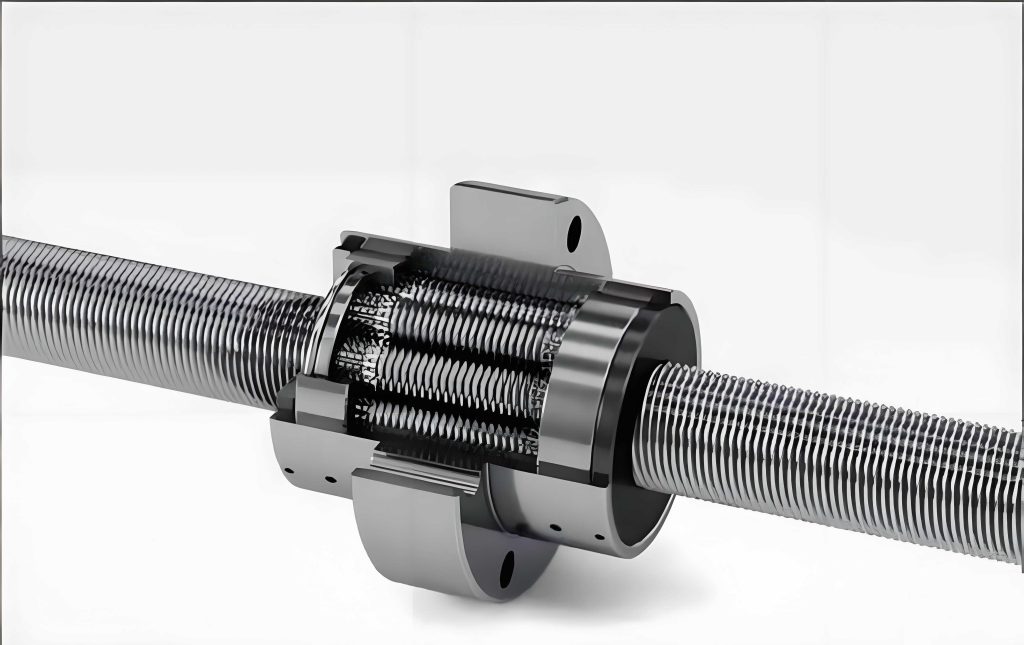
The planetary roller screw is a precision mechanical device that converts rotary motion into linear motion, offering advantages such as high load capacity, stability, and suitability for high-speed operations. It consists of five main components: the screw, rollers, nut, retainer ring, and gears. Compared to ball screw mechanisms, the planetary roller screw utilizes threaded rollers as load-bearing elements, resulting in larger curvature radii at contact surfaces and increased contact points. This design enhances its lifespan, load-bearing capability, and operational speed. The planetary roller screw finds applications in critical fields like medical devices, aerospace, optical instruments, robotics, and high-precision machine tools. However, while existing research often addresses large angular movements, small angular movements—common in servo systems—require further investigation into their dynamic and force characteristics. Our work aims to fill this gap by analyzing the planetary roller screw’s behavior under small angular displacements through mathematical modeling and finite element simulation.
To model the planetary roller screw, we consider its axial displacement as comprising two parts: the elastic deformation from mating contacts and the displacement from transmission. This decomposition allows us to separately analyze the effects of contact mechanics and kinematic relationships. The elastic deformation is determined using Hertz contact theory, which assumes smooth surfaces, elastic deformation obeying Hooke’s law, and negligible tangential friction. For the planetary roller screw, these assumptions hold under rated load conditions where plastic deformation is minimal. The contact between the screw and rollers, as well as between the rollers and nut, is treated as point contact, expanding into elliptical areas under load. The Hertz theory provides formulas for the semi-major and semi-minor axes of the contact ellipse and the elastic approach. Specifically, for two bodies in contact, the semi-major axis \(a\) and semi-minor axis \(b\) are given by:
$$ a = m_a \sqrt[3]{\frac{3Q}{E’ \sum \rho}}, \quad b = m_b \sqrt[3]{\frac{3Q}{E’ \sum \rho}} $$
where \(Q\) is the normal force, \(E’\) is the equivalent elastic modulus, \(\sum \rho\) is the sum of principal curvatures at the contact point, and \(m_a\) and \(m_b\) are coefficients dependent on the ellipse’s eccentricity. The elastic approach \(\delta\) is calculated as:
$$ \delta = \frac{K(e)}{\pi m_a} \sqrt[3]{\frac{3}{E’^2} Q^2 \sum \rho} $$
Here, \(K(e)\) and \(L(e)\) are the first and second kinds of complete elliptic integrals, respectively, and \(e\) is the eccentricity derived from the principal curvature function \(F(\rho)\). For the planetary roller screw, we compute the principal curvatures for screw-roller and roller-nut contacts based on geometric parameters. The planetary roller screw’s basic structural parameters are summarized in the table below:
| Component | Lead (mm) | Number of Threads | Contact Radius R (mm) | Nominal Diameter d_m (mm) | Helix Angle λ (°) | Contact Angle α (°) |
|---|---|---|---|---|---|---|
| Screw | 4.75 | 5 | ∞ | 18 | 4.8 | 42.2 |
| Roller | 0.95 | 1 | 2.8 | 6 | 2.9 | 42.2 |
| Nut | 4.75 | 5 | ∞ | 30 | 4.8 | 42.2 |
Using these parameters, the principal curvatures for screw-roller contact are \(\rho_{11} = 0.3571\), \(\rho_{12} = 0.2466\), \(\rho_{21} = 0\), and \(\rho_{22} = 0.1089\), yielding a curvature function \(F(\rho) = 0.0022\). For roller-nut contact, the values are \(\rho_{11} = 0.3571\), \(\rho_{12} = 0.2466\), \(\rho_{21} = 0\), and \(\rho_{22} = 0.0429\), with \(F(\rho) = 0.1534\). The material used is 42CrMo4, with an elastic modulus of 210 GPa, density of 7800 kg/m³, and Poisson’s ratio of 0.29. We solve for the eccentricity \(e\) numerically using Romberg integration for the elliptic integrals and iterative methods for the curvature function equation. The elastic deformation \(\delta\) is then computed for different axial loads \(Q\). The results for screw-roller and roller-nut contacts are shown in the following tables, illustrating how the contact ellipse dimensions and elastic approach vary with load.
| Axial Load Q (N) | Semi-major Axis a (mm) | Semi-minor Axis b (mm) | Elastic Approach δ (mm) |
|---|---|---|---|
| 10 | 0.0123 | 0.0085 | 0.0008 |
| 20 | 0.0155 | 0.0107 | 0.0016 |
| 50 | 0.0218 | 0.0151 | 0.0032 |
| 100 | 0.0275 | 0.0190 | 0.0051 |
| 200 | 0.0346 | 0.0239 | 0.0081 |
| Axial Load Q (N) | Semi-major Axis a (mm) | Semi-minor Axis b (mm) | Elastic Approach δ (mm) |
|---|---|---|---|
| 10 | 0.0118 | 0.0072 | 0.0007 |
| 20 | 0.0149 | 0.0091 | 0.0014 |
| 50 | 0.0209 | 0.0128 | 0.0028 |
| 100 | 0.0263 | 0.0161 | 0.0044 |
| 200 | 0.0332 | 0.0203 | 0.0070 |
These tables demonstrate that the elastic deformation increases with load, highlighting the importance of accounting for this component in precision control systems. The planetary roller screw’s performance is significantly influenced by such deformations, especially under small angular movements where minute displacements matter.
Next, we derive the transmission axial displacement, which relates the screw’s rotation to the nut’s linear movement. The planetary roller screw operates through rolling contacts without slip, but in reality, sliding may occur. For no-slip conditions, the kinematic relationship is based on the pitch diameters and leads of the components. The axial displacement \(l\) is given by:
$$ l = \frac{1}{2\pi} \left( p_S \theta_S \pm p_R \frac{\theta_S r_S}{r_R} \right) $$
where \(p_S\) and \(p_R\) are the leads of the screw and roller, \(\theta_S\) is the screw rotation angle, \(r_S\) and \(r_R\) are the pitch radii, and the sign depends on the thread handedness (positive for same, negative for opposite). For our planetary roller screw, with opposite threads, the equation becomes:
$$ l = 0.302394 \theta_S $$
Considering slip, where the screw experiences a sliding angle \(\theta_{\text{slide}} = 0.005 \theta_S\) under rated loads, the actual screw rotation is \(\theta_S’ = 0.995 \theta_S\). The transmission relationship adjusts to:
$$ l’ = \frac{1}{2\pi} \left( p_S \theta_S’ \pm p_R \frac{\theta_S’ r_S}{r_R} \right) = 0.3008824 \theta_S $$
This shows that slip slightly reduces the axial displacement per unit rotation, a factor that must be considered in high-precision applications of the planetary roller screw.
To validate and extend our mathematical model, we develop a finite element model of the planetary roller screw. Given the complexity of the threaded structures, we simplify the geometry by considering only the contact regions of the screw, rollers, and nut, omitting non-essential cylindrical parts. The model is meshed with tetrahedral elements (C3D4), totaling 67,944 elements to balance accuracy and computational efficiency. Material properties are set as earlier, with a density of \(7.8 \times 10^{-9}\) ton/mm³, elastic modulus of 210,000 MPa, and Poisson’s ratio of 0.29. Contact interactions between threads are defined as surface-to-surface with small sliding, a Coulomb friction coefficient of 0.3 for tangential behavior, and hard contact for normal behavior.
The analysis involves two steps. First, a preload force is applied to the nut to ensure full contact between threads, while axial degrees of freedom are released for rollers and nut, and all other freedoms are constrained. The preload curve increases gradually to 100 N over time. Second, a torque is applied to the screw to induce rotation, with rotational freedoms released for all components. The torque curve ramps up to a specified value. The total simulation time is 0.001 seconds, and we extract stress distributions and dynamic responses at key time points. The von Mises stress contours at 0.0003136 s and 0.000704 s reveal uniform stress distribution across the threads, with higher stresses at screw-roller contacts due to smaller curvature radii. The maximum stresses are summarized below:
| Time (s) | Component | Maximum Stress (MPa) |
|---|---|---|
| 0.0003136 | Screw | 675.1 |
| Roller (Screw Side) | 1247.0 | |
| Roller (Nut Side) | 761.6 | |
| Nut | 474.4 | |
| 0.000704 | Screw | 984.1 |
| Roller (Screw Side) | 1335.0 | |
| Roller (Nut Side) | 1335.0 | |
| Nut | 424.2 |
At 0.0003136 s, the roller’s screw-side stress exceeds the material’s yield strength, indicating localized plastic yielding, which is acceptable under rated conditions. The dynamic response curves show angular displacements for the screw, rollers, and nut, as well as axial displacements for rollers and nut. At 0.0002 s, under a 100 N preload, the roller’s axial displacement is 0.00164042 mm, closely matching the Hertz theory prediction of 0.0016 mm (2.5% error). The nut’s axial displacement versus screw angle curve yields a slope of 0.300010, consistent with the slip-inclusive theoretical value of 0.3008824 (0.29% error). This validates our mathematical model and highlights the planetary roller screw’s predictable behavior under small angular movements.
Further analysis of the planetary roller screw’s dynamics involves examining the energy dissipation and vibration characteristics. The finite element simulation provides insights into how contact stresses fluctuate during operation, affecting the overall stiffness and natural frequencies of the system. For instance, the planetary roller screw’s axial stiffness can be derived from the elastic deformation calculations, offering a way to optimize design parameters for specific applications. Additionally, the role of the retainer ring in maintaining roller alignment is crucial for minimizing skew and ensuring smooth motion. We also consider thermal effects, as frictional heating from contacts may influence material properties and dimensional stability. However, for small angular movements, these effects are often negligible, allowing us to focus on mechanical aspects.
To enhance the understanding of the planetary roller screw, we explore its efficiency and load distribution across multiple rollers. The planetary arrangement distributes loads evenly, but slight variations due to manufacturing tolerances can lead to uneven stress. Our model assumes ideal geometry, but in practice, factors like thread profile errors and surface roughness must be accounted for. The Hertz contact theory provides a baseline, but advanced models incorporating surface topography could refine predictions. Moreover, the planetary roller screw’s ability to handle high accelerations makes it suitable for servo systems, where dynamic response times are critical. By analyzing the frequency response from simulations, we can identify resonant frequencies and avoid operational ranges that might exacerbate vibrations.
In terms of applications, the planetary roller screw’s robustness in medical devices, such as surgical robots, relies on its precision and reliability. For aerospace actuators, the planetary roller screw must withstand extreme temperatures and loads, necessitating material selections like titanium alloys or specialized coatings. Optical systems benefit from the planetary roller screw’s smooth motion, reducing jitter and improving alignment accuracy. Each application imposes unique requirements on the planetary roller screw, driving continuous improvement in design and analysis techniques. Our work contributes by providing a detailed framework for evaluating small angular movement dynamics, which is often overlooked in favor of large-scale motion studies.
The mathematical and finite element models developed here can be extended to other screw mechanisms, such as ball screws or differential roller screws, by adjusting contact geometries and material properties. However, the planetary roller screw remains distinct due to its multi-roller design and high contact area. Future research could involve experimental validation using strain gauges or laser displacement sensors to measure actual deformations and compare them with simulations. Additionally, investigating the effects of lubrication on contact mechanics would be valuable, as reduced friction can enhance efficiency and lifespan. The planetary roller screw’s complexity offers ample opportunities for optimization, such as tuning thread profiles or roller counts to balance load capacity and speed.
In conclusion, our analysis of the planetary roller screw for small angular movements reveals key insights into its elastic deformation, transmission relationships, and dynamic response. The Hertz contact theory effectively models elastic deformations, which are significant under preload and must be compensated in precision systems. The derived transmission equations account for both no-slip and slip conditions, aligning closely with finite element results. The finite element simulation demonstrates stress distributions and kinematic behaviors, validating the mathematical model and providing a tool for further design iterations. The planetary roller screw’s performance in small angular movements is characterized by predictable axial displacement and manageable stress levels, making it suitable for high-precision applications. We emphasize the importance of considering elastic deformations and slip in control systems to achieve accurate positioning. This study lays groundwork for advancing planetary roller screw technology, ensuring its reliability in critical mechanical systems. The planetary roller screw continues to be a vital component in modern engineering, and our findings aim to support its ongoing development and application across various industries.