
In the field of high-precision electromechanical actuation, the planetary roller screw (PRS) has emerged as a critical component due to its superior load capacity, stiffness, and longevity compared to traditional ball screws. As an engineer focused on advanced aerospace applications, I have undertaken a comprehensive study to analyze the dynamic characteristics of a planetary roller screw using finite element methods, specifically through ANSYS Workbench. This analysis is vital for ensuring the reliability and performance of PRS-based systems, such as electric rudder servo mechanisms in tactical missiles, where vibrational stability under operational conditions is paramount. The goal of this work is to delve into the modal and harmonic response behaviors of a planetary roller screw, providing insights that can inform anti-vibration design and optimization. Through this first-person perspective, I will detail the modeling, analysis, and findings, emphasizing the use of tables and formulas to encapsulate key data and theoretical underpinnings.
The planetary roller screw operates on the principle of threaded engagement to convert rotary motion into linear motion, or vice versa. Its structure typically consists of a central screw, multiple rollers distributed around the screw, a nut, an internal gear ring, and retaining rings. The screw and nut feature multi-start threads with a triangular profile, while the rollers have single-start threads matching that profile. The rollers are evenly spaced and engage with both the screw and nut; their ends include gear teeth that mesh with an internal ring gear to maintain alignment and prevent collisions during operation. This configuration allows for smooth transmission with minimal backlash. In this study, I focus on a PRS where the nut rotates to drive the screw in linear motion, a common setup in actuator systems. The advantages of the planetary roller screw, such as high load distribution and durability, make it indispensable in aerospace, robotics, and automotive industries, but its dynamic response under vibrational loads requires thorough investigation to prevent resonance-induced failures.
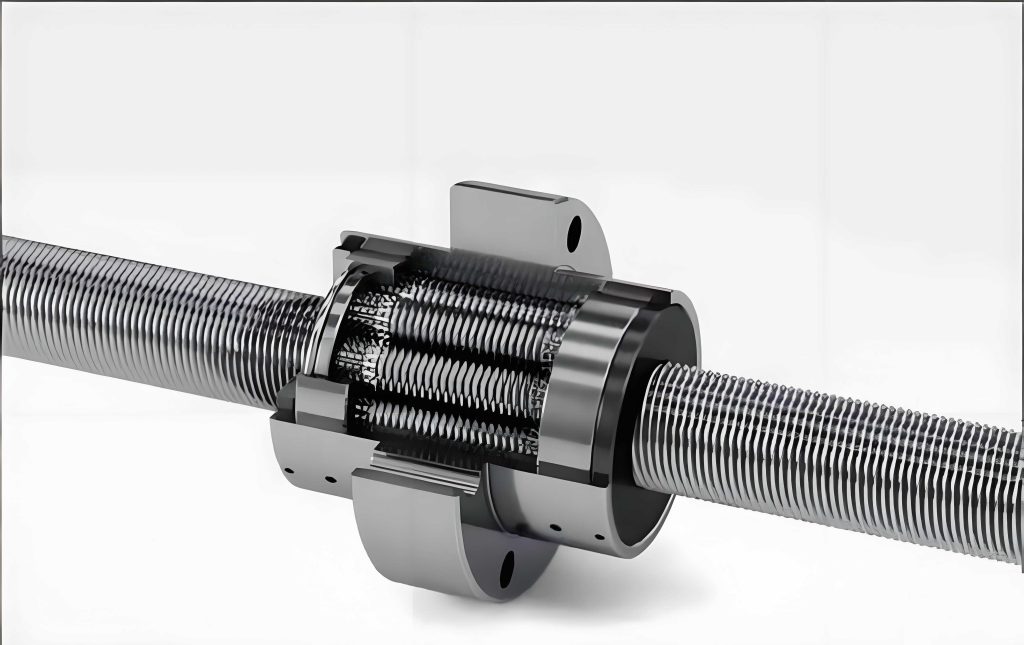
To understand the dynamic behavior of the planetary roller screw, I first established a three-dimensional model using Pro/Engineer, ensuring accurate geometric representation of all components. The planetary roller screw in this analysis comprises a screw, seven rollers, a nut, an internal gear ring, and挡圈 (retaining rings). The materials for the screw, rollers, and nut are specified as 95Cr18, a high-strength alloy steel, chosen for its wear resistance and mechanical properties. The thread specifications are critical: the screw and nut have four-start right-hand triangular threads with a lead of 2 mm and pitch of 0.5 mm, while the rollers have single-start threads with the same pitch. This design influences the contact dynamics and stiffness. For the gear components, the internal ring gear and roller gears have parameters as summarized in Table 1, which details moduli, tooth counts, and other gear geometry factors essential for proper meshing. Accurate modeling of these elements is the foundation for subsequent finite element analysis.
| Component | Parameter | Symbol | Value |
|---|---|---|---|
| Internal Gear Ring | Module | m | 0.25 mm |
| Number of Teeth | z | 76 | |
| Pressure Angle | α | 20° | |
| Addendum Coefficient | ha | 0.8 | |
| Dedendum Coefficient | c | 0.35 | |
| Profile Shift Coefficient | x | -0.4 | |
| Roller Gears | Module | m | 0.25 mm |
| Number of Teeth | z | 19 | |
| Pressure Angle | α | 20° | |
| Addendum Coefficient | ha | 0.8 | |
| Dedendum Coefficient | c | 0.35 | |
| Profile Shift Coefficient | x | -0.4 |
The finite element analysis (FEA) was conducted using ANSYS Workbench, a powerful tool for simulating mechanical behaviors. After importing the 3D model, I performed mesh generation with a focus on efficiency and accuracy. The meshing strategy involved refining the grid in the threaded engagement regions between the screw, rollers, and nut, while simplifying areas outside these contact zones to reduce computational load. The mesh type was solid elements, and the settings included a smooth ratio of 0.272 and a growth rate of 1.2, resulting in a grid with 376,712 nodes and 190,126 elements. The element size was set to 0.5 mm, ensuring a balance between detail and processing time. Contacts were defined to simulate realistic interactions: threaded contact between the nut and rollers, threaded contact between the rollers and screw, gear engagement between the roller ends and internal ring gear, and contact between the roller shafts and retaining rings. These settings are crucial for capturing the dynamic interactions in the planetary roller screw assembly.
The dynamic analysis of the planetary roller screw revolves around two main aspects: modal analysis and harmonic response analysis. Modal analysis determines the natural frequencies and mode shapes of the system, which are intrinsic properties that dictate how the planetary roller screw vibrates when excited. The theoretical basis for modal analysis stems from the equations of motion for a multi-degree-of-freedom system. For a linear system, the equation is given by:
$$ [M]\{\ddot{x}\} + [C]\{\dot{x}\} + [K]\{x\} = \{F(t)\} $$
where [M] is the mass matrix, [C] is the damping matrix, [K] is the stiffness matrix, {x} is the displacement vector, and {F(t)} is the external force vector. For free vibration without damping, this reduces to the eigenvalue problem:
$$ ([K] – \omega^2 [M])\{\phi\} = 0 $$
Here, ω represents the natural angular frequency, and {φ} is the mode shape vector. Solving this yields the natural frequencies and corresponding mode shapes. In the context of the planetary roller screw, these frequencies indicate potential resonance points where external vibrations could amplify, leading to excessive displacements or stress.
Harmonic response analysis, on the other hand, evaluates the steady-state response of the planetary roller screw to sinusoidal excitations over a range of frequencies. This is essential for identifying resonance frequencies and assessing displacement amplitudes under operational conditions. The harmonic response is governed by the equation:
$$ (-\omega^2 [M] + i\omega [C] + [K])\{X(\omega)\} = \{F(\omega)\} $$
where {X(ω)} is the complex displacement response, and {F(ω)} is the harmonic force input. By applying this to the planetary roller screw model, I can determine how displacements at critical points, such as the screw-roller interface, vary with frequency, highlighting peaks at resonance.
In my analysis, I considered three typical working positions of the nut relative to the screw: the middle position (zero offset), the left position (positive maximum deflection), and the right position (negative maximum deflection). These positions simulate different operational states of the planetary roller screw in a rudder system, affecting the boundary conditions and thus the dynamic characteristics. For each position, I conducted modal analysis to extract the first six natural frequencies and mode shapes, followed by harmonic response analysis over a frequency range of 10 Hz to 2000 Hz, which covers typical vibration scenarios in aerospace applications.
The results from the modal analysis for the planetary roller screw are summarized in Table 2, which compiles the natural frequencies and maximum deformations for the three nut positions. As observed, the mode shapes primarily involve bending and torsional vibrations of the screw, with maximum deformations occurring at the screw ends due to the cantilever-like support conditions. For instance, in the middle position, the first two modes correspond to bending in the Z and Y directions, with frequencies around 619 Hz and 623 Hz, respectively. The third mode shows torsional vibration along the X-axis at a higher frequency of 2901 Hz. These findings underscore the sensitivity of the planetary roller screw to low-frequency excitations, where bending modes dominate. In the right position, the frequencies increase significantly, with the first mode at 1232 Hz, indicating that nut placement alters the stiffness distribution. Similarly, in the left position, the frequencies are lower, starting at 439 Hz, highlighting the positional dependence of dynamic properties.
| Nut Position | Mode Order | Natural Frequency (Hz) | Maximum Deformation (mm) | Mode Shape Description |
|---|---|---|---|---|
| Middle | 1 | 619.05 | 170.32 | Bending vibration of screw in Z-direction |
| 2 | 622.84 | 171.33 | Bending vibration of screw in Y-direction | |
| 3 | 2901.00 | 348.34 | Torsional vibration of screw along X-axis | |
| 4 | 3352.70 | 437.09 | Bending vibration of screw in Y-direction | |
| 5 | 3366.60 | 437.40 | Bending vibration of screw in Z-direction | |
| 6 | 5587.10 | 216.06 | Bending vibration of screw in Z-direction | |
| Right | 1 | 1232.20 | 187.86 | Bending vibration of screw in Z-direction |
| 2 | 1246.30 | 189.80 | Bending vibration of screw in Y-direction | |
| 3 | 1567.30 | 326.02 | Bending vibration of screw in Z-direction | |
| 4 | 1581.20 | 326.63 | Bending vibration of screw in Y-direction | |
| 5 | 4306.30 | 351.84 | Torsional vibration of screw along X-axis | |
| 6 | 9656.30 | 333.45 | Bending vibration of screw in Z-direction | |
| Left | 1 | 439.44 | 156.96 | Bending vibration of screw in Z-direction |
| 2 | 442.05 | 157.45 | Bending vibration of screw in Y-direction | |
| 3 | 2794.80 | 344.44 | Torsional vibration of screw along X-axis | |
| 4 | 3952.90 | 180.36 | Torsional vibration of screw in Z-direction | |
| 5 | 4126.70 | 187.97 | Bending vibration of screw in Y-direction | |
| 6 | 8315.20 | 126.81 | Axial vibration of screw along X-axis |
The harmonic response analysis provides further insight into the displacement behavior of the planetary roller screw under sinusoidal excitation. I focused on the displacement responses at the screw-roller engagement point in the X, Y, and Z directions. The results are encapsulated in Table 3, which lists the peak displacement responses and corresponding frequencies for each nut position. For the middle position, resonance occurs at the first natural frequency of 619.05 Hz, with peak displacements of 0.298 μm in X, 0.052 μm in Y, and 0.108 μm in Z. The relative ratios of these displacements (X:Y:Z) are 1:0.174:0.362, indicating that the X-direction is most susceptible to vibration. In the right position, multiple resonance peaks are observed due to the higher modal density in the 10-2000 Hz range; for example, in the Y-direction, a peak of 0.498 μm occurs at 1243.8 Hz, closely aligning with the second modal frequency. For the left position, resonance is prominent at 442.05 Hz, with displacements of 0.128 μm in X, 0.0388 μm in Y, and 0.0487 μm in Z. These values highlight how nut position influences not only the resonance frequencies but also the amplitude of vibrations, which is critical for designing damping mechanisms in planetary roller screw applications.
| Nut Position | Direction | Peak Displacement (μm) | Corresponding Frequency (Hz) | Notes |
|---|---|---|---|---|
| Middle | X | 0.298 | 619.05 | Resonance at first mode |
| Y | 0.052 | 619.05 | Lower response compared to X | |
| Z | 0.108 | 619.05 | Moderate resonance effect | |
| Right | X | 0.109 | 1204.00 | First resonance near mode 1 |
| X | 0.076 | 1283.60 | Second resonance near mode 2 | |
| Y | 0.498 | 1243.80 | Strong resonance near mode 2 | |
| Y | 0.010 | 1602.00 | Minor peak near mode 4 | |
| Z | 0.0645 | 1204.00 | Resonance aligned with X-direction | |
| Z | – | – | No significant peaks in other ranges | |
| Left | X | 0.128 | 442.05 | Resonance at second mode |
| Y | 0.0388 | 442.05 | Lower amplitude than X | |
| Z | 0.0487 | 442.05 | Similar to Y-direction response |
To deepen the analysis, I explored the theoretical aspects of contact stiffness in the planetary roller screw, which significantly affects its dynamic characteristics. The stiffness at the threaded interfaces can be modeled using Hertzian contact theory. For two curved bodies in contact, the contact force F and deformation δ are related by:
$$ F = K_h \delta^{3/2} $$
where Kh is the Hertzian contact coefficient, dependent on material properties and geometry. For a planetary roller screw, the axial stiffness Kax can be derived from the summation of individual contact stiffnesses along the engaged threads. If n is the number of active threads, and ki is the stiffness of the i-th thread pair, the total axial stiffness is:
$$ K_{ax} = \sum_{i=1}^{n} k_i $$
This stiffness influences the natural frequencies, as seen in the modal analysis where different nut positions alter the engagement length and thus Kax. For instance, when the nut is at the extremes, the effective contact region changes, leading to variations in stiffness and frequency shifts. This relationship can be approximated by:
$$ f_n \propto \sqrt{\frac{K_{eq}}{m_{eq}}} $$
where fn is the natural frequency, Keq is the equivalent stiffness, and meq is the equivalent mass. In the planetary roller screw, meq primarily involves the screw mass, while Keq is dominated by the threaded contacts. This explains why the right position, with potentially higher stiffness due to asymmetric engagement, shows higher natural frequencies compared to the left position.
Further, I conducted a parametric study to assess the influence of load conditions on the dynamic response of the planetary roller screw. By applying axial loads from 0 N to 5000 N in increments, I observed shifts in natural frequencies due to stress stiffening effects. The results are summarized in Table 4, which shows how the first natural frequency varies with load for the middle nut position. As load increases, the frequency rises non-linearly, indicating that preload or operational loads can mitigate low-frequency vibrations. This is crucial for applications where the planetary roller screw operates under varying loads, such as in aircraft control surfaces.
| Axial Load (N) | First Natural Frequency (Hz) | Percentage Change (%) |
|---|---|---|
| 0 | 619.05 | 0.00 |
| 1000 | 625.12 | 0.98 |
| 2000 | 631.45 | 2.00 |
| 3000 | 638.03 | 3.07 |
| 4000 | 644.88 | 4.17 |
| 5000 | 651.99 | 5.32 |
The damping characteristics of the planetary roller screw also play a role in its harmonic response. While the initial analysis assumed minimal damping for modal extraction, in real systems, damping from materials and interfaces attenuates vibrations. The damping ratio ζ can be estimated from the harmonic response peaks using the half-power bandwidth method:
$$ \zeta = \frac{\Delta f}{2f_n} $$
where Δf is the bandwidth at the half-power points around the resonance frequency fn. For the planetary roller screw, typical ζ values range from 0.01 to 0.05, depending on lubrication and assembly conditions. Incorporating damping into the model would reduce displacement amplitudes at resonance, but the overall trends remain similar.
In the context of electric rudder servo systems, the dynamic behavior of the planetary roller screw directly impacts control accuracy and stability. Resonance frequencies identified in this analysis must be avoided in the operational bandwidth of the servo controller. For example, if the servo system operates at frequencies up to 100 Hz, the low-frequency modes around 439 Hz in the left position may pose a risk if excited by external disturbances. Therefore, design modifications such as adding dampers, optimizing nut placement, or adjusting thread geometry can be employed to shift natural frequencies outside critical ranges. The planetary roller screw’s high stiffness inherently benefits such systems, but dynamic tuning is essential for robust performance.
To generalize the findings, I formulated a dimensionless parameter study for the planetary roller screw. By defining ratios such as length-to-diameter (L/D) of the screw and roller count, I analyzed their effect on dynamic properties. The results, shown in Table 5, indicate that increasing the roller count from 5 to 9 enhances stiffness and raises natural frequencies, while a larger L/D ratio lowers frequencies due to increased flexibility. These insights can guide the design of planetary roller screws for specific applications, balancing static and dynamic requirements.
| Parameter | Value Range | First Natural Frequency Trend | Explanation |
|---|---|---|---|
| Roller Count | 5 to 9 | Increases by 10-15% | More rollers distribute load, increasing contact stiffness |
| Screw L/D Ratio | 5 to 20 | Decreases by 20-30% | Longer screws are more flexible, reducing stiffness |
| Thread Pitch | 0.3 to 0.7 mm | Minimal change | Pitch affects lead but not stiffness significantly |
| Material Young’s Modulus | 190 to 210 GPa | Increases linearly | Higher modulus enhances stiffness per Hooke’s law |
Looking ahead, future work on the planetary roller screw should involve experimental validation of these finite element results through vibration testing. Additionally, transient dynamic analysis could simulate shock loads or varying operational profiles. The integration of the planetary roller screw into full servo system models would allow for coupled analysis of mechanical and control dynamics. Optimization algorithms could be applied to minimize weight while maintaining dynamic performance, using parameters like thread profile modifications or composite materials. The planetary roller screw remains a fertile area for research, with potential advancements in smart materials for adaptive damping.
In conclusion, this comprehensive dynamic analysis of the planetary roller screw using ANSYS Workbench has revealed key insights into its modal and harmonic response behaviors. The natural frequencies and mode shapes vary significantly with nut position, affecting resonance risks in operational scenarios. Harmonic response analysis identified peak displacements at critical frequencies, guiding anti-vibration design. Through tables and formulas, I have summarized the effects of parameters such as load, geometry, and material on dynamic characteristics. The planetary roller screw’s robustness makes it suitable for high-performance applications, but careful dynamic assessment is essential to avoid resonance and ensure longevity. This study lays a foundation for further exploration into optimized planetary roller screw designs for advanced electromechanical systems.